On this page · 9 sections
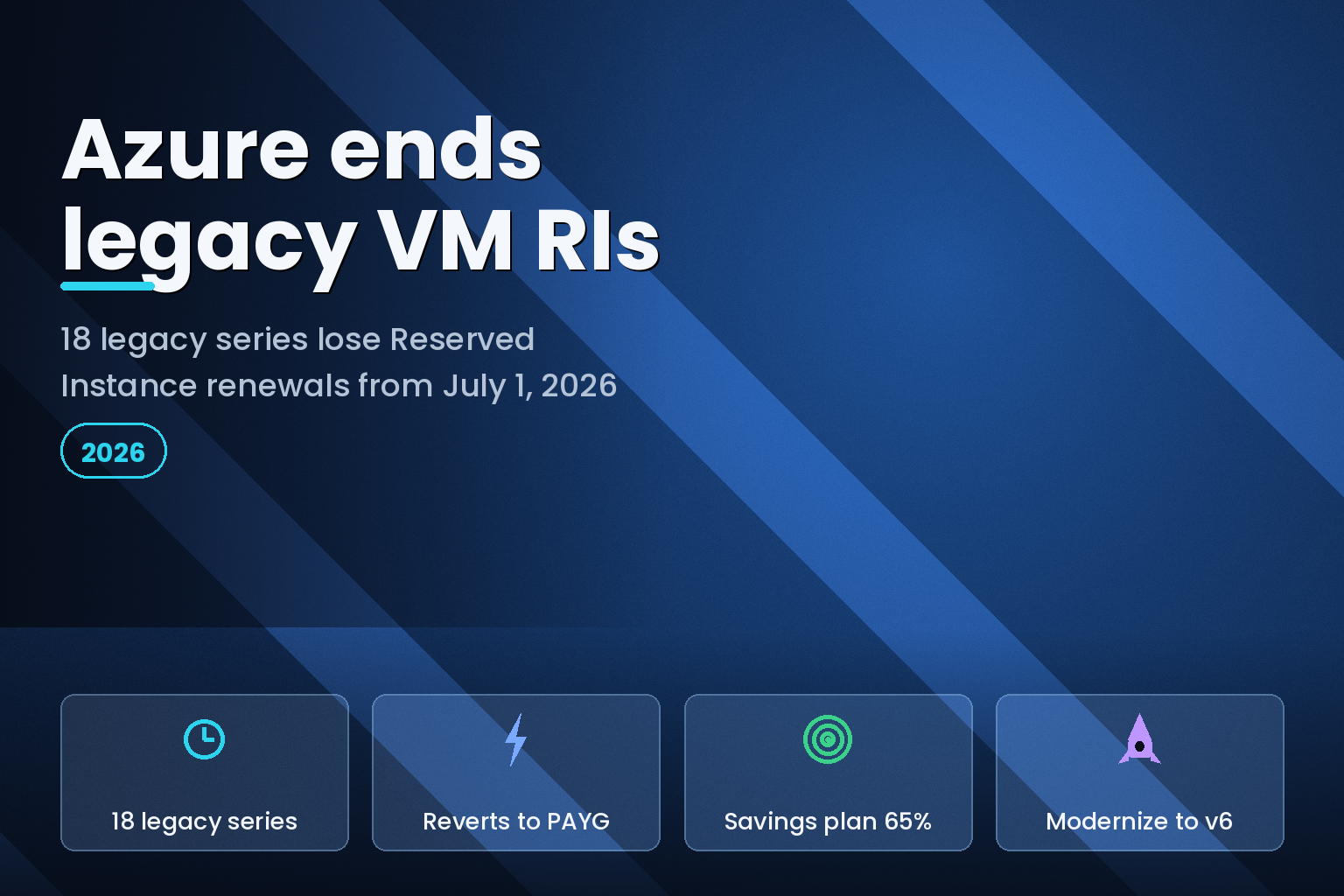
Summary. On July 1, 2026 Microsoft stopped new purchases and renewals of Azure Reserved VM Instances for 18 legacy VM series: one-year reservations for 14 families (Av2, Amv2, Bv1, D, Ds, Dv2, Dsv2, F, Fs, Fsv2, G, Gs, Ls, Lsv2) and both one-year and three-year reservations for four more (Dv3, Dsv3, Ev3, Esv3). Existing reservations still apply through the end of their term, and no virtual machine shut down that day. The risk is quieter: when a reservation expires with no action, the workload reverts to pay-as-you-go, and the discount of up to 72% that a reservation can carry against on-demand pricing disappears in a single billing cycle. This is the playbook to keep that saving.
Two clocks are now running. Reserved Instance renewals for these series closed on July 1, 2026. Separately, most of the older families reach full VM retirement on May 1, 2028 or November 15, 2028, after which the sizes are deallocated. The v3 families are the exception: Dv3, Dsv3, Ev3, and Esv3 are marked product active and are not retiring, but their reservation discounts still ended. For an Indian or global platform team running any of these SKUs, the next commitment decision is worth making deliberately rather than at renewal time.
What actually changed on July 1, 2026
Microsoft announced the change on May 4, 2026 and it took effect on July 1. The mechanic is narrow and specific: purchases and renewals of Reserved VM Instances for the listed series are no longer available. Nothing about the running VM changes, because a reservation is a billing construct, not a runtime state. Your machines keep running, your existing reservations keep discounting until their own expiry date, and only the ability to buy or renew a reservation for these specific series has gone.
The affected list splits cleanly. Fourteen series lose one-year reservations only, because their three-year reservations had already closed on earlier dates in 2025. Four v3 series, Dv3, Dsv3, Ev3, and Esv3, lose both one-year and three-year reservations as of July 1, 2026, yet keep running as active products. Two more, HBv2 and NP-series, had their reservations end even earlier, on April 2, 2026, and retire on May 31, 2027.
Here is the authoritative timeline, drawn from Microsoft's retired VM sizes migration guide.
| VM series | 1-year RI ends | 3-year RI ended | VM retirement date |
|---|---|---|---|
| D, Ds, Dv2, Dsv2, Ls | July 1, 2026 | May 1, 2025 | May 1, 2028 |
| Av2, Amv2, Bv1 | July 1, 2026 | November 15, 2025 | November 15, 2028 |
| F, Fs, Fsv2, G, Gs, Lsv2 | July 1, 2026 | November 15, 2025 | November 15, 2028 |
| Dv3, Dsv3, Ev3, Esv3 | July 1, 2026 | July 1, 2026 | product active |
| HBv2, NP-series | April 2, 2026 | April 2, 2026 | May 31, 2027 |
What doing nothing costs
The cost is not on July 1. It lands on the day each reservation expires. A reservation can save up to 72% against pay-as-you-go for virtual machines on a three-year term, and an Azure savings plan for compute can save up to 65%. When a reservation lapses and nothing replaces it, the workload does not get cheaper or more expensive to run; its billing simply reverts to the full on-demand rate. In relative terms, a bill that a reservation held at roughly 28% of on-demand snaps back toward 100%, close to a 3.5x jump on the covered spend, with no change in performance to show for it.
That is why this is a FinOps event, not an operations event. The machines are fine. The commitment coverage is what erodes, quietly, one expiring reservation at a time, until a quarter closes with a compute bill nobody planned for. The fix is to decide what replaces each reservation before it expires, not after. Our guide to how Indian teams cut Azure and AWS cloud spend covers the wider discipline; this piece is the Azure-specific move.
Your three live options now
Because the renewal window closed on July 1, 2026, one option from Microsoft's original guidance, renewing a reservation for these series, is no longer on the table for new commitments. If you renewed before the deadline, those reservations are honored for their full term. From today, three live paths remain.
| Option | Discount vs pay-as-you-go | Flexibility | Best for |
|---|---|---|---|
| Azure savings plan for compute | up to 65% | any eligible VM family and region | dynamic or scaling workloads |
| Modernize to a v5 or v6 series, then commit | up to 72% (RI) or 65% (plan) | reservation is SKU-locked; plan is flexible | workloads due for a refresh |
| Accept pay-as-you-go | 0% | full, but no discount | short-lived or soon-migrating workloads |
| Exchange an existing reservation | preserves reservation economics | swap to a supported series, no penalty | stable workloads on active SKUs |
| Trade in reservations for a savings plan | up to 65% | broad, spend-based | estates consolidating commitments |
The first path, the Azure savings plan for compute, is Microsoft's primary recommendation for teams that want to keep using compute past the deadline. A savings plan is a commitment to a fixed dollar-per-hour spend for one or three years, and its discount applies automatically across eligible compute services, families, and regions, starting with the usage that receives the highest discount. It trades a few points of discount for the freedom to change VM size, family, or region without re-buying a commitment. Microsoft lets you trade in eligible reservations for a savings plan through a self-service flow in the Azure portal.
The second path is modernization. Moving off a v2 or v3 family onto a newer v5 or v6 series improves price-performance and, critically, restores full access to both reservations and savings plans, which the newer series continue to support. It is the right call when a workload was due for a refresh anyway. The reservation trade-in and the modernization decision are best made together, because both are commitment decisions.
Where each legacy series should go
Microsoft's migration guide maps every retiring series to recommended replacements. The through-line is v5 for a conservative move and v6 for the newest hardware, with the caveat that v6 sizes require the NVMe disk interface, Generation 2 VMs, and the Microsoft Azure Network Adapter, so the guest OS has to support them.
| Current series | Recommended replacement | Note |
|---|---|---|
| D, Ds, Dv2, Dsv2 | Dsv5, Dasv5, Dsv6, Dasv6, or Esv6 family | v6 uses NVMe; needs a Gen 2, NVMe-capable OS |
| Ls | Lsv3, Lasv3, Lsv4, Lasv4 | Lsv4 and Lasv4 are the newest L-series |
| Av2, Amv2 | Bsv2, Basv2, Dsv5, Esv5, Dsv6, Esv6 | Bsv2 not available in sovereign clouds |
| Bv1 | Bsv2, Basv2, Dlsv5, Dlsv6 family | burstable to burstable is the closest match |
| F, Fs, Fsv2 | Falsv6, Dlsv6, Dlsv5, Dsv5, Ddsv5 | compute-optimized path |
| G, Gs, Lsv2 | Lsv3, Lasv3, Lsv4, Lasv4 | storage-optimized path |
| Dv3, Dsv3 | Dsv5, Ddsv5, Dasv5, Dsv6, Ddsv6 | not retiring, but reservations ended |
| Ev3, Esv3 | Esv5, Edsv5, Easv5, Esv6, Edsv6 | memory-optimized path |
The migration itself
Resizing a VM to a newer series is a short, well-defined operation, but it is not zero-touch. Confirm your subscription has quota for the target v6 size and request an increase if not, since v6 capacity is not guaranteed in every region and zone. Then stop and deallocate the VM, resize it to the chosen series, and start it again. In-memory and temporary disk data is lost on deallocation, while managed disk data is preserved, so the change belongs in a maintenance window with a tested rollback.
For reservation holders, sequence the billing move alongside the resize. You can exchange an existing reservation for one that matches a supported series with no penalty, or trade it in for a savings plan through the portal. Savings plan purchases cannot be canceled or refunded, so size the hourly commitment against real usage before you buy; Azure Advisor and the purchase experience both produce commitment recommendations from your own consumption. Microsoft's own advice is to start planning six to twelve months before each reservation expires, not on the expiry date. For a parallel view of how commitment sizing works on the other major cloud, see our analysis of AWS savings plans coverage and sizing, and for the Azure-native tooling angle, agentic FinOps on Azure with Copilot and Graviton-class compute.
India-specific considerations
For Indian enterprises and global capability centres running Azure, the retirement lands on some of the most common estates: older D, Ds, and Dv2 general-purpose fleets that have quietly sat on three-year reservations since 2023. The exposure is the same as anywhere, but two local factors sharpen it. Enterprise Agreement customers are billed in local currency, so a reservation lapsing to pay-as-you-go shows up directly in the rupee compute line, and finance teams reconciling in INR feel the full on-demand rate immediately. Many regulated workloads under the Digital Personal Data Protection Act 2023 are already pinned to specific Indian datacentre regions and specific SKUs; when you re-platform to a v6 size, confirm the target series is available in the India region you require before you commit, because newer series are not offered in every region and zone. The wider cost-discipline playbook is in our note on FinOps for Indian AI and cloud teams across AWS, Azure, and GCP.
FAQ
How eCorpIT can help
eCorpIT is a Gurugram-based, senior-led engineering organisation, founded in 2021 and assessed at CMMI Level 5, that runs Azure cost and modernization programmes for teams with real reservation exposure. We inventory your affected reservations by expiry date, model savings plan versus reservation versus modernization for each workload, sequence the v5 or v6 resizes with tested rollback, and confirm target SKUs are available in your required India region. If a wave of reservations is about to lapse, talk to our team and we will build the migration schedule against your own Azure usage.
References
- Microsoft Learn, Transition guide for retired Azure Reserved VM Instances, May 2026.
- Microsoft Learn, Retired VM sizes migration guide, updated July 16, 2026.
- Microsoft Community Hub, Azure Reserved VM Instances for select VM series will no longer be available starting July 1, 2026, May 4, 2026.
- Microsoft Learn, What are savings plans?, March 2026.
- Microsoft Learn, Decide between a savings plan and a reservation.
- Microsoft Learn, Trade in reservations for a savings plan.
- Microsoft Learn, Exchange and refund Azure reservations.
- Microsoft Azure, Azure Reserved Virtual Machine Instances pricing offer, accessed August 2, 2026.
- Microsoft Azure, Azure savings plans offer, accessed August 2, 2026.
- Microsoft Learn, Buy an Azure savings plan.
- Microsoft Learn, Resize a virtual machine, accessed August 2, 2026.
_Last updated: August 2, 2026._