On this page · 10 sections
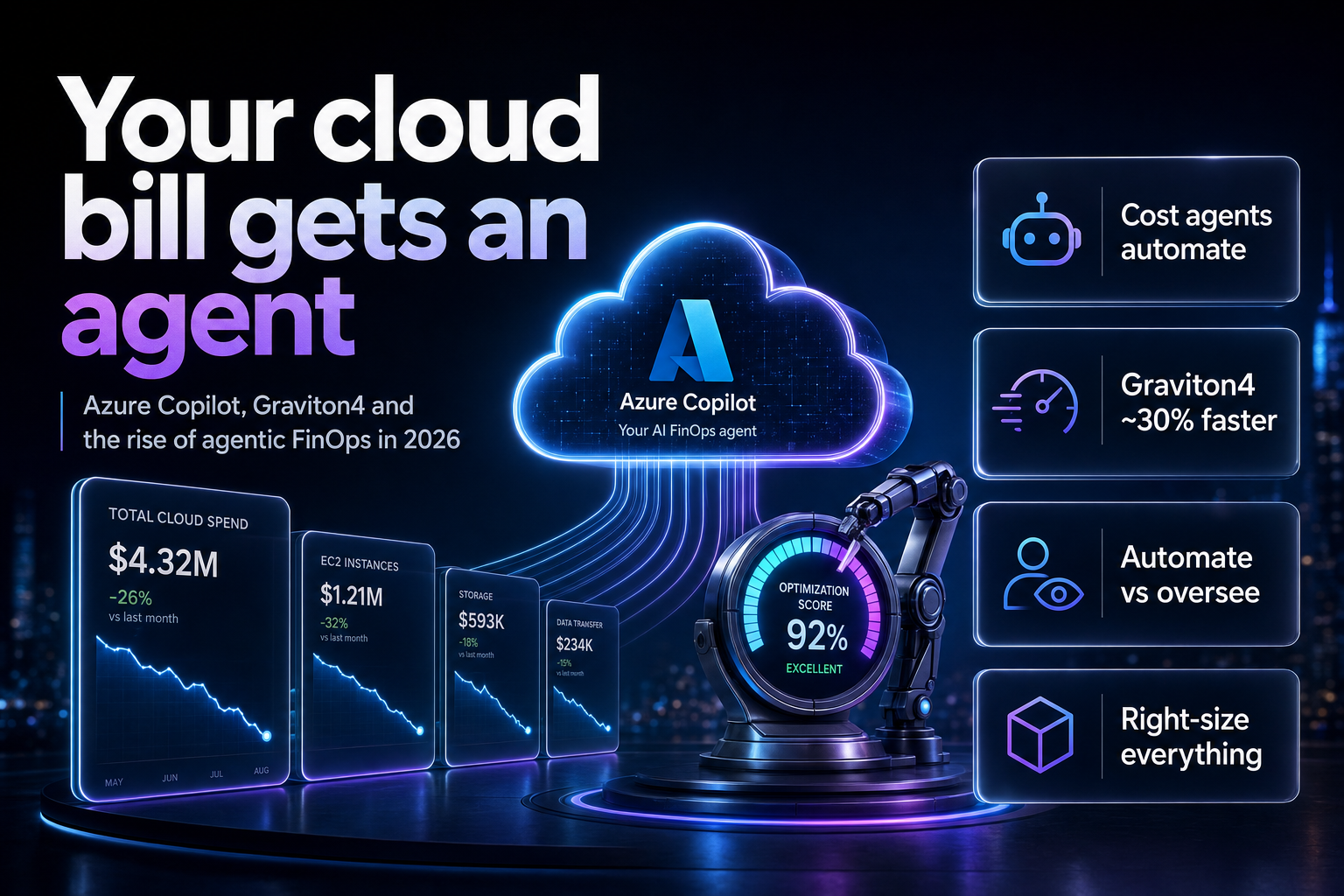
Summary. FinOps changed shape in 2026. The FinOps Foundation's sixth annual State of FinOps survey, published February 2026 across 1,192 respondents, found 98 percent of teams now manage AI spend, up from 31 percent two years earlier, and AI cost management is the top skill teams need. Microsoft answered with agentic cloud operations: an Azure Copilot optimization agent that ranks and executes cost actions under governance, plus a now-generally-available observability agent. AWS pushed the hardware lever, with Graviton4 instances delivering up to 40 percent better price-performance. Because on-demand compute is near-identical at roughly $0.19 per hour for a 4 vCPU, 16 GB instance across the big three clouds, the saving now comes from optimization and architecture, not from shopping the rate card. This is what to automate, and what to keep human.
FinOps went agentic
The headline shift is that optimization stopped being a report and became an action. Microsoft announced agentic cloud operations, with optimization agents that identify and execute cost, performance and sustainability improvements under governance guardrails. The Azure Copilot observability agent is generally available, and the optimization agent ranks candidate actions by cost, environmental impact and implementation ease, surfacing cost implications during development before a resource is even created.
The plumbing that makes this work is the Model Context Protocol. The Azure Resource Manager MCP Server, in public preview, lets AI agents read cost and usage data through a standard interface, so cost insight appears inside developer tools without custom integrations, and a FinOps MCP Server is in preview alongside it. The point is scaling FinOps without adding manual work.
Why the State of FinOps 2026 matters
The FinOps Foundation renamed its own mission this year, from advancing the people who manage the value of cloud to the value of technology. That is not branding. It reflects the survey data: 98 percent of teams manage AI spend, 90 percent manage SaaS, 64 percent manage software licensing, and 48 percent manage data-center spend. FinOps is no longer only about EC2 and Blob storage. Our FinOps guide for Indian cloud teams covers the discipline; the 2026 change is scope.
The hardware lever: Graviton4
Not every saving is agentic. Graviton4 instances, the m8g, c8g and r8g families, reached general availability in early 2026 with up to 30 percent better compute performance per dollar than Graviton3 and up to 40 percent better price-performance than earlier generations. The network-optimized M8gn variant adds sixth-generation Nitro cards and up to 600 Gbps of bandwidth. Migrating a compatible workload to Graviton4 is a one-time architecture decision that keeps paying, which is exactly the kind of move an agent should recommend but a human should approve.
| Layer | Tool | What it does |
|---|---|---|
| Optimization | Azure Copilot optimization agent | Ranks and executes cost actions under governance |
| Observability | Azure Copilot observability agent (GA) | Monitors usage and surfaces issues early |
| Cost data access | Azure Resource Manager and FinOps MCP Servers | Standard interface for agents to read cost data |
| Compute efficiency | AWS Graviton4 (m8g, c8g, r8g) | Up to 40 percent better price-performance |
| Recommendations | AWS Cost Optimization Hub CSV export | Pulls cost recommendations out of the console |
What to automate, and what to keep human
The useful question in 2026 is not whether to use agents but where. Automate the high-frequency, low-risk, reversible work, and keep a human on the decisions that are expensive to undo.
| FinOps task | Safe to automate now | Keep human oversight |
|---|---|---|
| Rightsizing recommendations | Yes, agent surfaces and ranks | Approve the execution |
| Idle and orphaned resource cleanup | Yes, in non-production | Confirm before production |
| Commitment purchases (savings plans) | Partial, agent models options | Human signs off on the commitment |
| Architecture moves (Graviton migration) | No | Human decision |
| Anomaly detection and alerting | Yes | Human triages the alert |
The line is reversibility. An agent that rightsizes a dev box or flags an idle disk saves money with little downside. An agent that buys a three-year commitment or re-architects a service can lock in a costly mistake, so those stay gated behind human sign-off. This is the same governance logic that keeps GPU and AI spend under control.
Governance is the whole game
Agentic FinOps only works with guardrails, because an optimization agent with broad permissions is a cost risk of its own. Scope each agent to read-only cost data by default, require approval for any action that spends or commits money, and log every recommendation and execution. Microsoft's framing of governed loops is the right instinct: the agent proposes and acts inside a policy boundary, and a human owns anything irreversible.
India-specific considerations
For Indian teams, the rupee cost of cloud makes automation attractive, but the same governance rules apply. Route agent-driven savings through your existing approval chain, and treat a Graviton4 migration as a planned architecture project rather than an agent action. The wider India cost picture is in our guide to cutting cloud spend for Indian teams. The blunt rule holds: the biggest cloud savings are architectural, and architecture is still a human call.
What to do this quarter
Turn on the observability and cost-recommendation agents in read-only mode and let them surface findings for a month before granting any execution rights. Identify the workloads that can move to Graviton4 and schedule the migration as a project. Set an explicit automate-versus-approve policy using the reversibility test above, and make sure every agent action is logged. Measure savings against a baseline, not against the agent's own claims.
FAQ
How eCorpIT can help
eCorpIT is a Gurugram-based, CMMI Level 5 consultancy and an AWS and Microsoft partner. Our senior cloud engineers set up agentic FinOps safely: read-only cost agents, approval gates for anything irreversible, Graviton migration assessments, and logging that keeps optimization auditable. We help cloud teams and CFOs cut spend without handing an agent the keys. To scope a FinOps engagement, talk to our team.
References
- From insight to action: the next phase of agentic cloud operations - Microsoft Azure Blog.
- Agentic cloud ops with the new Azure Copilot - InfoWorld.
- Azure Copilot becomes agentic: governed AI loops for cloud observability and cost control - Windows News.
- Configure AI agents for FinOps hubs - Microsoft Learn.
- State of FinOps 2026 report - FinOps Foundation.
- State of FinOps survey: AI value and skills top priorities (98% manage AI) - Linux Foundation.
- FinOps 2026: shift left and up as AI drives technology value - theCUBE Research.
- AWS vs Azure vs GCP: cloud pricing guide 2026 - Usage.ai.
_Last updated: July 10, 2026._