On this page · 11 sections
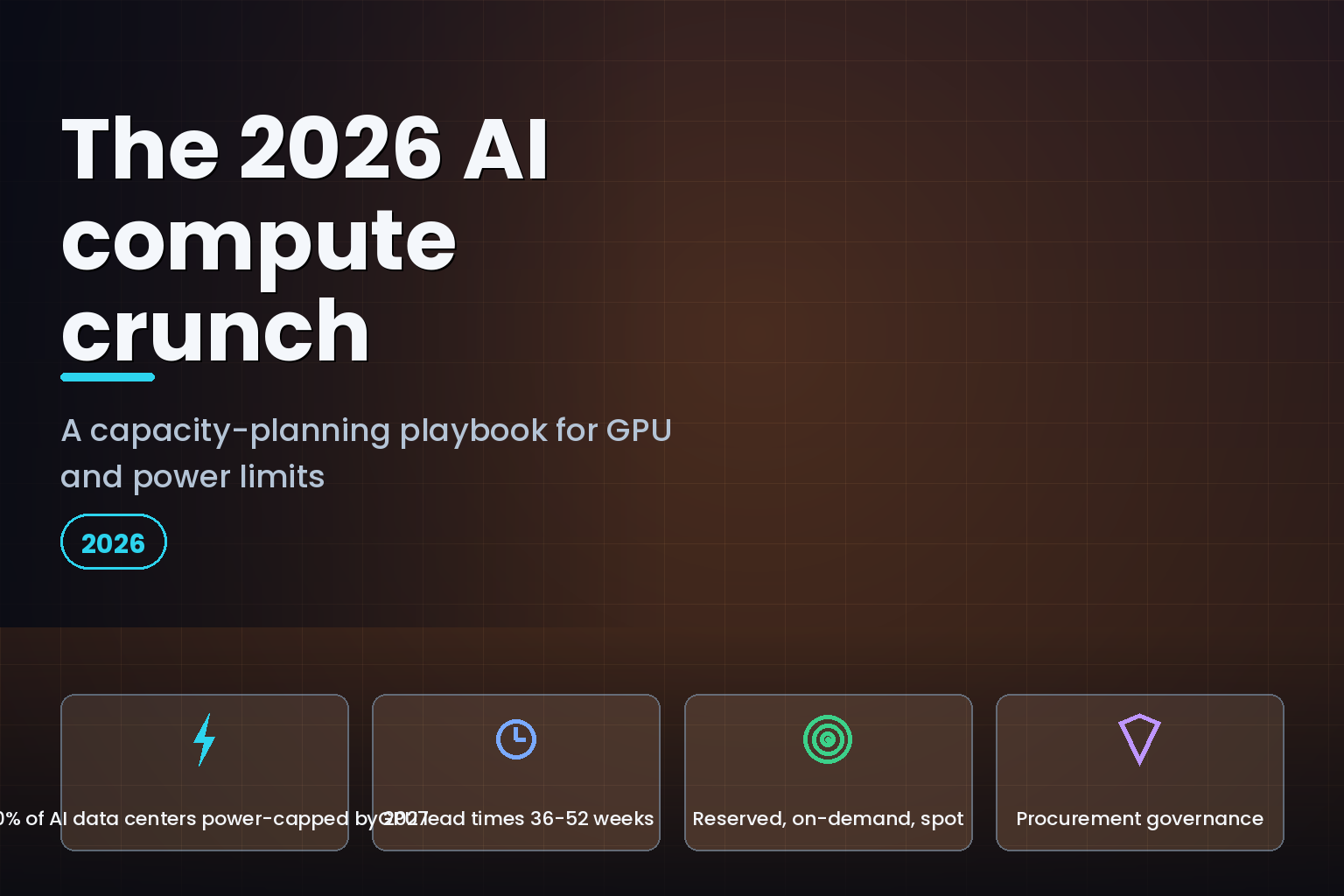
Summary. Gartner expects power availability to operationally constrain 40% of existing AI data centers by 2027, with the electricity for incremental AI servers reaching 500 terawatt-hours a year, 2.6 times the 2023 level. On the silicon side, capacity providers report data-center GPU lead times of 36 to 52 weeks, while on-demand cloud prices sit anywhere from about $1.49 to $18 per GPU-hour across H100, H200, and B200 cards as of mid-2026. The lesson for any team scaling AI in 2026 is blunt: treat compute as constrained infrastructure with a 6-to-18-month lead time, not a line item you buy on the day you need it. This playbook covers how to forecast demand, choose between reserved, on-demand, and spot capacity, spread supply across hyperscalers and neo-clouds, right-size models, and put procurement governance around GPU spend. It closes with a build-versus-buy-versus-wait framework and India-specific notes for teams using IndiaAI compute.
The uncomfortable part is that the binding constraint has moved. Two years ago the shortage was chips. In 2026, the harder wall is the power and packaging behind those chips, and neither expands on a quarterly planning cycle. Plan as if capacity is the scarce resource, because it is.
What the crunch actually is
The headline number comes from Gartner. In a November 2024 prediction that has aged into the base case, Gartner said power shortages will restrict 40% of AI data centers by 2027, and estimated the power for incremental AI-optimized servers at 500 TWh per year in 2027, up 2.6 times from 2023. Bob Johnson, VP Analyst at Gartner, put the cause plainly: "The explosive growth of new hyperscale data centers to implement GenAI is creating an insatiable demand for power that will exceed the ability of utility providers to expand their capacity fast enough."
Two consequences follow directly. First, the cost of power rises as operators compete for it, and Gartner expects those costs to pass through to AI product and service providers. Second, the largest buyers lock in supply ahead of everyone else. Johnson noted that big power users "are working with major producers to secure long-term guaranteed sources of power independent of other grid demands." If the hyperscalers are signing multi-year power deals, a mid-size team buying on-demand next quarter is at the back of the queue.
This is why "GPU shortage" undersells the problem. You can have GPUs allocated and still be unable to rack them because the megawatts, cooling, and grid interconnect are not there. Capacity is the product of chips, power, and the building that holds both, and in 2026 the scarcest of the three is usually power.
The GPU side: lead times and the packaging bottleneck
Chips are still tight, and the reason is memory and packaging, not the logic die. An H200 carries 141GB of HBM3e; a Blackwell B200 needs 192GB to feed its transistors. That high-bandwidth memory, and the TSMC CoWoS packaging that bonds it to the GPU, is the pinch point, and capacity providers report it is booked far ahead. Hyperscalers placed multi-billion-dollar forward orders for Blackwell parts through 2025, which soaks up much of the near-term allocation.
The practical signal is lead time, and it varies wildly by who you are. Capacity-market trackers report headline data-center GPU lead times of 36 to 52 weeks. Buyers with established OEM relationships and priority SXM allocations report much shorter windows, on the order of 8 to 16 weeks, and some in-stock H200 SXM modules ship in 2 to 4 weeks. The spread itself is the point: your lead time depends on your relationships and your willingness to commit, not on a published catalog date. A first-time buyer ordering a large cluster in 2026 should plan around the long end of that range, not the short.
The power side: the grid is the real 2026 bottleneck
The reason capacity does not simply expand to meet demand is that electricity infrastructure moves on a different clock. New generation and grid interconnection are permitted and built over years, not quarters, in most major markets. Gartner's framing is that utility expansion cannot keep pace with data-center demand from 2026 onward, which is why 40% of existing AI data centers are expected to hit a power ceiling by 2027 even where the servers are available.
For a planning team, the takeaway is to ask your provider not just "do you have GPUs?" but "do you have powered, cooled capacity in a region I can use, and when does the next tranche energize?" Availability is regional and time-boxed. A cluster that is orderable in one metro may be a year out in another because the local substation is full. Build that regional reality into your forecast.
What it costs now
Cloud GPU pricing in 2026 is a wide band, and the spread between discount neo-clouds and the big three hyperscalers is the single biggest lever on unit cost. The figures below are on-demand ranges reported by cloud GPU pricing trackers as of mid-2026; treat them as directional, since rates move weekly.
| Option (mid-2026) | Typical on-demand ($/GPU-hour) | Trade-off |
|---|---|---|
| H100, neo-cloud | ~$1.49 to $2.50 | Cheapest mainstream card, thinner support and SLAs |
| H100, hyperscaler | ~$6.88 to $12.29 | Integrated tooling and networking, highest price |
| H200 | ~$2.30 to $13.78 (median near $4.11) | More memory for large models, very wide vendor spread |
| B200 | ~$4.99 to $18.00 | Newest generation, launch premium, roughly doubled in a year |
| Spot or preemptible | 50% to 80% below on-demand | Cheapest per hour, can be interrupted without notice |
Two patterns matter for budgeting. On-demand rates for the newest cards, B200 and B300, roughly doubled over the past year, while mainstream H100, H200, and A100 pricing held a tighter band; chasing the newest silicon carries a price premium on top of the availability risk. And the neo-cloud versus hyperscaler gap runs 40% to 85% on the same card, so where you buy often matters more than which card you buy. For deeper cost mechanics, our note on why GPU spend is the top FinOps concern in 2026 walks through the drivers.
The capacity-planning playbook
Here is the practical sequence we use with teams scaling AI workloads.
1. Forecast compute as constrained infrastructure
Stop treating GPU access as an on-demand utility. Forecast GPU-hours by workload the way you would forecast data-center megawatts: a rolling 6-to-18-month view, split into training (bursty, schedulable) and inference (steady, latency-bound). Give the forecast an owner. Finance and IT teams increasingly run a standing AI-capacity review that allocates GPU-hours across projects each month, which turns a scramble into a plan.
2. Match the buying model to the workload
Reserved, on-demand, and spot are not interchangeable. Use the shape of the workload to choose.
| Buying model | Best for | Watch-out |
|---|---|---|
| Reserved or committed | Steady base load and scheduled training | Lock-in if your forecast is wrong |
| Capacity reservation blocks | Guaranteed short-term bursts for training runs | Priced at a premium, must be booked ahead |
| On-demand | Spiky, unpredictable inference | Highest unit price; capacity not guaranteed |
| Spot or preemptible | Fault-tolerant batch and checkpointed training | Interruptions; capacity can vanish in a region |
The design pattern that survives the crunch is a base-plus-burst mix: commit to a reserved floor for predictable load, add capacity-reservation blocks for known training windows, and let spot soak up fault-tolerant batch work. AWS EC2 Capacity Blocks are one example of the reservation model; we cover the mechanics in our note on AWS capacity blocks and GPU price rises.
3. Diversify supply on purpose
Single-vendor dependency is the fastest way to get stuck when a region fills up. Keep at least one hyperscaler for integrated networking and one neo-cloud for cheaper bulk capacity, and qualify a second neo-cloud before you need it. Portability is what makes this real: containerize training and inference so a job can move between providers, which our work on a managed Kubernetes AI platform is built around.
4. Right-size the model to the hardware you can get
The cheapest GPU-hour is the one you do not spend. Before you reserve a bigger cluster, cut demand: quantize models to fit smaller cards, distill to a smaller model where quality holds, batch inference to raise utilization, and cache repeated results. For many production workloads a well-tuned open model on H100s beats a frontier model on scarce B200s once you price in availability. Running inference locally or on smaller footprints is a live option; see our guide to local LLM production with vLLM, Ollama, and LM Studio.
5. Put governance around the spend
Gartner's own recommendation is to negotiate long-term contracts for compute and power at reasonable rates and to build higher power costs into product plans. Operationally that means metering GPU consumption by the hour, charging it back to the teams that use it, and reviewing utilization monthly so idle reservations get released. Treat a reserved GPU that sits at 30% utilization as the waste it is.
Build, buy, or wait
The largest teams are asking whether to own hardware. For most, renting still wins, but the calculus has three honest answers.
| Path | When it fits | Cost and risk |
|---|---|---|
| Build or colocate your own GPUs | Large, steady demand over 18-plus months, with access to power | Capex, 36-to-52-week lead times, depreciation and obsolescence |
| Rent cloud, reserved plus spot | Most teams, variable demand | Opex, price volatility, capacity not guaranteed |
| Wait and optimize | Demand uncertain, workloads still changing | Opportunity cost, but avoids over-committing to the wrong card |
The trap is committing capex to a specific card just as the next generation lands and doubles in availability while your owned fleet depreciates. Unless your demand is large, steady, and power-backed, renting with a disciplined reserved-plus-spot mix keeps you flexible. The real cost of owning is rarely the hardware; it is the power contract and the depreciation you signed up for.
India-specific considerations
For teams building in India, the compute crunch has a national workaround and a set of local constraints. The IndiaAI Mission subsidizes GPU access through a common compute pool that, as of February 2026, had onboarded more than 38,000 GPUs across 14 empanelled providers, with a target of 100,000 by end of 2026. High-end GPU-hours were bid as low as ₹150, and effective post-subsidy rates fall below ₹100 per GPU-hour for eligible projects, with up to a 40% reduction for work of national importance and free H100 hours for teams building indigenous foundational models. That can undercut on-demand hyperscaler rates by a wide margin; we cover the programme in our piece on India's sovereign AI push and the IndiaAI Mission. Weigh it against the same power and regional-availability limits that apply everywhere, plus data-residency needs under the Digital Personal Data Protection Act, 2023, which can push you toward in-country capacity even when foreign GPU-hours are cheaper. The practical move is a hybrid: subsidized or in-country capacity for data-resident and steady workloads, global spot for fault-tolerant batch. If cost control is the priority, our cloud FinOps managed service is built for exactly this trade-off.
Common mistakes
Three errors show up repeatedly. The first is planning for GPUs while ignoring power and region, then discovering the capacity is orderable only in a metro you cannot use. The second is buying only on-demand because it feels flexible, which pays the highest unit price for the least guaranteed capacity; a reserved floor is cheaper and more reliable for predictable load. The third is over-provisioning the newest card for prestige when a right-sized open model on last-generation hardware ships sooner and costs less. Match the hardware to the workload, not to the launch cycle.
FAQ
How eCorpIT can help
eCorpIT is a senior-led engineering organisation in Gurugram that helps global and Indian teams plan and run AI infrastructure under real capacity limits. We build the GPU-hour forecast, design the reserved-plus-spot mix, make workloads portable across hyperscalers and neo-clouds, right-size models to the hardware you can actually get, and put FinOps governance around the spend. If you are scaling AI in 2026 and worried about lead times or cost, talk to our team and we will build the capacity plan with you.
References
_Last updated: July 19, 2026._