On this page · 9 sections
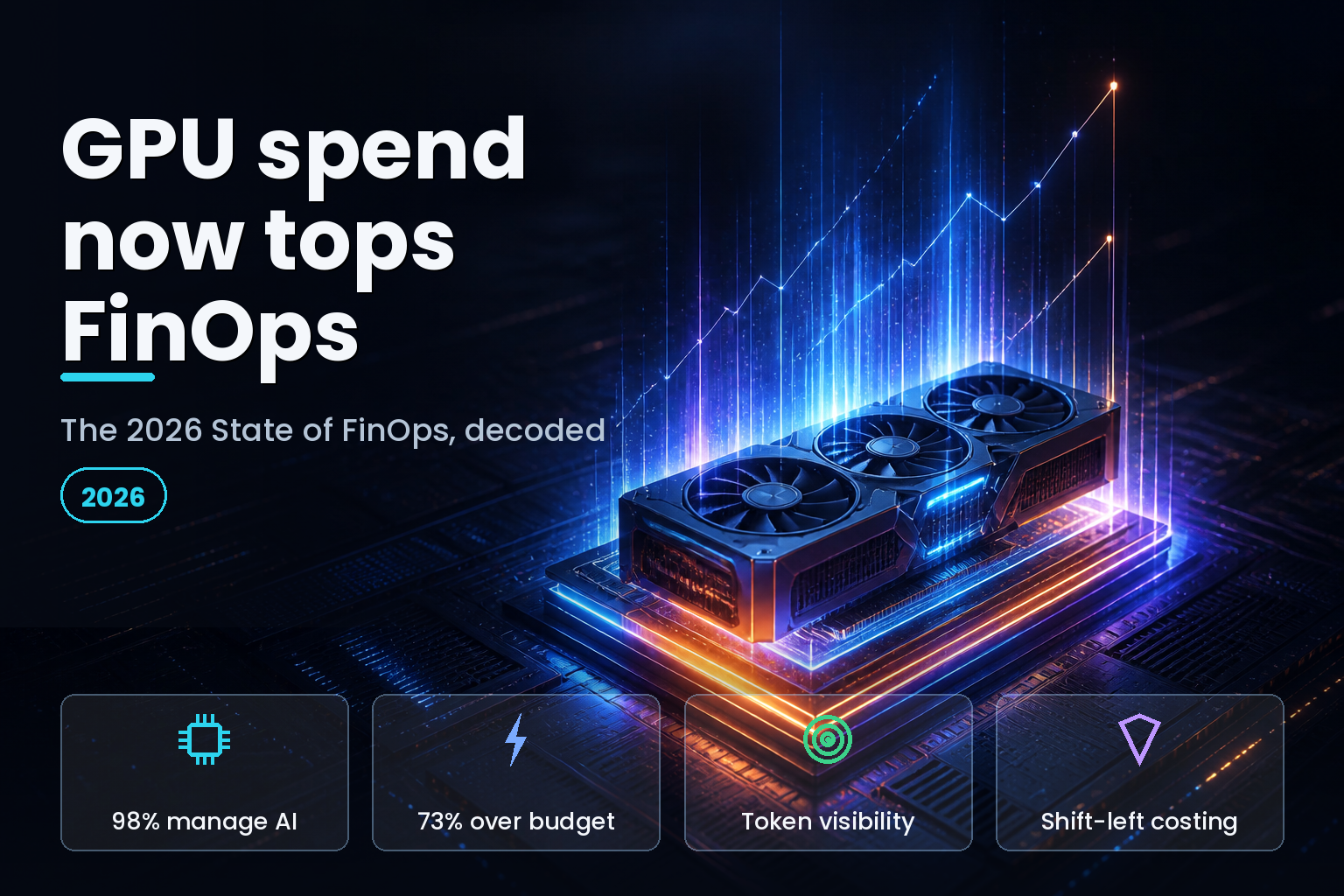
Summary. The FinOps Foundation's 2026 State of FinOps report, drawn from 1,192 respondents who represent more than $83 billion in annual cloud spend, marks a clear shift: 98% of teams now manage AI spend, up from 63% in 2025 and 31% in 2024. AI cost management is the single skill teams most want to add, prioritised by 58% of respondents, and GPU consumption sits at the centre of that concern. The pressure is real: 73% of organisations exceeded their original AI cost projections in 2026, AI workloads now make up about 19% of total cloud spend, and global data center spending reached roughly $650 billion, up 31.7% from 2025. J.R. Storment, executive director of the FinOps Foundation, put the panic plainly, describing companies that were "3x over our entire 2026 token budget and it's only April." This is what changed, and what to do about it.
If your AI bill is growing faster than you can explain, you are not an outlier. GPU and token spend have moved from a line item to the main event. This analysis walks through the 2026 data, why the old cloud playbook falls short, and the concrete controls that work.
AI spend went from edge case to everyday scope
Two years ago, managing AI cost was a minority activity. Now it is nearly universal. The FinOps Foundation reports that the share of teams managing AI spend climbed from 31% in 2024 to 63% in 2025 and 98% in 2026, per the Linux Foundation announcement of the report. That is the fastest scope expansion the survey has tracked.
FinOps is no longer only about cloud compute. The 2026 report shows scope widening across the technology estate at the same time.
| FinOps scope area | Earlier reading | 2026 |
|---|---|---|
| Manage AI spend | 31% (2024), 63% (2025) | 98% |
| Manage SaaS | 65% (2025) | 90% |
| Manage licensing | prior year baseline | 64% |
| Manage private cloud | prior year baseline | 57% |
| Manage data center | prior year baseline | 48% |
Sources: Linux Foundation and Finout.
The headline is not just that AI joined the list. It is that AI cost management became the top forward-looking priority and the number one skillset teams are trying to hire and build, chosen by 58% of respondents, as theCUBE Research summarised. GPU consumption, token billing, retraining cycles, and hybrid placement decisions introduce financial volatility that classic cloud FinOps was not built to handle.
Why GPU and token spend broke the old playbook
Traditional cloud cost control assumes fairly predictable, resource-based billing. AI breaks two of those assumptions at once.
The first break is scale of data. Storment framed it sharply: "Tracking cloud costs is a hundreds-of-millions-of-rows-a-month data problem. Tracking token costs is a trillions-of-rows-a-month data problem," as reported by TechCrunch. Token-level metering produces orders of magnitude more events than instance-hour billing, and most cost tools were not designed for it.
The second break is that falling unit prices do not lower bills. Token prices keep dropping, yet total spend rises because usage volume grows faster than price falls. That is why 73% of organisations still overshot their AI cost projections in 2026, per the CIO Dive coverage of the Foundation's work. A cheaper model that you call ten times as often is not a saving.
Underneath the software bill sits hardware scarcity. The infrastructure numbers explain why GPU cost is hard to walk back.
| AI infrastructure metric | 2026 figure | Note |
|---|---|---|
| AI share of total cloud spend | ~19% | Up from 8% in 2023 |
| Global data center spending | ~$650 billion | Up 31.7% from 2025 |
| Average enterprise AI cloud spend | ~$1.7 million per year | Inference now exceeds training compute |
| NVIDIA H100 cloud rental | ~$2.50 to $6.50+ per hour | Varies by provider |
| GPU procurement lead time | 36 to 52 weeks | Data center vacancy at a record 1.6%, per CBRE |
Sources: ClarityArc, OneSourceCloud, and Tech Insider.
When lead times run past a year and vacancy sits near zero, you cannot simply buy your way out of a GPU crunch. That scarcity is a large part of why GPU spend has become the top concern for AI-first organisations, surpassing general cloud cost for the first time.
What the best teams are actually doing
The report is not only a warning. It names the capabilities practitioners want most, and they point to a clear playbook. Three tooling needs rose to the top: granular monitoring of AI spend across tokens, model requests, and GPU utilisation; shift-left, pre-deployment architecture costing; and a single pane of glass across different technology spend, per CloudKeeper.
Translated into action, four moves matter most.
Get token-level visibility first. You cannot control what you cannot see, and instance-level dashboards hide the real driver. Attribute tokens and GPU hours to teams, products, and features. Our note on free tools to measure LLM spend is a practical starting point.
Cost the architecture before you ship it. Shift-left costing means estimating the token and GPU bill of a design in review, not discovering it in the invoice. A model choice, a caching strategy, or a retrieval design can change the bill by an order of magnitude.
Right-size the model to the task. The most expensive model is rarely the right default. Route simple work to smaller or cheaper models and reserve frontier models for tasks that need them. We cover this trade-off in our generative AI enterprise strategy guide.
Set budgets and alerts on tokens, not just dollars. The teams that got burned in early 2026 had no token budget at all. A budget with automated alerts turns a quarter-end shock into a same-week correction.
India-specific considerations
For Indian enterprises, the GPU squeeze lands with two extra edges. The first is currency and capital cost: at roughly $2.50 to $6.50 per hour for an NVIDIA H100, a modest training or heavy-inference workload can run into lakhs of rupees per month before optimisation, and hardware lead times of 36 to 52 weeks make on-premise buildouts a long bet. Renting capacity in a governed cloud, with strict token budgets, is often the pragmatic path.
The second is data governance under the Digital Personal Data Protection Act, 2023 (DPDP). Cost decisions and data-residency decisions are now linked: choosing a region or provider to save on GPU hours must not move regulated personal data outside your consent basis. Indian teams should fold DPDP checks into the same shift-left review that estimates cost. Our guides to FinOps for Indian teams and cutting cloud spend go deeper on the local picture.
Allocation and chargeback make GPU cost accountable
Visibility without ownership changes nothing. The teams that hold AI spend flat give every token and GPU hour an owner. That means tagging workloads by team, product, and environment, then reporting cost back to the group that generated it, either as showback (you can see your spend) or chargeback (you pay for your spend). The 2026 report ranks cost allocation and per-project chargeback among the capabilities practitioners most want, as Spheron details.
| Practice | What it does | Why it works for GPU and tokens |
|---|---|---|
| Tag-based allocation | Attributes GPU hours and tokens to a team or feature | Turns one opaque bill into owned line items |
| Showback | Shows each team its own AI spend | Creates awareness without billing friction |
| Chargeback | Bills spend back to the owning budget | Aligns the team spending with the team paying |
| Token budgets with alerts | Caps and warns at the token level | Catches a 3x overrun in-week, not at quarter end |
The order matters. Start with tagging and showback to build awareness, then move to chargeback once the data is trusted. A team that sees its own token curve tends to fix its own waste before finance has to intervene. This is the same discipline that made classic cloud FinOps work, applied to a far larger stream of events.
The bottom line
The 2026 data settles an argument. AI cost is not a future FinOps topic; it is the present one, managed by 98% of teams and overshooting budgets for 73% of them. The organisations that regain control share a habit: they measure tokens and GPU hours as first-class costs, cost their designs before shipping, and match models to tasks. The real cost is usually the design, not the model.
How eCorpIT can help
eCorpIT is a Gurugram-based, senior-led technology consultancy that builds AI systems with the bill in mind. We set up token-level and GPU cost visibility, run shift-left architecture costing so you see the number before you ship, and right-size models to workloads so frontier compute is spent only where it earns its keep. If your AI cloud bill is outrunning your forecast, talk to our team for a FinOps-for-AI review.
FAQ
References
_Last updated: 10 July 2026._