On this page · 11 sections
- What AWS changed on July 1, 2026
- The numbers: what a Capacity Block costs now
- Why AWS raised prices, and why analysts disagree
- How Capacity Blocks compare to the other ways to buy GPUs
- What this does to your AI budget
- The FinOps response
- India-specific considerations
- What to watch next
- FAQ
- How eCorpIT can help
- References
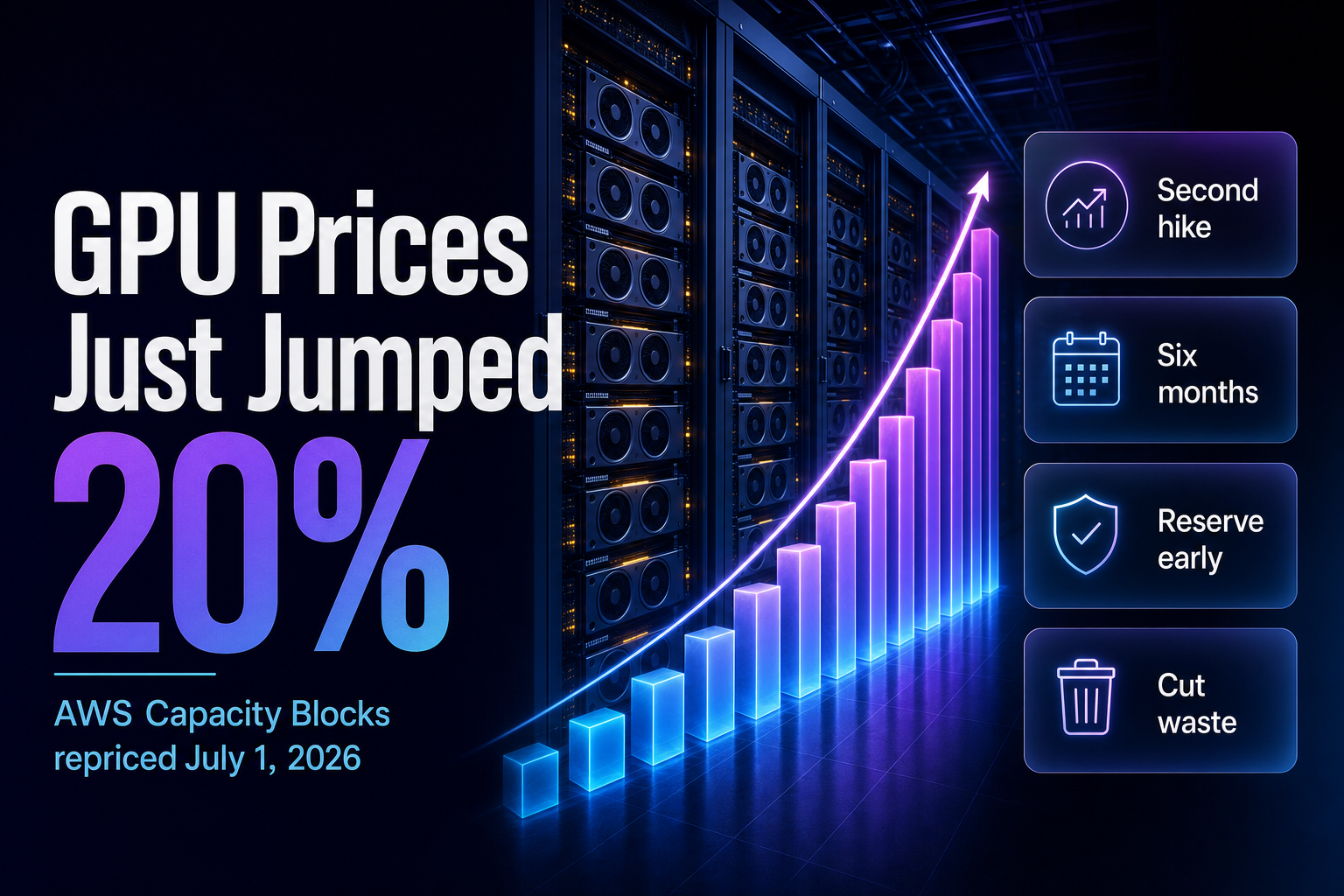
Summary. AWS raised prices on EC2 Capacity Blocks for ML by roughly 20% effective July 1, 2026, covering the P6-B300, P6-B200, P5, P5e, P5en and P4de instance families. It is the second increase in six months: on Saturday, January 4, 2026, AWS lifted H200-linked Capacity Block rates 15%, pushing p5e.48xlarge from $34.61 to $39.80 per hour in most regions and from $43.26 to $49.75 in US West (N. California). After the July change, P6-B300 bills at $14.04 per accelerator hour in available non-GovCloud regions, and P5 capacity tied to H100 accelerators bills at $5.191 per accelerator hour in US regions and $4.72 elsewhere. All other EC2 prices were unchanged. Amazon has committed roughly $200 billion in AI infrastructure capital expenditure for 2026. Two hikes inside six months tell you AWS now treats constrained Nvidia supply as a pricing lever rather than a one-off correction, and that reserved GPU capacity is no longer a line item you can set and forget.
What AWS changed on July 1, 2026
Capacity Blocks for ML are a reservation product. You book a defined block of GPU capacity for a fixed window, from a single day up to several weeks, and AWS guarantees the hardware is there when your job starts. That guarantee is the whole point. Spot capacity can vanish mid-run; a Capacity Block cannot. Teams use them for training runs, fine-tuning jobs and evaluation sweeps where a mid-job eviction costs more than the premium.
The July change touched only the accelerator rates on that product. According to reporting from Network World and SDxCentral, the increase applies to P6-B300, P6-B200, P5, P5e, P5en and P4de, and leaves the rest of the EC2 price list alone. That scoping matters. If your GPU workload runs on on-demand or Savings Plan capacity rather than Capacity Blocks, your bill did not move on July 1. If your training pipeline books blocks, it did.
AWS did not publish a blog post or send a customer advisory. The rates simply changed on the Capacity Blocks pricing page. This is the same pattern as January, when The Register noted the 15% rise landed on a Saturday with no announcement.
The numbers: what a Capacity Block costs now
Here are the published post-July rates alongside the January reference points that reporters captured at the time.
| Instance or family | Accelerator | Rate cited (effective July 1, 2026) |
|---|---|---|
| P6-B300 | Nvidia Blackwell B300 | $14.04 per accelerator hour, non-GovCloud regions |
| P5 (US regions) | Nvidia H100 | $5.191 per accelerator hour |
| P5 (non-US regions) | Nvidia H100 | $4.72 per accelerator hour |
| p5e.48xlarge | Nvidia H200 | $39.80 per hour in most regions after the January 15% rise |
| p5e.48xlarge (US West, N. California) | Nvidia H200 | $49.75 per hour after the January 15% rise |
| P6-B200, P5en, P4de | Blackwell B200, H200, A100 | Included in the July increase; rates on the AWS pricing page |
Two things stand out. First, the per-accelerator framing hides the cluster arithmetic. A single 8-GPU B300 block at $14.04 per accelerator hour runs about $112 per hour before storage, networking and egress. Book that for a two-week training window and you are at roughly $37,700 for the compute alone. Second, the regional spread is real. The same p5e instance cost $9.95 per hour more in US West (N. California) than in most other regions after January. Region choice is a lever most teams pull once at project start and never revisit.
Why AWS raised prices, and why analysts disagree
AWS gave a consistent explanation to reporters. Its statement, quoted by Network World: "EC2 Capacity Blocks for ML pricing vary based on supply and demand patterns... This price adjustment reflects the supply/demand patterns we expect this quarter."
Analysts split on whether to take that at face value.
Pareekh Jain, CEO at EIIRTrend and Pareekh Consulting, reads it as ordinary scarcity pricing. "The most defensible explanation is simply market-based pricing tied to supply and demand," he said, adding that as demand for H100 and H200 GPUs outstrips supply, AWS is applying a scarcity premium to guaranteed inventory and recovering higher infrastructure and capital costs from urgent capacity rather than from overall capacity.
Cloud economist Corey Quinn disagrees with the framing. "This was AWS updating the published base rates on their pricing page... That's a policy decision, not supply/demand," he said. His point is narrow and worth holding onto: a spot market clears dynamically, but a list price is a choice somebody makes. Calling a list-price edit "supply and demand" borrows the language of a market mechanism the product does not actually use.
Sanchit Vir Gogia, CEO and chief analyst at Greyhound Research, pointed at the competitive angle, noting that Google Cloud's approach differs because "they're using scheduling to compete, not price."
You do not have to resolve the argument to act on it. Both readings point the same direction for buyers. If it is scarcity, prices rise until supply loosens. If it is policy, prices rise until customers push back. Either way, the base case for 2027 planning is not a price cut.
How Capacity Blocks compare to the other ways to buy GPUs
Capacity Blocks sit in a specific slot: short commitment, guaranteed availability, premium rate. They are not the cheapest way to get a GPU, and they were never meant to be. The mistake teams make is defaulting to them for workloads that do not need the guarantee.
| Buying model | Typical saving vs on-demand | Best fit |
|---|---|---|
| On-demand | Baseline | Unpredictable, short, interactive work |
| Spot or preemptible | 70–91% reduction, per nOps analysis | Fault-tolerant training with frequent checkpointing |
| Capacity Blocks | Premium over on-demand | Fixed-date training runs where eviction is unacceptable |
| Reserved, 1 year | 30–40% | Steady-state inference and known baseline load |
| Reserved, 3 year | 50–60%, pulling H100 toward roughly $3.00 per GPU hour | Long-horizon platforms with confident forecasts |
| Committed hybrid | Blend of the above | Most real AI teams (see below) |
The hyperscaler comparison is worth a second table, because the per-GPU normalised rates diverge more than the headline instance prices suggest.
| Provider | Approximate H100 on-demand, per GPU hour | Note |
|---|---|---|
| Google Cloud | About $3.00 | Lowest published on-demand for H100 class |
| AWS | About $3.90 | Reflects the 44% H100 price cut AWS made in June 2025 |
| Azure | $6.98 | Enterprise agreements reduce this substantially |
| AWS Capacity Blocks (B200) | About $9.36 | Guaranteed-capacity product, not comparable to plain on-demand |
| Spot, AWS or Google Cloud | $1.95–$2.50 | Eviction risk; requires checkpointing |
Read the two tables together and the shape of a sensible policy appears. On-demand rates favour Google Cloud. Spot favours Google Cloud and AWS. Long-term commitments roughly equalise the three. The differentiator is rarely the sticker price. It is whether your workload can tolerate eviction.
What this does to your AI budget
The July increase is small next to the waste most teams are already carrying. That is the uncomfortable part.
nOps puts GPU idle waste at 30–60% of GPU spend for most AI teams, and GPU instances are typically the largest single line item on an AI cloud bill. A 20% rise on a reservation product is painful. A 45% idle rate on the same hardware is worse, and it is inside your control in a way that the AWS pricing page is not.
The macro numbers explain why nobody should expect relief. AI infrastructure spending for 2026 is projected at about $1.5 trillion. Alphabet guided to $180–190 billion of 2026 capital expenditure and Microsoft to roughly $190 billion for calendar 2026, with Amazon at roughly $200 billion. In Q1 2026, Google Cloud grew 63% year over year, AWS 28% and Azure 40%. Providers are spending at a rate that assumes demand holds. Nothing in that picture creates downward pressure on guaranteed GPU capacity in the next few quarters.
The demand side is not disciplined either. In LeanOps' account of FinOps X 2026, the keynote opened with the statistic that by June, many organisations had already burned through three times their entire annual AI budget. Budgets set in January were written before anyone knew what agent workloads would cost in production.
The real cost is usually the idle hour, not the price per hour.
The FinOps response
Seven moves, roughly in order of return on effort.
1. Separate the workloads that need a guarantee from the ones that do not
This is the highest-use decision and it is free. Capacity Blocks carry a premium because availability is guaranteed. If your job checkpoints every ten minutes and can restart, you are paying that premium for nothing. Spot at $1.95–$2.50 per GPU hour against a Capacity Block at $9.36 for B200 is not a rounding difference. Audit which of your booked blocks genuinely cannot survive an eviction.
2. Adopt a hybrid commitment ratio rather than an all-or-nothing one
The pattern that FinOps practitioners converged on in 2026: commit 60–70% of capacity to cover baseline steady-state usage, and keep 30–40% on-demand or spot for the variable portion. You take the discount on the predictable base and keep flexibility for spikes. Committing 100% locks you into hardware that will be superseded; committing 0% pays retail on load you could have forecast.
3. Measure utilisation before you buy anything
If you do not know your GPU utilisation rate, you cannot tell whether a price rise or an idle cluster is the bigger problem. Most teams discover the answer is the cluster. Instrument first.
4. Revisit region choice
The p5e spread between US West (N. California) and most other regions was $9.95 per hour. Data residency and latency requirements constrain this, but many training workloads have neither constraint and are running in an expensive region because that is where the account was set up.
5. Checkpoint aggressively so spot becomes viable
Spot delivers 70–91% reductions for fault-tolerant training. The engineering work to checkpoint reliably is a one-time cost that pays back on every subsequent run. This is the clearest case in AI infrastructure where an engineering investment beats a procurement negotiation.
6. Price the alternatives before renewing
Specialised GPU providers price well below the hyperscalers on paper, and the gap runs 40–85% across major GPU models on on-demand rates. The honest caveat: hyperscalers add egress, storage, networking and reserved capacity overhead that compound on real workloads, and moving a pipeline has migration cost. Price the alternatives anyway. A quote you never requested is a negotiation you never had.
7. Rebuild the budget on a quarterly cycle
An annual AI budget set in January is a guess about a market that repriced twice by July. Organisations burning 3x their annual AI budget by June are not overspending so much as under-forecasting. Move to quarterly re-planning.
India-specific considerations
For teams running AI workloads from India, the arithmetic differs enough to change decisions.
AWS Mumbai H100 capacity is estimated at ₹600–740 per hour, and A100 at ₹390–480 per hour. Domestic GPU providers publish materially lower rates. Cyfuture AI lists H100 (80GB SXM5) at ₹219 per hour, A100 (80GB) at ₹195 per hour, L40S at ₹61 per hour and V100 from ₹39 per hour. E2E Networks, India's only publicly listed pure-play GPU cloud company, lists H100 from $1.80 per hour, H200 from $2.20 and B200 from $4.90 per GPU, billed in rupees through UPI, NEFT, cards or direct debit with GST-compliant invoices.
| Route | Indicative H100 rate | Trade-off |
|---|---|---|
| AWS Mumbai | ₹600–740 per hour (estimated) | Full AWS service surface; highest rate |
| Cyfuture AI | ₹219 per hour | Lower rate; smaller service ecosystem |
| E2E Networks | From $1.80 per GPU hour | Rupee billing, GST invoices, listed company |
| IndiaAI Mission | ₹115–150 per GPU hour | Roughly 42% below market; eligibility rules apply |
| Reserved, 3–12 months | ₹130–150 per hour effective | 30–40% off; requires a confident forecast |
The IndiaAI Mission route deserves attention. It makes 34,000 GPUs accessible at ₹115–150 per GPU-hour, roughly 42% below market rates, with a stated target of 100,000 GPUs by the end of 2026. For startups and research teams that qualify, no FinOps optimisation on a hyperscaler bill competes with a 42% subsidised rate.
Data residency is now a genuine option rather than an aspiration. Credible providers host A30, A100, L40S and H100 GPUs in Indian data centres with rupee billing and DPDP-aligned infrastructure, so training data no longer has to leave the country. Under the Digital Personal Data Protection Act 2023, that removes a category of transfer questions from your architecture review. If you are working through DPDP obligations more broadly, our FinOps guide for Indian teams cutting cloud spend and our India FinOps cloud cost playbook cover the adjacent ground.
One caution on the domestic comparison. Several of the published Indian rates come from provider marketing pages rather than independent measurement, and the hyperscaler figures for Mumbai are estimates rather than list prices. Treat the table as a prompt to request quotes, not as a settled benchmark.
What to watch next
Three signals will tell you whether July was the last increase this year.
Nvidia supply. Both hikes were tied to H100, H200 and Blackwell scarcity. If Blackwell supply loosens, the scarcity premium has less cover.
Google Cloud's scheduling play. Gogia's observation that Google Cloud competes on scheduling rather than price is the interesting divergence. If scheduling-based allocation wins customers, AWS has a reason to stop pricing guaranteed capacity as a premium good.
The third quarter pricing page. AWS said the July adjustment "reflects the supply/demand patterns we expect this quarter." That sentence has a shelf life. Watch the Capacity Blocks pricing page at the start of October, and set an alert rather than trusting an announcement, because neither of the 2026 changes came with one.
FAQ
How eCorpIT can help
eCorpIT is a CMMI Level 5 certified technology organisation in Gurugram, and our senior engineering teams work with AWS, Microsoft and Google platforms on cloud cost and AI infrastructure. We help teams instrument GPU utilisation before they commit, separate workloads that need guaranteed capacity from those that can run on spot, and set a commitment ratio their forecast actually supports. For Indian teams we also model AWS Mumbai against domestic and IndiaAI Mission routes with DPDP considerations included. If GPU spend is moving faster than your forecast, contact us and we will review your workload mix.
References
- AWS hikes prices for EC2 Capacity Blocks amid soaring GPU demand — Network World
- AWS raises GPU prices 15% on a Saturday — The Register
- AWS quietly increases prices for H200 EC2 instances by 15% — Data Center Dynamics
- Amazon quietly raises price tag on the AI boom — TheStreet
- Reserved vs. On-Demand GPU in 2026 — Compute Exchange
- Can AI answer the $3 trillion question? — TechCrunch
- Google Cloud, AWS, Microsoft Azure: The AI vertical integration race — Constellation Research
- GPU Cloud Pricing: India vs Global Providers — Cyfuture AI
- IndiaAI Mission: 34,000 GPUs at Rs 150/Hour for startups — Abhishek Gautam
_Last updated: July 15, 2026._