On this page · 9 sections
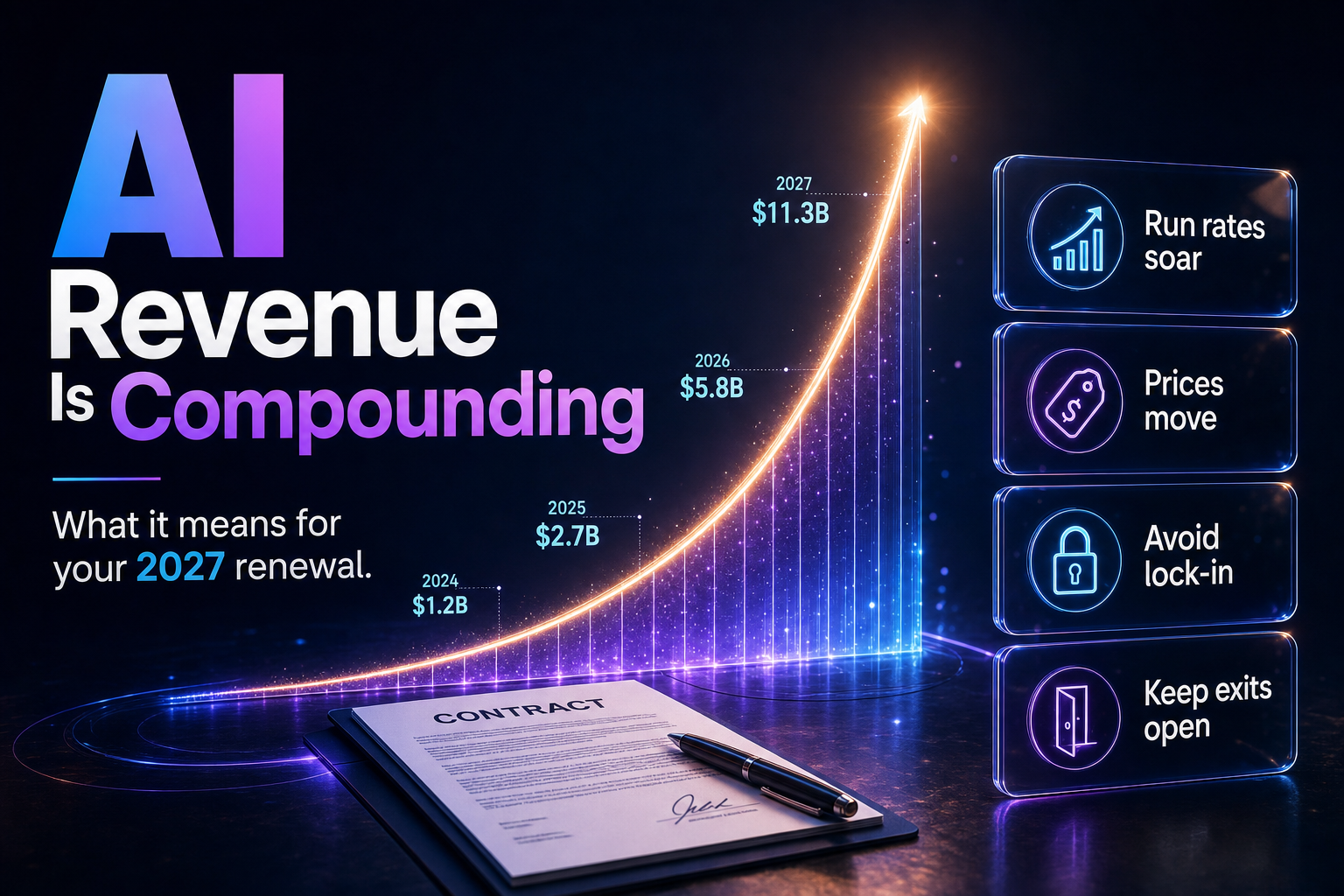
Summary. Anthropic's annualized run rate went from $9 billion at the end of 2025 to $47 billion by late May 2026, crossing $30 billion less than two months before it crossed $47 billion. It is not alone: Glean crossed $300 million ARR in May 2026, having taken nine months to go from $100 million to $200 million and then six months to reach $300 million; Sierra took seven quarters to reach its first $100 million ARR and two more quarters to add the second; Mercor crossed $2 billion of gross annualized revenue in June 2026, four months after reaching $1 billion. Meanwhile OpenAI reported about $13 billion of 2025 revenue and, as of June 11, 2026, was weighing steep token price cuts. Prices moved both ways this year: Anthropic shifted Claude's enterprise edition to dynamic usage-based pricing on April 15, then launched Claude Sonnet 5 on June 30 at introductory rates below its standard list. None of this is stable. The switching costs you accumulate in 2026 set your negotiating position in 2027, and that is the part you control.
The growth is real and it is accelerating
The pattern worth noticing is not that AI companies are growing. It is the second derivative.
| Company | Milestone | Time taken |
|---|---|---|
| Anthropic | $9 billion to $47 billion annualized run rate | End of 2025 to late May 2026 |
| Anthropic | $30 billion to $47 billion run rate | Less than two months |
| Glean | $100 million to $200 million ARR | Nine months |
| Glean | $200 million to $300 million ARR | Six months, crossing $300 million in May 2026 |
| Sierra | First $100 million ARR | Seven quarters |
| Sierra | Second $100 million ARR | Two quarters |
| Mercor | $1 billion to $2 billion gross annualized revenue | Four months, crossing $2 billion in June 2026 |
Every row shows the same shape: each increment arrives faster than the one before it. Glean took nine months for one hundred million and then six months for the next. Sierra needed seven quarters for the first hundred million and two for the second. Traditional enterprise software does not do this.
Anthropic's growth has been driven substantially by Claude Code, its autonomous coding agent. That detail matters for your planning, because coding agents are consumption products. Their revenue rises when your developers use them more, which means the vendor's growth rate and your bill are the same number viewed from two sides.
Prices moved both directions in five months
Anyone telling you AI prices only fall, or only rise, is describing half of 2026.
| Date | Action | Effect on buyers |
|---|---|---|
| April 15, 2026 | Anthropic moved Claude's enterprise edition from fixed pricing to dynamic usage-based pricing | A de facto increase; observers expected it could double or triple costs for heavy users |
| April 2026 | Uber's CTO told The Information the company had burned its entire 2026 AI token budget | Consumption, not list price, exhausted the budget in four months |
| June 11, 2026 | OpenAI reported to be weighing steep token price cuts to compete with Anthropic | Nothing announced; as of July 2 it remained an internal consideration with no numbers or timeline |
| June 30, 2026 | Anthropic launched Claude Sonnet 5 at $2 per million input and $10 per million output tokens, introductory through August 31, against $3 and $15 standard | A real cut, with an expiry date attached |
| Across enterprise software | Vendors raising subscription and licensing prices at an annualized 12.2% | Underlying compute costs fell while end-user prices rose |
The Uber data point is the one to sit with. A company with a serious engineering organisation exhausted a full-year AI coding budget in four months, mostly on token consumption from tools engineers could not stop using. No vendor raised a price to cause that. We covered the specifics in our piece on Microsoft, Uber and Claude Code token costs, and OpenAI's competitive response in OpenAI's price cuts and the Anthropic war.
The 12.2% line is the quiet one. Compute costs fell. Enterprise software prices rose at an annualized 12.2% anyway. The gap between input cost and list price is margin, and margin is a decision.
Note the expiry date on the Sonnet 5 introductory rate: $2 and $10 per million tokens run through August 31, against standard pricing of $3 and $15. If your 2027 model was built on introductory pricing, it is built on a promotion.
Why fast growth is a buyer's risk, not a comfort
The intuition says a fast-growing vendor is a safe vendor. For pricing, the opposite is closer to true, for three reasons.
A vendor growing 5x in five months has no reason to discount. Discounts buy growth. When growth arrives without them, the commercial logic for a discount disappears. Your use in a renewal is highest when the vendor needs your logo and lowest when they have a queue.
Consumption pricing transfers the risk to you. The April 15 shift from fixed to dynamic usage-based pricing for Claude's enterprise edition is the pattern to watch, and observers expected it could double or triple costs for heavy users. Fixed pricing caps your exposure. Usage-based pricing caps the vendor's.
The $3 trillion payback question sits underneath all of it. AI infrastructure spending for 2026 is projected at about $1.5 trillion, and the industry needs roughly $3 trillion of revenue to justify it, as we covered in AI's $3 trillion question. If that payback stretches, vendors under-earning against that bill have one reliable lever: your renewal. Every scenario in which the AI trade disappoints ends with someone trying to raise your price.
That is the asymmetry. If the boom continues, prices stay competitive because rivals are fighting. If it stalls, prices rise because someone has to pay for $1.5 trillion of hardware. Your renewal is exposed to the bad case and merely fine in the good one.
What to negotiate now
The switching costs you accumulate in 2026 determine your 2027 and 2028 negotiating position. That is the whole game, and it is decided before the renewal conversation starts.
| Term | Weak position | Strong position |
|---|---|---|
| Price-increase cap | No cap; renewal at then-current list | 0% is the best case worth pushing for; 3% is a strong outcome; anything below a 5% annual cap is reasonable |
| Pricing model | Dynamic usage-based with no ceiling | Fixed, or usage-based with a contractual cap |
| Exit provisions | Not negotiated, which is what most enterprises do | Data export format, timeline and assistance written in |
| Model portability | Single vendor; prompts and evaluations tuned to one model | Abstraction layer; a second model tested in production, even at low volume |
| Introductory rates | Budget built on the promotional price | Budget built on standard list, with the promotion as upside |
Two of these deserve more than a table row.
The price-increase cap compounds every year in your favour and costs the vendor little to give early, when they want the deal. Ask for 0%, expect to land under 5%, treat 3% as a good day. This single term is worth more over a three-year term than most of what procurement usually argues about.
Exit provisions are the term almost nobody negotiates, and commercial legal teams should be putting them in every enterprise AI agreement. Not because you plan to leave. Because the option to leave is what makes the renewal conversation a negotiation rather than an invoice. Sophisticated buyers maintain the option to switch even when the probability of switching is low. Single-vendor AI strategies can expose enterprises to up to 80% in unnecessary costs through limited model choice and pricing dependency.
The cheapest hedge is a second model in production at low volume. Not a pilot. Production, with real traffic, so that switching is a decision rather than a project. Chinese open models compete on capability at a fraction of operating cost, which is exactly why keeping one wired up has negotiating value even if you never route serious volume to it. Our note on Chinese open models and enterprise AI cost covers that ground.
India-specific considerations
Indian buyers carry two exposures that a US buyer does not.
Model pricing is dollar-denominated. A vendor holding list price flat still raises your rupee cost if the currency moves. Any AI budget built in rupees against a dollar rate card needs the exchange assumption stated explicitly and reviewed each quarter, not buried in a spreadsheet cell.
Consumption scales with delivery headcount. India's large engineering and global capability centres have more developers using coding agents than a comparable revenue-sized Western firm. If vendor growth and your bill are the same number seen from two sides, a delivery-heavy organisation is structurally more exposed to consumption pricing. That argues for per-team token attribution before the next renewal, not after.
The DPDP angle belongs in the contract too. Under the Digital Personal Data Protection Act 2023, where a model processes personal data and under what terms is a compliance question, and it is easiest to answer while you still have commercial use. Put data location and processing terms in the agreement at signature, when the vendor wants the deal.
What to watch
OpenAI's cuts. As of July 2, 2026 they were a reported internal consideration with no announced numbers or timeline. If they land, the whole market reprices and your renewal position improves. If they do not, that tells you something about how much pricing pressure vendors actually feel.
August 31, 2026. That is when Claude Sonnet 5's introductory $2 and $10 per million tokens is scheduled to end against $3 and $15 standard. Watch whether it extends. Promotions that quietly become permanent and promotions that expire on schedule tell you opposite things about a market.
Your own consumption curve, per team. It is the only figure here you control, and it is the one that decides your bill regardless of which way list prices go.
FAQ
How eCorpIT can help
eCorpIT is a CMMI Level 5 certified technology organisation in Gurugram, and our senior engineering teams build AI systems that keep model choice open. We design abstraction layers so a second model is a configuration change rather than a rewrite, set up per-team token attribution before renewal season, and help teams write DPDP-aligned data terms into agreements while they still hold use. If your AI contracts renew in 2027, contact us and we will review your switching-cost exposure now, while it is still cheap to change.
References
- Anthropic ARR Doubled Every 6 Weeks in 2026 — MindStudio
- Anthropic Passed OpenAI in Revenue: $30B ARR April 2026 — The AI Corner
- OpenAI and Anthropic Slash Token Prices Amid Competition — Let's Data Science
- AI Price War: OpenAI and Anthropic Face New Economics — The AI Chronicle
- Locked, stocked, and losing budget: AI vendor lock-in bites — The Register
- SaaS Pricing Shift: How to Negotiate AI-Driven Renewals — Baytech Consulting
- The coming AI reckoning: Slouching toward vendor lock — Federal News Network
- Can AI answer the $3 trillion question? — TechCrunch
_Last updated: July 15, 2026._