On this page · 10 sections
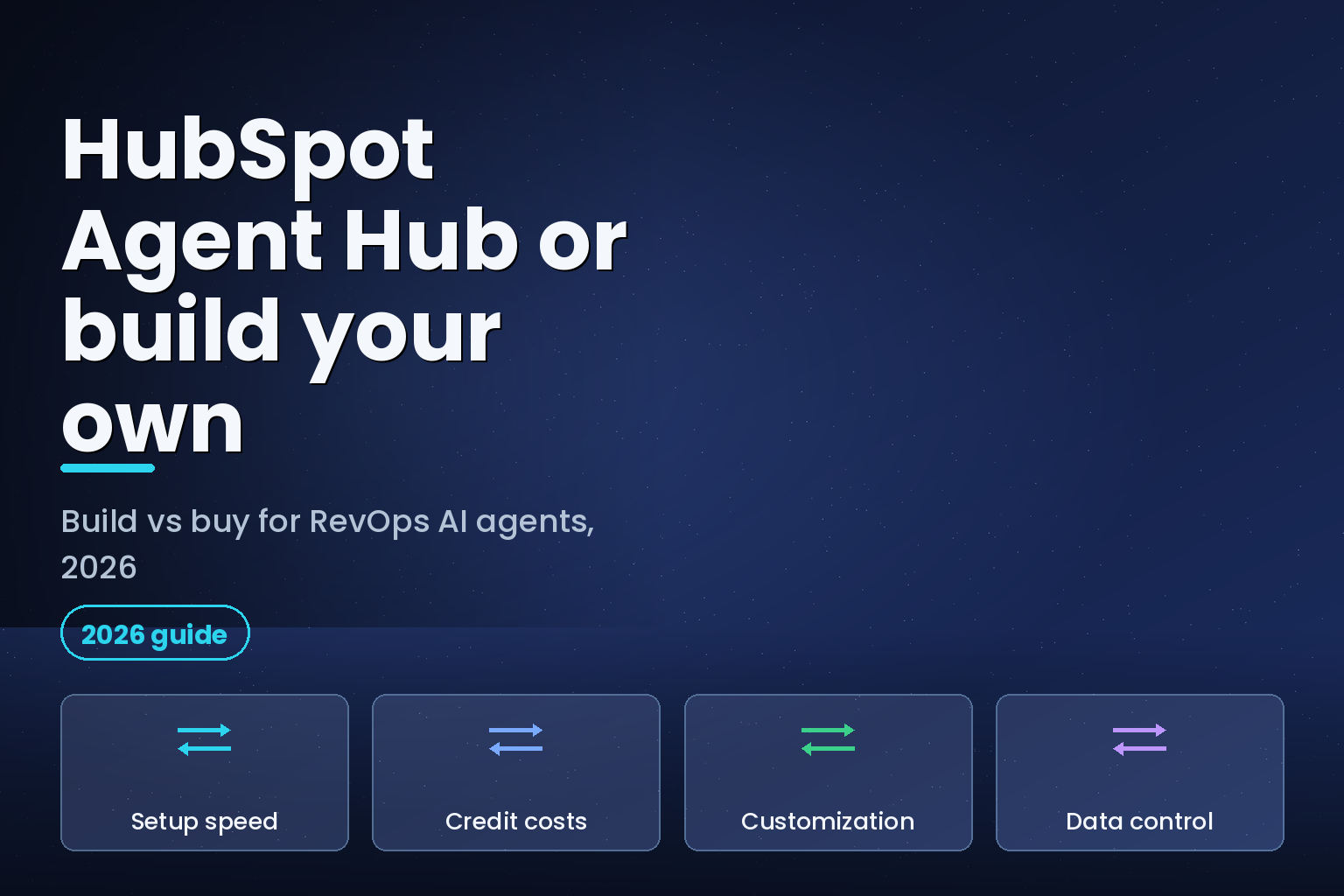
Summary. HubSpot opened Agent Hub and Agent Builder in public beta on July 23, 2026, giving Professional and Enterprise customers a single console for AI agents plus a no-code way to build their own. That forces a decision for revenue operations teams: buy HubSpot's pre-built agents, build custom agents on its canvas, or build entirely outside the CRM. The pre-built path is priced by outcome since April 14, 2026: the Customer Agent costs $0.50 per resolved conversation, the Prospecting Agent $1.00 per recommended lead, and the Data Agent $0.10 per answer, all metered in HubSpot Credits at roughly $10 per 1,000. Those agents sit on a Service Hub seat, from $90 per seat per month for Professional to $150 for Enterprise. The Customer Agent resolves 65% of conversations on average across 9 channels. The right answer depends on your data gravity, volume and control needs, not on the demo. This guide compares buy, build-on-HubSpot and build-your-own on cost, customization and data.
What HubSpot shipped on July 23, 2026
Agent Hub is a management console. It puts every AI agent, pre-built or custom, in one place with shared access to the customer context already in HubSpot's Smart CRM. Agent Builder, the second half of the release, is a no-code canvas that assembles custom agents from natural-language instructions, your knowledge sources and live CRM data. You describe what the agent should do, and it wires itself to the data. Agent Builder was previously called Breeze Studio, and it ships inside the Professional and Enterprise editions.
Alongside the builder, HubSpot sells three pre-built Breeze agents that cover the most common revenue tasks. The Customer Agent answers support questions from knowledge bases, FAQ pages and uploaded PDFs across 9 channels including SMS, Instagram and voice in beta, then hands off to a human. The Prospecting Agent researches contacts across CRM data, LinkedIn, company news and funding, then drafts outreach. The Data Agent answers ad-hoc CRM questions such as which deals over $50,000 closed last quarter. Custom agents built on the canvas run on HubSpot Credits when they take configured actions.
For RevOps, the honest framing is not "should we use AI agents" but "which of these three routes fits our stack and our volume." The routes are buy the pre-built agents, build custom agents inside HubSpot, or build your own outside it.
What buying gets you, and what it costs
The pre-built route is fast and metered by result. Since the April 14, 2026 move to outcome-based pricing, you pay when the agent produces the outcome, not per attempt. That is attractive at low volume and expensive at high volume.
| Pre-built agent | What it does | 2026 price |
|---|---|---|
| Customer Agent | Resolves support across 9 channels | $0.50 per resolved conversation (50 credits) |
| Prospecting Agent | Researches and drafts outreach | $1.00 per recommended lead (100 credits) |
| Data Agent | Answers CRM questions | $0.10 per answer |
| Custom agent (Agent Builder) | Your workflow, no code | HubSpot Credits per configured action |
| Seat requirement | Access to the suite | $90 per seat Pro; $150 per seat Enterprise |
Two costs sit underneath the per-outcome price. First, the seat: the agents require a Service Hub Professional seat at $90 per seat per month, usually with a one-time onboarding fee near $1,500, or Enterprise at $150 per seat per month with a 10-seat minimum. Second, the credit rate: HubSpot Credits have held at roughly $10 per 1,000 standard, or $9 per 1,000 on annual terms, through 2026. The strength of buying is speed and the shared context in Smart CRM, which is exactly the problem HubSpot says it built Agent Hub to solve.
The context problem HubSpot is selling against
The pitch for Agent Hub is not a single smarter agent, it is coordination. Duncan Lennox, HubSpot's chief product and technology officer, put it directly: "The problem isn't managing a single agent in isolation. It's that once you have multiple agents, they become fragmented, all working from different pictures of the customer, or even worse, no picture at all." That is the real value of the buy route. When agents share one CRM record, a support resolution and a prospecting touch see the same history. Recreating that shared state is the hidden cost of building your own, and it is where most home-grown agent projects stall.
What building your own costs
Building outside HubSpot buys control and pays for it in engineering. A custom RevOps agent on a framework such as LangGraph or CrewAI carries four ongoing costs: the engineering to build it, the model tokens it burns per run, the infrastructure it runs on, and the evaluation and guardrail work that keeps it safe in production. None of those is a line item HubSpot charges, and all of them are real. The upside is that a custom agent can orchestrate across systems HubSpot does not own, encode proprietary logic, keep data inside your own stack, and avoid per-outcome metering at scale. The build-vs-buy maths for support agents specifically is worked through in our note on AI customer support agent build vs buy cost.
Building custom agents on Agent Builder is a middle path: no engineering, but you stay inside HubSpot's data model and credit metering. It suits teams whose processes live in HubSpot but are not covered by the three pre-built agents.
| Decision axis | Buy pre-built (Agent Hub) | Build on Agent Builder | Build your own |
|---|---|---|---|
| Time to live | Days | Days to weeks | Weeks to months |
| Who builds it | No one, configure only | RevOps, no code | Engineers |
| Cost model | Per outcome plus seat | Credits per action | Build plus tokens plus ops |
| Customization | Fixed to the agent's scope | Within HubSpot data | Unlimited |
| Data control | In HubSpot | In HubSpot | In your stack |
| Cross-system reach | HubSpot-centric | HubSpot-centric | Any system |
| Best fit | Standard RevOps tasks | HubSpot-native custom flows | Complex, multi-system, high volume |
The cost crossover
Outcome pricing is cheap until volume makes it expensive. A Customer Agent handling 2,000 resolved conversations a month costs about 2,000 x $0.50, or $1,000 per month, plus seats. At 20,000 resolved conversations a month, that same rate is $10,000 per month, or $120,000 a year, before seats. A Prospecting Agent recommending 3,000 leads a month runs about $3,000 monthly at $1.00 each. Those are the numbers to model against a build. A custom support agent might cost more to build and run at 2,000 conversations, but far less at 20,000, because your marginal cost is tokens and infrastructure rather than a fixed $0.50 per outcome. The crossover point, not the sticker price, is the decision. Below it, buy. Well above it, a build with disciplined production use cases usually wins.
The trap is treating outcome pricing as free because it is usage-based. At RevOps volumes it is a variable cost that grows with your success, so forecast it against your best-case conversion, not your pilot.
How to decide
Buy the pre-built agents if HubSpot is your system of record, your use cases are standard support deflection, prospecting or CRM questions, and your monthly volume keeps per-outcome cost below a build. Build on Agent Builder if your process lives in HubSpot but the three pre-built agents do not cover it, and you have no engineers to spare. Build your own if the agent must reach across systems HubSpot does not own, must encode proprietary logic, must keep data inside your stack for compliance, or runs at a volume where per-outcome pricing dwarfs a build-and-run budget. Most teams end up with a mix, and the discipline is to place each agent on the route its volume and data justify.
India-specific considerations
For Indian RevOps teams the seat and outcome costs convert to real budget: a $150 per seat Enterprise plan is roughly ₹12,900 per seat per month at mid-2026 rates, and a 10-seat minimum sets a floor near ₹15.5 lakh a year before any credits. The Customer Agent at $0.50 per resolved conversation is about ₹43 per resolution, which is cheap against a human agent until volume climbs. The harder question is data. HubSpot agents process customer records, and the Digital Personal Data Protection Act, 2023 (DPDP) treats that as processing personal data, so a build-your-own route that keeps CRM data inside an Indian region can be the compliance-safer choice for regulated buyers. eCorpIT designs RevOps automation aligned with DPDP requirements, and that residency question belongs in the build-vs-buy decision, not after it.
FAQ
How eCorpIT can help
eCorpIT is a Gurugram-based, CMMI Level 5 and ISO 27001:2022 certified engineering organisation that helps revenue teams decide where AI agents should live and then builds them. Our senior-led teams model the buy-versus-build crossover against your real volumes, configure HubSpot's pre-built and Agent Builder agents where they fit, and build custom cross-system RevOps agents where control, data residency or scale demands it. We design that automation aligned with DPDP requirements so customer data stays where it should. If you are weighing HubSpot Agent Hub against a custom build, talk to our engineering team or see our GTM and RevOps AI agent service.
References
- HubSpot Breeze Prospecting Agent now costs 100 credits per lead — Vantage Point
- HubSpot Breeze AI 2026: the complete guide — MAN Digital
- What is HubSpot Agent Hub? — OneMetric
- Breeze Studio: HubSpot's no-code AI agent builder — CRM Curator
_Last updated: July 31, 2026._