On this page · 11 sections
- 1. Run AI-led WhatsApp commerce, not broadcast blasting
- 2. Treat return-to-origin as a margin lever
- 3. List on ONDC to cut platform dependence
- 4. Build a retail-media plan, on both sides
- 5. Offer credit at checkout with credit-on-UPI
- 6. Engineer your stack for quick commerce
- 7. Use GenAI for discovery and personalisation
- The compliance thread running through all seven
- FAQ
- How eCorpIT can help
- References
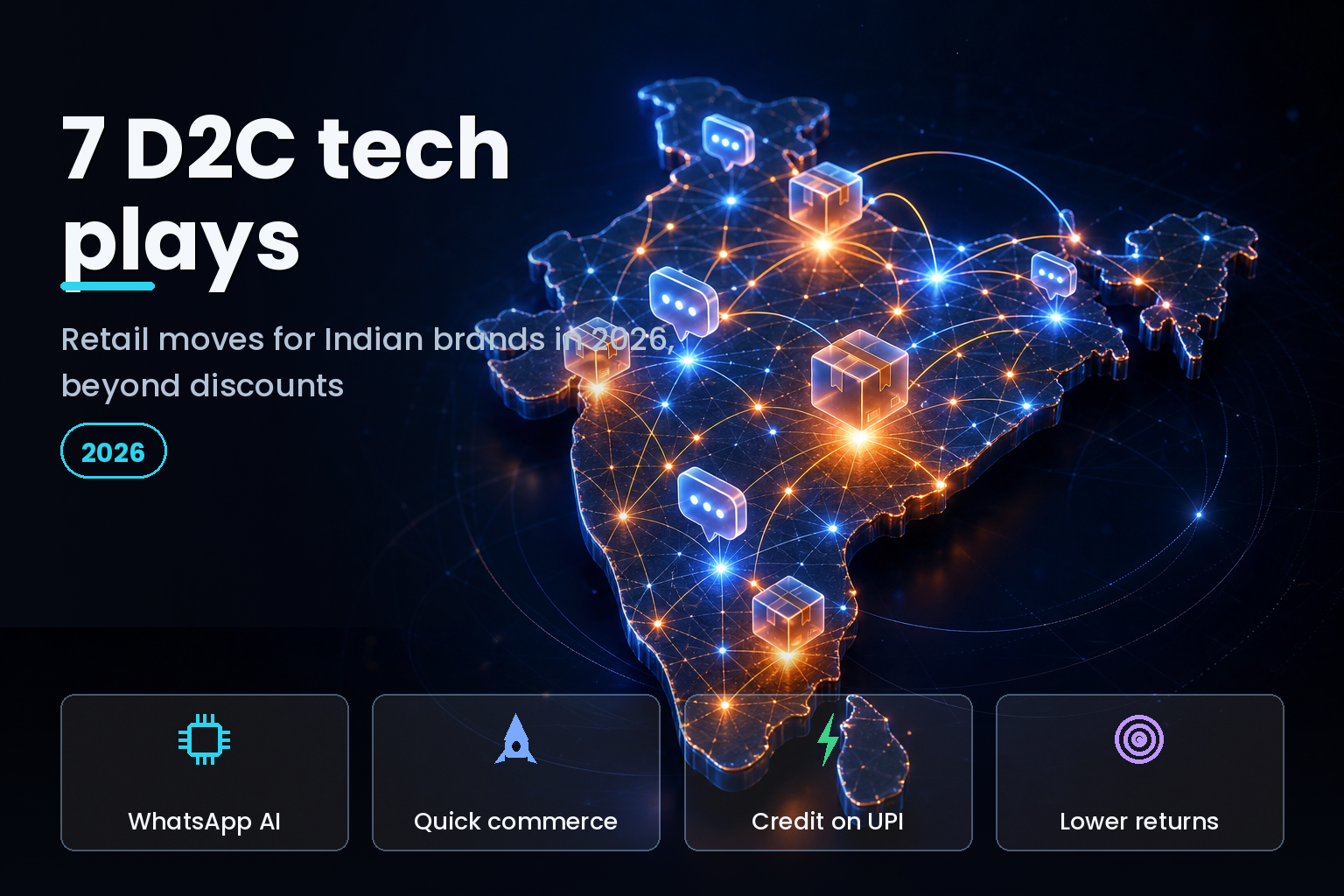
Summary. India's direct-to-consumer market is worth about $108.76 billion in 2026, up from $87.5 billion in 2025, on a 24.3% CAGR that Mordor Intelligence projects will reach $322.1 billion by 2031. That growth is real, but the discount-led version of it is not durable: acquisition costs keep climbing and a rupee spent on coupons does not come back. The seven plays below are the technology moves that build margin instead of buying sales. Each is grounded in a 2026 number: WhatsApp now drives 20-35% of digital revenue for brands that automate it well; return-to-origin rates fell from 39% to 21% between November 2025 and February 2026; quick-commerce GMV hit roughly ₹11,000 crore in January 2026 alone; and India has 420 million UPI users against about 110 million credit-card holders. Read this as a checklist for retail CTOs and D2C founders who want to compete on capability, not price.
The common thread is that each play changes unit economics. Discounts move today's revenue and leave nothing behind. Infrastructure — a WhatsApp funnel, a cleaner returns pipeline, an ONDC listing, a checkout credit line — keeps paying after the campaign ends. Here is the short version before the detail.
| # | The play | The 2026 number that justifies it |
|---|---|---|
| 1 | AI-led WhatsApp commerce | 20-35% of digital revenue; 90%+ open rates |
| 2 | Treat RTO as a margin lever | RTO fell 39% to 21% (Nov 2025 to Feb 2026) |
| 3 | List on ONDC | 3 lakh+ sellers, 400+ cities, 100+ buyer apps |
| 4 | Build a retail-media plan | India retail media near ₹30,000 crore in 2026 |
| 5 | Offer credit-on-UPI at checkout | 420M UPI users vs ~110M card holders |
| 6 | Engineer for quick commerce | ~₹11,000 crore GMV in January 2026 |
| 7 | GenAI discovery and personalisation | LLMs hit 50M monthly users faster than any prior tech |
1. Run AI-led WhatsApp commerce, not broadcast blasting
India has more than 500 million active WhatsApp users, and for D2C brands that build proper automation, the channel now contributes 20-35% of total digital revenue. The reason is attention: WhatsApp messages in India see open rates above 90%, against 20-25% for email. But the gap between winners and everyone else is not volume. GoKwik's WhatsApp Commerce Intelligence Report 2026, which analysed 26 billion messages from more than 1,800 D2C brands, found that 83% of WhatsApp-driven orders during the October to December 2025 festive quarter came from first-time buyers, and that bot-led query resolution rose to 73.4% from 67.1% over the year.
"The brands seeing outsized growth on WhatsApp aren't sending more messages. They are letting AI decide which message to send, to whom, and when," said Chirag Taneja, co-founder and chief executive of GoKwik. That is the play: use AI to pick the message, the recipient and the timing, and put checkout inside the chat with WhatsApp Flows and in-chat UPI. One caveat to design around — WhatsApp Pay and UPI carry per-transaction ceilings that pinch premium baskets, so keep a fallback for high-ticket orders.
2. Treat return-to-origin as a margin lever
Nothing destroys D2C margin faster than a parcel that ships out and comes back unsold. Unicommerce's India D2C Report 2026, built from more than 410 million shipments across 6,000-plus brands, recorded return-to-origin rates falling from nearly 39% during the November 2025 festive peak to about 21% by February 2026. The split by payment method is stark: fewer than 2% of prepaid orders are returned, against nearly 26% of non-prepaid orders, and cash-on-delivery returns ran at 58% during the festive quarter.
| Order type | Return / RTO behaviour (FY2026) |
|---|---|
| Prepaid | Under 2% returned |
| Non-prepaid (COD) | About 26% returned |
| COD, festive quarter | Up to 58% returns |
The brands that fixed high RTO ran three changes at once: a prepaid incentive at checkout, pin-code-level courier routing based on actual delivery performance, and address verification before dispatch. None of that is glamorous, and all of it is cheaper than the coupon it replaces. This is the clearest example of the whole thesis: an operations fix that raises contribution margin without touching the price.
3. List on ONDC to cut platform dependence
The Open Network for Digital Commerce is India's attempt to unbundle e-commerce from any single marketplace. By 2026 it had onboarded roughly 3 lakh sellers, with more than 100 buyer apps active across 400-plus cities and towns, and it recorded a single-month peak of about 8.9 million transactions back in May 2024 across retail and mobility. The government's stated aim is for ONDC to carry 25% of India's e-commerce transactions by 2030.
For a D2C brand, the point is not that ONDC is bigger than Amazon or Flipkart today; it is not. The point is optionality. A listing on an open network means your catalogue is reachable through many buyer apps instead of renting visibility from one gatekeeper. Treat ONDC as a low-cost distribution hedge in 2026, and as insurance against marketplace take-rate hikes later.
4. Build a retail-media plan, on both sides
Retail media is the fastest-moving money in Indian advertising. It is projected to approach ₹30,000 crore in 2026, roughly 15% of the country's ad revenue, and e-commerce, quick-commerce and food-delivery platforms together are estimated to generate more than $2.97 billion in ad revenue this year, up about 30% year on year. Blinkit, Zepto and Swiggy Instamart are growing their ad businesses at triple-digit rates from small bases, while Amazon and Flipkart remain the two largest retail ad sellers.
There are two plays here, not one. As a buyer, retail-media placements put your product in front of shoppers at the moment of intent, which converts better than upper-funnel spend. As a seller with your own traffic, a first-party ad surface turns your store into a margin line rather than a cost centre. Either way, commerce-led advertising is forecast to expand 24.2% in 2026, and brands that learn the mechanics early will pay less for the same reach later.
5. Offer credit at checkout with credit-on-UPI
India has about 420 million unique UPI users and only around 110 million credit-card holders, so the addressable base for credit at checkout is roughly four times the card market. The Reserve Bank of India's credit-line-on-UPI framework lets banks extend pre-sanctioned credit through UPI rails, reaching the more than 30 crore consumers and businesses already active on the network. For a D2C brand, offering a small-ticket credit option at checkout can lift conversion and average order value without discounting the product.
The honest caveat: adoption has been slower than the headline potential. Business Standard reported in October 2025 that unclear guidelines on treatment and reporting have held back credit-on-UPI since launch, as banks and fintechs stay cautious. So treat this as a 2026 pilot, not a bet-the-quarter rollout — wire it in with a lending partner, measure incremental conversion, and scale it as the rules settle.
6. Engineer your stack for quick commerce
Quick commerce stopped being a grocery story. GMV reached roughly ₹11,000 crore in January 2026 alone, close to double the year before, and the segment is forecast to grow from about $11.3 billion in 2025 to somewhere between $60 billion and $83 billion by 2030. The scale of the leaders is now hard to ignore.
| Platform | Recent scale marker |
|---|---|
| Blinkit | Gross order value ₹11,821 crore in Q1 FY26 |
| Zepto | FY25 revenue ₹9,668 crore, more than doubled |
| Swiggy Instamart | GOV ₹4,670 crore in Q4 FY25, up 101% YoY |
For a brand, engineering for quick commerce means real integration work: live inventory feeds to dark-store partners, SKU packs sized for 10-minute baskets, and pricing that survives the platform's margin. It is a different fulfilment model from your own website, and the brands that treat it as a first-class channel, not an afterthought, are the ones capturing the growth.
7. Use GenAI for discovery and personalisation
Bain's How India Shops Online 2026 frames the next shift as moving retail from "search and browse" to "describe and get." Generative AI adoption is accelerating fast — large language models reached 50 million monthly active users in India quicker than earlier digital innovations — and e-retailer agents such as Amazon's Rufus and Flipkart's conversational engine, along with LLM shopping agents like ChatGPT's Instant Checkout, are already shaping discovery and consideration. India's e-retail GMV reached $65-66 billion in 2025, with Q1 2026 growth estimated at 23-25%.
The near-term play for a D2C brand is not to build a chatbot for its own sake. It is to make your catalogue legible to these agents — clean structured product data, accurate attributes, answer-shaped content — so that when a shopper describes a need, your product is what the agent surfaces. That is the same discipline behind ranking in AI search, and it is worth reading alongside our guide to generative engine optimisation and enterprise GenAI strategy.
The compliance thread running through all seven
Six of these seven plays touch customer data: WhatsApp identities, purchase histories, credit signals, personalisation profiles. In India that data falls under the Digital Personal Data Protection Act, 2023. Consent has to be specific and revocable, and the brand — not the vendor — carries accountability for how the data is processed. Build data-minimisation and consent into each play from the start; retrofitting it after a breach or a notice is far more expensive. For a broader view of how AI and search intersect with brand visibility, our SEO in 2026 guide covers the discovery side of the same problem.
FAQ
How eCorpIT can help
eCorpIT builds the technology behind these plays for Indian retail and D2C brands: WhatsApp commerce automation, ONDC and quick-commerce integrations, checkout and payments work, and data pipelines designed in line with DPDP Act 2023 requirements. We are a senior-led engineering organisation that ships production systems, not slide decks. If you want to move past discounting and compete on capability in 2026, talk to our team about a build plan scoped to your stack.
References
- Mordor Intelligence, "India D2C E-commerce Market" — mordorintelligence.com
- Unicommerce, "India D2C Report 2026" — unicommerce.com
- ONDC, "Open Network for Digital Commerce" — ondc.org
- GlobeNewswire, "India Quick Commerce Report 2026: Market to Reach $12.97 Billion by 2029" — globenewswire.com
- Upstox, "Zepto vs Blinkit vs Instamart: revenue and profitability" — upstox.com
- EY India, "How recent changes to UPI are helping fill India's credit gap" — ey.com
- Business Standard, "Unclear guidelines hold back growth of credit line on UPI" (October 2025) — business-standard.com
- Storyboard18, "Digital to command 68% of India's ad spend in 2026 as commerce gains share: WPP Media" — storyboard18.com
- The Current, "In India, advertisers searching for outcomes turn to commerce media" — thecurrent.com
- Outlook Business, "D2C Brands Lean on WhatsApp to Find New Customers" (GoKwik report coverage) — outlookbusiness.com
- Bain & Company, "How India Shops Online 2026" — bain.com
- IBS Intelligence, "FinTech 2026: Why Credit Line on UPI Will Reshape the Entire Ecosystem" — ibsintelligence.com
_Last updated: July 5, 2026._