On this page · 10 sections
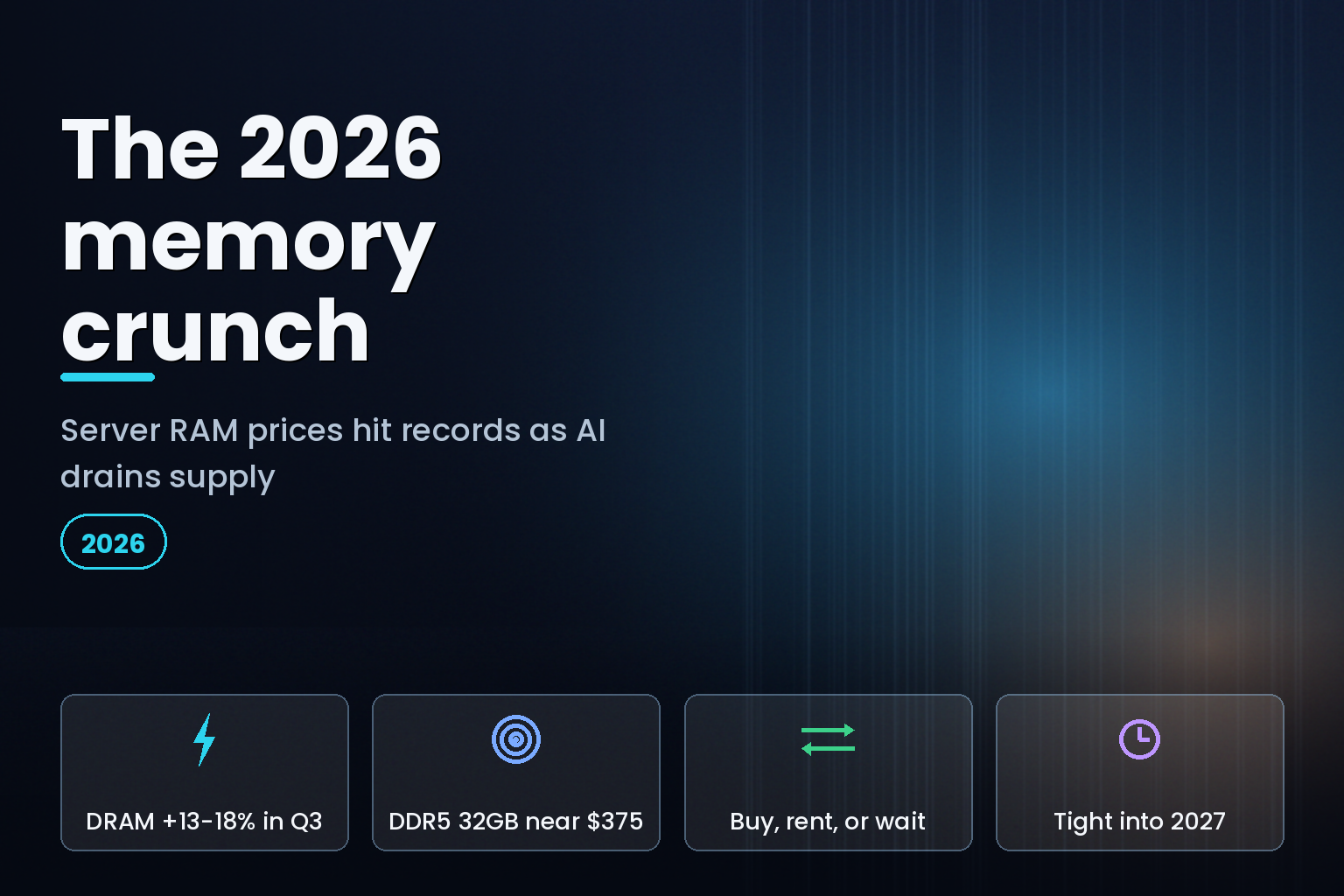
Summary. Memory is the cost story of 2026. TrendForce puts conventional DRAM contract prices up 13-18% quarter-on-quarter in the third quarter of 2026, on top of a roughly 90% jump in the first quarter that it called the steepest on record. A 32GB DDR5 desktop kit that cost double digits in mid-2025 carried a floor near $375 by June 2026. On July 30, 2026 Amazon told investors it was raising 2026 capital spending to about $220 billion from about $200 billion, and named higher memory costs as a reason. When the largest buyer of compute on earth flags memory in its guidance, every CTO planning a refresh needs a position. This piece lays out what changed, why, and a sourced way to decide whether to buy hardware now, move the workload to cloud, or wait.
The short read for a budget owner: prices are high because memory makers have pointed their best capacity at AI, and that will not reverse in a single quarter. Buying blind is expensive; waiting blind is a gamble on lead times you do not control. The right call depends on how memory-heavy your workload is, how long your hardware has to last, and whether your data can legally sit in someone else's data center.
What actually happened to memory prices
The numbers moved fast and in one direction. TrendForce, the memory-market research firm most quoted by the industry, reported that conventional DRAM contract prices rose around 90% quarter-on-quarter in the first quarter of 2026, then kept climbing. Its July 3, 2026 survey forecast a further 13-18% quarter-on-quarter rise in conventional DRAM contract prices for the third quarter, with NAND flash contract prices up 10-15%, and described the DRAM market as "extremely tight" (TrendForce).
Retail buyers felt it first. Tom's Hardware tracked the cheapest 32GB DDR5 kit in the United States climbing to about $375 by June 2026, a part that sold in the low double digits a year earlier (Tom's Hardware). Server buyers felt it next. Tom's Hardware separately reported that server memory prices are set to roughly double year over year in 2026, a shift its sources called seismic because even smartphone-class LPDDR was pulled into the squeeze (Tom's Hardware).
Hardware vendors passed it through. Dell and Lenovo moved to raise server and PC prices by as much as 15% from December 2025, citing DRAM and AI demand (Tom's Hardware). On a memory-heavy server node the effect is larger than the headline percentage, because RAM is often the single biggest line in the bill of materials. A memory supplier general manager at Team Group summed up the mood bluntly, warning that "the RAM pricing crisis has only just started" (Tom's Hardware).
Here is how the moves stack up across the memory types a data center actually buys.
| Memory segment | Q1 2026 contract move (QoQ) | Q3 2026 contract move (QoQ, forecast) | Where it hurts |
|---|---|---|---|
| Conventional DRAM | ~90% (record) | +13-18% | Server RDIMMs, workstations |
| Server DRAM (RDIMM) | Sharply higher | Undersupplied, gains moderating | Every new server node |
| NAND flash | Rising | +10-15% | SSDs, storage tiers |
| DDR5 retail kit (32GB) | Near $375 floor by June 2026 | Still elevated | Edge boxes, dev machines |
| HBM (AI accelerators) | Sold-out, allocated | Allocated to AI first | GPU servers, priced separately |
Sources: TrendForce, Tom's Hardware DDR5 tracking.
Why memory got this expensive
Three decisions by the three companies that make most of the world's memory explain the whole chart.
First, the memory makers pointed capacity at high-bandwidth memory (HBM) for AI accelerators, because it earns far more per wafer than commodity DRAM. SK Hynix reported record second-quarter 2026 results and a 76% operating margin, and told investors it was steering DRAM output into higher-value HBM; Reuters noted the company missed some DRAM price upside precisely because it converted DRAM bits into HBM instead (SK Hynix; CNBC). Every wafer sent to HBM is a wafer not making the RDIMM your server needs.
Second, at least one major supplier walked away from the low-margin consumer segment to protect enterprise supply. Micron announced it would exit its Crucial consumer memory and storage brand by February 2026 and concentrate output on AI and data-center customers. Micron's chief business officer, Sumit Sadana, framed it as "winding down its Crucial consumer business to focus supply on its largest strategic customers." The company reported fiscal 2025 revenue of $37.38 billion, up close to 50% year over year, with data-center and AI applications accounting for about 56% of the total (Micron; DataCenterDynamics).
Third, demand kept rising while supply discipline held. Samsung warned that memory shortages would drive an industry-wide price surge through 2026 (Network World). TrendForce reported that suppliers keep prioritizing AI and server allocations, and that general-purpose x86 servers with RDIMM memory remain the primary platform for agentic AI workloads, so server DRAM stays undersupplied even as consumer demand cools (TrendForce). New fabs take years to come online, so the supply side cannot answer quickly.
The result is a market where the biggest buyers get served first. That is the single most important fact for planning: you are now competing for memory against hyperscalers who sign multi-year agreements and pay whatever the AI economics justify.
What it means for your infrastructure bill
The clearest signal came from the demand side. On July 30, 2026 Amazon raised its 2026 capital-expenditure guidance to about $220 billion from about $200 billion and cited higher memory costs as a driver, while AWS revenue grew 37% year over year (CNBC). Chief executive Andy Jassy told investors that even at $220 billion, Amazon would not have enough capacity to meet demand (Fortune). Amazon's finance chief added that much of 2027 capacity is already reserved and some 2028 capacity is spoken for.
Two things follow for a normal enterprise. Higher hardware input costs eventually flow into cloud list prices and into the premium you pay for guaranteed capacity, so cloud is not a free hedge against the memory market; it is a different way of paying for the same scarce parts. And because hyperscalers are pre-committing years of capacity, the cheapest reserved and committed-use cloud rates may tighten for the memory-heavy instance families exactly when you want them. The scarcity shows up in your bill whether you buy the DIMM or rent it.
For on-premises and colocation buyers, the practical effects are a higher purchase price, longer lead times on memory-heavy configurations, and quotes that no longer hold. When your workload is memory-bound rather than compute-bound, this is now a first-order budget item, not a rounding error.
The decision: buy now, move to cloud, or wait
There is no single right answer, because the answer depends on your workload shape and your constraints. Use concrete vectors, not vibes. The table below compares the realistic options against the factors that actually decide the call.
| Option | Best when | Upfront cost | Main risk | 2026-27 outlook |
|---|---|---|---|---|
| Buy servers now | Predictable, steady load; 4-5 year horizon; data-residency needs | High, and higher than 2024 | Overpaying near a price peak | Prices stay elevated; owning locks your unit cost |
| Lease or finance hardware | You need capacity now but want to smooth cash flow | Low upfront, higher total | Rates price in memory scarcity | Spreads the peak; keeps a refresh option |
| Public cloud (on-demand) | Spiky or uncertain demand; short projects | None | Highest unit cost long term | Exposed to any list-price pass-through |
| Public cloud (reserved / committed) | Steady cloud-native load, 1-3 year horizon | Commitment, not capex | Locking in before you know the workload | Discounts real, but capacity tightening |
| Wait and refresh later | Current fleet has headroom; workload not memory-bound | None now | Lead times and further rises | DRAM expected to stay tight into 2027 |
A few rules of thumb make the table usable. If your workload is memory-bound, in-memory databases, large caches, analytics, virtualization density, then the memory line dominates and every option is more expensive than last year; the question is only how you finance it. If your workload is compute- or GPU-bound, the memory move matters less to your total, and cloud capacity for accelerators is the tighter constraint. If your data must stay in a specific jurisdiction, cloud may be limited before economics even enter, which pushes you toward buying or colocation.
The one option that rarely wins is "buy a big memory-heavy fleet on the spot market this quarter." Paying a record price for depreciating hardware, with no financing and no reserved capacity, concentrates the risk at the worst moment. If you must buy, buy to a plan: size to real utilization, not to a comfort margin, and get pricing locked in writing.
A 90-day playbook for infrastructure and procurement leads
You do not need to predict the market to protect the budget. You need to remove the avoidable losses.
Start by measuring memory utilization across the fleet. Most enterprises run servers with far more RAM provisioned than used; right-sizing before you buy is the cheapest capacity you will find this year. Reclaim stranded memory through consolidation and denser scheduling before you sign a purchase order.
Next, lock quotes and lead times in writing. Vendors have moved to terms that let them reprice between the day you accept a quote and the day the hardware ships, so an unlocked quote is not a price. Ask explicitly whether your quote is firm, and get the ship date in the contract.
Then split the decision by workload. Put memory-bound, steady, or data-resident workloads on a buy-or-colocate track with a four to five year horizon so the high unit cost amortizes. Put spiky, experimental, or short-lived workloads on cloud with reserved or committed-use pricing sized to the floor of your demand, not the peak. Keep a small on-demand buffer for genuine bursts.
Finally, model the total cost honestly. Compare owning versus renting over the full hardware life, including power, cooling, and the memory premium, not just the sticker. For a deeper method, our guide to cloud FinOps for Indian teams walks through commitment sizing, and our analysis of the AI capex question for cloud budgets explains how hyperscaler spending feeds back into the rates you pay.
India-specific considerations
For Indian teams the memory crunch lands on top of costs that are already dollar-denominated. Server memory is imported and priced in dollars, so the rupee exchange rate and customs duties sit on top of a global price that has already jumped. A memory-heavy purchase in 2026 is therefore doubly exposed, to the DRAM market and to the currency, which strengthens the case for right-sizing before buying and for financing rather than a single large capital outlay.
Data residency changes the math too. Where personal data must stay in India under the Digital Personal Data Protection Act 2023, a pure public-cloud answer may not be available, which pushes memory-bound, regulated workloads toward Indian colocation or owned hardware. That is a business reason to buy, not just an economic one. Domestic AI-cloud capacity is expanding, and our comparison of India GPU cloud rental pricing and the domestic versus hyperscaler GPU cloud decision covers where renting Indian capacity beats importing servers this year.
The pragmatic Indian playbook is a hybrid: keep regulated, steady, memory-heavy workloads on right-sized owned or colocated hardware, and push elastic workloads to reserved cloud capacity, revisiting the split each quarter as prices move.
When will it ease?
Not immediately, and not evenly. TrendForce's outlook for 2027 has DRAM supply staying tight while NAND flash conditions ease, a split that matters because it means system memory stays scarce even as some storage relief arrives (TrendForce). New fabrication capacity is being built, but it takes years to reach volume, and as long as AI accelerators keep absorbing HBM and premium DRAM, commodity server memory stays second in line.
The practical planning assumption for the next several quarters is that memory stays expensive and supply stays allocated to the largest buyers. Build your 2026-27 budget around elevated prices rather than a quick return to 2024 levels, and treat any easing as upside. For the compute side of the same squeeze, our AI compute capacity planning guide and the analysis of the Nvidia Rubin buildout and enterprise cloud budgets track how accelerator supply interacts with the memory market.
FAQ
How eCorpIT can help
eCorpIT is a senior-led engineering organisation in Gurugram that helps CTOs plan infrastructure through cost shocks like the 2026 memory market. We run memory and capacity utilization audits, model owning versus renting over the full hardware life, size cloud commitments to real demand, and design hybrid architectures that keep regulated data in the right jurisdiction. As a CMMI Level 5 and ISO 27001:2022 certified team, we build to a documented process. To pressure-test your 2026-27 infrastructure plan against current memory pricing, contact us.
References
_Last updated: August 2, 2026._