On this page · 11 sections
- What just changed: India now has its own Blackwell supply
- The three ways to rent a modern GPU in India
- Cost: what a GPU-hour actually costs in 2026
- Beyond price: data residency, DPDP and the sovereignty case
- Where the hyperscalers still win
- A decision framework: which one, for which workload
- How to run a one-week bake-off before you commit
- India-specific considerations
- FAQ
- How eCorpIT can help
- References
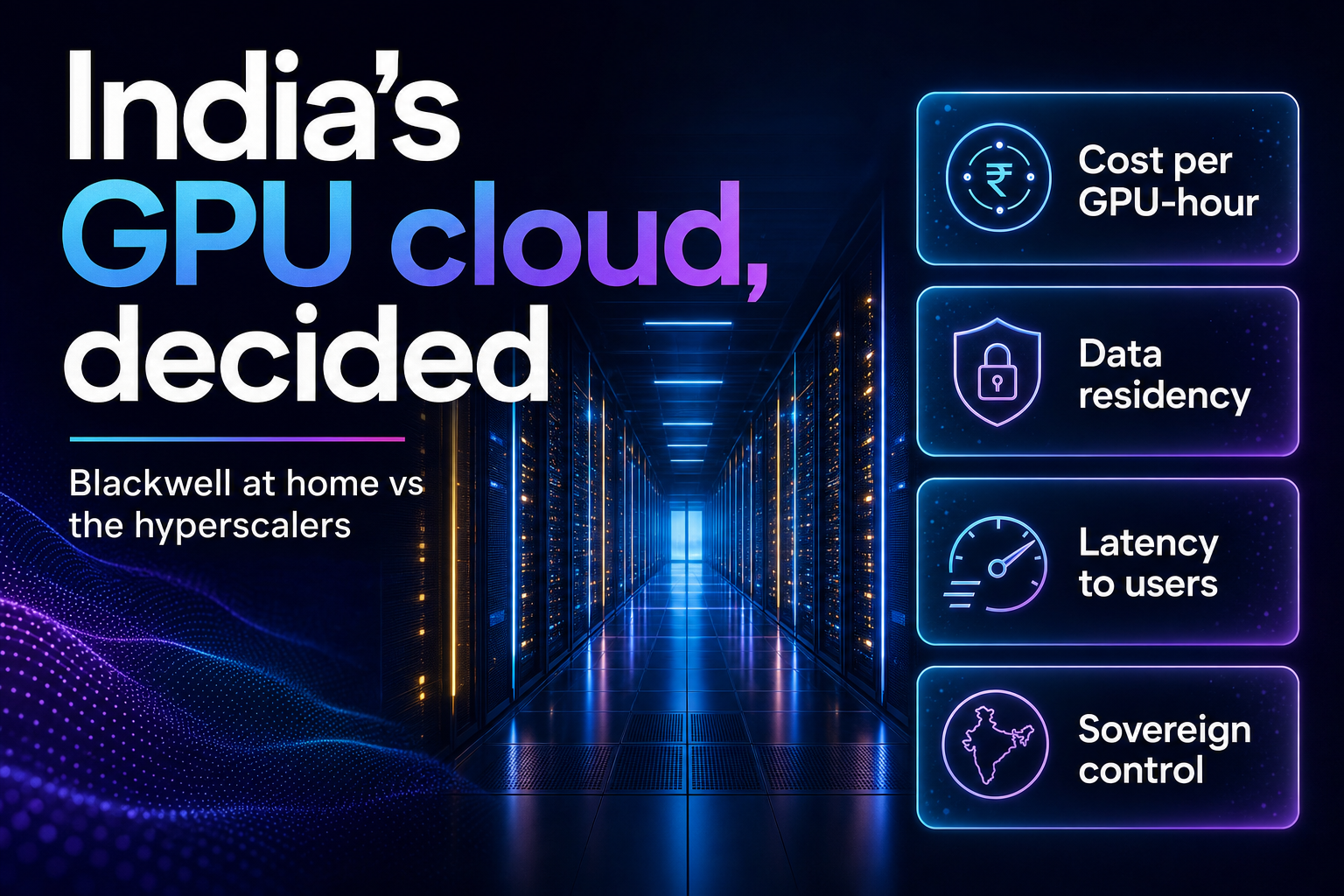
Summary. In July 2026 Yotta Data Services raised USD 150 million at a valuation near ₹37,000 crore and said it will scale its AI cloud to about 85,000 NVIDIA Blackwell GPUs by the end of its financial year, up from the 8,192 H100 GPUs it already runs at Navi Mumbai. At the same time the IndiaAI Mission has put roughly 38,000 GPUs on tap at about ₹65 per hour, roughly 72 US cents, through 14 empanelled providers. That changes the build-versus-rent maths for Indian teams. A single Blackwell B200 on a global hyperscaler runs about USD 6 per GPU-hour on-demand as of March 2026, and a GB200 rack slice runs USD 12 to 18. Domestic H100 capacity at E2E Networks lists at ₹249 per hour. This guide is a decision framework: when domestic sovereign cloud, the subsidised IndiaAI pool, or a global hyperscaler is the right call, weighed on price, data residency, latency and availability rather than on any single number.
What just changed: India now has its own Blackwell supply
For two years the honest answer to "where do we get GPUs in India" was "a waitlist, or a US region." That has shifted. Yotta's raise, reported by Business Standard, funds a buildout that the company frames as making India a producer of AI compute rather than only a consumer of it. Its Shakti Cloud platform already runs 1,024 L40S and 8,192 H100 GPUs at the NM1 data centre in Navi Mumbai, and Yotta has named specific next-generation deployments: 30,000 NVIDIA B300 Ultra GPUs at a 60 MW facility in Greater Noida and 36,000 GB300-class GPUs at a 75 MW campus in Navi Mumbai, targeting more than 80,000 next-generation GPUs by FY27 to FY28. Frost & Sullivan named Yotta its 2026 Indian Company of the Year for sovereign AI infrastructure.
Yotta is not alone. E2E Networks has brought a NVIDIA B200 cluster live on a certified reference architecture, and the government-backed IndiaAI Mission runs a national common compute facility of about 38,000 GPUs through its IndiaAI Compute Portal. Between them, an Indian team in 2026 has three distinct ways to rent a modern GPU without leaving the country. They are not interchangeable.
The three ways to rent a modern GPU in India
The first decision is not price; it is which of three supply models fits the workload. A sovereign enterprise cloud, the subsidised national pool, and a global hyperscaler solve different problems.
| Decision vector | Domestic sovereign cloud (Yotta, E2E) | IndiaAI Mission pool | Global hyperscaler (AWS, Azure, GCP) |
|---|---|---|---|
| Headline price signal | ₹249/hr H100 at E2E; Blackwell by contract | About ₹65 per GPU-hour, subsidised | About USD 6/hr B200; USD 12 to 18 GB200 |
| Data residency | In India, DPDP-aligned by design | In India, government facility | Region-dependent; India regions exist |
| Availability today | H100 now; B200 and B300 landing through FY27 | Allocation-based, eligibility-gated | Broad, but Blackwell still waitlisted |
| Managed services depth | Growing; storage and platform partners | Bare compute plus portal tooling | Deepest: databases, networking, MLOps |
| Best fit | Regulated data, steady training, BFSI and government | Startups, research, MSMEs, price-first | Global products, spiky inference, rich tooling |
Read across the rows and the pattern is clear. Domestic sovereign cloud wins on data residency and rupee-denominated predictability; the IndiaAI pool wins on raw price for eligible users; the hyperscalers win on managed depth and global reach. The rest of this guide costs each one out and then maps them to workloads.
Cost: what a GPU-hour actually costs in 2026
Price is where the domestic story is strongest, but the comparison has to be honest about GPU generation. Much of India's cheap domestic capacity today is H100 and H200 class; Blackwell B200 and B300 pricing at Yotta and E2E is largely enterprise-contract and not published, while the hyperscaler figures below are for Blackwell parts that are newer than the domestic H100 they undercut.
| Option | GPU | Indicative price | Source basis |
|---|---|---|---|
| E2E Networks (India) | H100 on-demand | ₹249 per hour | Provider list price, 2026 |
| E2E Networks (India) | H100 spot | ₹70 per hour | Provider list price, 2026 |
| IndiaAI Mission | Subsidised pool | About ₹65 per GPU-hour | IndiaAI Compute Portal, 2026 |
| IndiaAI empanelled | Unsubsidised | ₹115 to ₹150 per GPU-hour | Empanelment bids, 2026 |
| Global hyperscaler | B200 on-demand | About USD 6 per GPU-hour | Market rate, March 2026 |
| Global hyperscaler | GB200 slice | USD 12 to 18 per GPU-hour | Early-adopter rate, 2026 |
Two numbers frame the gap. The IndiaAI Mission rate of about ₹65 per hour is under one US dollar, and government analysis puts empanelled rates 40 to 60 percent below global cloud on-demand pricing. On the other side, the median on-demand B200 price across providers rose about 11 percent between July 2025 and 2026, from USD 5.50 to about USD 6.12 per GPU-hour, because Blackwell demand still outruns supply. For a price-sensitive training run on H100-class silicon, domestic is not a little cheaper; it is a different order of cost. For teams that need the newest Blackwell parts at scale today, the hyperscalers still have the deepest pools, which is why our India GPU cloud rental pricing breakdown treats availability as a first-class variable alongside the rate.
Beyond price: data residency, DPDP and the sovereignty case
The reason a BFSI or government buyer will pay more for a domestic contract is not patriotism; it is data residency. Yotta positions Shakti Cloud as keeping data inside India and aligning with the Digital Personal Data Protection (DPDP) Act, and it reports that government and BFSI customers often prefer its enterprise contracts over global providers for exactly that reason. When a training set contains Indian personal data, keeping storage and inference in-country removes a cross-border transfer question that a US region reopens. That matters more each quarter as the DPDP Rules move toward enforcement. Teams weighing this trade should read it alongside the wider IndiaAI Mission and DPDP picture, because the sovereignty argument and the compliance clock are the same argument.
Latency is the quieter half of the residency case. A model serving users in Mumbai or Bengaluru from a data centre in Navi Mumbai answers faster than one served from Northern Virginia, and for interactive inference that round-trip is a product feature, not a footnote. Domestic clouds also bill in rupees, which removes the currency risk that turns a US-dollar GPU bill into a moving target for an Indian finance team.
Where the hyperscalers still win
None of this makes the global clouds a wrong answer. They win wherever the workload is not primarily about Indian data residency. AWS, Azure and Google Cloud have the deepest managed-service stacks, the broadest spot markets, and multi-region footprints that a product with users outside India actually needs. Azure's ND GB200-v6 virtual machines expose the GB200 NVL72 architecture with InfiniBand networking that a domestic provider may not match on day one. Spot and reservation markets on the hyperscalers can push effective B200 rates below USD 2.50 per hour for interruptible work, a lever the subsidised Indian pool does not offer. And for a team already deep in one hyperscaler's databases, networking and identity, the switching cost of moving only the GPU tier is real. Our AI compute capacity planning guide covers how to model that switching cost before it surprises a budget.
A decision framework: which one, for which workload
The choice resolves cleanly once you sort by data sensitivity, workload shape, and stage. The table below is the short version.
| Scenario | Recommended | Why |
|---|---|---|
| Indian personal or regulated data, steady training | Domestic sovereign cloud | Residency, DPDP alignment, rupee billing |
| Early-stage startup or research, price-first | IndiaAI Mission pool | Lowest rate, subsidy for eligible users |
| Global product, users outside India | Global hyperscaler | Multi-region, managed depth, spot markets |
| Spiky inference, need cheapest interruptible | Hyperscaler spot | Deep spot and reservation markets |
| BFSI or government contract | Domestic sovereign cloud | Data residency and enterprise support |
| Need newest Blackwell at scale this quarter | Hyperscaler, then domestic | Broadest Blackwell availability today |
The plain engineering read: match the cloud to the data, not the data to the cloud. A regulated training workload on Indian data belongs on a domestic sovereign platform even at a small price premium, because the alternative is a compliance exposure no discount offsets. A global inference product with spiky traffic belongs on a hyperscaler for the spot depth and the regions. And a cash-tight startup training on H100-class silicon should apply to the IndiaAI pool first, because nothing else in the market touches ₹65 per hour. Many teams will end up split across two of the three, and that is a defensible architecture, not a failure to decide. Costing that split is the same discipline as any other AI cloud cost in India exercise.
How to run a one-week bake-off before you commit
The way to avoid a wrong multi-year commitment is to test, not to argue. A one-week bake-off across two or three providers costs a few thousand rupees and settles most of the disagreement in a team.
Start by fixing one representative workload, not a public benchmark: your actual training step or your real inference request, at the batch size and sequence length you run in production. Synthetic throughput numbers hide the memory-bandwidth and interconnect differences that decide real performance. Run that identical workload on a domestic H100 instance, a hyperscaler B200 instance, and, if you qualify, an IndiaAI allocation, then record three things: samples or tokens per rupee, wall-clock time to a fixed checkpoint, and the p95 latency a user would feel.
Price the whole bill, not the sticker. Add egress, storage, idle time between jobs, and the engineering hours to port your stack. A rate that looks cheap per GPU-hour can lose once data transfer and orchestration land on the invoice. Domestic rupee billing removes one variable; a dollar-denominated hyperscaler bill needs a currency buffer in the model.
Test the exit last. Confirm you can move checkpoints and data out of each provider without a penalty or a re-architecture, because the cost that hurts most is the one you meet when you try to leave. A provider that makes leaving easy is one you can commit to safely.
India-specific considerations
Eligibility is the first practical gate. The IndiaAI Mission subsidy, worth up to 40 percent of compute cost, is aimed at startups, researchers, academia, MSMEs and government users, so a well-funded enterprise may not qualify for the headline ₹65 rate and should price against domestic enterprise contracts instead. Second, allocation is not the same as availability: the subsidised pool is oversubscribed, and a production roadmap cannot assume instant capacity the way an on-demand hyperscaler instance provides. Third, the domestic buildout is real but forward-dated. Yotta's largest Blackwell deployments land through FY27 to FY28, so a team that needs 500 B200s in the next month will still find the shortest path runs through a hyperscaler, with the domestic option maturing over the year. Finally, the broader capacity picture, from power to land, shapes what any of these providers can promise, which is why the India data-center capacity outlook is worth reading before signing a multi-year commitment.
FAQ
How eCorpIT can help
eCorpIT is a Gurugram-based, ISO 27001:2022-certified engineering organisation that helps Indian teams choose and run GPU infrastructure without overpaying. Our senior engineers model the real cost of a workload across domestic sovereign clouds, the IndiaAI pool and the global hyperscalers, weigh data-residency and DPDP exposure, and set up the FinOps guardrails that keep a GPU bill predictable. If you are deciding where to train or serve your models this year, our cloud FinOps managed service team can run the numbers with you. Start a conversation at /contact-us/.
References
_Last updated 28 July 2026._