On this page · 10 sections
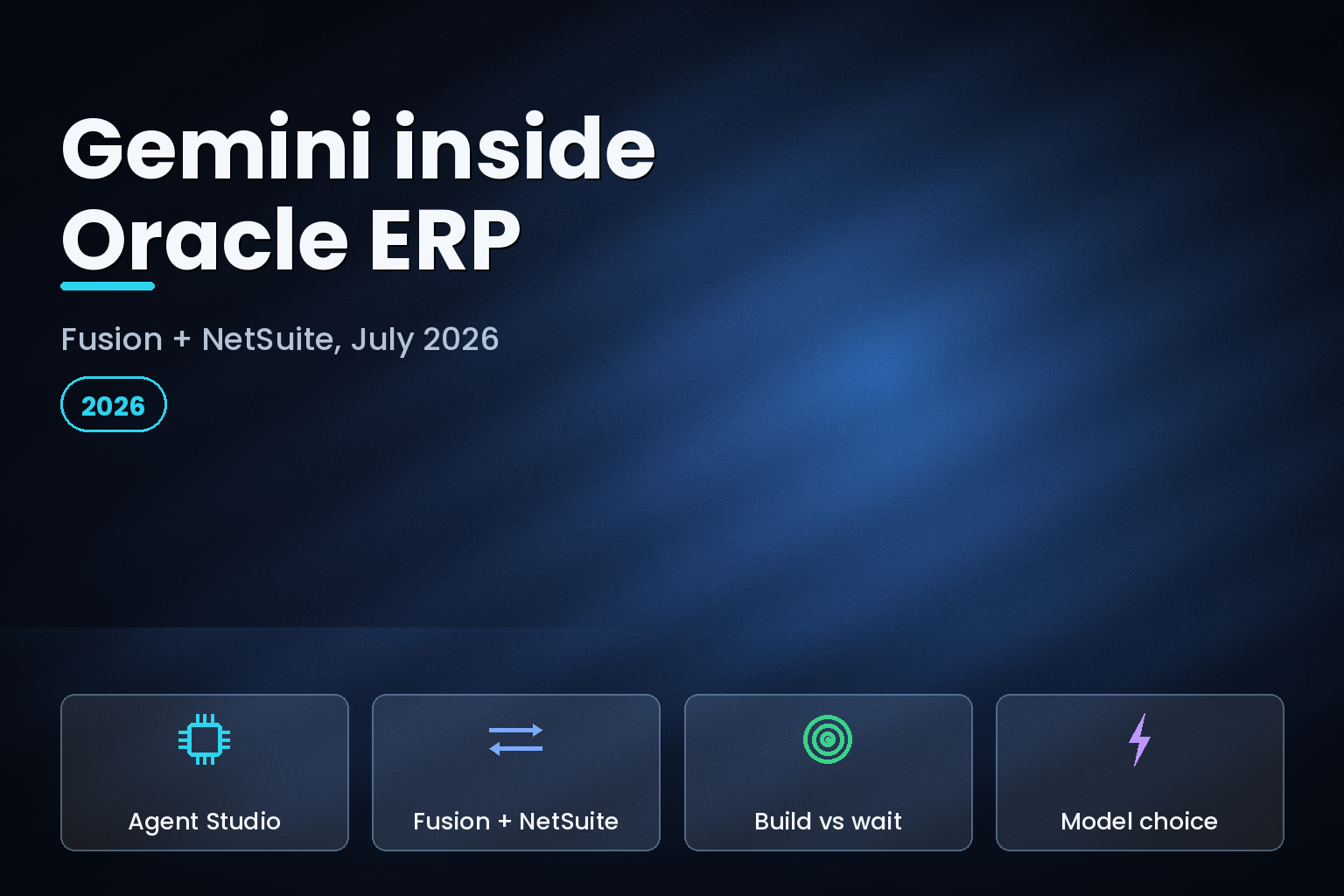
Summary. On July 30, 2026, Oracle said it will make Google's Gemini models available across its enterprise applications, starting with Oracle AI Agent Studio for Fusion Applications and extending to embedded features in Oracle Fusion Cloud Applications and Oracle NetSuite. The two named models are Gemini 3.1 Flash Lite, priced around $0.25 per million input tokens and $1.50 per million output tokens in July 2026, and Gemini 3.5 Flash at about $1.50 and $9.00. This lands in a crowded year: Salesforce reported $800 million in Agentforce annual recurring revenue for its fiscal 2026 fourth quarter, up 169% year over year across 29,000 deployments, while Microsoft says Copilot Studio has 160,000 organizations running more than 400,000 custom agents. If you run Oracle, the practical question is not whether Gemini is good. It is whether to wait for Oracle to ship embedded features, or build agents against your own model choice now. This article gives you a decision framework, the cost math, and the governance checks that matter.
What Oracle actually announced
Oracle and Google Cloud expanded an existing partnership on July 30, 2026. The plan puts Gemini models inside Oracle AI Agent Studio for Fusion Applications, the builder Oracle introduced on July 14, 2026 for creating, connecting, and running agentic applications using Oracle, partner, and external agents. Oracle also said it will use Gemini for embedded AI features inside Oracle Fusion Cloud Applications, the suite that covers ERP, HCM, SCM, and CX, and inside Oracle NetSuite, the cloud suite used by many mid-market companies.
Two specific models were called out. Gemini 3.1 Flash Lite is the price-performance option, aimed at high-volume, latency-sensitive work. Gemini 3.5 Flash handles more complex reasoning, including tasks that generate video and presentation content. Oracle framed the move as adding to a menu rather than replacing anything: customers who already use models from Cohere or Meta through Oracle Cloud Infrastructure Generative AI keep those options, and Gemini joins the list.
Chris Leone, executive vice president of applications development at Oracle, put the logic plainly: "To achieve the best business outcomes, organizations need the flexibility to choose the AI model best suited to each problem." That sentence is the whole strategy. Oracle is not trying to win the model race. It wants to be the place where your business data lives while you pick whichever model fits the job.
Why an ERP vendor wants a model menu
For a CTO, the useful frame is this: the model is becoming a swappable component, and the durable value sits in the data, the workflows, and the governance around them. Oracle owns the system of record for a large share of the Global 2000. By opening Fusion and NetSuite to Gemini alongside existing options, Oracle keeps you inside its applications while letting Google compete for the inference workload.
Google gets something it has wanted for years: distribution into a deep enterprise install base without having to sell each account itself. Oracle gets stickier applications and higher revenue per customer without building frontier models. The reader in the middle, the enterprise buyer, gets optionality, and a new set of decisions to make about where data flows and what each model costs.
This is the same pattern showing up across every major suite. SAP and Microsoft used SAP Sapphire 2026 to push agentic AI into the ERP core, including a planned agent-to-agent link between Microsoft 365 Copilot and SAP Joule. Salesforce built Agentforce directly into its CRM. The common message is that the ERP or CRM stops being only a system of record and starts acting as a system of action, where agents read business context and trigger governed processes.
| Platform (2026) | Model approach | Reported traction | Best fit |
|---|---|---|---|
| Oracle Fusion + NetSuite | Multi-model menu: Gemini 3.1 Flash Lite, Gemini 3.5 Flash, plus Cohere and Meta via OCI | Agent Studio shipped July 14, 2026; Gemini added July 30, 2026 | Oracle ERP, HCM, SCM, CX and NetSuite shops |
| Salesforce Agentforce | Einstein Trust Layer with bring-your-own and hosted models | $800M ARR, up 169% YoY, 29,000 deployments (Q4 FY2026) | CRM-led sales and service automation |
| Microsoft Dynamics + Copilot Studio | Azure OpenAI plus a growing model catalog | 160,000 organizations, 400,000+ custom agents | Microsoft 365 and Azure-centric estates |
| SAP Joule | SAP-hosted models plus Microsoft Copilot interop | 50+ Joule assistants orchestrating 200+ agents | SAP ERP depth and RISE with SAP |
Read the table for what it is. Every vendor now offers agents inside the suite you already pay for. The differences that matter are model choice, where data goes, and how much control you keep over prompts, tools, and evaluation. For a deeper split on two of these platforms, our comparison of Agentforce versus Copilot Studio enterprise agent cost breaks the pricing down line by line.
The build-vs-wait decision
Here is the decision most Oracle customers actually face over the next two quarters. Oracle's embedded Gemini features will arrive on Oracle's schedule, tuned for common tasks and governed inside Fusion. That is genuinely useful for standard work: summarizing a purchase order, drafting a supplier email, classifying an expense. But embedded features are shaped for the average customer, not for your specific process, your data model, or your cost ceiling.
Building your own agents against a model of your choice gives you control over prompts, tools, retrieval, and spend, at the cost of engineering time and a governance burden you now own. Waiting for Oracle costs you nothing to build but leaves you dependent on Oracle's roadmap and its pricing. Most mature teams end up hybrid: they let Oracle's embedded features handle commodity tasks and build custom agents only where a workflow is a real competitive difference or where the embedded version cannot meet a cost or accuracy target.
| Option | When it fits | Effort and cost | Main risk |
|---|---|---|---|
| Wait for Oracle embedded Gemini | Standard tasks, small team, no unusual accuracy or cost target | Low build effort; consumption billed by Oracle | Roadmap and pricing dependence; limited tuning |
| Build custom agents on your model choice | Differentiating workflow, strict cost or accuracy target, data you must control | Higher engineering and evaluation effort | You own governance, evals, and drift |
| Hybrid: embedded for commodity, custom for edge | Most mid-to-large Oracle estates | Medium; focus engineering where it pays | Needs clear rules on what goes where |
The trap is treating this as all-or-nothing. The disciplined move is to inventory your candidate use cases, then sort each into commodity or differentiating before you write a line of code. Our guide to scoping enterprise AI agents from pilot to production walks through that triage, and the broader enterprise AI agents production playbook covers the patterns that survive contact with real data.
The cost math nobody budgets for
Embedded AI hides the token bill inside subscription pricing, which is convenient until volume grows. Building your own agents exposes the bill, which is uncomfortable but controllable. The published API rates make the trade concrete. As of July 2026, Gemini 3.1 Flash Lite runs about $0.25 per million input tokens and $1.50 per million output tokens, and Gemini 3.5 Flash runs about $1.50 and $9.00. Google's Batch API cuts input and output by 50% for work that can tolerate delay, and context caching cuts input by up to 90% for repeated context.
Those numbers explain Oracle's model split. Flash Lite is the default for high-volume, low-complexity tasks where a fraction of a cent per call multiplied across millions of documents is the whole budget conversation. Flash is reserved for the smaller set of tasks that need stronger reasoning, where paying six times more per output token is worth it. When you build your own agents, you get to make that routing decision per task instead of accepting a vendor default. Teams that route deliberately between a cheap model and an expensive one, rather than sending everything to the strongest model, are the ones who keep spend flat as usage climbs. Our LLM hybrid routing and API spend framework has the decision tree.
| Model (July 2026) | Input per 1M tokens | Output per 1M tokens | Sensible use |
|---|---|---|---|
| Gemini 3.1 Flash Lite | $0.25 | $1.50 | High-volume classification, extraction, routing |
| Gemini 3.5 Flash | $1.50 | $9.00 | Reasoning, drafting, multi-step tasks |
| Batch API (either model) | 50% off input | 50% off output | Overnight or non-urgent jobs |
One more line on the bill that surprises teams: thinking tokens. Reasoning models can consume large numbers of internal tokens before they answer, and those count. Budget for them, cap them where you can, and measure output token consumption per use case before you commit a workload to production.
Data governance, residency, and lock-in
The moment you route Fusion or NetSuite data through Gemini, Google Cloud becomes a processor of that data for those requests, even when the models run within Oracle's environment. Three questions decide whether that is acceptable.
First, where does inference happen, and does the data leave the region you promised customers and regulators it would stay in? Second, what is the contractual position on training: is your prompt and response data excluded from model training, and is that written down? Third, who can see the prompts and outputs, and are they logged where your security team can audit them? Enterprise agreements with major clouds generally exclude customer data from training and keep data in-region, but you confirm this in your own contract rather than assuming it. The governance work does not disappear because the feature is embedded. If anything, embedded features make it easier to send sensitive data to a model without a review, so the control has to move earlier, into policy and configuration. Our note on enterprise AI agent governance layers sets out the checks worth enforcing before an agent touches production data.
Lock-in cuts two ways here. A multi-model menu reduces model lock-in, because you can switch from Gemini to another option without leaving Fusion. It does not reduce application lock-in, which is Oracle's actual moat. The more agents you build on Oracle Agent Studio, the more your automation is expressed in Oracle's builder rather than in portable code. That is fine if Oracle is your long-term platform. It is a real cost to weigh if you expect to move suites in the next five years.
India-specific considerations
For Indian enterprises and the global capability centers that run on Oracle, the Digital Personal Data Protection Act, 2023 makes the residency and processor questions concrete rather than theoretical. Personal data of Indian data principals routed to a model service pulls in DPDP obligations on purpose limitation, security safeguards, and the handling of any cross-border transfer. Both Oracle and Google Cloud operate data center regions inside India, so keeping inference in-country is technically possible. The work is contractual and architectural: pin the region, confirm the training exclusion, and log prompts and outputs in a store your compliance team controls.
For GCCs specifically, embedded Gemini in Fusion is attractive because it removes a build step, but the parent organization's data governance standard still applies. Treat an embedded model call the same way you treat any other cross-border processing decision, with a documented basis, not an implicit one. India's approach to AI in 2026 remains principles-based rather than a single statute, which means existing law, DPDP included, carries the weight.
What to do in the next 90 days
Start with an inventory, not a pilot. List the tasks in Fusion and NetSuite where AI could help, and mark each as commodity or differentiating. For commodity tasks, plan to test Oracle's embedded Gemini features when they reach your instance, and hold your engineering time. For the handful of differentiating workflows, prototype a custom agent against the model you choose, measure token consumption and accuracy on your real data, and only then decide whether to keep building or fold back to the embedded option.
Set the governance rules before the first agent ships, not after. Decide which data classes may reach a model, pin the region, get the training exclusion in writing, and stand up prompt and output logging. Put a cost ceiling and an evaluation step on every agent that reaches production. None of this is Oracle-specific, which is the point: the discipline you build now travels with you regardless of which suite or model you land on.
FAQ
How eCorpIT can help
eCorpIT is a Gurugram-based, ISO 27001:2022 certified engineering organisation that helps enterprises turn embedded-AI announcements into a grounded plan. We run the use-case triage, prototype custom agents against the model that fits your cost and accuracy target, and set the data-governance and evaluation controls before anything reaches production. Whether you keep to Oracle's embedded features or build alongside them, our senior engineering teams can scope the work with you. Start a conversation through our contact page or read how we deliver enterprise AI agent development.
References
- Oracle to make Gemini models available to thousands of enterprise applications customers - Oracle newsroom, July 30, 2026.
- Oracle to make Gemini models available (PR Newswire) - PR Newswire, July 30, 2026.
- Oracle introduces AI-native builder experience for agentic applications in Fusion - Oracle newsroom, July 14, 2026.
- Oracle adds Google Gemini to the agent menu - The Register, July 30, 2026.
- Oracle to make Gemini models available (AIwire) - AIwire, July 31, 2026.
- Oracle integrates Google's Gemini AI models into enterprise apps - IT Pro, July 2026.
- Oracle expands collaboration with Google to integrate Gemini model - GuruFocus, July 2026.
- Best enterprise-level agentic AI platforms for 2026 - MarkTechPost, May 2026.
- Microsoft Copilot hits 30 million seats - Futurum Group, 2026.
- Microsoft and SAP Sapphire 2026: agentic AI turns ERP into a system of action - Windows Forum, 2026.
- Gemini pricing in 2026: every model, every plan - CloudZero, 2026.
- Gemini 3.1 Flash Lite preview API pricing - PricePerToken, 2026.
_Last updated: August 1, 2026._