On this page · 9 sections
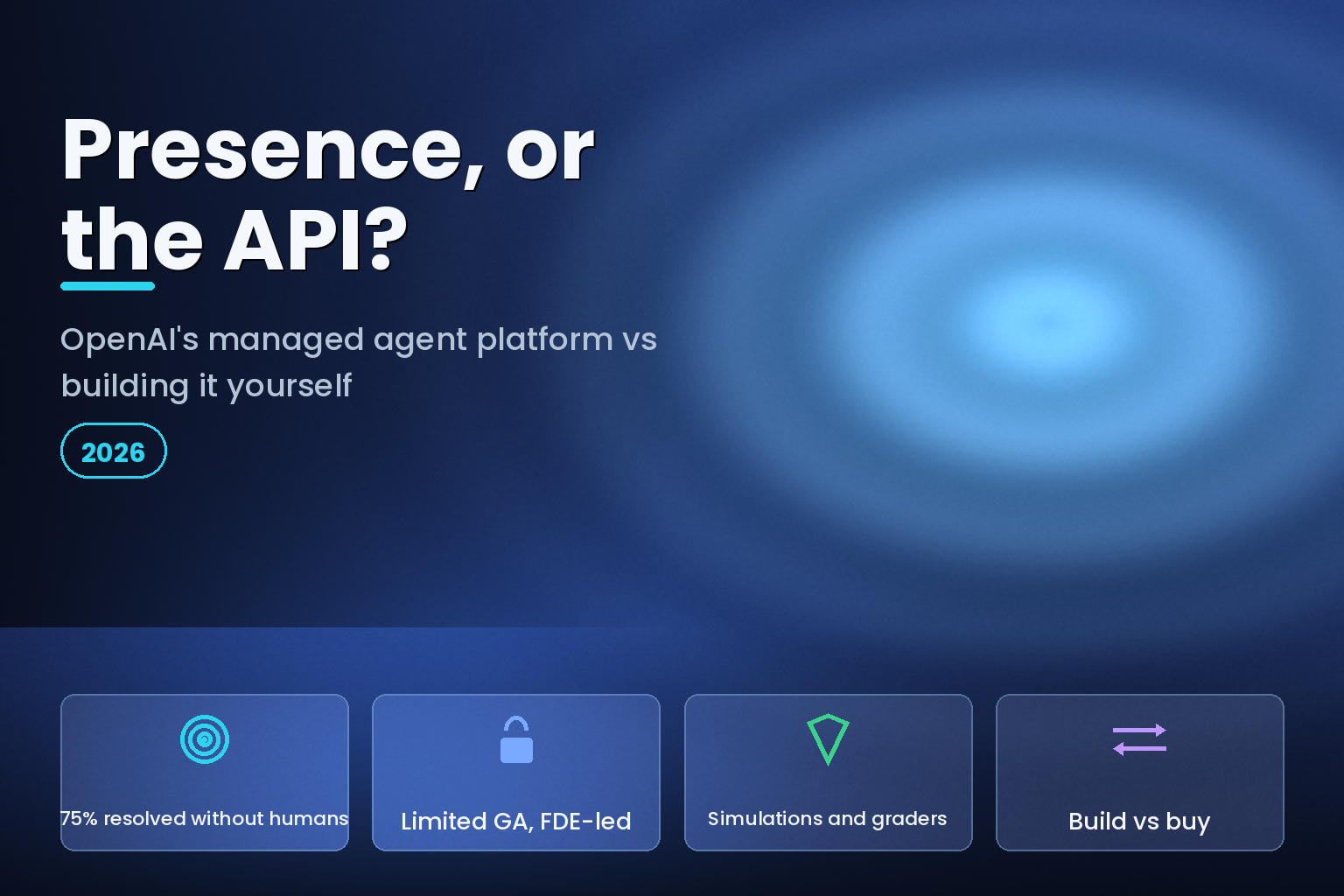
Summary. OpenAI launched Presence on 22 July 2026, an enterprise product for deploying voice and chat agents with policies, guardrails, simulations and a Codex-powered improvement loop. It publishes no price. It is available only "to eligible enterprise customers as a deployed product through a limited general availability program," with deployments led by OpenAI Forward Deployed Engineers and select global systems integrators, and it is "not yet available as a self-serve product." The alternative path, building on the Realtime API, does publish rates: gpt-realtime-2.1 costs $32.00 per 1M audio input tokens, $0.40 per 1M cached input tokens and $64.00 per 1M audio output tokens, with a mini tier at $10.00 and $20.00. The only hard performance figures OpenAI has released for Presence are about OpenAI itself: its own English-language phone line resolves 75% of inbound issues without human assistance, and a Codex-powered improvement loop cut human handoffs by 15 percentage points in 10 days. Three design partners are named, and all three describe their work in exploratory terms.
That combination, strong internal numbers and no external ones, is the honest starting point for this decision.
What OpenAI actually shipped on 22 July 2026
Presence is not a model and it is not an SDK. OpenAI describes it as a product that "helps enterprises deploy trusted AI agents that can answer questions, resolve issues, use company systems, take approved actions, and escalate to people when needed."
The components OpenAI lists are the ones that separate a demo from a production agent: policies and standard operating procedures, guardrails, approved actions, simulations, evaluation tools, and a Codex-powered improvement process. Before launch, simulations and graders "check whether it reached the right outcome, followed policy, used tools correctly, and escalated when appropriate." After launch, Codex investigates production sessions and escalations and proposes updates that a human tests and approves before a controlled rollout.
The delivery model matters as much as the product. Each deployment starts with one specific job, such as resolving billing issues or supporting insurance claims, and the agent receives only the knowledge and system access that job requires. OpenAI works alongside the customer to connect systems, set permissions and policies, test the agent and bring it into production. The Presence business page lists six use cases: customer support, demand generation, claims, human resources, IT help desk and procurement.
This is a consulting-shaped product wrapped around a software platform. That is a legitimate shape, and it is the right shape for regulated workflows. It is also the reason there is no price on the page.
The three numbers
Number one: 75%, and whose 75% it is
Presence runs OpenAI's own English-language phone support channel at 1-888-GPT-0090. "Within weeks, it met or exceeded frontline human-support quality and now resolves 75% of inbound issues without human assistance," said Glen Worthington, Head of User Operations, OpenAI. The same statement reports that the Codex-powered improvement loop "reduced human handoffs by 15 percentage points in just 10 days."
Those are real numbers and they are worth respecting. They are also OpenAI reporting on OpenAI, about a support queue whose callers are asking about OpenAI products, in English, with OpenAI's own account systems on the other end of the tool calls. That is close to a best case. Read 75% as a ceiling to aim at, not a baseline to expect.
The three named enterprises are all phrased in future or exploratory tense. "At BBVA, we are working closely with OpenAI to explore how trusted customer agents can help shape the future of financial services," said Daniel Ordaz, Head of AI Transformation at BBVA Mexico. SoftBank is "exploring" Japanese-language conversations, though Tadahisa Murakami, Vice President, Head of Data & Digital Transformation Division, SoftBank Corp., adds a concrete signal: "Our frontline teams have rated the agent's Japanese-language conversations highly for their natural and accurate quality." IAG describes an "opportunity." As of 23 July 2026, no third-party resolution rate for Presence has been published.
Number two: $32.00, and the unit it is charged in
The self-build path has published rates. These are the realtime and audio rows from OpenAI's pricing documentation, quoted per 1M tokens unless noted.
| Model | Modality | Input | Cached input | Output or cost |
|---|---|---|---|---|
| gpt-realtime-2.1 | Audio | $32.00 | $0.40 | $64.00 |
| gpt-realtime-2.1 | Text | $4.00 | $0.40 | $24.00 |
| gpt-realtime-2.1-mini | Audio | $10.00 | $0.30 | $20.00 |
| gpt-realtime-2.1-mini | Text | $0.60 | $0.06 | $2.40 |
| gpt-realtime-translate | Audio | not listed | not listed | $0.034 per minute |
| gpt-realtime-whisper | Audio | not listed | not listed | $0.017 per minute |
Two observations you will not get from a summary.
The mini tier is 3.2x cheaper than the full model on both audio input and audio output, but 6.7x cheaper on text input. If your agent's expensive path is retrieval and reasoning over text with audio only at the edges, the mini tier saves far more than the headline 3.2x suggests. Route accordingly rather than picking one model for the whole flow.
And the naming is inconsistent between OpenAI's own pages. The marketing pricing page brands the $32.00 and $64.00 row as "GPT-Realtime-2"; the developer documentation calls the identical row gpt-realtime-2.1. The mini tier appears only in the developer documentation and is absent from the marketing page entirely. If you are building a cost model, use the developer pricing table, not the marketing one.
Number three: the one OpenAI does not publish
Neither pricing page states how many audio tokens a second of speech consumes. Without that ratio you cannot convert $32.00 per 1M audio input tokens into a cost per minute of conversation, which is the only unit a contact centre budget is written in. Translation and transcription models are priced per minute, at $0.034 and $0.017 respectively; the conversational model is not.
Ratios circulating in secondary coverage do not appear on either OpenAI page we retrieved. Do not build a business case on them. Measure it: run 50 representative calls through gpt-realtime-2.1, read the token counts off your own usage, and derive your own cost per minute. That measured number is the single most useful artefact you can produce before this decision, and it takes an afternoon. Our build guide for gpt-realtime-2.1 voice agents covers the instrumentation.
Two further pricing mechanics are worth knowing. The pricing page offers a batch processing mode labelled minus 50%, and a data residency mode labelled plus 10%; OpenAI's documentation states the 10% uplift applies to models released on or after 5 March 2026 that are eligible for data residency. Neither pricing page carries an effective date, so re-check rates before you sign anything.
Which path fits which situation
| Situation | Presence | Realtime API | Why |
|---|---|---|---|
| Regulated workflow, claims or payments | Strong fit | Heavy lift | Policies, approved actions and escalation rules are the product |
| Need a price before approval | Blocked | Works | Presence publishes no rate card |
| Small team, no platform engineers | Strong fit | Risky | Deployments are led by OpenAI FDEs and partners |
| Want self-serve, start this week | Not available | Works | Presence is "not yet available as a self-serve product" |
| Multilingual beyond OpenAI's named languages | Unproven | Testable | Only English and Japanese have any published signal |
| Cost is the deciding constraint | Unknown | Modellable | Only the API path has published rates |
| Need to own the agent logic long term | Partial | Full | Presence keeps improvement inside OpenAI's Codex loop |
The pattern: Presence is a fit where the hard part is governance and the easy part is budget. The API is a fit where the hard part is budget and you have engineers who can build the governance layer. Very few teams are in the middle.
There is a third answer that the framing hides, and it is often the right one. If your agent's job is narrow, deterministic and high-volume, the honest comparison is not Presence versus the API at all; it is either of them versus a well-instrumented deflection flow that never invokes a model. We laid out that arithmetic in our note on the build-versus-buy cost of AI customer support agents in India.
What you have to build yourself on the API path
If you take the API route, the components Presence bundles do not disappear. You build them. Budget for all seven.
An evaluation harness with graders, so that a prompt change can be scored rather than argued about. A simulation suite covering common requests, edge cases and higher-risk scenarios, because the first production incident is always a scenario nobody rehearsed. Guardrails that can interrupt an interaction that has moved outside policy. An approved-actions layer, so the agent cannot execute a refund it was talked into. Escalation rules with a clean human handoff. Session recording and quality signals. And a change process, because the model will improve underneath you whether or not your prompts were written for it.
The security surface is the part teams underestimate. A voice agent with tool access is a prompt injection target reachable by anyone who can dial a phone number, and voice adds an attack path that text agents do not have. Our guidance on prompt injection guardrails for AI agents applies directly.
Presence bundles roughly this list. That bundle is what you are paying for, and comparing it against raw token prices understates the API path's true cost by a wide margin.
India-specific considerations
Language coverage is the first question, and the published evidence is thin. OpenAI's own deployment is English. SoftBank's is Japanese. Nothing has been published about Hindi or any other Indian language on Presence. For Indian consumer support, that is the difference between a product decision and a research project. Teams building multilingual Indian voice agents should benchmark against the domestic stack as well; we compared that landscape in our note on building multilingual voice agents with Bhashini and in our review of Indian enterprise voice AI vendors.
Data residency is the second. OpenAI's documentation states a 10% pricing uplift for regional processing on eligible models released on or after 5 March 2026. If your workflow handles personal data under the Digital Personal Data Protection Act 2023, that uplift is not optional, and it needs to sit in the model from the start rather than arriving as a surprise line item. Confirm which realtime models are actually eligible for regional processing before you commit an architecture.
Eligibility is the third and bluntest. Presence is a limited general availability programme delivered by Forward Deployed Engineers and select global systems integrators. Indian mid-market companies should assume they are not in the first cohort and plan the API path, keeping Presence as a later option rather than a dependency.
What we would do
Measure your own cost per minute first. Fifty representative calls through gpt-realtime-2.1 and gpt-realtime-2.1-mini will tell you more than any vendor comparison, because the audio-token ratio is the missing variable in every published analysis.
Ask your OpenAI account team two questions before anything else: are we eligible for Presence, and what is the commercial shape. If either answer is unsatisfying, the decision is made for you.
Build the evaluation harness regardless of path. It is the one artefact that transfers. If you start on the API and move to Presence later, your graders and simulation cases come with you; if you start on Presence and later want to bring the agent in-house, you will wish you had them.
And treat the 75% figure as a target rather than a forecast. It came from the single most favourable deployment anyone will ever run of this product.
FAQ
How eCorpIT can help
eCorpIT is a Gurugram-based technology consultancy that builds production voice and chat agents and the evaluation scaffolding around them. We measure your actual cost per minute on your own traffic before recommending a platform, build the graders, simulations and guardrails that decide whether an agent survives contact with real customers, and design for Digital Personal Data Protection Act obligations from the first architecture review. If you are weighing Presence against the API, talk to our team. We also run voice agent development and AI evaluation and observability engagements.
References
- Introducing OpenAI Presence, OpenAI, 22 July 2026.
- OpenAI Presence product page, OpenAI.
- OpenAI API pricing (marketing page), OpenAI.
- OpenAI unveils Presence, a new platform that lets enterprises launch and manage realtime voice agents and chatbots, VentureBeat, 22 July 2026.
- OpenAI Presence connects AI agents to enterprise data with built-in guardrails, Help Net Security, 22 July 2026.
- OpenAI makes its Presence felt in CX, No Jitter.
- OpenAI Launches Presence, an Enterprise AI Agent Platform for Voice and Chat Workflows, MLQ News, 22 July 2026.
- OpenAI Codex, OpenAI.
- OpenAI API platform overview, OpenAI.
- OpenAI for Business, OpenAI.
- OpenAI release notes, OpenAI.
Last updated: 23 July 2026.