On this page · 7 sections
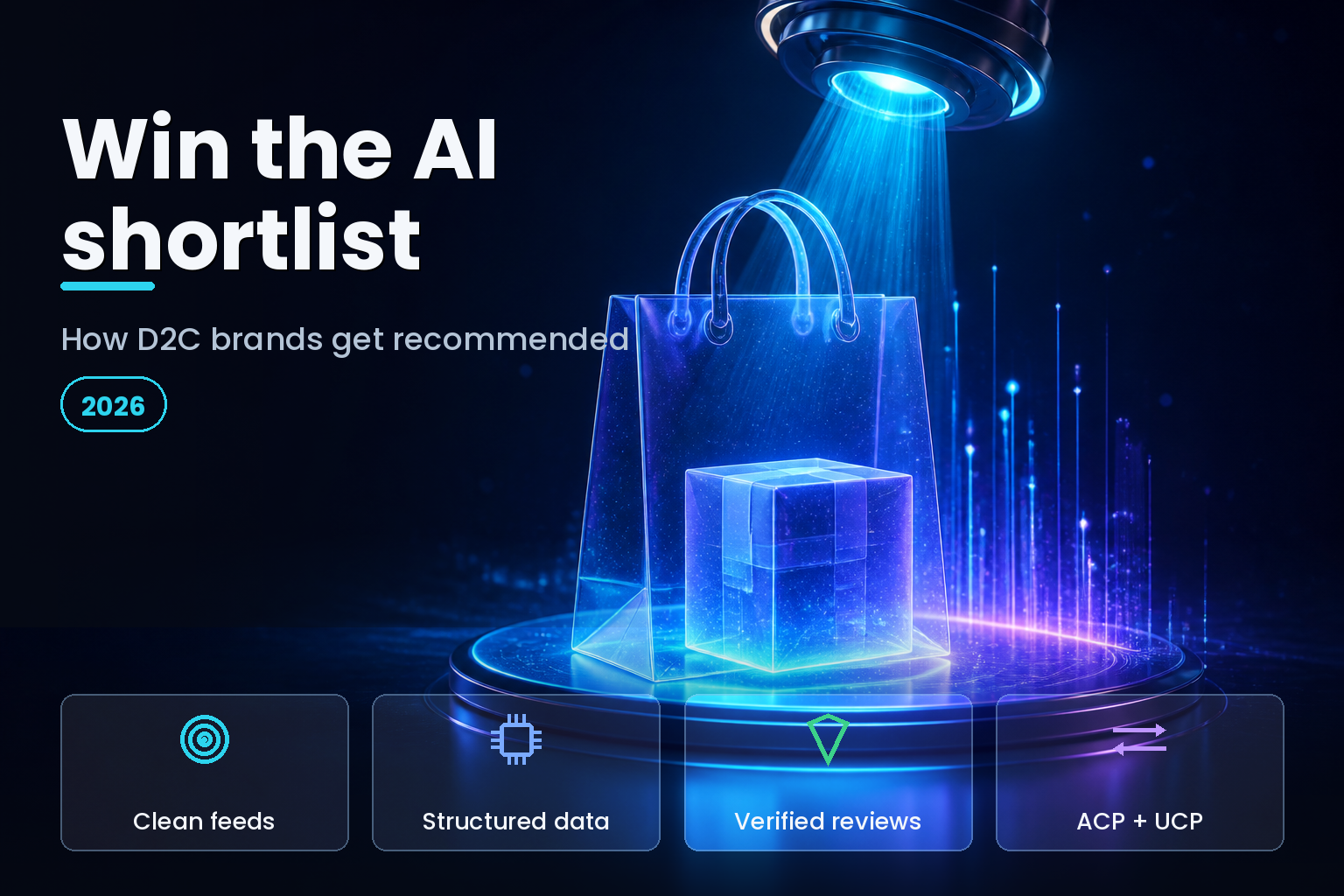
Summary. AI agents influenced 20% of global online sales during the 2025 holiday season, worth about $262 billion, according to Salesforce data. By March 2026, AI-referred traffic converted 42% better than non-AI traffic, and retailers running their own shopper agents grew sales 59% faster than those on the sidelines. AI referral traffic to US retail sites rose about 393% year over year in the first quarter of 2026. The shift for D2C founders and marketers is direct: an agent now reads your product data and recommends a shortlist before a human ever sees your homepage. If your catalog is not structured for machines, you are invisible at the moment of choice. This guide shows how to get recommended and picked.
What changed: the agent chooses the shortlist
Traditional ecommerce optimized for a human browsing a site. Agentic commerce inserts a machine in front of that human. A shopper asks ChatGPT, Google's AI Mode or Perplexity for "a breathable running tee under ₹2,000 with good reviews," and the agent checks inventory, compares options, confirms availability and returns a shortlist. The person picks from what the agent surfaced.
That reframes the job. Jyotirmoy Dutta, co-founder and CEO of the agentic-commerce startup Yarnit, put it plainly: "Most retailers still believe they are publishing webpages, when in reality, they are publishing data." The brands with the most complete, well-structured product data are the ones agents surface first.
The stakes are not abstract. ChatGPT alone handles roughly 50 million shopping queries a day. Forecasts for 2030 span a wide range by definition, from about $190 billion (Morgan Stanley) to $5 trillion (McKinsey), depending on how much of the commerce chain each firm counts. The direction is not in doubt.
How AI agents decide what to recommend
Agents do not rank on a single factor. They weigh structured data quality, relevance to the shopper's stated intent, price competitiveness, availability, reviews and merchant trust signals. Miss any of these and you drop off the shortlist. Get them right and the payoff is large: AI-referred shoppers browse 13% more pages, spend 48% longer on site and generate 37% more revenue per visit than average.
| Ranking signal | Why an agent weighs it | What to do |
|---|---|---|
| Structured data quality | Agents parse feeds, not page layouts | Complete, server-side JSON-LD with clean attributes |
| Intent relevance | The agent matches a specific request | Natural-language descriptions with clear attribute-value pairs |
| Price and availability | Agents confirm before recommending | Accurate, frequently refreshed inventory and price signals |
| Reviews | Social proof drives agent trust | Structured review schema tied to verified purchases |
| Merchant trust | Agents avoid risky sellers | Consistent data, returns policy, fulfillment reliability |
The how-to: publish data, not just pages
Four moves get a D2C brand recommended. None require a replatform.
Fix your feed hygiene first. Your Google Merchant Center, Meta Commerce Manager and TikTok Shop feeds need consistent attribute naming, accurate inventory and price signals, and a regular refresh cadence. A stale or inconsistent feed is the most common reason a good product never appears.
Write descriptions for semantic parsing. Agents read meaning, not keywords stuffed into a title. Complete, factual sentences with clear attribute-value relationships ("machine-washable merino, 180 gsm, sizes XS to XXL") perform better in agent retrieval than marketing slogans.
Add server-side JSON-LD on every product page. At minimum include name, description, image, brand and offers with price, priceCurrency, availability and priceValidUntil. Render it server-side so an agent that does not run JavaScript still sees it. This is the same answer-engine discipline covered in our guide to AEO versus GEO versus SEO.
Support more than one protocol. There is no single feed that wins every surface. ChatGPT and Copilot use the Agentic Commerce Protocol (ACP), which non-Shopify merchants reach by integrating with Stripe and building an ACP-compliant feed. Google's AI Mode uses the Universal Commerce Protocol (UCP), in developer preview, so the near-term move is a clean Merchant Center feed with complete schema. Perplexity and Alexa surfaces read product feeds too.
| AI shopping surface | Access path | First step for a D2C brand |
|---|---|---|
| ChatGPT and Copilot | ACP, via Stripe | Build an ACP-compliant product feed |
| Google AI Mode | UCP (developer preview) | Clean Google Merchant Center feed + schema |
| Perplexity | Product feed | Complete schema and verified reviews |
| Alexa for shopping | Product feed | Feed hygiene and accurate availability |
| Your own site | On-site agent | Structured data and an on-site assistant |
One correction worth knowing: OpenAI deprecated Instant Checkout in March 2026, so the current ACP model is product discovery plus a redirect to the merchant. The agent recommends; the shopper still buys on your site. That means your product page and checkout still matter, they just come after the agent has already decided whether to show you.
India-specific considerations
India's shopping surface is fragmented across ecommerce, quick commerce and D2C, and agents are already live on it. Swiggy, BigBasket and Flipkart have MCP implementations that let AI agents order through assistants like ChatGPT and Gemini. The pressure on brands is sharp: one 2026 India analysis estimates that 30% of generic D2C brands risk obsolescence within 24 months if they cannot prove superior utility to an agent. ONDC adds a national rail that can connect agents to storefronts and payments over time. For an Indian D2C brand, the practical order is the same as everywhere, clean feed, structured data, reviews, then protocol support, tied into the channel choices in our quick-commerce and ONDC D2C playbook, the ONDC scale playbook for D2C sellers, and the broader retail and D2C tech plays for Indian brands.
FAQ
How eCorpIT can help
eCorpIT is a Gurugram-based, CMMI Level 5 technology and digital-marketing consultancy that prepares D2C brands for agentic commerce. We audit and enrich product data, add server-side JSON-LD, clean up Merchant Center and channel feeds, and build ACP and UCP readiness so agents can find, trust and recommend your catalog. For an agentic-commerce readiness review, contact our team.
References
_Last updated: July 9, 2026._