On this page · 13 sections
- What Apple actually shipped, and when
- The eight slots you now have to fill
- The art rules that get assets rejected
- Image or video: two different production briefs
- In-App Events need two aspect ratios, not one
- Asset Library changes the release calendar, not just the storage
- Testing: what product page optimization already proves
- What this changes for the ASO team
- A production plan for the next six weeks
- India-specific considerations
- FAQ
- How eCorpIT can help
- References
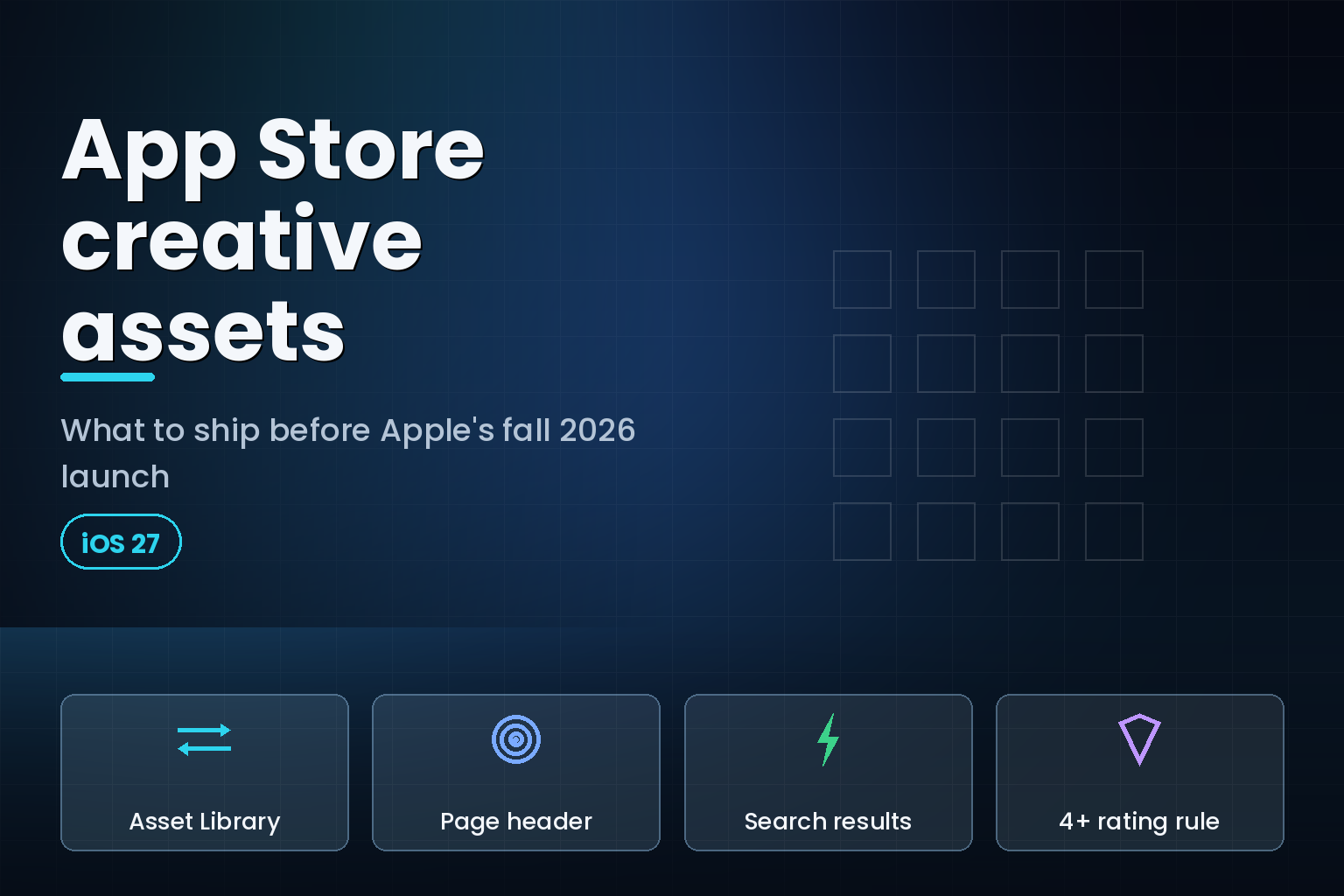
Summary. On 5 August 2026 Apple published its App Store asset best practices page along with Figma, Photoshop and Pixelmator templates, telling developers to plan images and videos "ahead of the fall launch". The feature itself was announced on 8 June 2026: creative assets are images and videos that appear in the product page header and in search results across the App Store in iOS 27 and iPadOS 27 and later, alongside the screenshots and app previews you already ship. Three things make this a production problem rather than a design refresh. Every asset shown on the App Store must meet a 4+ age rating even when your app is rated higher. Every asset must clear App Review, and Asset Library lets you submit artwork independently of a binary, which removes the release train as your excuse for stale creative. And every asset multiplies: you have up to 10 screenshots and up to 3 app previews on a product page today, up to 3 of each can surface in search results, and creative assets now sit above all of them. Apple charges $99 a year for Developer Program membership and distributes to 175 regions, so the cost of this work is entirely in art direction and localisation, not in fees. Product page optimization already gives you the measurement half: up to 3 treatments, a 90-day maximum test, and a 90% confidence threshold Apple recommends before you act. Apple's own published test data shows why guessing is expensive. Peak Brain Training tested 3 alternate icons over 44 days and its brain icon beat the control by 8%, while Simply Piano's hypothesis that adding an app preview video would lift conversion was wrong: the original page without the video won by 3%.
What Apple actually shipped, and when
The announcement sequence matters because the deadlines are staggered.
On 8 June 2026 Apple Newsroom described creative assets as "rich images and videos that appear in the product page header and search results", usable to highlight a brand, promote seasonal offerings or show new content. The same post introduced Asset Library, "one place in App Store Connect to manage all Creative Assets, app preview videos, and screenshots", and made the operationally important promise: developers can submit assets for App Review approval independent of an app update.
On 9 July 2026 the age rating questionnaire in App Store Connect gained social media questions, with answers becoming mandatory for new submissions and updates from September 2026.
On 5 August 2026 Apple published the asset best practices page and the design templates. Apple's own framing was to help you "plan your images and videos ahead of the fall launch".
Apple's What's New page lists creative assets, Asset Library and the App Store Connect product page preview tool as "coming this fall". Personalized Collections, the recommendation surface that will sit alongside search, is already live in select countries and regions for a limited number of apps.
The practical read: the tooling arrives with iOS 27, the artwork does not build itself, and the design templates went out five weeks or so before the usual September release window. That gap is the production window.
The eight slots you now have to fill
Creative assets do not replace screenshots and app previews. They stack on top of them, and each surface has a different job.
| Slot | Where it appears | Hard limits Apple publishes | Who usually owns it |
|---|---|---|---|
| App icon | Product page, search, Spotlight, Home Screen | Built in Icon Composer as layered Liquid Glass from a single design | Design |
| Product page header | Top of the product page | Image or video; testable via product page optimization | Brand and growth |
| Search results creative | Search tab and the Apple Games app | Falls back to In-App Events, app previews and screenshots if absent | Growth |
| Screenshots | Product page and search | Up to 10 on the product page; up to 3 can appear in search | Product marketing |
| App previews | Product page and search | Up to 3 on the product page; up to 3 may appear in search | Video |
| In-App Events media | Event card and event details page | 16:9 landscape for the card, 9:16 portrait for the details page | Campaign |
| Custom product pages | Deep-linked pages for specific audiences | Can use creative assets | Growth |
| Apple Ads creative | Today tab and search results ads | Uses the same approved assets | Paid acquisition |
Two of these are new production lines for most teams. The product page header is the first thing a visitor sees, and Apple's guidance for it is unusually blunt: "Focus on a single, clear idea. Visually dense or cluttered assets dilute your impact." The search results creative sits even earlier in the funnel, before anyone reaches your page. Apple's advice there is to "state the obvious", because search users arrive with a specific intent and decide in a glance.
There is a shortcut worth knowing. Apple explicitly allows a universal creative asset used for both the header and the search result, which halves the first round of production and keeps brand recognition consistent across two surfaces. Start there, then split them once you have data.
The art rules that get assets rejected
This is where teams lose a week. App Review evaluates creative assets against the App Review Guidelines, particularly section 2.3 on accurate metadata, and Apple's best practices page lists specific content that will not clear.
| Rule | What it forbids | Common way teams break it |
|---|---|---|
| 4+ age rating for all store artwork | Explicit or harmful imagery, profanity, illegal drugs, self-harm, hate speech, stereotypes, sexually suggestive content, inflammatory religious commentary | Reusing a 17+ game's key art on the store listing |
| No commercial overlays | Specific pricing, discounts, website URLs, copyright symbols | Putting a launch discount badge in the header |
| No unverifiable claims | Awards or recognition the app has not received | "Best app of the year" in a screenshot caption |
| No competing platform references | Logos or references to other platforms or marketplaces | A cross-platform banner listing every store |
| No Apple recognitions | Editor's Choice, App of the Day, Game of the Day, and Apple's annual design honours | Adding a badge Apple already shows automatically |
| Violence limits for games | Gore, graphic imagery, or weapons pointed directly at a person or the audience | Standard shooter key art |
Three of those six catch teams that have shipped App Store artwork for years. The pricing and discount ban is the one that hurts seasonal campaigns most, because the obvious use of a header during a sale is to say there is a sale. Apple's stated reason is that assets should stay relevant to a global audience and remain evergreen. Design the seasonal story around content and mood, not the number.
The 4+ rule deserves its own review gate. Your store artwork is held to a stricter standard than your app. A mature game can ship a 17+ experience and still needs 4+ store creative.
Image or video: two different production briefs
Apple's format guidance splits cleanly, and the video half carries most of the risk.
For images, the guidance is composition discipline: current photography and illustration, a clear focal point, and key elements inside a safe area so nothing clips across device sizes and orientations. Text is allowed as an overlay to demonstrate input mechanisms or highlight functionality, but Apple asks for a short phrase that enhances the visual rather than describes it, localised for every language the app supports.
For video, four constraints change how you edit:
- The poster frame is the first thing a person sees before playback, so it has to work as a standalone image.
- Videos autoplay and repeat, which means the loop point is a design decision, not an export setting.
- Audio is muted by default in most cases, so the creative has to carry meaning silently.
- Fast cuts are discouraged both for comprehension and for accessibility.
Treat audio as brand texture rather than information delivery. Apple's guidance favours a short music loop over heavy sound effects and warns against sudden loud moments. If your current app preview relies on a voiceover to explain the product, it will not survive as a header asset.
In-App Events need two aspect ratios, not one
In-App Events are the timely surface: competitions, premieres, live experiences, seasonal content launches. Apple requires media for both the event card at 16:9 landscape and the event details page at 9:16 portrait, and asks that both communicate the same idea with a consistent colour and illustration style.
The badge is the detail most teams miss. You pick one of Challenge, Competition, Live Event, Major Update, New Season, Premiere or Special Event, and Apple's guidance is to design media that complements the badge rather than repeating it. If the badge already says "Premiere", the artwork does not need the word.
Games get three additional badge types this year. Apple is rolling out featured sales and offers on the Apple Games app in the United States, where a Featuring Nomination accepted by the editorial team unlocks In-Game Offer, Now On Sale and Try Before You Buy badges for an In-App Event.
Asset Library changes the release calendar, not just the storage
The workflow change is larger than the feature description suggests. Until now, refreshing App Store creative usually meant coordinating with a binary release, because metadata review rode along with the build.
Asset Library is a centralised place in App Store Connect to upload and manage images, videos, app previews and screenshots, and to see where each asset can be used across the App Store. Approved assets can be reused across custom product pages and In-App Events without re-uploading. Assets can be submitted for review independently of an app submission and approved in advance for a future product page update or an Apple Ads campaign. It is reachable through the App Store Connect API, so the upload and status checks can live in your existing release automation rather than in a browser tab.
That last point is the one to plan for. If your team already scripts metadata pushes through the App Store Connect API, creative rotation becomes a scheduled job. If it does not, this is the year to build it, because the number of assets under management roughly triples.
There is also a new product page preview tool coming this fall that renders your header, app name, description, screenshots and search result creative as customers will see them, across languages, in Dark Mode, and in portrait or landscape. Use it before submission, not after rejection.
Testing: what product page optimization already proves
Creative assets become testable through product page optimization, which has published mechanics worth designing around.
| Constraint | Value Apple publishes | Consequence for planning |
|---|---|---|
| Treatments per test | Up to 3 alternates against the original | More treatments means slower significance |
| Test duration | Runs up to 90 days or until you stop it | Quarterly cadence, not weekly |
| Concurrency | One test at a time | Sequencing matters more than volume |
| Confidence to act | Apple recommends at least 90% | Do not call a winner on a 60% signal |
| Traffic split | You choose the proportion; it divides across treatments | 40% traffic with 2 treatments is 20% each |
| Icon variants | Must be included in the binary of the published app | Icon tests need a release; other tests do not |
| Platform floor | Shown on iOS and iPadOS 15 or later | Older devices see the original |
Apple publishes two developer results on that page, and they point in opposite directions. Peak Brain Training ran a 44-day test with 3 icon treatments; the brain icon won by 8% at greater than 98% confidence, while the orange variant lost 2.9% and the robots variant lost 3.5%. Simply Piano ran a 12-day test on a single treatment, hypothesising that leading with an app preview video would beat screenshots alone. The control won by 3% at 100% confidence.
Read those two together and the lesson is not "video is bad". It is that a plausible creative hypothesis was wrong for one specific app, and only a test caught it. With more surfaces to fill, the number of untested assumptions in a launch goes up, not down.
What this changes for the ASO team
The workflow shift is from a single product page to a set of surfaces with different intents.
Tamuna Tushishvili, Senior ASO Manager at SplitMetrics, put it this way in the firm's WWDC 2026 analysis: "From an ASO perspective, the real impact of WWDC26 is not just that we get more placements - it's that creative strategy needs to become more modular. Different App Store surfaces will likely serve different purposes, and what works in screenshots style may not necessarily work in a Product Page Header or a search result visual."
Modular is the operative word for the production plan. Build a component system, not a set of finished images: a background layer, a device or gameplay layer, a message layer that can be swapped and localised, and an export pipeline that renders every required ratio from one source. Apple shipping Figma, Photoshop and Pixelmator templates for the header and search result is a strong hint that this is the intended workflow.
The real cost is usually the localisation matrix, not the hero design. Every asset can be localised per region, and a header plus a search result across a dozen storefronts is dozens of exports before you have tested anything.
A production plan for the next six weeks
Work backwards from the fall launch, and sequence around what needs App Review and what does not.
| Week | Work | Blocked by |
|---|---|---|
| 1 | Audit existing artwork against the 4+ rule and the six content bans; flag every asset with pricing, awards, or other-platform logos | Nothing |
| 2 | Download Apple's Figma, Photoshop or Pixelmator templates; build the modular layer system for header and search | Design capacity |
| 3 | Produce one universal creative asset covering header and search results in the primary storefront | Brand approval |
| 4 | Cut video variants: poster frame, clean loop point, silent-first edit | Video team |
| 5 | Localise the priority storefronts; render In-App Event media at 16:9 and 9:16 | Translation |
| 6 | Wire Asset Library uploads into the App Store Connect API release job; queue the first product page optimization test | Asset Library availability |
Two sequencing notes. Icon tests need the variants inside a shipped binary, so an icon experiment has to be planned into a release. Everything else, including product page optimization tests without alternate icons, can be submitted for review independently of a new version.
If you are also touching the iOS 27 SDK this cycle, the artwork refresh and the iOS 27 Liquid Glass and Xcode 27 migration work land in the same window. Plan them as one release, not two.
India-specific considerations
For Indian studios and D2C teams shipping to global storefronts, three points change the plan.
Localisation is the budget line. Apple lets you localise images and videos per region, and the guidance to "build for a global audience" with inclusive imagery is not decoration: assets that read clearly in Mumbai and in Munich cut the number of variants you have to maintain. Design the base asset so that only the message layer needs translation.
The pricing ban interacts with festive campaigns. Diwali and end-of-season promotions are the natural use of a seasonal header, and Apple forbids specific pricing and discounts in store artwork. The workable pattern is to carry the campaign mood and content in the creative asset, and let the offer live in the In-App Event, the custom product page destination, or inside the app.
Personal data is the third. If your creative or your custom product page routing depends on user attributes, the collection and consent path falls under the Digital Personal Data Protection Act 2023, and the engineering choices there are covered in the DPDP Act engineering playbook for Indian startups.
Teams running a broader iOS 27 readiness programme should sequence this against the wider iOS 27 enterprise fleet readiness plan, and against the App Store age rating social media declaration that becomes mandatory in September 2026.
FAQ
How eCorpIT can help
eCorpIT builds and ships iOS applications from Gurugram as a senior-led engineering organisation, CMMI Level 5 assessed and ISO 27001:2022 certified. Our teams handle the parts of this work that break under deadline pressure: the modular asset system that renders every required ratio from one source, the localisation matrix across storefronts, and the App Store Connect API automation that pushes creative and reads review status without a browser. We also run the measurement side, sequencing product page optimization tests so a creative decision rests on data rather than a hypothesis. If you want the fall 2026 artwork planned, produced and instrumented as one programme, talk to our team.
References
- Apple Developer, Get ready for new creative assets on the App Store, 5 August 2026.
- Apple Developer, App Store asset best practices and resources, accessed 6 August 2026.
- Apple Newsroom, Apple expands App Store capabilities to help developers grow and reach new users, 8 June 2026.
- Apple Developer, What's new in App Store, accessed 6 August 2026.
- Apple Developer, Product page optimization, accessed 6 August 2026.
- Apple Developer, Age rating questionnaire now includes social media questions, 9 July 2026.
- Apple Developer, App Review Guidelines, accessed 6 August 2026.
- Apple Developer, In-App Events, accessed 6 August 2026.
- Apple Developer, Custom product pages, accessed 6 August 2026.
- Apple Developer, Icon Composer, accessed 6 August 2026.
- Apple Developer, App Store Connect API, accessed 6 August 2026.
- Apple Developer, Apple Developer Program, accessed 6 August 2026.
- SplitMetrics, WWDC 2026: what latest App Store changes mean for your growth strategy, 15 June 2026.
- Apple Developer, Enhance your presence on the App Store, WWDC26 session 205, June 2026.
Last updated: 6 August 2026.