On this page · 12 sections
- First, the deadline question, because it is the wrong question
- The eleven changes, ranked by blast radius
- The SMS OTP delay is the one that will page you
- Local network permission is now mandatory
- Reflection and native code stop being a loophole
- Networking: two changes you configure rather than code
- Contacts, audio and Bluetooth
- A migration order that does not waste a sprint
- India-specific considerations
- FAQ
- How eCorpIT can help
- References
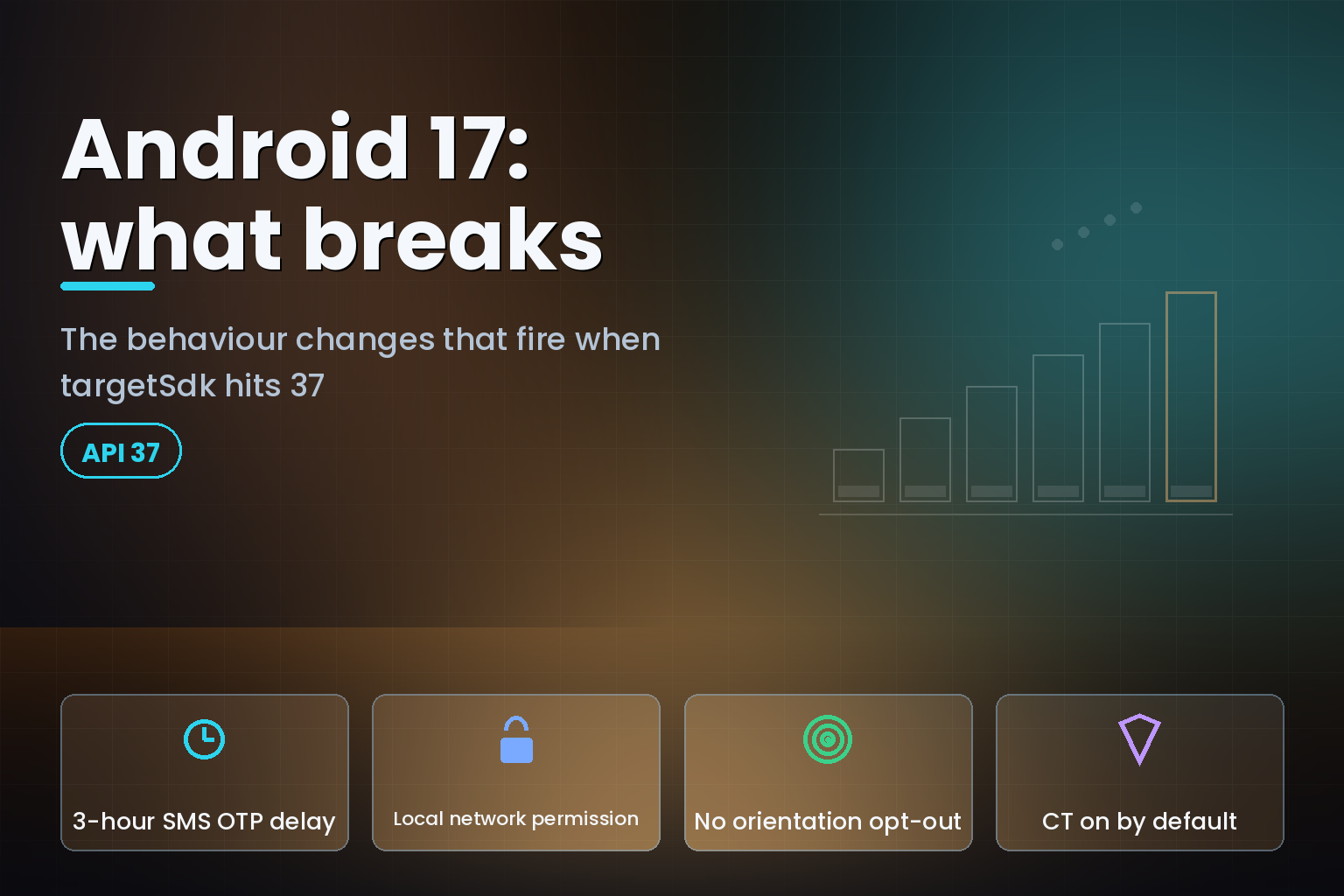
Summary. Android 17 is API level 37, and it shipped on 16 June 2026 to most supported Pixel devices. Google's behaviour-changes documentation for apps targeting Android 17, last updated 14 July 2026, lists eleven changes that fire only when your targetSdkVersion reaches 37. The most disruptive is silent: standard SMS messages carrying a one-time password are withheld from most apps for three hours after receipt, with the SMS_RECEIVED_ACTION broadcast suppressed and SMS provider queries filtered for that window. Any login flow still reading the inbox directly will fail in production and pass every test on an emulator. Two other changes bite reflection-heavy codebases: static final fields become unmodifiable, throwing IllegalAccessException or crashing outright through JNI, and android.os.MessageQueue gets a lock-free implementation that breaks anything reflecting on its private fields. Here is the part nobody says out loud: Google's Play target API level page, updated 15 July 2026, sets no deadline for API 37 at all. The only binding date is 31 August 2026 for API level 36. So the bump to 37 is voluntary right now, and at senior Android rates of ₹3,500 to ₹8,000 per hour in India, doing it blind is expensive. Do it deliberately, in this order.
First, the deadline question, because it is the wrong question
Search volume for "targetsdk 37" is rising, and most of it is people looking for a date. There isn't one.
Google's page titled "Meet Google Play's target API level requirement", last updated 15 July 2026, sets one deadline: 31 August 2026. From that date, new apps and app updates must target Android 16 (API level 36) or higher, with exceptions at API level 35 for Wear OS and Android Automotive OS and API level 34 for Android TV and Android XR. Existing apps must target Android 15 (API level 35) or higher to remain available to new users on devices running a higher Android OS version than the app targets. An extension request path runs to 1 November 2026.
The consequence of missing it is stated plainly: apps targeting Android 14 (API level 34) or lower "will only be available on devices running Android OS that are the same or lower than your app's target API level."
Nothing on that page mentions API level 37. Based on the annual cadence, a requirement will arrive, but planning against an invented date is how teams end up doing the work twice. The reason to move to 37 now is that the changes below are easier to absorb in a planned sprint than in a forced one, not because a clock is running.
The Android 17 launch was written up by Matthew McCullough, VP of Product Management, Android Developer, who confirmed the rollout on 16 June 2026: "Today we're releasing Android 17 and making it available on most supported Pixel devices." Beta builds were already running on handsets, tablets and foldables from Honor, iQOO, Lenovo, OnePlus, OPPO, Realme, Sharp, vivo and Xiaomi, so the device base targeting 37 will grow through the second half of 2026 regardless of what Play requires.
The eleven changes, ranked by blast radius
| Change | What fires at targetSdk 37 | Likely to break | Fix effort |
|---|---|---|---|
| Standard SMS OTP delay | SMS with an OTP withheld ~3 hours; SMS_RECEIVED_ACTION suppressed, provider queries filtered |
Any inbox-reading login flow | High: product change, not a refactor |
| Local network permission | ACCESS_LOCAL_NETWORK runtime permission enforced |
Casting, smart home, LAN discovery, local printers | Medium |
static final immutability |
Reflection writes throw IllegalAccessException; JNI writes crash |
Test doubles, feature-flag hacks, old DI tricks | Medium |
| MessageQueue lock-free rewrite | Private fields and methods change shape | Frame-timing libraries, custom loopers | Medium, often vendor SDK |
| Background audio hardening | Foreground service with while-in-use capability required | Alarms, media resume, background playback | Medium to high |
| Safer native DCL | Files loaded via System.load() must be read-only or UnsatisfiedLinkError |
Apps shipping downloadable .so payloads |
Medium |
| Certificate Transparency on | CT enabled by default rather than opt-in | Private or internal CAs | Low unless you pin |
| ECH enabled | Encrypted Client Hello used for TLS where supported | SNI-based network middleboxes | Low, config-level |
| CP2 PII columns hidden | ACCOUNT_NAME, ACCOUNT_TYPE, ACCOUNT_TYPE_AND_DATA_SET removed from the data view |
Contact sync and dedupe logic | Low to medium |
| CP2 strict SQL | Strict column and grammar checks without READ_CONTACTS |
Hand-built selection strings | Low |
Bluetooth RFCOMM read() |
Returns -1 on close or drop instead of only throwing |
Read loops that catch IOException only |
Low |
Two more apply at API 37 without breaking much: password characters are hidden by default when a physical keyboard is in use, and the large-screen orientation opt-out disappears. The second one is significant enough that we covered it separately in Android 17 targetSdk 37 adaptive layout migration.
The SMS OTP delay is the one that will page you
Google's wording is precise. Beginning with Android 17, SMS OTP protection extends to standard SMS messages, meaning those carrying an OTP that do not use the WebOTP or SMS Retriever formats. For most apps targeting API level 37, these messages "do not become available until three hours after receipt." During that window the SMS_RECEIVED_ACTION broadcast is withheld and android.provider.Telephony.Sms database queries are filtered. The message arrives eventually. Three hours later.
Exemptions exist for a narrow set: the default SMS assistant app, connected device companion apps and similar. Your fintech app is not on that list.
Google's instruction is unambiguous: all apps that rely on reading SMS messages for OTP extraction should move to the SMS Retriever API or SMS User Consent.
This is the change that most needs calling out to product, not just engineering, and it lands hardest on Indian apps. OTP-over-SMS is the default second factor across UPI onboarding, wallet KYC, ecommerce logins and delivery confirmations. A large share of Indian apps still read the inbox with READ_SMS because autofill was easier that way in 2019.
Moving to SMS Retriever is not a drop-in. It requires an 11-character app hash appended to the message body, which means your SMS templates change, which means your SMS gateway vendor and possibly your DLT template registration change too. That is a multi-week path involving a third party, so start it before you touch targetSdkVersion.
Note the split: additional SMS OTP protections for WebOTP and SMS Retriever format messages apply to all apps regardless of target API level. Only the standard-SMS three-hour delay is gated on targeting 37.
Local network permission is now mandatory
Android 17 adds the ACCESS_LOCAL_NETWORK runtime permission. In Android 16 apps could opt in; from Android 17, Google states that "enforcement is mandatory for apps that target Android 17 (API level 37) or higher."
It sits inside the existing NEARBY_DEVICES permission group, so users who already granted another permission in that group are not prompted again. Google's stated reason is preventing covert tracking and fingerprinting through unrestricted LAN access.
Two paths are offered. Adopt system-mediated, privacy-preserving device pickers and skip the prompt entirely, or request the permission at runtime. For a casting or smart-home app, the picker route is usually better product design as well as fewer prompts. For a warehouse or retail app talking to a local label printer over the LAN, the runtime permission is the practical answer.
Test this on a device that has never granted a NEARBY_DEVICES permission. On your own phone, which has granted Bluetooth scanning to a dozen apps, the prompt may never appear and you will conclude wrongly that nothing changed.
Reflection and native code stop being a loophole
Three changes close doors that older codebases lean on.
`static final` fields are unmodifiable. Apps running on Android 17 that target API level 37 cannot change a static final field. Reflection attempts throw IllegalAccessException. Attempts through JNI APIs such as SetStaticLongField() crash the app outright. If your test suite swaps a static final constant to fake a build flavour or a feature flag, it will fail, and if a native library does it, you get a crash rather than an exception you can catch.
MessageQueue is lock-free now. Apps targeting API level 37 get a new lock-free implementation of android.os.MessageQueue. Google says it improves performance and reduces missed frames, but "may break clients that reflect on MessageQueue private fields and methods." In practice this is rarely your code. It is an APM agent, a frame-timing library, or an older crash reporter. Audit your dependency list before you audit your own source.
Native dynamic code loading tightens. The Safer Dynamic Code Loading protection introduced in Android 14 for DEX and JAR files now extends to native libraries. Every native file loaded with System.load() must be marked read-only, or the system throws UnsatisfiedLinkError. Google's own advice goes further than the mechanics: avoid dynamically loading code at all where you can, because it raises the risk of code injection and tampering.
The honest read: if any of these three break your app, the change is doing its job. These are the patterns that get apps compromised.
Networking: two changes you configure rather than code
Encrypted Client Hello. For apps targeting API level 37, ECH is used for TLS connections. It encrypts the Server Name Indication in the handshake so network observers cannot easily see which domain you are reaching. It only activates when both your networking library, such as HttpEngine, WebView or OkHttp, has integrated ECH support and the remote server supports the protocol. When ECH cannot be negotiated, the client sends an ECH extension with randomised contents, a mechanism called ECH GREASE, described in RFC 9849.
Android 17 adds a <domainEncryption> element to the Network Security Configuration file, usable inside <base-config> or <domain-config>, so you can set ECH mode globally or per domain:
            <network-security-config>
  <base-config>
    <domainEncryption mode="enabled" />
  </base-config>
  <domain-config>
    <domain includeSubdomains="true">internal.example.in</domain>
    <domainEncryption mode="disabled" />
  </domain-config>
</network-security-config>
The realistic failure mode is corporate or telco middleboxes that route on SNI. If your enterprise customers run SNI-based filtering, ECH is the change that generates the support ticket.
Certificate Transparency by default. On Android 16, CT was available but apps had to opt in. If your app targets API level 37, CT is enabled by default. If you issue certificates from a private CA that does not log to CT, this is where you find out.
Contacts, audio and Bluetooth
Contacts Provider 2 hides PII columns. For apps targeting API level 37, CP2 removes ACCOUNT_NAME, ACCOUNT_TYPE and ACCOUNT_TYPE_AND_DATA_SET from the data view. Google's migration path is to read them from ContactsContract.RawContacts instead, joining on RAW_CONTACT_ID. Contact dedupe and sync code that assumed those columns on ContactsContract.Data needs the join added.
CP2 enforces strict SQL. When an app without READ_CONTACTS queries the ContactsContract.Data table, StrictColumns and StrictGrammar are applied. A query using an incompatible pattern is rejected and throws. Hand-built selection strings with clever SQL are the casualty here; parameterised queries generally survive.
Background audio hardening. From Android 17 the audio framework restricts background audio playback, audio focus requests and volume-change APIs. Some restrictions apply to every app, but they are more stringent for apps targeting API level 37: an app interacting with audio in the background must have a foreground service running, and that foreground service must have while-in-use capabilities, or the app must hold the exact alarm permission and be working with USAGE_ALARM streams. Alarm clocks, meditation apps and anything that resumes playback from a background trigger need to check this explicitly.
Bluetooth RFCOMM read semantics. For apps targeting API level 37, read() on the InputStream from an RFCOMM-based BluetoothSocket returns -1 when the socket closes or the connection drops, matching LE CoC sockets and standard InputStream.read() behaviour. Read loops that only catch IOException to break out will now spin. Add an explicit check for -1:
            val buffer = ByteArray(1024)
while (true) {
    val bytes = try {
        inputStream.read(buffer)
    } catch (e: IOException) {
        break
    }
    if (bytes == -1) break
    handle(buffer, bytes)
}
Small change, and easy to miss because the old code compiles and runs fine until a device disconnects.
A migration order that does not waste a sprint
Do the long-lead item first. Everything else is code you control; the SMS change is not.
- Week 0. Start the SMS Retriever migration, including SMS template changes with your gateway and any DLT re-registration. This is the critical path.
- Week 1. Audit third-party SDKs for
MessageQueuereflection and for native libraries loaded withSystem.load(). Raise vendor tickets now, because their release cadence is not yours.
- Week 1. Grep for reflection writes to
static finalfields, including in test source sets.
- Week 2. Bump
targetSdkVersionto 37 on a branch. Run the full instrumentation suite on an Android 17 device, not just an emulator.
- Week 2. Add
ACCESS_LOCAL_NETWORKor move to a system device picker. Test on a device with no priorNEARBY_DEVICESgrant.
- Week 3. Verify TLS against your own backends with CT on and ECH active. Test from a network with SNI-based filtering if any enterprise customer uses one.
- Week 3. Fix CP2 joins, Bluetooth read loops, and background audio foreground-service declarations.
- Week 4. Staged rollout at 5%, watching Android vitals rather than only crash-free rate.
If you are still on API 34 or lower, do not attempt 37 in one jump. Get to 36 first, ship it, then take 37 as a separate release. The Android target API 36 Play Store deadline migration covers that step, and we run it as a managed piece of work through our Android target API 36 migration service.
India-specific considerations
The SMS change is the whole story for Indian apps, and it is worth being blunt about why.
India's OTP-over-SMS habit is deeper than most markets. Bank logins, UPI onboarding, marketplace sign-ins, delivery OTPs and ticket confirmations all ride on it, and a generation of Indian apps shipped READ_SMS-based autofill because it worked and users accepted the permission. Google Play has already tightened READ_SMS access over several policy cycles. Android 17's three-hour delay for standard SMS is the platform closing the same door from the other side.
Two practical consequences. First, your SMS vendor and DLT template registration sit on the critical path, which is a procurement timeline rather than an engineering one; a template change with a registered principal entity is not a same-day operation. Second, apps that share an OTP flow across web and Android should move to WebOTP on the web side at the same time, so you maintain one message format rather than two.
The privacy changes also fit the direction of travel under the Digital Personal Data Protection Act 2023. Contact-list access, local network scanning and SMS reading are the three most common sources of over-collection in Indian consumer apps, and all three are narrowed at API 37. We design applications aligned with DPDP Act requirements rather than claiming certification against them.
On budget, published 2026 Indian rates put mid-level developers at ₹1,500 to ₹3,500 per hour and senior developers and architects at ₹3,500 to ₹8,000 or more. A targetSdk 37 migration for a mid-sized consumer app is a few developer-weeks plus the SMS vendor timeline, and the SMS work dominates. Budget for the vendor, not the code.
For the wider architecture and delivery picture, see the enterprise mobile app development guide, and for the release-quality side of a staged rollout, our Android vitals ANR and crash remediation service.
FAQ
How eCorpIT can help
eCorpIT is a Gurugram-based technology organisation founded in 2021, with senior-led Android and Flutter teams shipping consumer and enterprise apps to Google Play for Indian businesses. We are CMMI Level 5 assessed, MSME certified and ISO 27001:2022 certified. For an API 37 migration we start with the SMS OTP path because it involves your gateway and DLT templates, audit third-party SDKs for reflection and native loading, and run the target SDK bump as a staged rollout measured on Android vitals rather than crash-free rate alone. Send us your current target API level and OTP flow at /contact-us/ and we will come back with a sequenced plan.
References
- Android 17 API 37: breaking changes before the June release, byteiota, 2026.
- Android 17 is here: fix these 4 issues before June 16, byteiota, 2026.
- Android 17 API deep dive: every confirmed change and what your app needs, Android Newswire, 2026.
- Android 17 (API level 37): everything Android developers need to know, daily.dev, 2026.
- Meet Google Play's target API level requirement, Android Developers, last updated 15 July 2026.
- Android 17 is here, Matthew McCullough, VP of Product Management, Android Developer, 16 June 2026.
- Google launches Android 17, rolling out now to Pixel, 9to5Google, 16 June 2026.
- API diffs: API 36 to API 37, Android Developers.
- android.os.MessageQueue reference, Android Developers.
- Local network permission, Android Developers.
- Network security configuration, including Encrypted Client Hello and certificate transparency, Android Developers.
- RFC 9849: GREASE ECH, IETF.
- SMS Retriever API, Android Developers.
- SMS User Consent API, Google for Developers.
- ContactsContract.RawContacts reference, Android Developers.
- Transfer Bluetooth data, Android Developers.
- uses-sdk element, Android Developers.
- Mobile app development cost in India 2026, Astha Technologies.
Last updated: 6 August 2026.