On this page · 10 sections
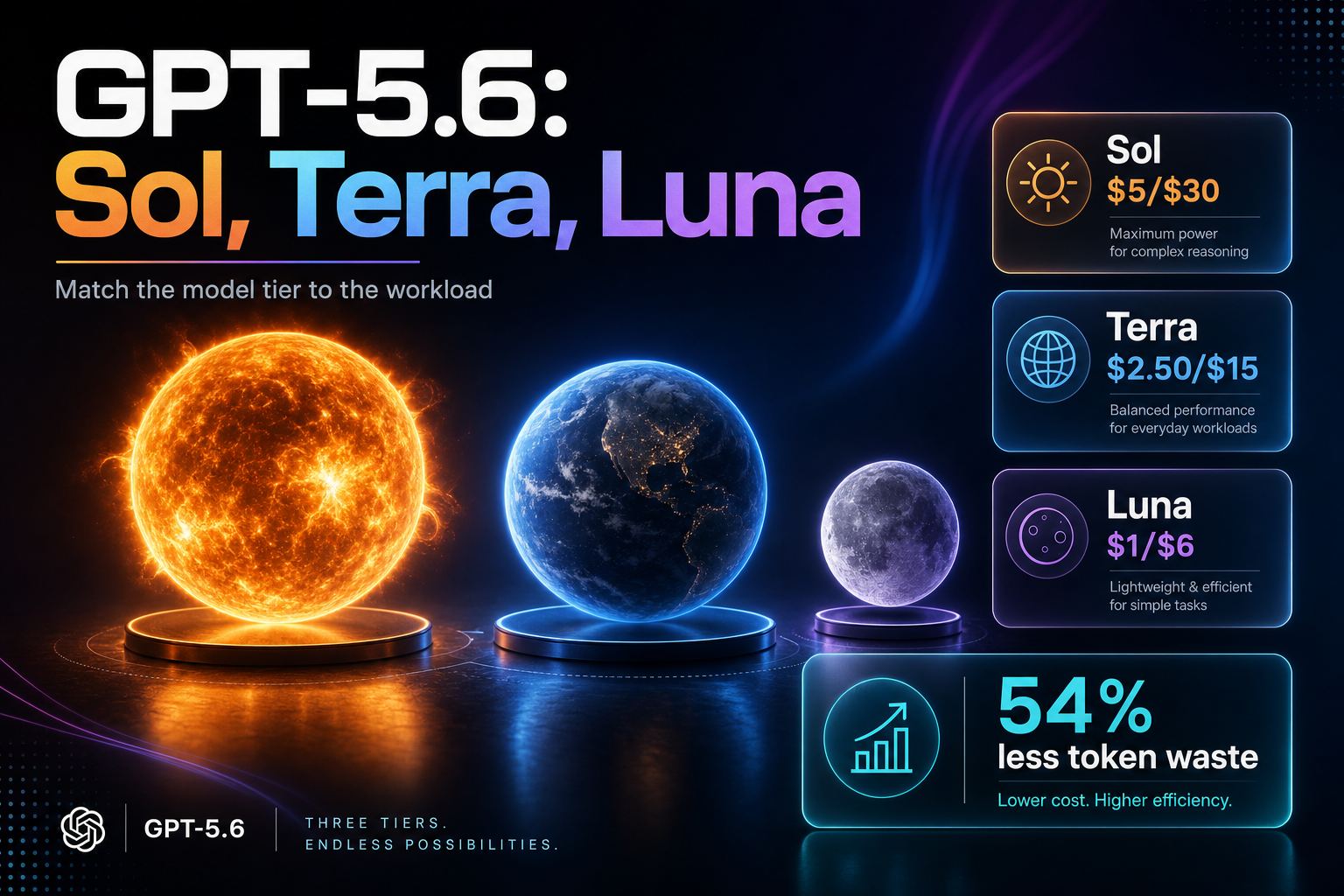
Summary. OpenAI shipped the GPT-5.6 family to general availability on July 9, 2026, across ChatGPT, Codex, and the API, after a preview that opened June 25, 2026. There are three tiers, and the price gap between them is wide: Sol costs $5 per million input tokens and $30 per million output; Terra costs $2.50 and $15; Luna costs $1 and $6. That is a 5x spread on input and output between the top and bottom tier for the same family. Sam Altman told CNBC that GPT-5.6 Sol is 54% more token efficient on agentic coding tasks and "as good or better" than competing models. The practical question for engineering teams is not which tier is best in the abstract. It is which tier fits each workload, because picking Sol for a job Luna could handle can multiply your bill for no measurable gain. This guide maps tiers to workloads and shows the cost math.
What GPT-5.6 changed
The headline is a family, not a single model. OpenAI split GPT-5.6 into three named tiers so buyers can trade quality against cost per workload rather than paying a flagship rate for everything. Sol is the flagship for complex reasoning and demanding coding. Terra is the balanced middle, positioned to match the prior GPT-5.5 quality at roughly half the cost. Luna is the fast, cheap tier for high-volume, latency-sensitive work.
Altman framed the release around cost discipline. "Every enterprise now is thinking about spend and the value they're getting in exchange for AI, and this is what we really want to do," he said as OpenAI unveiled the family. OpenAI also called GPT-5.6 its strongest cybersecurity model yet and said the efficiency gains cut token usage on agentic coding. The release followed a US government approval process that OpenAI described as a collaborative back and forth.
The three tiers at a glance
| Tier | Input / output per 1M tokens | Built for |
|---|---|---|
| Sol | $5.00 / $30.00 | Complex reasoning, hard coding, agents that must not fail |
| Terra | $2.50 / $15.00 | General production work at GPT-5.5-level quality |
| Luna | $1.00 / $6.00 | High-volume classification, extraction, drafting, chat |
Prices are the OpenAI API list rates as of July 2026, reported by pricing trackers including aipricing.guru and Finout. Two billing details matter for cost planning: cache writes are billed at 1.25x the model's uncached input rate, and cache reads keep a 90% discount, so prompt caching pays off fast on repeated system prompts.
How to choose: match the tier to the workload
The cheapest correct answer is the goal, not the highest score. Route each workload to the lowest tier that clears your quality bar, and reserve Sol for the jobs where a wrong answer is expensive.
| Workload | Recommended tier | Why |
|---|---|---|
| Autonomous coding agent on production repos | Sol | Reasoning depth and token efficiency reduce failed runs |
| Code review and bug triage | Terra | Strong quality without the flagship rate |
| Retrieval-augmented Q&A over docs | Terra | Balanced accuracy for grounded answers |
| Bulk classification, tagging, extraction | Luna | Volume work where per-call cost dominates |
| Customer chat and first-draft replies | Luna | Latency and cost matter more than peak reasoning |
| Data pipeline summarisation at scale | Luna | Cheap tokens win when quality is adequate |
A useful rule: start every new workload on Luna, measure quality against a labelled test set, and promote to Terra or Sol only where Luna misses. Most teams discover that a large share of their traffic is extraction, drafting, and routing, work that Luna handles at a fifth of Sol's price. Our comparison of GPT-5.6 and Claude Sonnet 5 for enterprise agents goes deeper on the agent use case.
The cost math, with a worked example
Tier choice is the single biggest lever on an LLM bill, ahead of prompt tuning. Take a workload that consumes 100 million input tokens and 20 million output tokens in a month, a realistic mid-size production load.
| Tier | Input cost | Output cost | Monthly total |
|---|---|---|---|
| Sol | $500 | $600 | $1,100 |
| Terra | $250 | $300 | $550 |
| Luna | $100 | $120 | $220 |
Same token volume, same job description, and the bill ranges from $220 to $1,100 depending only on tier. If Luna clears your quality bar, running it instead of Sol saves $880 a month, or about $10,560 a year, on this one workload. Prompt caching then trims the input line further wherever your system prompt repeats. This is why tier routing, not model loyalty, is the core cost skill in 2026. Our guide to controlling AI cloud cost across providers covers the FinOps side.
Where GPT-5.6 sits against Claude and Gemini
Tier selection inside OpenAI is one decision; whether to use OpenAI at all is another. On reported coding benchmarks the frontier is close at the top and spread on specifics.
| Model | SWE-bench Pro | Context window | Input / output per 1M |
|---|---|---|---|
| GPT-5.6 Sol | 64.6% | Large (agentic-tuned) | $5.00 / $30.00 |
| Claude Sonnet 5 | 63.2% | 200K standard | $2.00 / $10.00 (intro to Aug 31) |
| Claude Fable 5 | 80.0% | 200K standard | see Anthropic pricing |
| Gemini 3.1 Pro | leads WebDev Arena (1,487 Elo) | up to 2M tokens | see Google pricing |
On SWE-bench Pro, GPT-5.6 Sol (64.6%) and Claude Sonnet 5 (63.2%) are essentially tied, while Claude Fable 5 leads that test at 80.0%, and Gemini 3.1 Pro tops WebDev Arena at 1,487 Elo with a 2 million-token context window, per benchmark trackers such as EdenAI and LM Council. The takeaway is not a single winner. It is that the right model depends on the task: long-context document work favours Gemini's window, some coding tasks favour Claude, and OpenAI's tiering gives the finest cost control. Many teams route across all three and pick per workload. Our Grok 4.5 enterprise coding evaluation adds another data point.
The honest caveats
Two cautions belong in any GPT-5.6 decision. First, OpenAI and xAI did not publish classic academic benchmarks such as GPQA, MMLU, or AIME for their July 2026 launches, reporting agentic and coding evals instead, so cross-model comparisons on reasoning are incomplete. Judge on your own evals, not the leaderboard. Second, vendor efficiency claims like the 54% agentic-coding figure are measured on OpenAI's chosen tasks; your mileage depends on your prompts and tools. Treat published numbers as a starting hypothesis and confirm on a representative test set before you standardise.
India-specific considerations
For Indian teams the tier decision carries the same 5x cost spread, and the savings compound at scale, so Luna-first routing is worth building into your gateway from the start. One additional constraint: any personal data sent to a US-hosted API should be handled under the Digital Personal Data Protection Act, 2023, with a documented purpose and, for regulated data, a data protection officer's review. Where data cannot leave India, weigh an India-hosted model against the OpenAI tiers, and keep an abstraction layer so you can route sensitive workloads to a resident model without rewriting application code.
How eCorpIT can help
eCorpIT is a Gurugram technology consultancy, founded in 2021, that helps teams deploy AI at a defensible cost. Our senior-led engineers build model-routing gateways that send each workload to the cheapest tier that clears its quality bar, set up evaluation harnesses so promotions from Luna to Terra or Sol are evidence-based, and design data handling aligned with Digital Personal Data Protection Act, 2023 requirements. We benchmark OpenAI, Anthropic, and Google models on your own tasks rather than generic leaderboards. To optimise your AI spend, contact us.
FAQ
References
- The new GPT-5.6 family: Luna, Terra, Sol — Simon Willison
- GPT-5.6 pricing: Sol $5, Terra $2.50, Luna $1 per 1M — AI Pricing Guru
- AI model benchmarks, July 2026 — LM Council
_Last updated: July 14, 2026._