On this page · 10 sections
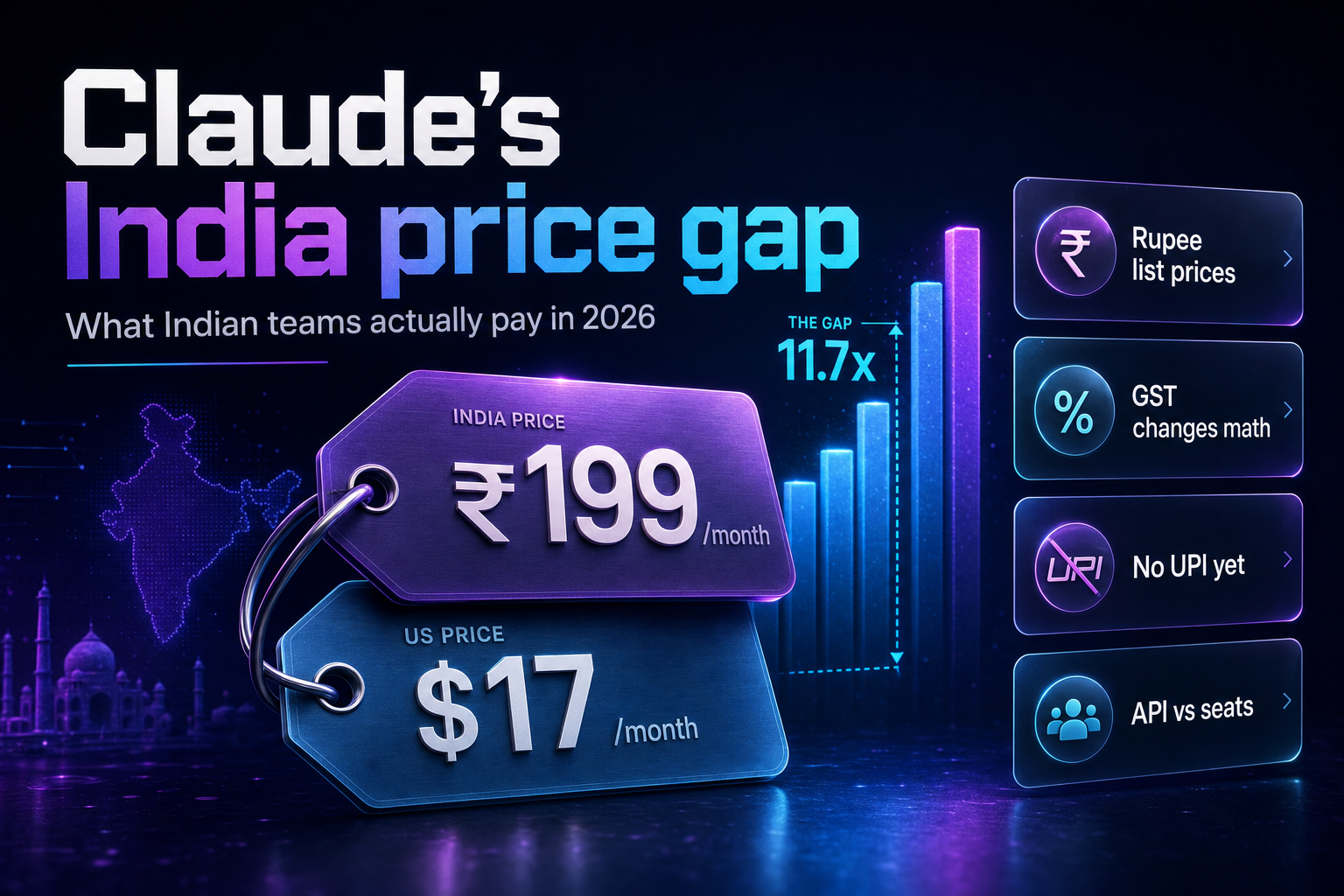
Summary. Anthropic started showing Indian rupee prices for Claude on July 13, 2026: Claude Pro at ₹2,000 a month billed annually, Claude Max from ₹11,999 a month, and Team seats from ₹2,399 a month, according to TechCrunch. Against the US list prices of $17, $100 and $20 on claude.com/pricing, those rupee figures land 24% to 25% higher. Almost all of that gap is tax. The India prices include local taxes; the US prices do not, and India charges 18% GST on foreign digital subscriptions. Strip the tax out and the underlying gap is roughly 5% to 6%. India is Anthropic's second-largest market, at 5.8% of global Claude.ai use per its own India Country Brief. The rollout still has one real gap: no UPI.
The headline number travelled fast. The arithmetic behind it did not.
What actually changed on July 13
Local pricing began appearing for some users in India on Claude's website and mobile apps. It is a phased rollout, not a switch: TechCrunch noted that prices on Claude's mobile apps vary slightly from those listed on the website, and Anthropic did not respond to its request for comment on the rollout.
Here is what is on the page, side by side.
| Plan | India list (incl. local taxes) | US list (excl. tax) |
|---|---|---|
| Pro, billed annually | ₹2,000/month (about $21) | $17/month ($200 up front) |
| Pro, billed monthly | Not separately reported | $20/month |
| Max | From ₹11,999/month (about $125) | From $100/month |
| Team, standard seat | From ₹2,399/seat/month (about $25) | $20/seat/month annually, $25 monthly |
| Enterprise | Not separately reported | $20/seat plus usage at API rates |
The India figures come from TechCrunch's July 13 report; the US figures are from claude.com/pricing as of July 16, 2026. TechCrunch's own dollar conversions imply a rate of roughly ₹95 to ₹96 per dollar.
The 24% gap is mostly GST
This is the part the headlines skipped, and it is the only part that changes a budget.
Claude's pricing page carries a plain line under both the individual and team tiers: "Prices shown don't include applicable tax." TechCrunch reports the opposite for India: "The India prices include local taxes." So the two numbers are not comparable as printed. One is tax-exclusive, the other is tax-inclusive.
India taxes online digital services at a standard GST rate of 18%, and that rate applies to foreign suppliers selling into India, with no registration threshold for non-resident companies (PayPro Global's India tax reference). Software and IT services carry the same 18% rate (Busy's 2026 GST rate reference for IT services).
Strip the 18% out of the India prices, using TechCrunch's own dollar conversions so no exchange rate of ours enters the sum.
| Plan | India list ex-GST | US list | Real gap |
|---|---|---|---|
| Pro, annual | $17.80 | $17.00 | +4.7% |
| Max 5x | $105.93 | $100.00 | +5.9% |
| Team standard seat, annual | $21.19 | $20.00 | +5.9% |
| Pro, sticker comparison | $21 | $17 | +23.5% |
| Team seat, sticker comparison | $25 | $20 | +25.0% |
So the real story is a 5% to 6% premium, not 24%. The rest is a tax you were always going to pay. An Indian consumer buying Claude Pro on a card today already pays 18% GST somewhere in the chain; rupee pricing moves it from an invisible line to a visible one.
For a company, it moves further than that. India applies the reverse charge mechanism to B2B purchases of foreign digital services: where the buyer holds a GSTIN, the foreign supplier does not charge GST and the Indian business pays it directly to the government instead. A registered Indian company was already accounting for that 18% on its Claude bill. The rupee price does not add cost to a GST-registered buyer so much as re-label it, and how the invoice is issued determines whether input tax credit is available. That question belongs to your CA, not to a pricing page.
The blunt version: for a registered Indian company, rupee pricing is mostly a currency-friction fix, not a discount and not a tax hike.
Why India, and why now
India accounts for 5.8% of total Claude.ai use, second only to the United States, based on roughly 1 million Claude.ai conversations sampled globally between November 13 and 20, 2025 (N = 975,160 globally, N = 58,098 for India). But the same brief reports a second number that explains the pricing move better than the first: on a per-capita basis, adjusted for working-age population, India ranks 101st out of 116 countries with enough observations.
"India ranks 2nd in total use but 101st in per-capita use," the brief states. "The gap between these two figures reflects both India's large population and how narrowly concentrated current adoption is."
That concentration is geographic and occupational. Maharashtra (15.5%), Tamil Nadu (13.2%), Karnataka (12.7%) and Delhi (10.5%) together account for over half of India's Claude.ai use. And 45.2% of Indian usage maps to software-related occupations, the highest share of any country, ahead of Vietnam at 42.1% and Egypt at 39.2%.
Anthropic opened its Bengaluru office on February 16, 2026, its second in Asia after Tokyo, and said its run-rate revenue in India had doubled since the October 2025 expansion announcement. Irina Ghose, Managing Director of India at Anthropic, framed the bet this way in that announcement:
"India represents one of the world's most promising opportunities to bring the benefits of responsible AI to vastly more people and enterprises. Already, it's home to extraordinary technical talent, digital infrastructure at scale, and a proven track record of using technology to improve people's lives."
Ghose joined from Microsoft, where she was Managing Director of Microsoft India. Chris Ciauri, Managing Director of International at Anthropic, said at her January 16, 2026 appointment that she "will ensure our approach is grounded in local insight."
Rupee pricing is the cheapest lever available against a 101st-place per-capita rank. Currency friction is a conversion problem, and Anthropic just removed one source of it.
The UPI hole
Anthropic has not enabled UPI. Indian users still pay by card, or through Apple's and Google's app store billing.
That matters more than the 5% premium. OpenAI rolled out Indian rupee pricing for ChatGPT in August with UPI support; Anthropic has shipped the price change without the payment rail. Indian developers have asked for rupee subscriptions for long enough that the request sits on a public GitHub issue in the Claude Code repository.
Card-only billing has a specific failure mode in India that a US pricing team may not model: recurring international card mandates fail, get flagged, or need re-authentication, and a failed renewal on a ₹2,000 annual plan is a churn event, not an inconvenience. UPI is not a nice-to-have in a market where it is the default way money moves.
| Friction point | Claude, July 2026 | ChatGPT |
|---|---|---|
| Rupee-denominated plans | Yes, rolling out from July 13, 2026 | Yes, since August |
| UPI support | No | Yes |
| App store billing | Yes (Apple, Google) | Yes |
| Card billing | Yes | Yes |
| Prices include local tax | Yes | Rupee pricing set for India |
What Indian teams should actually do
Four decisions, in the order they matter.
1. Check whether seats are the right unit at all. This is the decision that moves real money, and it has nothing to do with rupees. Claude's API list prices as of July 16, 2026 are $2 per million input tokens and $10 per million output tokens for Sonnet 5 — introductory pricing through August 31, 2026, rising to $3/$15 after that. Opus 4.8 is $5/$25. Haiku 4.5 is $1/$5. Fable 5 is $10/$50. Batch processing cuts those by 50%.
A ₹2,399 Team seat is roughly ₹2,033 ex-GST, about $21. At Sonnet 5's introductory rate, $21 buys about 10.5 million input tokens, or a little over 2 million output tokens. For a person chatting through a browser all day, the seat is far better value. For a scripted, high-volume, mostly-input workload, it is not close, and the seat is the wrong instrument. Our decision framework for hybrid LLM routing and API spend covers where the crossover sits.
2. Note the August 31, 2026 cliff. Sonnet 5's $2/$10 rate is explicitly introductory. Standard pricing of $3/$15 is a 50% increase on both input and output, and it lands in six weeks. Any FY27 budget built on today's Sonnet rate is 50% light on that line. Model the standard rate, not the promotional one.
3. Decide monthly versus annual with the failure mode in mind, not the discount. Pro is $17 a month billed annually against $20 billed monthly — a 15% saving for a ₹24,000 up-front commitment (₹2,000 × 12). Team standard is $20 a seat annually against $25 monthly, a 20% saving. Those are real savings. But annual billing on a card that may fail re-authentication, in a market with no UPI, concentrates the payment risk into one transaction a year. If your finance team has ever had an international card mandate rejected, price that in.
4. Separate the price question from the availability question. In June 2026, Anthropic suspended access to its Fable 5 and Mythos 5 models for non-US entities, which pushed some Indian developers and founders to look at alternatives. The Fable 5 restriction has since been lifted; access to Mythos 5 remains limited. A 5% price premium is a rounding error next to a model you cannot call. Teams building on frontier models from a single US vendor should read our analysis of model suspension versus chip export controls as an enterprise risk and of the cost case for Chinese open models before treating any single provider as permanent infrastructure.
India-specific considerations
GST registration changes the sum. A registered business and an individual developer are not buying the same thing at ₹2,000. Confirm with your CA how the invoice is raised and whether input tax credit applies before you compare the India price to the US price at all. Getting this wrong in either direction is more expensive than the 5% premium.
DPDP is a separate question from pricing. The Digital Personal Data Protection Act 2023 governs what personal data you put into any AI tool, whoever bills you and in whatever currency. Rupee pricing does not change data residency, consent, or processing obligations. If you are building on Claude with customer data, the compliance cost for Indian startups ahead of the 2027 deadline is the number to model, not the seat price.
The adoption gap is the opportunity. 51.3% of Indian Claude.ai use is work-related, against 46% globally. Indian users delegate more autonomy to AI (3.60 versus 3.38 globally on a 1-5 scale). And they get more out of it: Indian users complete tasks in about 14.8 minutes that would take 3.8 hours without AI, a 15x speedup, against 12x globally. Teams outside Maharashtra, Tamil Nadu, Karnataka and Delhi are not competing for these tools yet.
Named Indian deployments exist, and they are not pilots. Air India uses Claude Code to help developers ship custom software faster and at lower cost. CRED reports 2x faster feature delivery and 10% better test coverage with Claude Code. Cognizant is deploying Claude to 350,000 employees globally. Emergent, an AI platform for building software from plain-language descriptions, reached $25 million in annual recurring revenue and two million users in under five months, built entirely with Claude. Anthropic has also partnered with Infosys and Tata Consultancy Services to scale enterprise deployments.
What this does not tell you
Three honest limits on the above.
The rupee prices are a phased rollout observed on July 13, 2026, and TechCrunch reported that app store prices differ slightly from web prices. Check what your own account shows before you build a budget on ₹2,000.
The exchange rate is implied, not quoted. TechCrunch's conversions imply ₹95 to ₹96 per dollar; a different rate moves the 5% to 6% figure by a point or two in either direction. The conclusion — that most of the visible gap is tax — survives any plausible rate. The exact percentage does not.
Anthropic did not comment on the rollout, so there is no stated rationale, no announced UPI timeline, and no confirmation that these prices are final. Prices and plans are subject to change at Anthropic's discretion, per its own pricing page.
FAQ
How eCorpIT can help
eCorpIT is a Gurugram-based technology consultancy that builds AI systems for Indian and global companies, and our senior engineering teams size these decisions before the invoice arrives, not after. We model seat-versus-API economics against your actual token volumes, plan for the August 31, 2026 Sonnet rate change, and design multi-provider routing so a single vendor's availability decision does not stop your product. If you are budgeting AI tooling for FY27 and want the numbers checked against your own workload, contact us.
References
- Anthropic starts localizing Claude pricing for India, its biggest market after the US — TechCrunch, July 13, 2026.
- Plans & Pricing — Claude by Anthropic, retrieved July 16, 2026.
- India Country Brief: The Anthropic Economic Index — Anthropic, February 16, 2026.
- Anthropic opens Bengaluru office and announces new partnerships across India — Anthropic, February 16, 2026.
- Anthropic appoints Irina Ghose as Managing Director of India ahead of Bengaluru office opening — Anthropic, January 16, 2026.
- SaaS Sales Tax in India: VAT/Sales Tax Rate — PayPro Global, retrieved July 16, 2026.
- New GST Rate for IT Services 2026: 18% Rate on Software, IT — Busy, retrieved July 16, 2026.
- Support Indian Rupee pricing — anthropics/claude-code GitHub issue.
- Anthropic, Blackstone bet the next trillion-dollar AI business is implementation, not just models — TechCrunch, July 15, 2026.
- Anthropic taps former Microsoft India MD to lead Bengaluru expansion — TechCrunch, January 15, 2026.
- As Anthropic suspends access to new models, India debates its AI future — TechCrunch, June 13, 2026.
- Trump drops restrictions on Anthropic's Mythos and Fable models — TechCrunch, June 30, 2026.
- Usage limit best practices — Anthropic Support.
- Anthropic taps TCS to scale its enterprise AI deployments — TechCrunch, June 11, 2026.
Last updated: July 16, 2026.