On this page · 11 sections
- What Microsoft actually reported
- The price that changed was not the Copilot price
- The free tier got better while the paid tier stayed the same price
- Independent adoption data, and why the vendor model reads differently
- Seat plus consumption: the licensing change that outlasts this renewal
- The alternative: Google Workspace bundles Gemini instead of charging for it
- India-specific considerations
- The renewal checklist
- FAQ
- How eCorpIT can help
- References
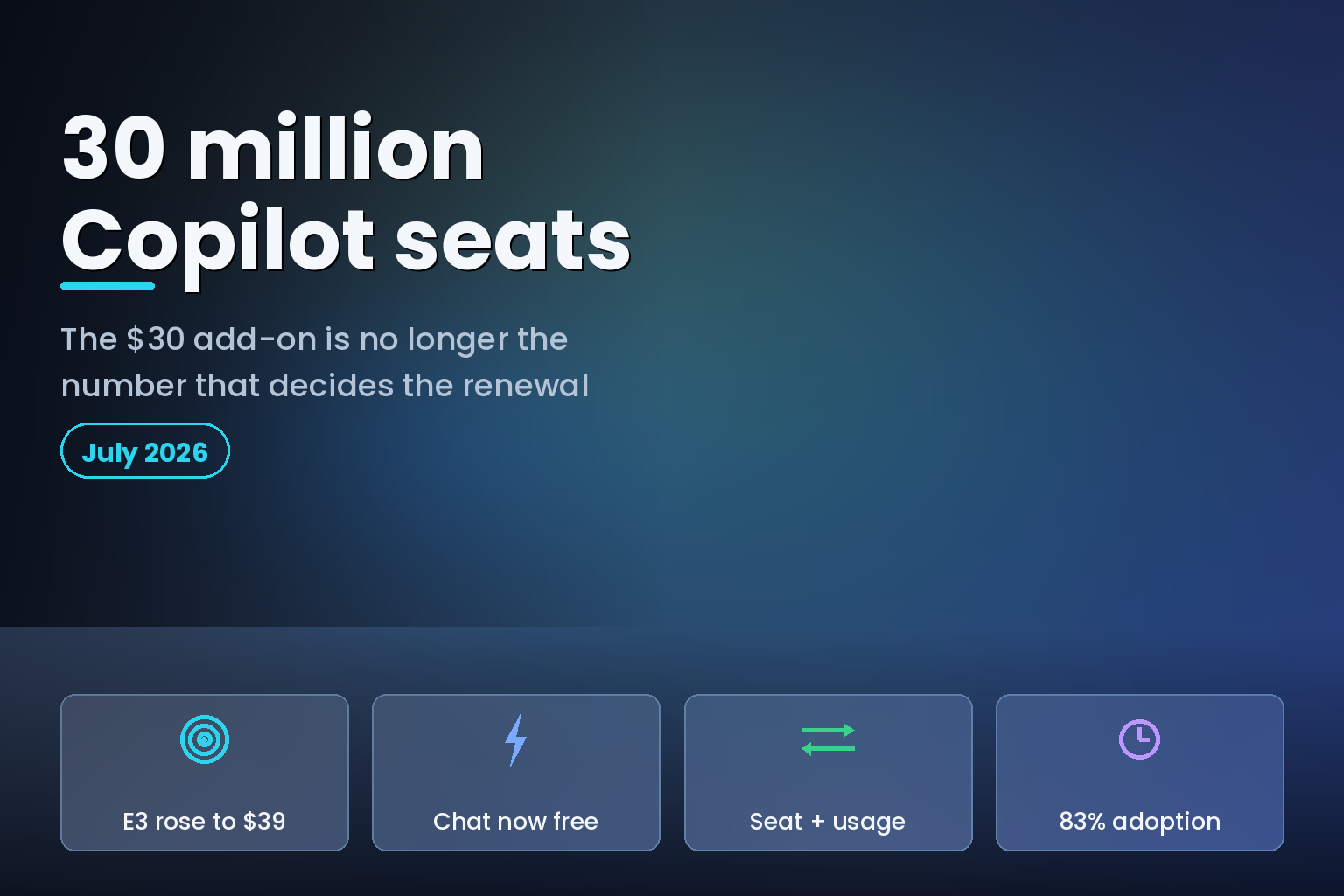
Summary. Microsoft reported over 30 million paid Microsoft 365 Copilot seats on 29 July 2026, in a quarter that delivered $90.0bn of revenue at 18% growth and Azure growth of 43%. The Copilot add-on itself still lists at $30 per user per month on an annual commitment. Three other things moved, and they matter more to a 2026 renewal than the headline. Microsoft 365 E3 rose from $36 to $39 and E5 from $57 to $60 on 1 July 2026, so the all-in cost of a Copilot seat on E3 went from $66 to $69 without the Copilot price changing at all. Copilot Chat remains free for eligible Microsoft 365 users and gained analytics and enhancements folded into E1, E3, E5, F1, F3 and the Business suites at no add-on cost. And Microsoft has started billing Copilot on consumption alongside seats. Independent UK public sector evaluations, covering roughly 26,500 licences across three departments, put realised adoption near 80% and time savings well below the vendor-commissioned model. This is the arithmetic to run before renewal.
What Microsoft actually reported
The FY26 Q4 results, published 29 July 2026 for the quarter ended 30 June 2026, put the seat figure in the CEO's own words. "This year, Azure revenue surpassed $100 billion for the first time, and Microsoft 365 Copilot reached over 30 million paid seats," said Satya Nadella, Chairman and Chief Executive Officer of Microsoft, in the earnings release.
The supporting quarter numbers:
- Revenue $90.0bn, up 18%, or 17% in constant currency.
- Microsoft Cloud revenue $59.3bn, up 27%.
- Azure and other cloud services up 43%, with Azure passing $100bn for the full year.
- Commercial remaining performance obligation up 84% to $678bn.
- Additions to property and equipment of $35,802m in the quarter, per the cash flow statement.
- Segment revenue of $39,306m for Intelligent Cloud, up 32%, and $37,847m for Productivity and Business Processes, up 14%. Full-year revenue $331,839m, up 18%.
One correction is worth making, because it circulated widely in the days after the results. The frequently repeated line about Copilot revenue accelerating over 60% quarter over quarter refers to GitHub Copilot, not to Microsoft 365 Copilot. Do not carry that number into a business case for seats.
The price that changed was not the Copilot price
Microsoft 365 Copilot for enterprise still lists at $30.00 per user per month on an annual subscription, or $31.50 billed monthly under an annual commitment. That figure has been stable, which is exactly why buyers keep modelling against it and getting the wrong answer.
What moved on 1 July 2026 was the base licence. Microsoft announced the change on 4 December 2025 and documented it in its licensing news update dated 16 February 2026. E3 went from $36 to $39 and E5 from $57 to $60 per user per month. That page also states plainly that standalone Teams and Copilot SKUs are not included in the update, which is how the increase gets missed: procurement checks the Copilot line, sees no change, and approves.
A Copilot seat is never a $30 line item. It is a base licence plus $30, and Copilot requires a qualifying Microsoft 365 plan, stated on Microsoft's own enterprise pricing page as a separate licence requirement.
| Seat configuration | List price per user per month | Change since 30 June 2026 |
|---|---|---|
| E3 alone | $39.00 | Up from $36.00 |
| E3 plus Copilot | $69.00 | Up from $66.00 |
| E5 alone | $60.00 | Up from $57.00 |
| E5 plus Copilot | $90.00 | Up from $87.00 |
| E7 alone | $99.00 | New tier in the published lineup |
| Business Premium with Copilot | $32.00 | Bundled SMB price, paid yearly |
For a 5,000-seat E3 estate with Copilot on every seat, the annual list difference is $180,000 attributable entirely to the base licence rather than to any AI decision. That is the number to take into the negotiation, and it is invisible if you model the add-on in isolation.
Two smaller pricing facts belong in the same conversation. Microsoft 365 Copilot Business, the SMB SKU that reached general availability on 2 December 2025 for organisations of 300 or fewer users, lists at $21.00 per user per month paid yearly with a promotional $18.00 running between 1 July 2026 and 30 September 2026, first year only. And Microsoft 365 Premium at $19.99 per month is a consumer product launched 1 October 2025 that replaced Copilot Pro. It is not an enterprise seat and should never appear in an enterprise comparison, though it does turn up in vendor-neutral price roundups that scrape by product name.
The free tier got better while the paid tier stayed the same price
This is the part of the 2026 picture that changes the shape of a renewal rather than the size of it.
Copilot Chat is available at no additional cost to all Microsoft Entra account users with an eligible Microsoft 365 subscription. Microsoft's 16 February 2026 licensing update folds Copilot Chat enhancements and Copilot Chat Analytics into E1, E3, E5, F1, F3 and the Business suites, effective with the 1 July 2026 update, at no add-on cost.
The difference between free and paid is now sharper and narrower than it was in 2025. Chat users get agents priced on a metered basis. Licensed $30 users get assistive custom agents at no additional cost, plus the in-app experiences in Word, Excel, Outlook, PowerPoint and Teams that carry the actual work.
The renewal question follows from that: how many of your licensed seats are using the in-app surfaces, as opposed to a chat window they could have had for free? If the answer is unknown, you are renewing on faith. Copilot Chat Analytics arriving in the base suites is Microsoft handing you the instrument to answer it, which is a slightly awkward gift for the seat count.
Independent adoption data, and why the vendor model reads differently
Three UK public sector evaluations, covering roughly 26,500 licences, are the most useful non-vendor evidence available in 2026, because they were published by the organisations that paid the bill.
| Evaluation | Scale and date | Headline finding |
|---|---|---|
| UK Government Digital Service | 20,000 employees, 12 organisations, published 2 June 2025 | 83% adoption at peak, held near 80%; self-reported saving 26 minutes per day; 17% reported no clear time saving |
| HMRC phase 3 trial | 3,000 licences, published 9 July 2026 | 83% of licensed staff used it; saving around 60 minutes per week; 46% of non-users cited security or data privacy |
| DWP trial | 3,549 licences, published 29 January 2026 | Headline 19 minutes per day, but the unadjusted coefficient is 10 minutes per day before controlling for prior AI interest |
| Forrester Total Economic Impact | Commissioned by Microsoft, March 2025 | 116% ROI, $19.7M NPV, 10-month payback, 9 hours saved per user per month |
| Gartner forecast | Published 2 April 2026 | Over half of enterprises will stop paying for assistive intelligence by 2028 in favour of platforms committing to workflow results |
Two things stand out when you read them together.
The adoption rates are good. Roughly 80% of licensed users actively using the product is a better number than most enterprise software achieves, and it kills the lazy argument that Copilot seats sit idle.
The time savings do not agree, and the gap is methodological rather than a matter of one department getting more value. HMRC measured around 60 minutes per week. GDS measured 26 minutes per day, which is more than double on a weekly basis. DWP's own report shows the difference between a raw and an adjusted estimate: 10 minutes per day unadjusted, 19 after controlling for prior AI interest and experience, with the authors explicitly warning that self-selection may lead to an overestimation of the benefits. HMRC's analysts applied a haircut of roughly 20% to self-reported savings to reflect that not all licence holders used Copilot.
The Forrester Total Economic Impact study, commissioned by Microsoft in March 2025, models 9 hours saved per user per month at $30 a seat and returns 116% ROI over three years. Read the model rather than the headline: it applies no adoption or seat-utilisation rate at all, so every licensed user is assumed to realise the full saving, and underutilisation appears only as an unquantified risk. It also attributes 40% of the modelled benefit to assumed top-line revenue growth. None of that makes the study wrong. It makes it a ceiling rather than a forecast, and the honest way to use it is to apply your own measured adoption rate to its per-user saving.
Gartner's April 2026 forecast is the strategic counterweight. Alastair Woolcock, VP Analyst at Gartner, is quoted in the firm's release: "By 2028, over half of all enterprises will stop paying for assistive intelligence (such as copilots and smart advisors) and instead will favor platforms that commit to workflow results." Whether or not the number lands, the direction of travel matches what Microsoft itself is now doing with billing.
Seat plus consumption: the licensing change that outlasts this renewal
Microsoft has begun billing Copilot on consumption alongside seats, and the mechanics are documented rather than merely signalled. Microsoft 365 Copilot pay-as-you-go, described on Microsoft Learn in a page last updated 17 July 2026, lets organisations access Copilot features with usage-based billing without the commitment of a full licence. It covers Copilot Chat, SharePoint agents and the Copilot Retrieval API in preview, bills through Azure meters, and is disabled by default.
Copilot Studio sits alongside it with its own economics. It is sold as a tenant-wide licence including Copilot Credit capacity packs of 25,000 credits each at $200.00 per pack per month, with credits consumed per action or response at a varying rate. A pay-as-you-go meter exists with no up-front licence commitment, and Microsoft states there are no feature differences between the pack and the meter, only the payment method. A pre-purchase commit plan saves up to 20%. Note that the published pricing page gives no dollar rate for the pay-as-you-go meter itself, so model the packs unless your account team gives you the meter rate in writing.
For anyone renewing in 2026, this changes the negotiating position. A pure per-seat agreement locks you into a unit that Microsoft is itself moving away from. The version of the estate worth modelling has three lines rather than one: base licences, Copilot seats for the population that uses in-app surfaces, and metered agent capacity for everything else. That structure also happens to be the one that survives the Gartner scenario, because metered agent spend attaches to a workflow outcome in a way a seat never does.
If you are also weighing agent platforms against each other, the comparison of Agentforce and Copilot Studio enterprise agent costs covers the per-action economics in more depth, and Gemini Enterprise agent platform cost breakdown does the same on the Google side.
The alternative: Google Workspace bundles Gemini instead of charging for it
The strategic contrast is worth pricing, because it is the most common board-level question after a Copilot renewal quote lands.
Google Workspace list prices on the annual, fixed-term plan as of the edition documentation last updated 22 July 2026 are $7 for Business Starter, $14 for Business Standard and $22 for Business Plus per user per month. The flexible plan runs $8.40, $16.80 and $26.40. Gemini is included in Workspace Business and Enterprise plans without a separate add-on purchase, and the legacy Gemini Business and Gemini Enterprise add-on SKUs are discontinued.
Google's own framing of the bundling, published 15 January 2025, is that a customer on Business Standard with a Gemini Business add-on previously paid $32 per user per month and now pays $14, which the company described as only $2 more than the previous Business Standard price.
Two caveats keep this from being a straight $69 against $14 comparison. Business Starter gets only limited Gemini, restricted to Gmail and Vids rather than Docs, Sheets, Slides, Drive, Meet and Chat, so Standard is the honest floor. And an AI Expanded Access add-on now exists for higher usage limits, with Google stating that pricing depends on local currency and subscription duration rather than publishing a rate. Enterprise tier pricing is contact-sales only.
The comparison that survives scrutiny is Business Standard at $14 with full Gemini against E3 plus Copilot at $69, holding in mind that E3 carries compliance, device management and identity capabilities that Business Standard does not. Most enterprises are not choosing between these on AI features. They are choosing on everything else and getting the AI as a consequence, which is precisely why Google bundled it.
India-specific considerations
Indian enterprises face the same arithmetic with two local modifiers.
Base licence economics bite harder where salary-linked productivity savings are lower in dollar terms. A saving of 60 minutes per week, the HMRC figure, converts into a different business case at Indian engineering and back-office salary levels than at UK civil service levels, and a $69 all-in seat is a materially larger share of per-employee tooling budget. The honest sequence is to measure the time saving locally on a few hundred seats before committing the estate, exactly as HMRC and DWP did, rather than importing a UK or US number.
Data residency and the Digital Personal Data Protection Act 2023 also shape the deployment more than the licence. Nearly half of HMRC's non-users cited security or data privacy as the reason they did not use their licence, and that concern is not smaller in an Indian regulated context. Where prompts and grounded responses will touch personal data, the residency and retention position needs settling before seats are bought, not after, because it is the single most common reason licensed seats go unused.
For teams working out where AI spend goes once it is approved, the same attribution problem applies to copilot licences as to model APIs, which we covered in the AI cost attribution and ownership playbook. Copilot seats are the hardest AI cost to see, because they arrive on a procurement line as ordinary software rather than as engineering spend.
The renewal checklist
| Step | What to measure | Decision it drives |
|---|---|---|
| Recompute the all-in seat | Base licence at the 1 July 2026 price plus $30, not $30 alone | The true year-over-year increase, separated from the AI decision |
| Pull Copilot Chat Analytics | Share of licensed users active in in-app surfaces, not just chat | How many seats could drop to the free Chat tier |
| Measure locally | Time saving on a sample of a few hundred seats over 8 to 12 weeks | Replace the vendor 9-hours-per-month assumption with your own number |
| Apply an adoption haircut | Your measured active rate, and a discount on self-reported savings | A defensible ROI rather than a ceiling |
| Split the agreement | Base licences, Copilot seats, metered agent capacity as three lines | Avoids locking a per-seat unit Microsoft is moving away from |
| Price the alternative | Workspace Business Standard at $14 with Gemini included | Negotiating use, even where a switch is not realistic |
The single highest-value item on that list is the third one. Every published evaluation that measured its own outcome came in below the vendor-commissioned model, and every one that measured adoption found it good but not universal. Two months of instrumented measurement on 200 seats is cheaper than one year of 5,000 renewed on an assumption.
FAQ
How eCorpIT can help
eCorpIT runs Copilot renewal reviews for enterprise IT and procurement teams: an instrumented adoption measurement on a sample of seats, an all-in cost model that separates base-licence movement from the AI decision, and a three-line agreement structure covering licences, seats and metered agent capacity. Our senior engineering teams also build the custom agents that replace metered spend where a bespoke workflow is cheaper than a per-action rate. eCorpIT is CMMI Level 5 appraised, ISO 27001:2022 certified and MSME registered, and works with Microsoft, Google and AWS as technology partners. If your Microsoft agreement renews in the next two quarters, talk to our team about running the measurement before the quote lands.
Related reading: enterprise AI agents from pilot to production scoping, auditing the agentic SaaS budget as a CIO, selecting AI models beyond benchmarks with an enterprise scorecard, and the Microsoft Build 2026 enterprise AI takeaways.
References
- The Total Economic Impact of Microsoft 365 Copilot, Forrester, commissioned by Microsoft, March 2025
Last updated: 3 August 2026.