On this page · 12 sections
- The three layers you actually pay for
- The 2026 billing calendar: what starts metering, and when
- Model token rates on the platform
- Grounding and tool calls: the charges agents trigger silently
- Seat editions: the subscription layer
- A worked budget: pilot versus production
- India-specific considerations
- How to keep the agent bill down
- How this compares to the wider market
- FAQ
- How eCorpIT can help
- References
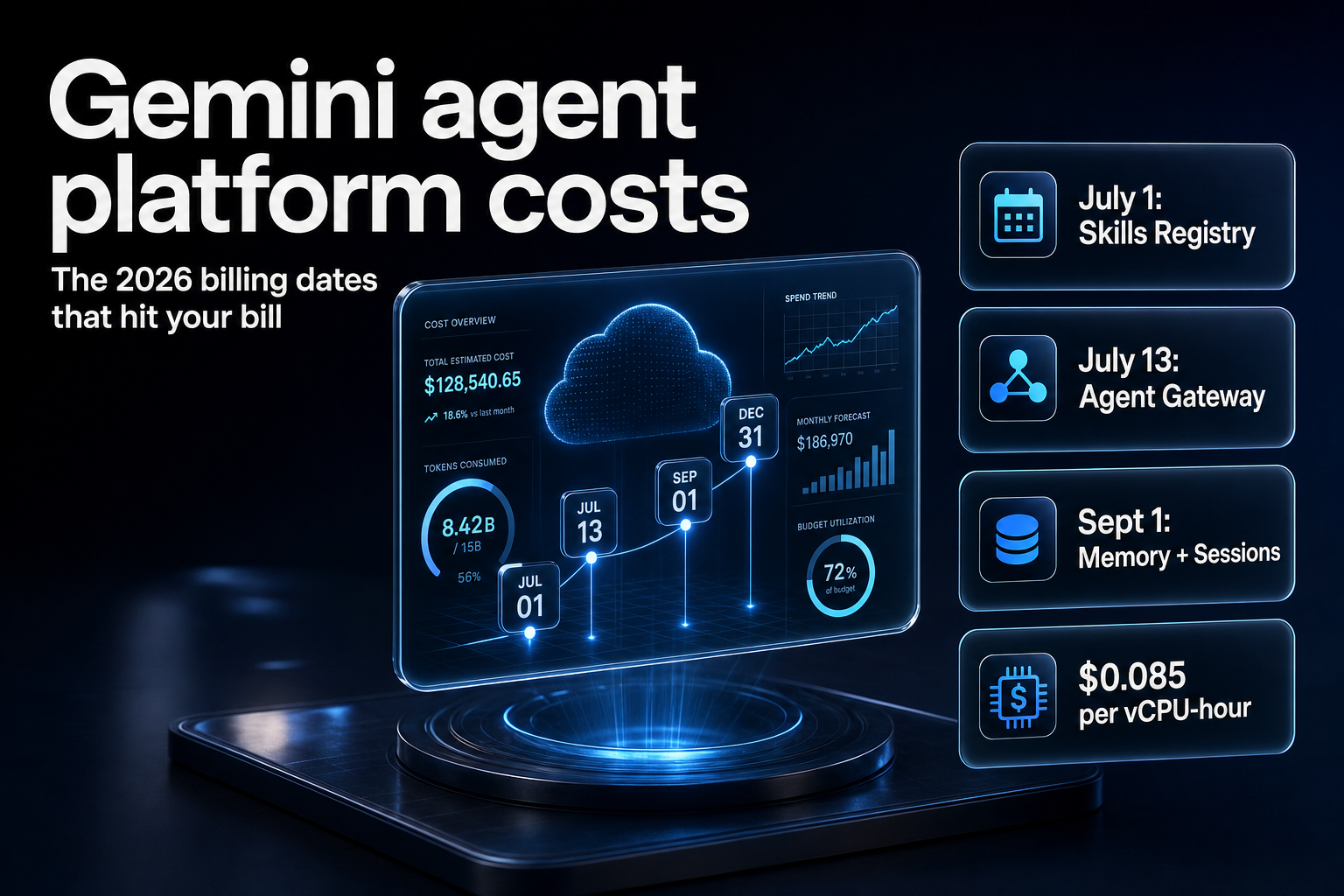
Summary. Between July 1 and September 1, 2026, four agent-infrastructure services on Google Cloud's Gemini Enterprise Agent Platform stop being free and start metering. Skills Registry billing begins July 1, 2026; Agent Gateway (Agent-to-Anywhere) becomes effective July 13; Semantic Governance Policies start August 1; and both Memory Bank and Sessions begin September 1. Each meters on Agent Compute at $0.085 per vCPU-hour, with storage at $0.30 per GiB-month. On top of that sit model tokens (Gemini 3.1 Pro at $2/$12 per million input/output tokens) and seat editions from $21 to $60 per user per month. If you piloted agents while these components were free, your production bill in the second half of 2026 will not match your pilot. This breakdown maps every line item, with the dates, so platform and FinOps teams can budget before the invoices change.
Google Cloud CEO Thomas Kurian describes the product as "the new front door for AI in the workplace." The pricing behind that front door has three separate layers that teams routinely confuse: a per-seat subscription, per-million-token model charges, and per-hour agent-infrastructure metering. Getting the layers wrong is how a pilot that cost a few hundred dollars becomes a five-figure monthly production line item. This is the Gemini Enterprise Agent Platform launch priced out in full.
The three layers you actually pay for
Gemini Enterprise (capital E, the standalone platform formerly called Agentspace) launched in October 2025 and is a Google Cloud product, not a Google Workspace add-on. That distinction matters because the two are billed separately and buyers frequently merge them in a budget line.
The Agent Platform bills across three independent layers:
- Seat subscriptions, charged per user per month, for access to the platform, enterprise search, and the no-code agent builder.
- Model tokens, charged per million input and output tokens, for every call an agent makes to a Gemini model.
- Agent infrastructure, charged per vCPU-hour and per GiB-month, for the memory, sessions, skills, and gateway services that keep an agent running between prompts.
A seat fee does not cover token or infrastructure consumption. Compute stacks on top of the subscription, and for a busy agent the consumption layer usually dwarfs the seat fee. That is the single most common budgeting error we see when teams move an agent from pilot to production.
The 2026 billing calendar: what starts metering, and when
The change that reshapes second-half budgets is not a rate rise. It is that several services which ran free during preview begin billing on fixed 2026 dates. Google's own Agent Platform pricing page lists each one.
| Component | What it meters | Rate | Billing starts |
|---|---|---|---|
| Skill Registry | Storage plus read/write operations | $0.30/GiB-month storage; $0.085/vCPU-h per 1M writes | July 1, 2026 |
| Non-global endpoints | Regional model serving premium | About 10% over global token rates | July 1, 2026 |
| Agent Gateway (Agent-to-Anywhere) | Agent Compute for API and authorization calls | $0.085/vCPU-h, roughly 15,000 calls | July 13, 2026 |
| Semantic Governance Policies | Policy evaluation on agent actions | Agent Compute (vCPU-hours) | August 1, 2026 |
| Memory Bank | Memory storage and operations | $0.30/GiB-month; $0.085/vCPU-h per 1M writes | September 1, 2026 |
| Sessions | Conversation history and state | $0.30/GiB-month; $0.085/vCPU-h per 1M writes | September 1, 2026 |
Read operations are cheaper than writes: one Agent Compute vCPU-hour ($0.085) covers about 3 million read API requests, while the same $0.085 covers 1 million write operations. A free usage tier applies per month, per account, for each resource, so small agents may still land near zero. Production agents that hold long conversations, write memory frequently, or call many external tools will not.
Model token rates on the platform
Every agent turn spends model tokens. The platform prices each Gemini family separately, and the gap between tiers is wide enough that model choice, not agent design, often decides the bill. These are the published per-million-token rates as of July 2026.
| Model | Input ($/1M) | Output ($/1M) | Cached input ($/1M) |
|---|---|---|---|
| Gemini 3.1 Pro | $2.00 | $12.00 | $0.20 |
| Gemini 3.5 Flash | $1.50 | $9.00 | $0.15 |
| Gemini 3 Flash | $0.50 | $3.00 | $0.05 |
| Gemini 3.1 Flash-Lite | $0.125 | $0.75 | N/A |
| Gemini Deep Research Agent | $2.00 | $12.00 | $0.20 |
| Gemini Omni Flash | $1.50 | $9.00 | N/A |
Output tokens cost six to eight times more than input across the Pro and Flash tiers, so a chatty agent that returns long responses is expensive in a way that a retrieval agent returning short answers is not. Cached input is an order of magnitude cheaper than fresh input, which rewards agents that reuse a stable system prompt and context. Two more rules affect the total: if a single request's input context runs longer than 200,000 tokens, all tokens in that request are charged at long-context rates, and a tuned model endpoint costs 1.5 times the base model. For a deeper tier-by-tier view, see our budget LLM tier cost comparison and the note on Gemini 3.6 Flash token efficiency.
Image generation is priced on the same page. Nano Banana Pro (Gemini 3 Pro Image) charges $1 per million input tokens, $6 per million text output tokens, and $60 per million image output tokens, where a 1K or 2K image costs about $0.134 and a 4K image about $0.24. Nano Banana 2 (Gemini 3.1 Flash Image) is cheaper at $0.25 input, $1.50 output, and $30 per million image output tokens.
Grounding and tool calls: the charges agents trigger silently
An agent that searches the web or queries your data spends money outside the token meter. Grounding with Google Search and Web Grounding for Enterprise include 5,000 queries per month at no charge, aggregated across all Gemini 3 models, then bill $14 per 1,000 search queries. That billing started January 5, 2026. One user request can fan out into several search queries, and you are charged for each query performed, not per user request. Grounding with Google Maps follows the same structure. Grounding with your own data is separate at $2.50 per 1,000 prompts.
These tool charges are easy to miss because they do not appear in a token estimate. An agent that grounds every answer against Google Search can quietly pass the 5,000 free queries in a day at moderate traffic, after which each additional thousand queries adds $14. FinOps teams that model only tokens under-forecast the bill. The same discipline that governs agentic FinOps on Azure applies here: meter the tool calls, not just the model.
Seat editions: the subscription layer
The subscription layer has four editions. Google positions them by capability and support rather than by raw usage, and independent pricing trackers report the list rates below. Annual commitment is roughly 17% cheaper than the flexible monthly option, and volume discounts of 10% to 20% are reported above 500 seats.
| Edition | Annual ($/user/mo) | Flex ($/user/mo) | Notes |
|---|---|---|---|
| Business | $21 | $21 | Entry tier for smaller teams |
| Standard | $30 | $35 | Higher quotas and controls |
| Plus | $50 | $60 | Advanced governance and support |
| Frontline | Custom | Custom | 150-seat minimum, deskless workers |
As reported by pricing trackers Coworker AI and GoSearch, the actual cost an organisation pays is rarely the list price, because compute consumption stacks on top and the commit-versus-flex choice swings the per-seat figure by about 17% to 20%. Treat the seat fee as the floor, not the estimate.
A worked budget: pilot versus production
Consider a 25-seat customer-service agent on the Standard edition. The seat layer is fixed: 25 users at $30 annual is $750 per month. If the pilot ran before July 2026, that was close to the whole bill, because Skills Registry, Sessions, and Memory Bank were free.
From September 2026, the same agent in production pays for the infrastructure it uses. Sessions stores every conversation and bills storage at $0.30 per GiB-month plus write operations at $0.085 per million. Memory Bank adds the same structure for retained user memory. If the agent grounds answers against Google Search and clears the 5,000 free queries, it adds $14 per additional thousand. Model tokens depend on the tier: on Gemini 3 Flash at $0.50/$3, a light agent stays inexpensive; on Gemini 3.1 Pro at $2/$12, the same traffic costs four to eight times more per turn. The seat fee did not move. Everything metered on top of it did. That gap between a pre-July pilot and a post-September production run is the number to put in front of finance now.
India-specific considerations
Indian teams face one extra line. From July 1, 2026, non-global endpoint pricing takes effect for the generally available Gemini 3 and later families, and before that date global pricing applied to non-global endpoints. Regional endpoints such as Mumbai (asia-south1) carry roughly a 10% premium over the global rate, so Gemini 3.1 Pro input moves from $0.125 to about $0.1375 per relevant unit on a non-global endpoint.
For regulated entities, that premium is often not optional. The Digital Personal Data Protection Act 2023 (DPDP) and sector rules push banks, insurers, and healthcare providers toward keeping personal data in-country, which means routing agents through regional endpoints and paying the non-global rate. Budget the premium into any India deployment that cannot use a global endpoint, and price agent memory and session storage in the same region. Teams that model everything at the global rate and in USD will under-forecast both the endpoint premium and the rupee cost of a falling exchange rate.
How to keep the agent bill down
The pricing structure rewards a handful of engineering choices, and each one maps to a number on Google's own rate card. None of these is a trick. They are the levers a platform team controls once the July-to-September dates make every service a line item.
Match the model tier to the task. A support agent that classifies and retrieves does not need Gemini 3.1 Pro at $2/$12 per million tokens when Gemini 3 Flash at $0.50/$3 answers the same query. That is a four-to-eight-times swing on every turn, and it is the largest single lever most teams have. Reserve the Pro tier for reasoning that measurably fails on Flash.
Cache the stable context. Cached input on Gemini 3.1 Pro is $0.20 per million against $2.00 for fresh input, roughly a tenth of the cost. An agent that resends the same system prompt and tool definitions on every turn should be caching them. Keep each request under 200,000 tokens, because crossing that line charges every token in the request at long-context rates.
Gate grounding. The first 5,000 Google Search queries each month are free, then every additional thousand costs $14, and one user request can trigger several queries. Decide which agent turns are allowed to ground against the web and which answer from your own data at $2.50 per 1,000 prompts. An always-ground design is the fastest way to blow past the free tier.
Prune sessions and memory. From September 1, 2026, Sessions and Memory Bank both bill storage at $0.30 per GiB-month plus write operations at $0.085 per million. Reads are about three times cheaper than writes per vCPU-hour, so a read-heavy retrieval pattern with a retention limit on stored conversations costs less than one that writes memory on every exchange and keeps it forever. Set a time-to-live on session data and archive what you do not query.
Watch the endpoint and the tuning. Use a global endpoint wherever data-residency rules allow, because non-global endpoints add about 10% from July 1, 2026. Avoid a tuned model endpoint unless a base model genuinely cannot do the job, since a tuned endpoint costs 1.5 times the base rate.
How this compares to the wider market
The billing dates are part of a market-wide shift from free agent tooling to metered agent tooling. OpenAI began charging for agent usage in mid-2026, and other agent platforms increasingly meter runtime, memory, and tools as separate line items rather than bundling them into one fee, a pattern we cover in Bedrock AgentCore production scaling. Google's move to bill Skills Registry, Agent Gateway, Memory Bank, and Sessions puts the Gemini Enterprise Agent Platform on the same footing: the model is one cost among several, and the infrastructure that keeps an agent stateful and connected is now its own invoice.
FAQ
How eCorpIT can help
eCorpIT is a Gurugram-based, senior-led engineering organisation, founded in 2021, CMMI Level 5 and ISO 27001:2022 certified, and a partner of Google, AWS, and Microsoft. We help platform and FinOps teams cost, instrument, and control Gemini Enterprise Agent Platform deployments before the July-to-September billing dates change the invoice. That means modelling the token, grounding, and Agent Compute layers together, choosing the right model tier per agent, and building the metering that keeps a production agent's bill predictable. To pressure-test your agent budget against the 2026 rates, talk to our AI infrastructure team.
References
- Gemini Enterprise Agent Platform pricing — Google Cloud (Agent Compute, Skills Registry, Agent Gateway, Memory Bank, Sessions billing dates).
- Gemini Enterprise Agent Platform generative AI pricing — Google Cloud (per-million token rates, grounding, image models, non-global endpoints).
- Google launches Gemini Enterprise to boost AI agent use at work — CNBC, October 9, 2025.
- Google Cloud announces the dawn of the agentic enterprise at Next '26 — SMEStreet (Thomas Kurian quote).
- Gemini Enterprise pricing 2026, explained — Coworker AI (seat editions, commit versus flex).
- Gemini Enterprise pricing 2026: plans, costs and FAQ — GoSearch (edition list prices, billing dates).
- Gemini pricing in 2026: every model, every plan — CloudZero (model tier and thinking-token context).
- Gemini Enterprise Agent Platform leads enterprise AI governance as OpenAI starts billing for agents — Tech Times, July 19, 2026.
- Nano Banana 2 and Nano Banana Pro are generally available — Google Cloud Blog.
- Google Cloud CEO Thomas Kurian's crowning achievement — Cloud Wars.
_Last updated: July 28, 2026._