On this page · 10 sections
- What actually changed
- What "closing to new customers" means for you
- The BYOI migration path, and what does not carry over
- The generative-BI landscape you are choosing within
- What Amazon Quick costs
- A migration plan that survives contact with production
- India-specific considerations
- FAQ
- How eCorpIT can help
- References
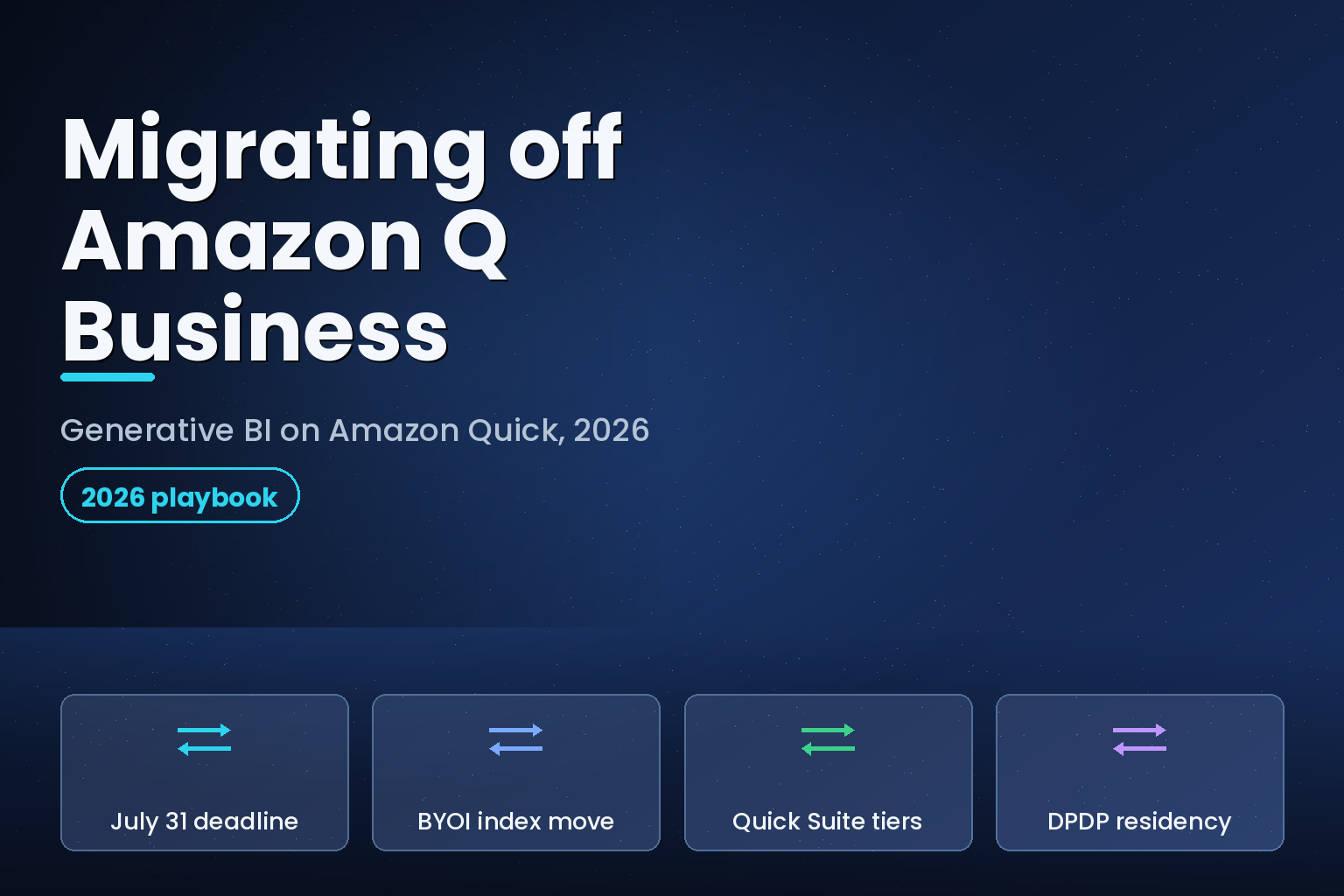
Summary. Amazon Q Business stops accepting new customers on July 31, 2026, and AWS is steering both new and existing generative-AI work to Amazon Quick, the rebranded evolution of QuickSight and Q Business that reached general availability on October 9, 2025. Existing Q Business deployments keep running with bug fixes and security patches, but no new features. The recommended move is Bring Your Own Index (BYOI), a phased migration that connects your existing Q Business index to Quick without downtime. Two limits shape the plan: you can attach a maximum of 2 Q Business indexes per AWS region, and Guardrails, the User Store and Q Apps do not carry over automatically. Quick Suite pricing runs from $3 for Reader to $24 for Author, with Author Pro cut to $40 per month from $50. This playbook covers the deadline, the BYOI path, what breaks, the cost model, and the DPDP checks Indian teams need before moving data.
What actually changed
AWS published the change plainly: Amazon Q Business will no longer be open to new customers starting on July 31, 2026, and anyone who wants to start on it must sign up before July 30. This is a soft sunset, not a shutdown. Existing customers keep a fully supported service with continued bug fixes and security updates, but new feature requests will not be considered. In practice that freezes Q Business as a maintained-but-static product while investment moves to Amazon Quick.
Amazon Quick, often still written as Quick Suite, is where QuickSight business intelligence and Amazon Q's assistant capabilities now live together. AWS positions it as the next evolution of Q Business, with more advanced generative-BI and agentic features: Quick chat for natural-language questions, Quick Research for deeper analysis, Quick Flows for workflow automation, and Spaces for shared knowledge. For teams standing up anything new, AWS recommends building on Quick rather than Q Business from day one.
The decision most enterprises face is not whether to move but when, and how much rebuilding the move requires. That is where the detail matters.
What "closing to new customers" means for you
If you already run Q Business, nothing breaks on July 31. Your applications keep answering, your connectors keep syncing, and AWS support stays in place. What you lose is the roadmap: no new connectors, no new model options, no new capabilities. A maintained product with a frozen feature set is a managed risk, not an emergency, but it is a countdown. The teams that plan a move in 2026 will migrate on their own schedule; the teams that wait until support policy changes will migrate on someone else's.
If you were about to adopt Q Business, the window is effectively closed, and Amazon Quick is the intended starting point. Either way, the target is the same platform, so the planning below applies to both.
The BYOI migration path, and what does not carry over
AWS built a deliberate on-ramp called Bring Your Own Index. BYOI connects your existing Amazon Q Business index to Amazon Quick without disrupting the running service, so users and apps move to Quick at your pace while keeping the index they already have. It supports two authentication models: an IAM Identity Center (IDC) implementation, where both Q Business and Quick authenticate through IAM Identity Center, and a non-IDC implementation that allows native identities, AWS Managed Microsoft AD, and IAM federation, with Quick users automatically granted access to the connected Q Business indexes.
The limits are where migration plans succeed or fail. You can connect a maximum of two Amazon Q Business indexes per region, and that quota cannot be raised. Q Apps do not move automatically; each must be rebuilt manually as a Quick Flow. Most important for security teams, Guardrails and User Store configurations are not part of BYOI and must be recreated in Quick. That last point is the one that quietly breaks access control, because permissions that looked migrated were never actually copied. We cover that failure mode in detail in our note on Q Business to Quick migration ACL gaps.
| Item in Q Business | BYOI behaviour | Action you must take |
|---|---|---|
| Search index | Connected to Quick in place | Attach index, respect the 2-per-region cap |
| Users and app access | Carried through auth model | Choose IDC or non-IDC federation |
| Q Apps | Not migrated | Rebuild each as a Quick Flow |
| Guardrails | Not included in BYOI | Recreate policies in Quick |
| User Store | Not included in BYOI | Rebuild permissions and access rules |
| New connectors and features | Q Business frozen | Adopt on Quick going forward |
The lesson from that table is simple: BYOI moves your data quickly, but your governance and custom apps are a rebuild, not a copy. Budget the migration around the rebuild, because that is the real work.
The generative-BI landscape you are choosing within
Amazon Quick is not the only option, and the honest comparison for a data leader is against the platforms already in the building. By 2026 the feature gap in surface-level generative authoring has narrowed: Amazon Q now matches Microsoft Power BI Copilot for natural-language querying, executive summaries and scenario building, while Databricks Genie leads on structured, SQL-driven analytics grounded in Unity Catalog and Metric Views.
| Capability | Amazon Quick | Microsoft Power BI Copilot | Databricks Genie |
|---|---|---|---|
| Natural-language querying | Yes, Quick chat | Yes, in-report Copilot | Yes, Genie spaces |
| Home data gravity | AWS data and Q index | Microsoft Fabric and Office | Databricks lakehouse |
| Identity model | IAM Identity Center | Microsoft Entra ID | Unity Catalog |
| Entry pricing | $3 Reader to $24 Author | Per-user plus capacity | Consumption on lakehouse |
| Best fit | AWS-centric estates | Microsoft-centric estates | Data and ML-heavy teams |
The platform choice rarely comes from the BI tool itself. It comes from where your data already sits, which identity provider you run, and how your team distributes reports. Many enterprises in 2026 keep data across Databricks, Snowflake and Microsoft at once, and the cross-platform federated query story is still rough, so the tool that sits closest to your warehouse and identity usually wins. If your estate is AWS-centric, Quick is the low-friction answer, and the migration is a modernisation exercise rather than a rip-and-replace. Our cloud FinOps guide for Indian teams covers how to keep that estate's spend under control.
What Amazon Quick costs
Quick Suite prices by role, and AWS adjusted the tiers during the transition. Reader access stays at $3 and Author at $24, unchanged. Author Pro dropped to $40 per month from $50, and Reader Pro at $20 per month now includes Quick Suite Professional capabilities. The Pro tiers are where the generative features, Quick chat, Quick Research and Quick Flows, are gated, so the real budgeting question is how many of your users need Pro rather than plain Reader or Author seats.
For a rough model, a 100-user rollout with 20 Author Pro seats, 30 Reader Pro seats and 50 Readers runs about 20 x $40 plus 30 x $20 plus 50 x $3, roughly $1,550 per month in seats before any underlying data and query costs. That is the licence floor. The variable cost sits in the data platform beneath Quick, which is exactly why data platform engineering belongs in the migration plan and not after it.
A migration plan that survives contact with production
Treat the move as a project with four stages, not a switch. First, inventory: list every Q Business application, Q App, Guardrail, User Store rule and connector, because BYOI will only bring the index. Second, decide the authentication model, IDC or non-IDC, before you touch anything, since it dictates how users land in Quick. Third, connect the index with BYOI in a non-production space, rebuild Guardrails and permissions, and re-create Q Apps as Quick Flows, then test access with real user roles rather than an admin account. Fourth, cut over by seat cohort, validate that report distribution and permissions behave, and only then retire the parallel Q Business path.
The single most common mistake is assuming permissions migrated because the data did. They did not. Verify authorisation with a least-privileged test user on day one of the pilot, not at go-live.
India-specific considerations
For Indian enterprises the migration is also a data-residency decision. The Digital Personal Data Protection Act, 2023 (DPDP) and its 2025 Rules govern how personal data is processed, and any generative-BI tool that grounds answers on customer or employee records is processing personal data by definition. AWS operates the Asia Pacific (Mumbai) and Hyderabad regions, so the practical control is to keep the Q index, the Quick deployment and the underlying data in an Indian region and to confirm that no grounding call routes personal data outside it. The 2-index-per-region cap interacts with this: a multi-region Indian estate may need its index topology planned around residency, not just performance. eCorpIT designs data platforms aligned with DPDP requirements, and this review belongs at the inventory stage, before BYOI connects anything.
FAQ
How eCorpIT can help
eCorpIT is a Gurugram-based, CMMI Level 5 and ISO 27001:2022 certified engineering organisation and an AWS partner that runs Amazon Q Business to Amazon Quick migrations end to end. Our senior-led teams inventory your Q Business estate, choose the authentication model, connect the index with BYOI, and rebuild the Guardrails, permissions and Q Apps that do not carry over, then validate access with least-privileged testing before cut-over. We design the underlying data platform aligned with DPDP requirements so residency is handled before any data moves. If you need to migrate off Q Business or stand up generative BI on Amazon Quick, talk to our engineering team, and see our cloud migration and modernisation service for the broader picture.
References
- Amazon Q Business availability change — AWS documentation
- Bring Your Own Amazon Q Business Index (BYOI) — Amazon Quick Suite documentation
- Reimagine business intelligence: Amazon QuickSight evolves to Amazon Quick Suite — AWS Business Intelligence Blog
- Announcing Amazon Quick Suite: your agentic teammate — AWS News Blog
- Accelerate migration from traditional BI tools to Amazon QuickSight with generative AI — AWS Business Intelligence Blog
- AWS service lifecycle summary as of June 30, 2026 — DevelopersIO
- Comparing Databricks Genie, Microsoft Copilot Studio, and Amazon Q Business — Towards Data Engineering
_Last updated: July 31, 2026._