On this page · 11 sections
- What Google actually shipped on 4 June 2026
- Three things a Search profile does not do
- The announcement that matters more, one day earlier
- Should you ever switch the AI toggle off?
- What Google says to do instead, in its own guidance
- A six-step playbook for sites that cannot get a Search profile
- India-specific considerations
- What we would do first
- FAQ
- How eCorpIT can help
- References
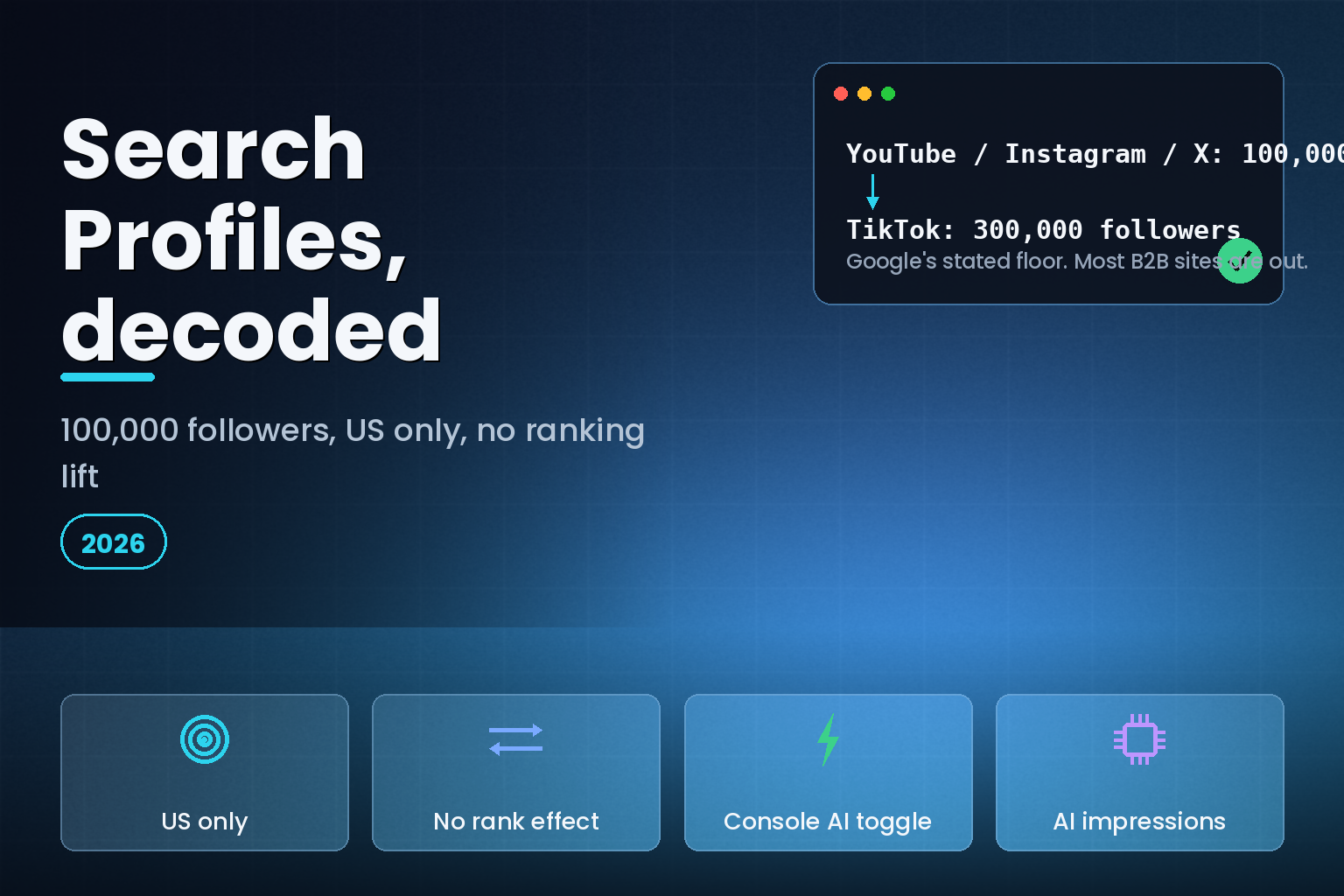
Summary. Google launched Search Profiles on 4 June 2026, and almost no B2B website qualifies. The Help Center sets a hard floor of 100,000 subscribers or followers on YouTube, Instagram or X, or 300,000 on TikTok, on at least one platform, plus a minimum age of 18. Availability is the United States only. Google also answers the question every SEO lead asks in its own FAQ: "Creation of a Search profile doesn't directly affect your content's ranking on Google Search." The announcement that actually changes B2B work landed one day earlier, on 3 June 2026, when Google began testing a Search Console toggle that controls whether a site appears in and helps ground responses in generative AI Search features, alongside new impressions data for AI responses. Those features started rolling out to a subset of website owners in the UK. Scale context from the same post: AI Overviews now has over 2.5 billion monthly active users and AI Mode has surpassed one billion. For Indian marketers deciding where the next budget line goes, Dentsu's 2026 report puts India's total advertising market at ₹1,30,416 crore by the end of 2026, with digital at roughly 61% of it, so the cost of chasing the wrong Google feature is real.
This piece separates the two announcements, states plainly who can and cannot get a Search profile, and sets out what a B2B site should build instead.
What Google actually shipped on 4 June 2026
Ibrahim Badr, Product Manager for Search, described the feature in one line: "Search profiles help publishers and creators shape their presence on Search, and help their audiences better follow their content across the web."
The mechanics, from Google's own announcement and Help Center pages:
- A Search profile is a claimable, shareable page holding a creator's latest articles, videos and social posts, customisable with an avatar, bio, website and platform links.
- It is reached three ways: through a creator's knowledge panel on mobile, by tapping a publisher or creator name on Discover, or through a direct URL at profile.google.com.
- Claiming a profile may trigger the creation of a knowledge panel for eligible creators. An existing knowledge panel is enhanced with the updated avatar, latest content and a direct profile link.
- People can follow a source from the profile, which makes them more likely to see that content on Discover.
- Google may have already generated an unclaimed profile from your online presence. The Help Center tells you to check before creating a new one.
The eligibility bar is where most organisations stop.
| Requirement | Threshold | Where it is stated |
|---|---|---|
| YouTube subscribers | 100,000 | Google Search Help, "Create a new Search profile" |
| Instagram followers | 100,000 | Google Search Help, "Create a new Search profile" |
| X followers | 100,000 | Google Search Help, "Create a new Search profile" |
| TikTok followers | 300,000 | Google Search Help, "Create a new Search profile" |
| Minimum age | 18 years | Google Search Help, "Create a new Search profile" |
| Country availability | United States only | Google Search Help and the 4 June 2026 announcement |
| Platforms needed | At least one qualifying account | Google Search Help, "Create a new Search profile" |
Three operational details are worth knowing before anyone on your team spends an afternoon on this. Your profile handle is set to match your most-followed linked account, and if that handle is taken, the next most-followed platform handle is used. Content from a newly linked social account typically goes live on the profile within 24 hours. And changes to factual information, meaning your name, social links and bio, require Google approval and sit in "Pending" status until reviewed.
Three things a Search profile does not do
It does not improve your rankings. Google's FAQ is unambiguous: profile creation does not directly affect ranking on Google Search. The only stated traffic mechanism is Discover, where someone who follows you from the profile may see more of your content.
It does not surface for generic queries. Google states the profile "is designed to trigger when users are specifically searching for you", and warns that a common name may not display a profile because many others compete for that query. The workaround Google itself suggests is to search your social handle rather than your name. A profile is a branded-search asset, not a demand-capture asset.
It is not a website feature. Search profiles attach to a creator, publisher or brand identity backed by social accounts, not to a domain. If your organisation's audience lives on a company blog, a documentation site and LinkedIn, none of that counts toward the follower thresholds.
The practical result is a narrow qualifying set.
| Who you are | Likely eligible today | What to do |
|---|---|---|
| US creator with 100,000+ YouTube subscribers | Yes | Check for an auto-generated profile at profile.google.com, then claim it |
| US news publisher with a large X or Instagram following | Yes | Claim, link every platform, keep the bio factual to avoid a long approval queue |
| Multi-brand media company | Yes, per identity | Google generates one profile per persona; each needs a separate Google Account |
| B2B SaaS or services firm outside the US | No | Skip it; build the Search Console and citation work below |
| Indian agency, consultancy or product company | No | US-only availability blocks this regardless of following |
The announcement that matters more, one day earlier
On 3 June 2026, Mrinalini Loew, General Manager of the Google Search Ecosystem, published a set of changes aimed squarely at website owners. Three of them change real work.
A generative AI opt-out control in Search Console. In her words: "With this new toggle in Search Console, website owners can decide if they want their site to appear in and help ground responses in our generative AI Search features (like AI Overviews, AI Mode or AI Overviews in Discover)." Google states two consequences plainly. Sites that opt out will not receive traffic or impressions from those generative AI features. And the control will not be used as a ranking signal for search results outside those features.
New AI appearance insights in Search Console. Google is rolling out impressions metrics plus information about which pages appear in AI responses and in what countries, with more metrics promised over time.
A staged rollout. Both are beginning with a subset of website owners in the UK, ahead of a global rollout. Google explicitly ties this to engagement with the UK's Competition and Markets Authority.
That third point sets your planning horizon. If you are in India, the United States or anywhere outside the UK test group, the toggle and the AI insights are not yet in your Search Console, and the correct move is to prepare the decision rather than wait for the button.
Should you ever switch the AI toggle off?
For most sites, no. The trade-off is stark once you write it down.
| Consideration | Opting out | Staying in |
|---|---|---|
| Traffic from AI Overviews and AI Mode | None, per Google's statement | Retained, including inline links and previews |
| Impressions data in Search Console | None from generative AI features | Available through the new AI insights |
| Ranking in classic search results | Unaffected; the control is not a ranking signal outside AI features | Unaffected |
| Grounding your content in AI answers | Blocked | Allowed, with attribution links |
| Reach at current scale | Forfeits exposure to 2.5 billion AI Overviews users | Keeps it |
The only defensible reasons to opt out are legal or contractual: licensed content you are not permitted to expose to grounding, or a paywall business where a cited summary substitutes for a subscription. Even then, model it first. Cutting off a surface used by billions of people monthly to protect a small share of content is a large bet on a small risk. Our earlier analysis of ranking without clicks in AI Overviews covers what citation actually earns compared with a blue link.
What Google says to do instead, in its own guidance
Alongside the 3 June release, Google pointed website owners to updated guidance for improving visibility in generative AI Search features. The emphasis in that guidance is on unique, non-commodity content, sensible content organisation, page experience, and high-quality images and video.
Two things it does not say are worth as much as what it does. Google's AI optimization guidance does not require any special structured data to be eligible for generative AI features, and it does not treat an llms.txt file as a ranking or eligibility input. We covered the second point in detail in whether llms.txt helps SEO on Google, and the wider picture in our guide to optimising for Google's AI search surfaces. If a vendor is selling you an llms.txt implementation -search unlock, that is not supported by Google's published guidance.
Google also brought Preferred Sources into AI Overviews and AI Mode and launched subscription labels in those features, so users can choose which sites they see more prominently. That is a genuine, low-effort win: a site with an engaged audience can ask that audience to set it as a preferred source, and the effect compounds in exactly the surfaces where organic reach is hardest to buy.
A six-step playbook for sites that cannot get a Search profile
- Claim the entity you can actually get. A Search profile is out of reach, but a knowledge panel for your organisation is not, and the same identity signals feed it: consistent naming, an about page, Organization schema, and links to the profiles you do control. Google's own flow shows how tightly profiles and knowledge panels are coupled.
- Instrument for AI impressions before the toggle arrives. The new Search Console insights report impressions and the countries where your pages appear in AI responses. Decide now which pages you expect to be cited, so you have a hypothesis to test on day one rather than a dashboard you stare at.
- Write the things an AI answer cannot compress. Comparison tables with real numbers, dated benchmarks, configuration and code, and original data. Google's guidance asks for unique, non-commodity content, and the commercial reason is the same: a page that can be summarised in two sentences will be.
- Ask your audience to make you a preferred source. It costs one line in a newsletter and it is the only lever that directly changes what a specific user sees in AI Overviews and AI Mode.
- Fix author identity, not just page SEO. Named authors with real credentials, a person page, and consistent bylines are what an AI engine uses to decide whether to trust and cite a source. This is the part of Search Profiles thinking that transfers to B2B: Google is clearly moving toward source-level identity, even where the profile product itself is closed to you.
- Keep a classic-search baseline. The toggle does not affect ranking outside generative AI features, and neither does a Search profile. Nothing in either announcement replaces the fundamentals, so do not let an AI-visibility project consume the budget that keeps ordinary rankings alive.
India-specific considerations
Search Profiles are United States only at launch, and Google has said only that it will "look to expand" to more publishers and creators around the world. For Indian brands, that makes this a watch item, not a work item. Nothing on the Help Center page suggests an India date.
The budget context matters more. The Dentsu e4m Digital Advertising Report 2026 projects India's advertising market at ₹1,30,416 crore by the end of 2026, with digital media taking roughly 61% of that spend. Search visibility work competes for that digital line. An Indian marketing team that spends a sprint chasing a US-only creator feature has spent it on nothing, while the Search Console AI insights, which will reach India after the UK test, will actually tell them which pages get cited.
One more India note. Because Search Profiles are built on linked social accounts, any Indian team that later qualifies should treat the linking step as a data decision, not a marketing one: you are connecting corporate identity to personal accounts, and under India's Digital Personal Data Protection Act 2023 the personal data in those accounts still belongs to the individual. Decide who owns the Google Account before you link anything.
What we would do first
If you run a B2B site and read both announcements this week, the honest priority list is short. Check whether Google has auto-generated a profile for any of your public-facing people, because claiming an existing profile is cheap if it already exists. Then ignore the feature.
Spend the time instead on the two things that are measurable: get your best pages into the shape that earns citation in AI Overviews and AI Mode, and be ready to read the new Search Console AI insights the day they reach your property. The most useful sentence in either announcement is the one nobody quoted: opting out means no traffic and no impressions from generative AI features. That is Google confirming these surfaces are a traffic channel, with data attached, and that you can lose it. Treat it as one.
FAQ
How eCorpIT can help
eCorpIT is a Gurugram technology consultancy founded in 2021, assessed at CMMI Level 5 and MSME certified, working with senior-led content and engineering teams on search visibility for Indian and global clients. We audit which of your pages are shaped to be cited in AI Overviews and AI Mode, rebuild the ones that are not, and set up measurement so the new Search Console AI insights are useful on the day they arrive in your property. We also fix the identity layer, meaning Organization and Person markup, author pages and entity consistency, that AI engines use to decide whether to trust a source. If that is on your roadmap, see our GEO and AEO optimisation service or start a conversation through /contact-us/.
References
Last updated: 22 July 2026.