On this page · 12 sections
- What a GCC costs in India in 2026
- Captive vs BOT vs product partner: the decision
- The per-engineer economics
- The hidden costs most models miss
- Which path fits which company
- Where eCorpIT fits
- The three-year picture for a 20-person team
- How a dedicated team spins up
- India-specific considerations
- FAQ
- How eCorpIT can help
- References
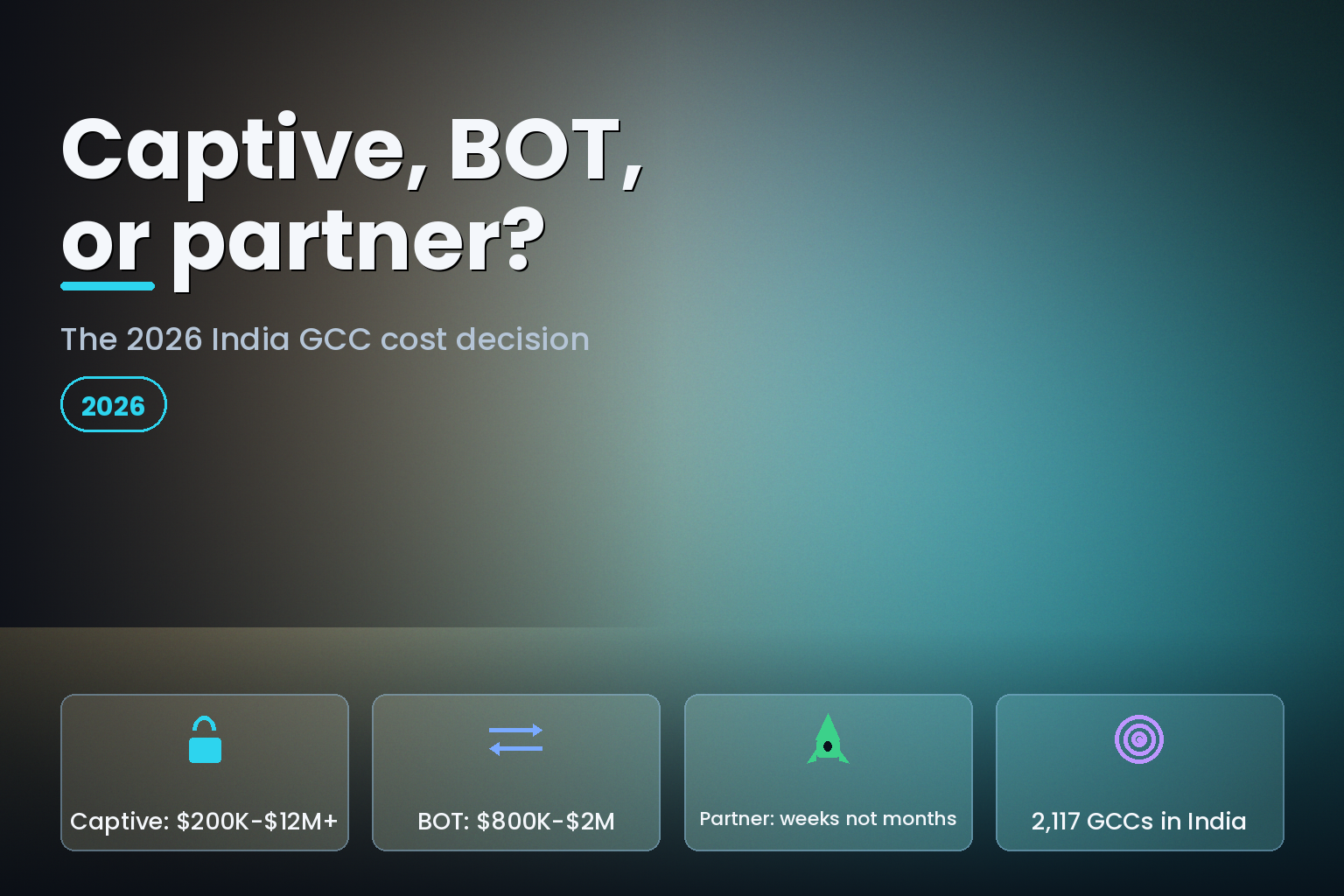
Summary. India now hosts 2,117 global capability centres generating $98.4bn in revenue and employing about 2.36 million people as of FY2026, according to the Zinnov-Nasscom GCC Landscape Report released in May 2026, with the centre count up 32% since FY2021. If you are sizing your own India centre, the sticker varies by an order of magnitude with the model you pick. A full captive setup runs from $200,000 for a 20-to-50-person pilot to $6M-$12M+ for a 300-plus-person operation. A build-operate-transfer (BOT) deal for a 20-to-50-person centre runs $800,000 to $2M across an 18-to-24-month concession before the partner hands it over. Time to first hire is 16 to 24 weeks for a captive, 8 to 16 weeks for BOT, and 4 to 8 weeks for a managed or dedicated-team model. A mid-level Bengaluru engineer earns ₹18-28 LPA in fixed pay, and reported fully-loaded costs land around $25,000 to $80,000 per engineer per year. This article breaks down all three paths so a CTO can pick the one that fits the mandate, not the hype.
The India GCC story in 2026 has moved from scale to ownership. "The centers that get this right will not simply benefit from India's rise. They will be the reason for it," said Pari Natarajan, chief executive of Zinnov, on the release of the report. That ambition is real, and it is also why the setup decision matters more than it used to. A centre built to run a back-office ticket queue and a centre built to own a product need very different structures, and picking the wrong one wastes both money and years.
What a GCC costs in India in 2026
There are three realistic ways to stand up engineering capacity in India, and they price very differently. A captive is a wholly-owned subsidiary you build and run yourself. A BOT hands the build and early operation to a partner who transfers ownership to you after a fixed concession, usually 18 to 24 months. A dedicated-team or product-partner model gives you a ring-fenced senior team inside an existing organisation, with no entity of your own to build.
| Setup path | Indicative cost | Time to first hire |
|---|---|---|
| Captive, pilot (20-50 people) | $200,000 to $3M | 16 to 24 weeks |
| Captive, mid (50-200 people) | $2M to $5M | 16 to 24 weeks |
| Captive, large (300+ people) | $6M to $12M+ | 16 to 24 weeks |
| Build-operate-transfer (20-50) | $800,000 to $2M over 18-24 months | 8 to 16 weeks |
| Managed / dedicated team | Monthly fee, no entity cost | 4 to 8 weeks |
The ranges come from 2026 GCC setup guides and vary with city tier, salaries, infrastructure, and provider margins. Two patterns hold across all of them. First, the captive is the cheapest at very large scale and the most expensive and slowest at small scale, because the fixed cost of an entity, compliance, and management is the same whether you hire 20 people or 200. Second, BOT and managed models trade a higher per-head operating cost for a much lower upfront cost and a faster start, which is why smaller and first-time entrants gravitate to them. For a fuller build-versus-partner walk-through, see our GCC versus product partner build decision for India.
Captive vs BOT vs product partner: the decision
The right model is a function of scale, urgency, and how much of your own governance you want to run on day one. The table below compares the vectors that actually move a decision.
| Dimension | Captive | Build-operate-transfer | Product partner (dedicated team) |
|---|---|---|---|
| Upfront cost | Highest: entity, real estate, compliance | Moderate: partner funds the build | Lowest: no entity, monthly fee |
| Time to market | Slowest, 16 to 24 weeks plus entity setup | Faster, 8 to 16 weeks | Fastest, 4 to 8 weeks |
| Maintenance overhead | You own all of it | Shared, then all yours after transfer | Partner owns HR, facilities, payroll |
| Data and IP control | Full, from day one | Full after transfer; shared during operate | Contractual; strong NDA and access controls |
| Best for | 200+ headcount, permanent strategic mandate | Firms wanting a captive but not the build risk | Product work, pilots, and teams under ~50 |
None of these is universally better. A large enterprise with a permanent mandate and a 300-person plan should probably own a captive, because at that scale the fixed cost amortises and full control is worth it. A company that wants a captive eventually but cannot absorb the build risk now uses BOT to get there. A company that needs to ship a product, run a pilot, or extend an existing team without founding a legal entity uses a dedicated product partner, because the entity overhead buys it nothing. Our guide to a dedicated offshore product engineering team in India covers that third path in depth.
The per-engineer economics
Headline setup cost is the number executives ask for first, but the recurring per-engineer cost is what determines the multi-year bill. In Bengaluru, India's largest GCC hub, fixed compensation for engineers in 2026 sits in the bands below, and Tier-2 cities run meaningfully cheaper.
| Level (experience) | Bengaluru fixed comp | Location and loading notes |
|---|---|---|
| Mid (3-5 years) | ₹18-28 LPA | 10-20% lower in Hyderabad |
| Senior (6-9 years) | ₹30-45 LPA | 20-30% lower in Pune and Chennai |
| Lead or principal (10+ years) | ₹48-70 LPA | Tier-2 hubs cheaper, senior pool thinner |
| Fully-loaded annual cost | reported $25,000 to $80,000 per engineer | Adds facilities, benefits, overhead |
| Derived industry benchmark | about $41,700 revenue per person | $98.4bn over 2.36 million people, FY2026 |
Two caveats keep this honest. Fixed compensation is not fully-loaded cost. Once you add facilities, benefits, employer contributions, equipment, and management, the real per-engineer figure is higher than the salary band, which is why reported fully-loaded numbers span $25,000 to $80,000 and depend heavily on seniority mix and city. And the roughly $41,700 revenue per person is a derived figure, computed by dividing the $98.4bn industry revenue by the 2.36 million headcount, not a published per-employee cost. Treat it as an industry productivity marker, not your budget line. For a direct cross-border comparison, our analysis of India versus US app development cost lays the rates side by side.
The hidden costs most models miss
The spreadsheet a vendor hands you rarely captures the four costs that decide whether a centre actually pays off.
Attrition is the first. Tier-1 hubs like Bengaluru see materially higher attrition than Tier-2 cities, so a centre staffed entirely in a hot market carries a constant rehiring and re-ramping tax that a flat salary model ignores. Ramp time is the second. A newly hired engineer is not productive on day one; the weeks to onboard, context-load, and reach full output are real cost, and they hit hardest when you are building an entity and a team at the same time.
Management overhead is the third. A captive needs its own HR, finance, legal, facilities, and engineering leadership, and for a sub-50-person centre that overhead can rival the productive payroll. Governance drift is the fourth. During a BOT operate phase you often run two governance layers at once, yours and the partner's, which is why BOT frequently costs more per head during the operate phase even though it starts faster and cheaper. A model that quotes only salaries and rent will understate the true cost by a wide margin.
Which path fits which company
Match the model to the mandate. If your India centre is a permanent strategic bet at 200-plus people, and you want full IP control and are willing to spend 16 to 24 weeks plus entity setup before the first hire, build a captive. If you want that captive outcome but cannot carry the build risk or the upfront cash, use BOT and plan for a higher operate-phase cost in exchange for a faster, de-risked start and a clean transfer in 18 to 24 months.
If your goal is to ship a product, validate a pilot, or extend an existing engineering team, and headcount will sit under about 50 for the foreseeable future, a dedicated product partner is almost always the better economics. You skip the entity, the real estate, and the standing overhead, you start in 4 to 8 weeks, and you convert a large fixed cost into a predictable monthly one. Many companies use this path first and only graduate to a captive once the headcount and the permanence of the mandate justify the fixed cost.
Where eCorpIT fits
eCorpIT, founded in 2021 and based in Gurugram, runs the product-partner model: senior-led, multi-disciplinary engineering teams that act as a ring-fenced extension of your organisation without you founding an Indian entity. For companies whose India need is product delivery rather than a 300-person captive, this removes the slowest and most expensive parts of the GCC decision while keeping the talent-cost advantage that draws firms to India in the first place. We are certified for CMMI Level 5, MSME, and ISO 27001:2022, and we work across the AWS, Microsoft, and Google ecosystems.
The three-year picture for a 20-person team
Setup cost is a one-time number; the model you pick is a three-year commitment, so it helps to think in total cost, not sticker. Take a 20-engineer product team as the example most first-time entrants actually plan for.
A captive at that size sits at the expensive, slow end. You pay the pilot-band setup of $200,000 to $3M, then carry the full recurring cost: fully-loaded per-engineer costs reported at $25,000 to $80,000 a year, plus the standing overhead of HR, finance, legal, and facilities that a 20-person centre cannot spread thin. At 20 people that overhead is a large share of the bill, which is why a captive rarely makes economic sense below roughly 50 heads.
A BOT for 20 to 50 people runs $800,000 to $2M across the 18-to-24-month concession, after which the centre is yours. You start faster than a captive and avoid the build risk, but you carry a higher per-head operating cost during the concession because of partner fees and the parallel governance layers. BOT earns its premium when you are confident you want a captive at the end and simply want someone else to absorb the build.
A product partner converts almost all of that into a predictable monthly fee with no entity, no real estate, and no standing overhead of your own. You start in 4 to 8 weeks and the per-head cost is transparent. For a team that stays under about 50 and is focused on shipping product rather than owning a subsidiary, this is usually the lowest three-year total cost, because you never pay the fixed entity and management tax at all. The crossover favours a captive only once headcount and the permanence of the mandate are high enough to amortise that fixed cost. A useful test before committing to any model is to run the three-year total cost for your specific headcount and city, including the hidden attrition, ramp, and overhead costs above, rather than comparing setup stickers alone; the model that wins on upfront cost is frequently not the one that wins over three years.
How a dedicated team spins up
The reason the product-partner path starts in weeks rather than months is that the entity, the office, the payroll, and the compliance already exist. The build is a hiring-and-onboarding exercise, not a company-formation one. In practice the sequence is a scoping conversation to define the roles, seniority mix, and stack; assembling a ring-fenced team from a mix of existing senior engineers and targeted hires; standing up access, security, and source-control under your controls with an NDA in place before any technical detail is shared; and a short ramp where the team context-loads on your product before it is at full output.
The honest trade is control versus speed and overhead. A captive gives you total ownership at the cost of time and fixed overhead. A dedicated team gives you speed and a clean monthly cost at the cost of running the relationship contractually rather than through wholly-owned equity. For product delivery under about 50 people, that trade almost always favours the partner, which is the case we make in our GCC versus product partner build decision for India.
India-specific considerations
Three local realities shape the decision. First, data protection: any India centre that handles personal data operates under the Digital Personal Data Protection Act 2023, so build your data-access, residency, and transfer controls in from the start rather than retrofitting them, whichever model you choose. eCorpIT designs delivery aligned with DPDP Act 2023 requirements. Second, entity and tax: a captive is an Indian subsidiary with its own compliance, GST, transfer-pricing, and statutory obligations, which is real recurring overhead that a partner model absorbs on your behalf. Third, talent geography: Bengaluru carries the deepest senior pool but the highest cost and attrition, while Tier-2 cities such as Pune, Hyderabad, and Chennai cut compensation 10-30% at the price of a thinner senior bench, so the city choice is itself a cost lever worth modelling before you commit.
FAQ
How eCorpIT can help
eCorpIT is a Gurugram-based, senior-led engineering organisation, founded in 2021 and certified for CMMI Level 5, MSME, and ISO 27001:2022, that gives global companies India engineering capacity through a dedicated product-partner model rather than a costly captive build. We stand up a ring-fenced team in weeks, run the HR, payroll, and facilities so you do not have to found an entity, and design delivery aligned with DPDP Act 2023 requirements. For teams that may want a captive later, we help you start delivering now and scale into ownership when the mandate justifies it. To scope an India delivery model that fits your headcount and timeline, contact us.
References
_Last updated: 2 August 2026._