On this page · 12 sections
- The number that reframes the decision
- What the spreadsheet usually misses
- Build versus partner, across the dimensions that decide it
- The breakeven headcount question
- The talent market you are actually entering
- Maturity is now a design choice
- The two clauses that actually decide it
- A decision rule you can apply this week
- India-specific considerations
- FAQ
- How eCorpIT can help
- References
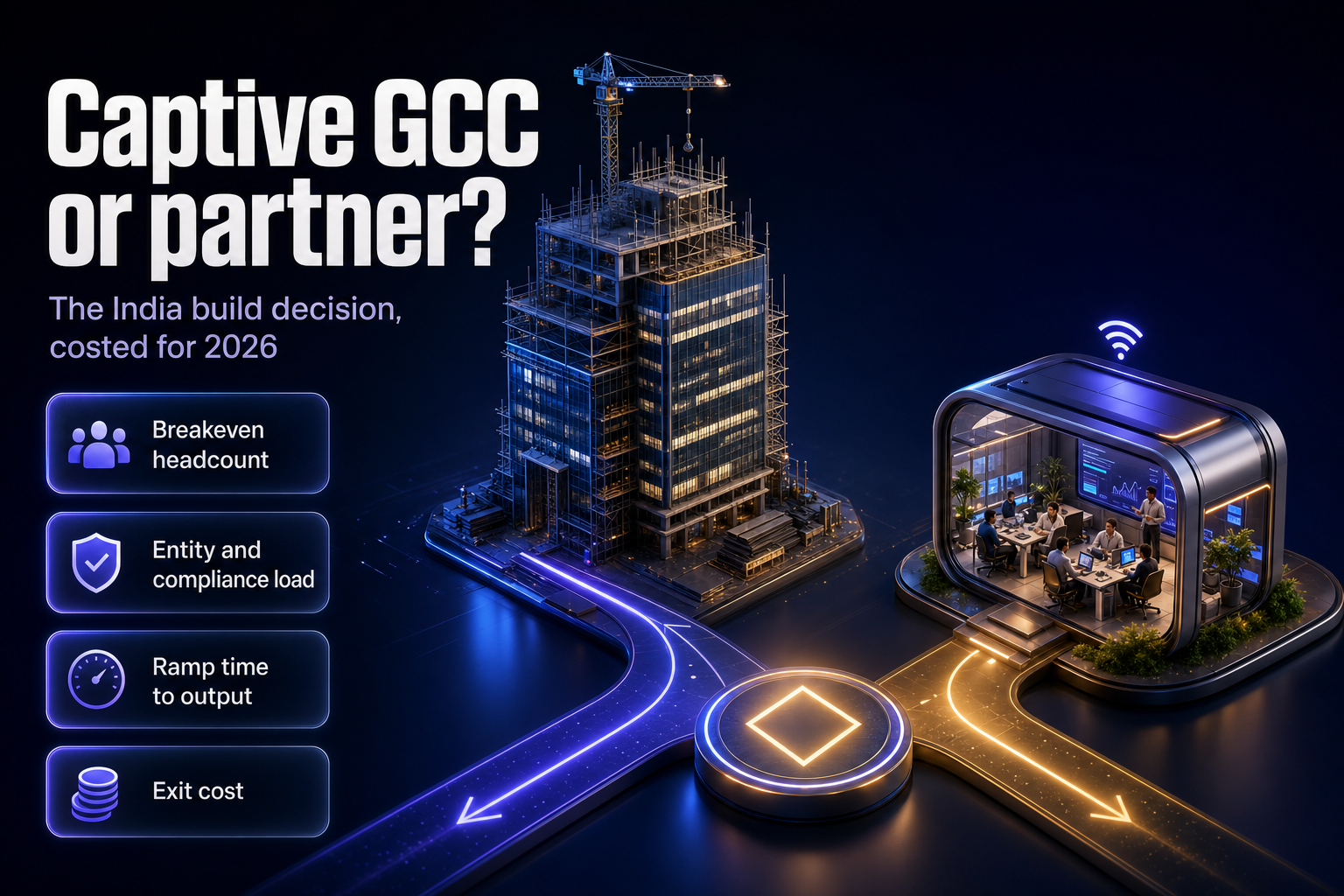
Summary. India ended FY2026 with 2,117 Global Capability Centres across 3,728 units, a talent base of 2.36 million and $98.4 billion in revenue, according to the Zinnov-Nasscom GCC Landscape in India 2026 report released on 6 May 2026. Those numbers matter because of what they were compared against: the September 2024 edition projected 2,100 to 2,200 centres and $99 billion to $105 billion in revenue by 2030. India reached the centre-count range roughly four years early, and landed within $600 million of the bottom of the 2030 revenue band. Meanwhile GCC recruitment is projected at 510,452 jobs in 2026, a 3.4-fold rise since 2021, with 227,991 hires already booked in the first half. If you are a foreign founder or CTO deciding whether to set up a captive entity in India or engage a product engineering partner, you are no longer early. You are entering a market that has already been bid up, and the decision now turns on breakeven headcount, entity and compliance load, ramp time, and what it costs you to leave.
This article is a decision framework, not a sales pitch for either option. Both are legitimate. The framework below is the one we use with clients at eCorpIT, and it produces "build a captive" as the answer more often than a product engineering firm would like.
The number that reframes the decision
Most build-versus-partner content still quotes India GCC figures from 2023 and 2024. Here is the FY2026 picture against the forecast it was measured toward.
| Metric | FY2026 actual | Sept 2024 forecast for 2030 |
|---|---|---|
| GCC count | 2,117 centres | 2,100 to 2,200 centres |
| GCC units | 3,728 units | not stated |
| Revenue | $98.4 billion | $99 billion to $105 billion |
| Talent base | 2.36 million | 2.5 million to 2.8 million |
| Growth since FY2021 | 32% in centre count | not stated |
| Forbes Global 2000 firms with an India GCC | 506 | not stated |
Two of the three headline 2030 targets were effectively met in FY2026. Only the talent base still has room, at 2.36 million against a 2.5 million to 2.8 million projection.
Reuters, reporting the release, attributed the acceleration to higher US visa costs, inflation tied to global conflicts, and AI-led disruption pushing multinationals to move strategic work to India and bring technology functions in-house rather than outsource them. India added or expanded more than 100 GCCs in FY2026, including centres for Anthropic, Eli Lilly, FedEx, Marriott and Lufthansa. North American firms accounted for two-thirds of new setups. In 2026 so far, BASF, eBay and Revolut have announced India expansion or launch plans.
The practical consequence for a company at the decision point: the arbitrage that made a captive obviously correct in 2019 has been competed away in the top cities. You are hiring against 2,117 other centres, 506 of them Forbes Global 2000 names with deeper pockets than yours.
What the spreadsheet usually misses
Most build-versus-partner models compare a fully-loaded cost per engineer against a partner's blended rate, find the captive cheaper at steady state, and stop. The model is not wrong. It is incomplete, because it prices the steady state and ignores four things that dominate the first 24 months.
Entity and compliance load. A captive is a legal entity, not a team. Incorporation, transfer pricing documentation, statutory audit, payroll and provident fund administration, and ongoing corporate secretarial work all continue whether the engineering team ships or not. This cost is close to fixed, which is precisely why it punishes small teams: the same compliance overhead spread across 12 engineers is a very different number per head than across 120.
Ramp time to first output. The clock on a captive starts at entity registration, not at the first hire. Registration, banking, office or co-working commitments, a country lead, and then a hiring funnel that has to compete with the 510,452 GCC roles being recruited this year. A partner engagement starts producing in weeks.
Attrition, which varies more by city than most models allow. In Tier 1 cities attrition runs 18% to 22%, against 8% to 12% in Tier 2 cities, per the foundit Insights Tracker data reported on 1 July 2026. At 20% attrition, a 50-person captive replaces 10 engineers a year, every year, and each replacement carries recruitment cost plus a ramp period during which that seat produces below capacity. A model that assumes stable headcount overstates captive output.
Exit cost. This is the asymmetry nobody quotes. Winding down a partner engagement is a notice period. Winding down a captive means employee separations under Indian labour law, entity closure or dormancy filings, asset disposal, and data migration obligations. If there is a realistic chance you will want out within three years, the exit cost belongs in the model on day one.
The real cost of a captive is rarely the salaries. It is the fixed overhead and the exit option you give up.
Build versus partner, across the dimensions that decide it
| Dimension | Captive GCC | Product engineering partner |
|---|---|---|
| Time to first shipped code | Months, gated on entity and hiring | Weeks, gated on scoping |
| Cost structure | High fixed, low marginal per head | Low fixed, high marginal per head |
| Breakeven | Improves with scale and duration | Better below the breakeven headcount |
| IP ownership | Direct, by employment | Contractual, needs explicit assignment |
| Control over roadmap and process | Full | Shared, governed by the contract |
| Talent competition | You compete directly with 2,117 GCCs | Partner absorbs the hiring risk |
| Attrition exposure | Yours, at 18% to 22% in Tier 1 | Partner's, backfill is their obligation |
| Exit cost | High: separations, closure, migration | Low: contractual notice |
| Data protection accountability | You are the data fiduciary | Shared, needs a processor agreement |
Read that table as a shape, not a scoreboard. A captive wins on the right-hand side of a long time horizon; a partner wins on speed, optionality and absorbed risk. The decision is mostly about where you sit on two axes: how many engineers you will still need in three years, and how certain you are of that number.
The breakeven headcount question
Do not ask "which is cheaper". Ask "at what headcount, held for how long, does the captive's fixed overhead amortise below the partner's margin".
The calculation is straightforward once you stop treating the inputs as constants:
- Take the annual fixed cost of the entity: compliance, statutory audit, transfer pricing, payroll administration, facilities, country leadership. This does not scale with headcount.
- Add fully-loaded per-engineer cost, then inflate it by your expected attrition rate. At 20% attrition with a three-month effective ramp for each replacement, a nominal 50-seat team delivers meaningfully less than 50 seats of output.
- Compare against the partner's rate for the same seniority mix, and apply the same attrition adjustment to zero, because backfill is the partner's obligation.
- Discount the captive's exit cost by the probability you exercise it inside three years.
- Add the ramp gap: months of partner output you would have had while the captive was still incorporating.
Two rules of thumb fall out of that structure. Below roughly a dozen engineers, the fixed entity overhead per head is usually punishing enough that a partner wins on pure cost, before you count ramp time. Above a few dozen engineers held for three years or more, the captive's marginal economics usually take over. The exact crossover depends on your city, your seniority mix, and your attrition, which is why the number should be computed rather than borrowed from a blog.
The honest version of this advice, from a firm that sells the partner side: if you know you need 80 engineers in Bengaluru for the next five years and the work is core to your product, build the captive. We will say that in the first meeting.
The talent market you are actually entering
The hiring data is where the build case gets tested, because a captive's plan is only as good as its ability to fill seats.
GCC hiring is projected at 510,452 roles in 2026, up 3.4 times since 2021, with 227,991 hires in the first half, up 11% year on year. That resilience stands out against a broader white-collar market where overall hiring fell 5% month on month and 9% year on year in June 2026.
Skills have shifted. Nearly two in three new GCC roles created in 2026, 64%, require AI, data science or intelligent automation skills. By function, IT and software development takes 31% of GCC hiring, AI, data science and analytics 18%, engineering and product R&D 16%, and cloud and cybersecurity 11%. AI, data science and analytics is the fastest-growing function at 38% year on year.
Tarun Sinha, CEO of Foundit, framed the shift this way:
"Companies are no longer setting up Global Capability Centres simply to reduce costs. They are building them to develop the AI, engineering and product capabilities that run their global businesses. India offers the depth of talent to do this at scale, and the growing pull of Tier 2 cities shows how far that capability now extends beyond the traditional metros"
Geography is the variable most build plans get wrong.
| City tier | Share of GCC hiring | Year-on-year growth | Attrition |
|---|---|---|---|
| Bengaluru | 30% | up 10% | 18% to 22% (Tier 1) |
| Hyderabad | 15% | up 15% | 18% to 22% (Tier 1) |
| Pune | 12% | up 11% | 18% to 22% (Tier 1) |
| Mumbai | 11% | up 8% | 18% to 22% (Tier 1) |
| Chennai | 9% | not stated | 18% to 22% (Tier 1) |
| Delhi NCR | 8% | not stated | 18% to 22% (Tier 1) |
| Tier 2 combined | 15% | up 23% | 8% to 12% |
Tier 2 cities are growing at nearly twice the pace of the metros, and the attrition gap is the reason. Coimbatore, Jaipur, Kochi, Ahmedabad, Indore, Bhubaneswar and Visakhapatnam are drawing GCC investment on the strength of talent availability and 8% to 12% attrition against 18% to 22% in Tier 1.
Seniority mix matters for a different reason. Professionals with 4 to 10 years of experience take 56% of GCC hiring, split 34% at 4 to 6 years and 22% at 7 to 10 years. Early-career talent at 0 to 3 years takes 30% and is the fastest-growing band at 18% year on year. Engineers with 11 to 15 years account for 10%, and those above 15 years just 4%. If your captive plan depends on hiring a deep bench of 15-plus-year architects, you are bidding for 4% of a market where 506 Forbes Global 2000 companies are also bidding. That is the single most common reason a captive plan slips.
Maturity is now a design choice
The Zinnov GCC Maturity Framework classifies India's centres into four stages, and the FY2026 distribution is worth sitting with: 13% Outpost, 43% Satellite, 39% Portfolio Hub, 5% Transformation Hub. Zinnov describes 27% reaching Portfolio Hub within five years, and frames the broader finding as maturity that once took a decade now being a choice made on day one.
For the build-versus-partner decision, this cuts against the traditional sequencing. The old model was: start a captive as a cost centre, earn scope over years, eventually own a product. If maturity is now designed in from day one, then a captive started as a delivery outpost with no charter to own product is starting in the 13% cohort by choice, and the ceiling there is delivery excellence.
That reframes the question. If you are not prepared to give the India centre genuine product ownership, you are building an Outpost, and an Outpost is the configuration a partner replicates most cheaply.
The two clauses that actually decide it
Beyond cost, two governance questions separate the options in practice.
Intellectual property. In a captive, IP vests through employment contracts under Indian law, which is clean but requires the employment agreements to be drafted correctly rather than copied from a US template. With a partner, IP transfers by contract, and the assignment must be explicit, cover pre-existing and derivative work, survive termination, and flow down to every subcontractor and individual contributor. A vague "work product belongs to client" clause is the most common defect we see in inherited contracts. Ask to see the flow-down language before you sign, not after.
Data protection. India's Digital Personal Data Protection Act 2023 assigns obligations to the data fiduciary, the entity determining the purpose and means of processing. A captive typically makes your India entity part of that chain directly. A partner arrangement needs a processor agreement that defines purpose limitation, security safeguards, breach notification timelines and deletion obligations. Neither structure is inherently safer; the difference is who holds the accountability and whether the paperwork reflects reality. Our DPDP Act engineering playbook for Indian startups covers the notice, consent and retention mechanics, and our DPDP-ready app development approach covers how this lands in an actual codebase. Compliance language matters here: we design systems aligned with DPDP requirements, and no vendor should tell you their product makes you compliant.
A decision rule you can apply this week
Answer five questions honestly.
How many engineers will you need in India in three years? If the answer is under a dozen, or you cannot answer it with confidence, a partner is almost certainly correct. Fixed entity overhead across a small team is the most reliable way to destroy the cost case.
Is the work core to your product, or adjacent to it? Core product ownership held for years favours a captive. Well-defined scope, platform work, modernisation, or a new surface you are still validating favours a partner.
Can you hire the seniority mix you have planned? Check your plan against the market: 4 to 10 years is 56% of hiring, 15-plus years is 4%. Plans that assume a bench of principal engineers usually slip by quarters.
What is your realistic exit probability inside three years? If it is meaningful, price the captive's exit cost properly. Optionality has value and a partner contract is where you buy it.
Which city, and have you priced its attrition? A Bengaluru plan at 30% of national hiring share and 18% to 22% attrition is a different financial model from a Tier 2 plan at 8% to 12%.
A common answer is a sequence rather than a choice: engage a partner to ship while you validate scope and demand, and stand up the captive once the three-year headcount is known and the product charter is real. That path costs a little more in total and removes most of the risk that makes captives fail. It is also how several of the centres in that 2,117 count actually started.
India-specific considerations
Three points that rarely appear in globally-written build-versus-partner guides.
Tax and structuring genuinely affect the answer, and the answer changes by state and by scheme. Zinnov and Nasscom both cite supportive tax policy as a driver of the FY2026 acceleration. Get India-specific tax advice before modelling; a captive's economics can shift materially on structuring decisions made at incorporation, and those are expensive to reverse.
The GCC label is doing less work than it used to. With 3,728 units across 2,117 centres and 583 mid-market GCCs alongside the 506 Forbes Global 2000 names, "we have a GCC" now describes structures ranging from a 15-person outpost to a full transformation hub with CXO mandates. When benchmarking against a peer's India centre, ask which of the four maturity stages it actually occupies before drawing conclusions.
Skills supply is the binding constraint, not headcount supply. With 64% of new roles requiring AI, data or automation skills and that function growing 38% year on year, the competition is concentrated in exactly the profiles most product teams want. Our analysis of the India GCC AI skills gap and reskilling goes into where that gap is widest, and our India versus US app development cost comparison covers the unit-cost side of the same question.
FAQ
How eCorpIT can help
eCorpIT is a Gurugram-based, CMMI Level 5 and MSME-certified technology organisation founded in 2021, working with AWS, Microsoft, Google, Shopify and Kaspersky as partners. Our senior-led, multi-disciplinary teams build and run product engineering for companies that have not yet decided whether India will eventually be a captive, and we design engagements so that transition stays open: documented architecture, explicit IP assignment with full flow-down, and DPDP-aligned data handling from the first sprint. We will also tell you when the numbers say build your own centre, which happens more often than you might expect from a partner. Talk to us about modelling your breakeven headcount against your actual city, seniority mix and three-year plan before you incorporate anything.
References
- Business Standard, India's offshore tech hubs hit $98.4 bn revenue in FY26, says report (6 May 2026)
Last updated: 21 July 2026.