On this page · 9 sections
Summary. India's online travel market is worth USD 25.38 billion in 2026, up from USD 23.34 billion in 2025, and Mordor Intelligence projects USD 38.58 billion by 2031 at 8.74% CAGR. Mobile carried 65.37% of bookings in 2025 and is forecast to grow at 14.39% a year through 2031, which makes the app the product rather than a channel. Online travel agencies hold 81.74% of bookings, so a new entrant is fighting MakeMyTrip, Yatra, EaseMyTrip, Cleartrip and Ixigo on their home ground. Build budgets for a production travel app with a backend commonly sit in the USD 15,000 to 60,000 band over 8 to 16 weeks, and the line item that breaks that budget is almost never the mobile UI. It is supplier integration: a single Amadeus flight search and booking integration typically takes 6 to 10 weeks on its own, and full GDS certification with NDC can exceed USD 15,000 to 25,000 before you have written a screen.
That gap between what founders budget and what the system actually needs is the reason this article exists. Below: what the segments are really worth, the four architectural decisions that set your cost, an honest cost table, and the India-specific requirements around UPI, DPDP and refunds that catch teams building from a global template.
The market, in numbers worth planning against
Mordor Intelligence's India online travel report, last updated 26 February 2026, breaks the market down in ways that should shape a product roadmap rather than just a pitch deck.
Transportation led with 36.24% of the market in 2025, but vacation packages are the fastest-growing service type at 11.24% CAGR through 2031. That matters commercially because take rates on air are structurally thin. If your model is flights-only, you are entering the lowest-margin part of a market where incumbents already run at scale.
Leisure travellers accounted for 66.74% of the market in 2025, while bleisure is the fastest-growing traveller type at 11.46% CAGR. The 31 to 45 age group held 51.24% share; 18 to 30 year-olds are growing fastest at 10.33% CAGR. Geographically, North India led at 33.73%, with West India projected to grow fastest at 13.35% CAGR.
Two of the strongest growth drivers Mordor identifies are engineering requirements, not marketing ones. UPI and digital wallet adoption carries the largest modelled impact on the forecast at around +2.1%, and smartphone penetration in tier-2 and tier-3 cities contributes about +1.2%. In plain terms: instant payment rails and a build that performs on mid-range Android handsets over patchy networks are where the growth is, not another iOS redesign.
The restraints are equally instructive. Escalating customer acquisition costs amid price wars carry a modelled -1.1% drag, and fragmented, unregistered accommodation supply -1.5%. A travel app that cannot acquire users cheaply or source inventory outside the metros is fighting both.
The four decisions that set your cost
1. Where your inventory comes from
This is the single largest cost driver and most build estimates understate it. Three routes exist, and they are not interchangeable.
Global distribution systems, meaning Amadeus, Sabre and Travelport, distribute the majority of global flight inventory sold through third parties. All three now offer modern REST APIs and NDC capability. Direct supplier APIs, meaning individual airline or hotel-chain connections, give better content and margins with far more integration work per supplier. Bed banks and aggregators trade margin for a single connection.
For a new OTA, starting with one GDS and adding a second at scale is the practical path, with Amadeus commonly chosen first for international coverage and developer tooling. Budget 6 to 10 weeks for a first Amadeus flight search and booking integration with a team experienced in REST APIs but new to GDS work, and expect Sabre to take longer given variation in API maturity. Travelport typically requires a commercial agreement before production credentials, with more restricted sandbox access than Amadeus.
NDC deserves its own line in the plan. Airlines are moving to it for richer content and ancillary sales, but each airline's implementation is separate and the standard has multiple versions with uneven adoption. Amadeus aggregates NDC content from participating airlines through its NDC-X programme, which is the difference between one integration and many.
2. the normalisation layer nobody quotes for
Every supplier returns a different shape. Amadeus works in JSON, Sabre mixes XML and JSON, and direct hotel APIs each carry their own schema. Without an adapter layer that normalises every supplier response into one internal model before it reaches the app, supplier number three becomes a rewrite. Build that layer first, on day one, when it is cheap.
The real cost of a travel platform is the adapter layer and the reconciliation logic, not the booking screen.
3. Search performance, which is a caching problem
GDS search APIs return responses in roughly 1 to 5 seconds depending on how many itineraries are searched. Query the GDS live on every user search and your conversion dies on the results screen. Travel apps need a caching and pre-fetch tier between the supplier and the app, with rules for how stale a fare can be before it must be revalidated. Getting that boundary wrong produces the failure every traveller recognises: a price that changes at checkout.
4. What happens after the booking
Cancellations, partial refunds, reschedules, no-shows, supplier-side schedule changes and chargebacks are where travel software genuinely differs from ecommerce. Mordor flags regulatory uncertainty on convenience fees and refund norms as a -0.9% drag on the market, driven by competition and consumer regulators. Post-booking flows are also the largest source of support volume, and they are routinely descoped in a first release, which is exactly why v1 support costs surprise founders.
What it costs, honestly
Ranges below reflect eCorpIT's indicative engagement bands, published on our own site, alongside the integration costs sourced from travel-technology practitioners. Final pricing depends on scope, supplier count, integrations and timeline.
| Build | Indicative range | Typical timeline |
|---|---|---|
| Hotel or property booking app, single supplier | USD 15,000 to 60,000 | 8 to 16 weeks |
| Multi-tenant travel SaaS platform MVP | USD 12,000 to 50,000 | 6 to 14 weeks |
| AI itinerary or support assistant on existing app | USD 5,000 to 30,000 | 3 to 10 weeks |
| Operator dashboard or channel-manager web app | USD 10,000 to 40,000 | 5 to 12 weeks |
| First GDS integration, Amadeus, as a work item | 6 to 10 weeks of the above | runs in parallel |
| Full GDS certification including NDC | can exceed USD 15,000 to 25,000 | supplier-dependent |
Read that last row carefully, because it sits outside the app budget rather than inside it. A founder who has budgeted USD 25,000 for "a travel app" and then discovers certification alone can consume most of it has not been badly quoted; they have been quoted for a different product.
The honest planning advice is to separate three budgets: the application, the supplier integrations, and the first year of operating a system that talks to third parties who change their APIs without asking. Teams comparing offshore and onshore rates for this work will find the trade-offs in our India against US app development cost comparison, and the scoping questions worth asking any vendor are in our mobile app development RFP template.
The hotel side is a different product
Founders often describe "a travel app" when they mean one of two unrelated systems. A booking app faces the traveller. A hospitality platform faces the property, and it is where most of the operational complexity of this sector actually lives.
A hotel or homestay operator needs rates and availability to stay consistent across their own app, their website and every channel they sell through. That is a channel-manager problem: one change to a rate plan has to propagate to multiple distribution partners, and the failure mode is overbooking, which costs a property more than a lost sale. Add a property management system for check-in, housekeeping status, folio and billing, and a rate engine that supports seasonality, length-of-stay rules and last-minute discounting, and the scope is closer to a small ERP than to a consumer app.
Multi-property groups compound it. Role-based access per property, consolidated reporting across a portfolio, and per-property tax handling under GST all arrive at once the moment a chain signs up. Mordor's finding that vacation packages are the fastest-growing service type at 11.24% CAGR points the same direction: the money is moving toward bundles, and bundles need inventory systems that can hold a room, a transfer and an activity together as one reservation.
If you are building for operators rather than travellers, scope the channel manager and the rate engine in phase one and treat the mobile app as the surface on top of them. Doing it the other way round is the most expensive sequencing mistake in this sector.
India-specific requirements that break global templates
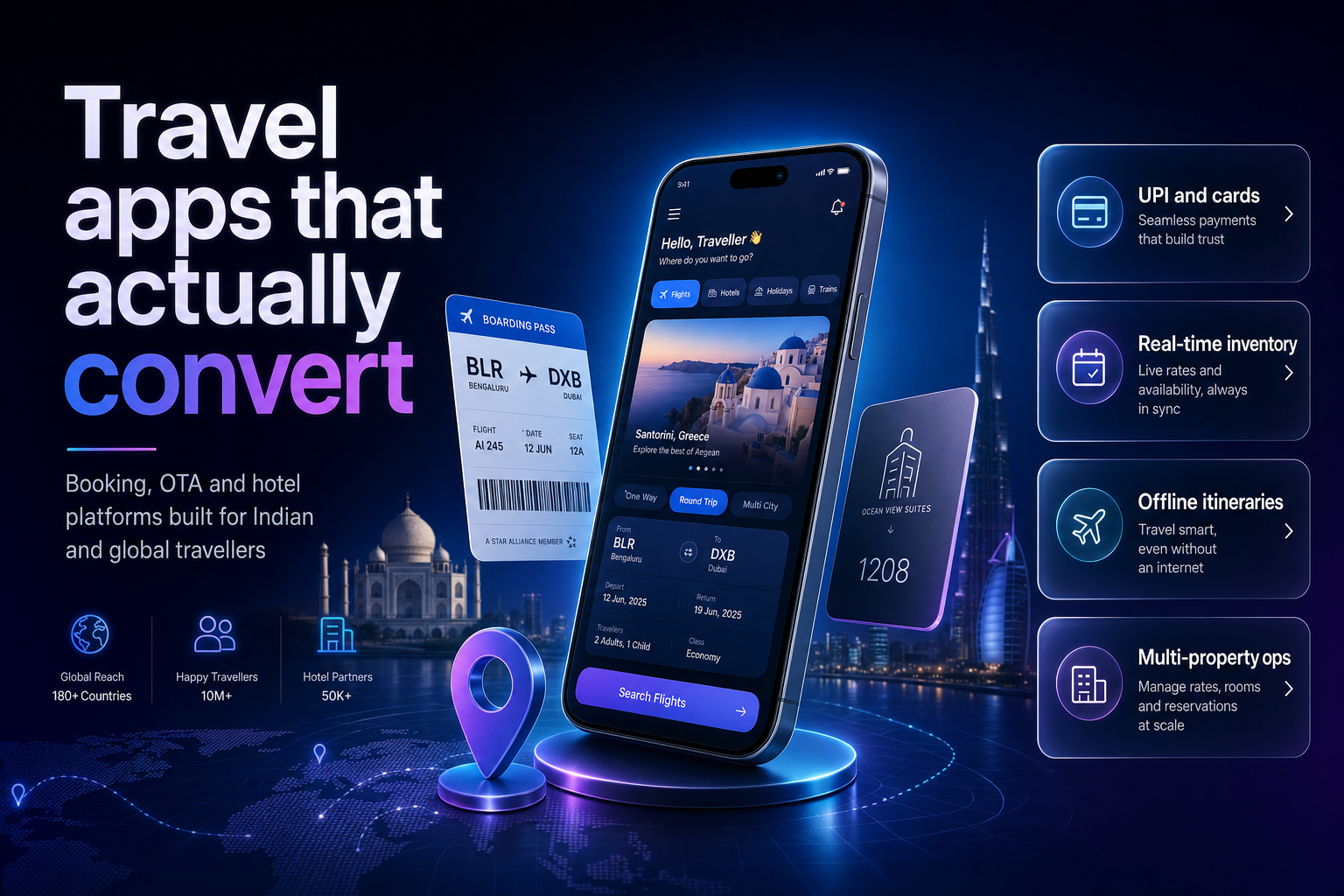
Payments. UPI is not an optional payment method in this market, it is the default expectation, and Mordor models it as the single largest driver of market growth. Travel adds specific complexity: pre-authorisation for hotel bookings, split payments across group travel, EMI on high-value international packages, and refunds that must return to the original instrument within a window travellers now expect to be short. Payment architecture patterns that hold up under this are covered in our fintech and payments app engineering work.
Data protection. Travel platforms hold identity documents, payment credentials and location history, which places them squarely inside the DPDP Act 2023. Passport and government ID capture for international bookings is sensitive processing that needs a defined retention period rather than an indefinite S3 bucket. The engineering obligations are set out in our DPDP engineering playbook for Indian startups. We design applications aligned with DPDP requirements; the compliance determination remains the operator's.
Language and network reality. Growth is coming from tier-2 and tier-3 cities. Both MakeMyTrip and Yatra shipped multilingual AI assistants in August 2025, Myra and DIYA respectively, with Yatra stating support across more than 100 languages. That sets a user expectation your app inherits whether or not you match it. Just as important, the app has to work on a mid-range Android device on an intermittent connection, which means offline itinerary access, aggressive payload trimming and a booking flow that survives a dropped request without double-charging.
Inventory outside the metros. The fragmented, unregistered accommodation supply Mordor identifies as a -1.5% drag is also an opportunity for anyone who solves onboarding for small properties. That is a field-operations product as much as a mobile one: a property owner with one Android phone needs to list rooms, set rates and manage availability without training.
| Requirement | Global template assumption | What India actually needs |
|---|---|---|
| Payments | Cards and one wallet | UPI first, cards, EMI, refunds to source |
| Identity | Email and password | Phone-first auth, ID capture with retention limits |
| Language | English | Hindi and regional languages in the booking flow |
| Network | Stable 4G or better | Offline itineraries, retry-safe booking, small payloads |
| Devices | Recent iPhone | Mid-range Android as the primary test target |
| Inventory onboarding | Chain APIs | Self-serve for small unbranded properties |
How we approach a travel build
eCorpIT has operated from Gurugram since 2021 as a multi-disciplinary engineering organisation, appraised at CMMI Level 5 and MSME certified, with working partnerships including AWS, Microsoft and Google. For travel and hospitality work, our sequence is deliberately integration-first.
We start with a discovery sprint that produces a supplier strategy before a design file, because which GDS or bed bank you connect to determines the data model, the caching rules and half the timeline. Then a design sprint delivers clickable prototypes you approve before code. Delivery runs in two-week sprints with a working build on a live staging URL at the end of each one, which for travel software matters more than usual: you need to watch a real booking flow against a supplier sandbox early, not in month four.
QA on a travel build includes the cases that only exist in this domain. Concurrent booking of the last room. Supplier timeout mid-transaction. Fare change between search and payment. Partial refund on a multi-passenger booking. Those tests are the difference between an app that demos well and one that survives a festival-weekend traffic spike.
Every engagement carries a mutual NDA before technical detail is shared, and full transfer of source code, infrastructure and documentation. Source lands in your repository and infrastructure deploys into your cloud account. If you want to see how we scope this class of work more generally, our guides on choosing a mobile app development company and our Flutter app development practice cover the process and the stack choices in more depth.
Cross-platform is usually the right call here. A travel app is content-heavy and form-heavy rather than graphics-intensive, both Flutter and React Native handle it well, and one codebase across iOS and Android matters when 65.37% of bookings already happen on mobile and your competitors ship weekly.
FAQ
How eCorpIT can help
eCorpIT builds booking platforms, hotel and property management apps, and operator dashboards for travel and hospitality businesses in India and abroad, with an integration-first approach that puts the supplier strategy ahead of the design file. Our senior engineering teams handle GDS and direct-supplier connections, the normalisation layer that keeps supplier number three from becoming a rewrite, UPI-first payment flows, and post-booking logic for refunds and schedule changes. Engagements run in two-week sprints with a working build on a live staging URL, under a mutual NDA and with full transfer of code and infrastructure to you. Contact us for a scoped estimate against your supplier mix and launch date.
References
- India online travel market size, growth and industry forecast — Mordor Intelligence, page last updated 26 February 2026: market size, mobile share, segment shares, drivers and restraints.
- GDS API integration for travel tech: comparing Amadeus, Sabre and Travelport — integration timelines, certification costs and data-format differences.
- How to choose a GDS: Travelport against Amadeus against Sabre — AltexSoft comparison of the three systems.
- Travel API integration in 2026 — API categories and integration specifics.
- Travel agency booking engine guide 2026: GDS, NDC and APIs — booking-engine architecture and NDC adoption.
- Amadeus against Sabre against Travelport: which GDS in 2026 — sandbox access and commercial-agreement differences.
- Travel mobile app development: architecture, tech stack and cost breakdown — architecture patterns for booking apps.
- Travel app development guide 2026 — booking and itinerary app feature scope.
- India OTA market to reach Rs 3,835 billion by FY28 — an alternative market sizing for comparison.
- India online travel and OTA platforms market — Ken Research sizing and OTA share.
- India travel services market analysis, 2026 to 2030 — Technavio forecast for context.
- Penalties and adjudication under India's DPDP Act, 2023 — obligations and penalty bands.
- India data privacy laws: DPDP Act 2023 and DPDP Rules 2025 — phased enforcement dates and retention requirements.
- eCorpIT engagement models and indicative pricing — published build ranges and delivery process.
Last updated: 20 July 2026.