On this page · 9 sections
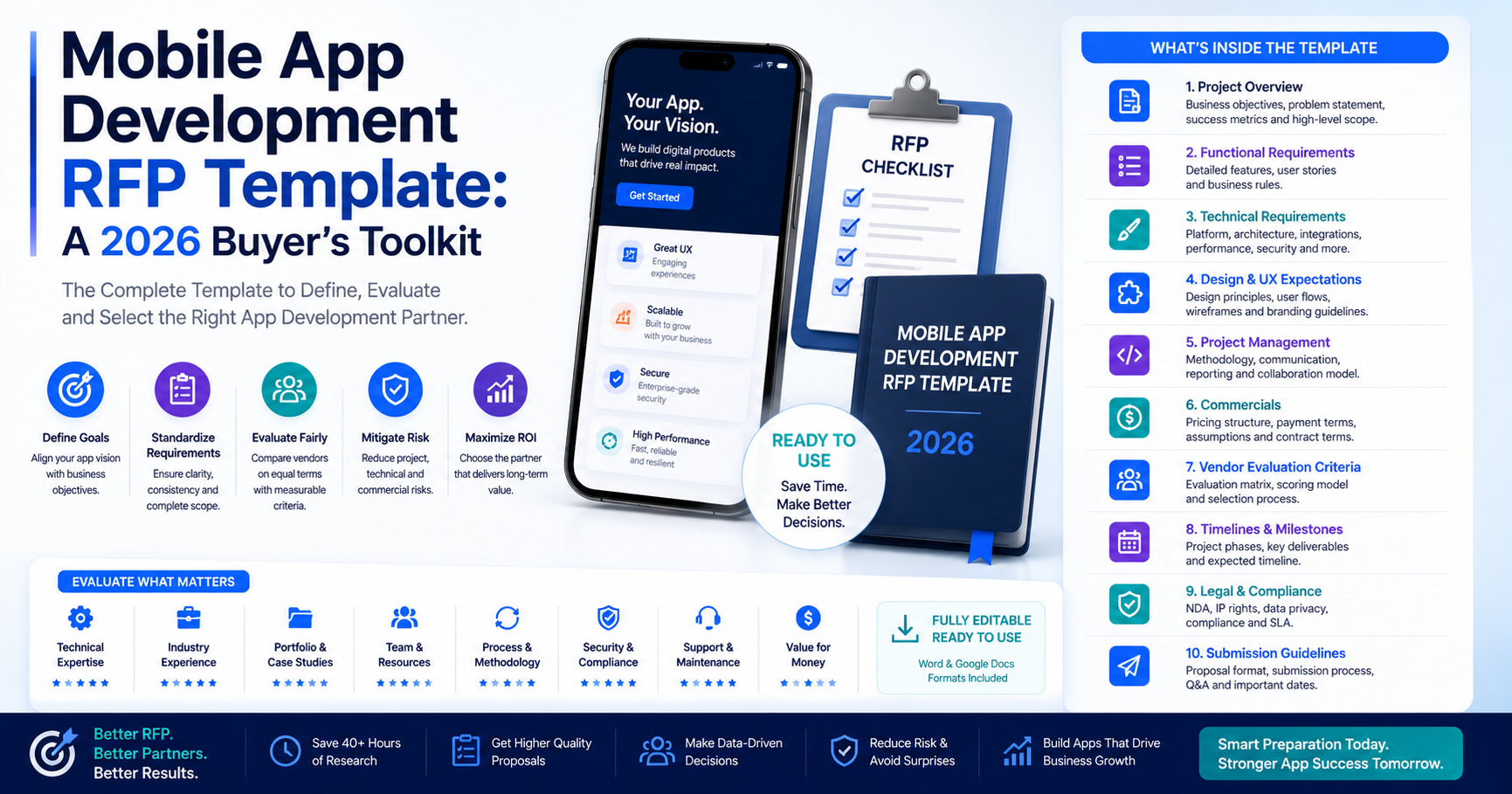
Summary. A good RFP for mobile app development does three things: gives shortlisted vendors enough information to write a useful proposal, asks the questions that filter serious vendors from less-serious ones, and gives your procurement team an evaluation framework they can defend. This template covers the ten sections every mobile RFP needs, with sample wording, a vendor-evaluation scorecard, and the procurement-grade questions that separate senior agencies from volume exporters. Use it as-is or adapt to your specific build.
Talk to eCorpIT about your build · Open the cost calculator
Why most app development RFPs underperform
Three common failure modes that produce worse vendor proposals than a good RFP would.
Too vague to scope. "We want a mobile app for our customers" gives vendors no basis to estimate. The proposals come back with vague pricing ranges and broad timeline windows. The decision becomes a beauty contest of marketing decks.
Too specific to be useful. A 40-page spec with screen-by-screen wireframes and a fixed technology stack tells vendors there is no room for their input. Senior agencies decline; volume exporters bid to the spec without questioning whether it makes sense.
Missing the procurement questions. The RFP asks about price and timeline but skips the credentials, references, IP transfer, and engagement-model questions that separate senior vendors from volume exporters. The shortlist is wrong before evaluation begins.
This template addresses all three. The sections give vendors enough information to estimate concretely while leaving room for their input on stack and approach. The procurement questions are baked in.
The ten sections every mobile app RFP needs
Each section includes the purpose, the recommended wording shape, and the procurement question every shortlisted vendor should answer in their response.
Section 1: Company background and engagement context
Purpose. Tell vendors who you are, what business problem the app addresses, and what success looks like.
Sample wording.
"[Your company] is a [B2B SaaS / D2C brand / healthcare network / fintech] based in [country]. We serve [customer description]. We are issuing this RFP for a mobile app that [primary problem the app solves]. The app's success will be measured by [primary metric: MAU, conversion, retention, NPS, internal-tool adoption]."
Procurement question. "Have you worked with companies in our category before? If so, name two reference clients we may contact."
Section 2: Project scope and required features
Purpose. Give vendors enough information to estimate without prescribing technology choices.
Sample wording.
"The app will include the following capabilities: [list 8–15 core features in plain language, not technical jargon]. The app will integrate with [list 3–5 third-party systems: payment processor, EHR, CRM, analytics]. Out of scope for this engagement: [list what is explicitly excluded]."
Procurement question. "Based on the scope above, what are the three highest-risk technical decisions, and what is your recommendation for each?"
Section 3: Target platforms and audience profile
Purpose. Help vendors recommend native, cross-platform, or single-platform approaches.
Sample wording.
"Target platforms: [iOS only / Android only / both]. Target audience geography: [US / UK / EU / India / global]. Target audience device profile: [premium / mid-market / low-end Android-heavy]. We expect [number] users at launch and [number] at the end of year one."
Procurement question. "Given the audience profile, do you recommend native iOS plus native Android, or a cross-platform framework (Flutter / React Native)? Why?"
Section 4: Compliance and regulatory requirements
Purpose. Filter vendors who can or cannot meet the regulatory perimeter.
Sample wording.
"This build must align with: [HIPAA / UK GDPR + DPA 2018 / GDPR / DPDP Act / PCI-DSS / SOC 2 / FCA operational resilience / NHS DCB0129]. We require [BAA-readiness for HIPAA / FCA-audit-cooperation / SOC 2 sub-processor disclosure] from the engaged vendor."
Procurement question. "Have you shipped production apps under these compliance requirements before? Name two references in our compliance category."
Section 5: Timeline and milestones
Purpose. Set timeline expectations without over-constraining.
Sample wording.
"Target start date: [date]. Target App Store and Play Store submission date: [date]. Required milestones: [discovery + design completion / MVP feature-complete / QA-complete / store submission]. We can adjust timeline by [number] weeks based on vendor recommendation."
Procurement question. "Is the timeline feasible at the scope described? If not, what scope adjustments or team-size increases would make it feasible?"
Section 6: Budget range and engagement model
Purpose. Filter vendors whose pricing model fits your budget.
Sample wording.
"Budget range for the initial engagement: $[lower] to $[upper]. Preferred engagement model: [Fixed-Price project / Time-and-Materials / Dedicated team / Hourly]. We are open to [recommendation if the vendor has a stronger view]."
Procurement question. "At the scope described and within the budget range, what does your team composition and timeline look like? Provide a milestone breakdown."
Section 7: Vendor credentials required
Purpose. Tell vendors upfront which credentials are mandatory.
Sample wording.
"Required credentials: [CMMI Level X / ISO/IEC 27001:2022 / ISO 9001:2015 / D-U-N-S verified / GDPR-aligned DPA / specific industry references]. Required vendor information: [legal entity name, country of registration, years in operation, total mobile engagements shipped]."
Procurement question. "Provide current certification documents (not stale), the issuing body, and the expiry date. Provide your legal entity registration and D-U-N-S number."
Section 8: References and case studies
Purpose. Require named references and category-relevant case studies.
Sample wording.
"Required: 3 named reference clients with named contacts we may call. At least 2 of these should be in our industry [fintech / healthcare / D2C / B2B SaaS / etc]. At least 1 should be a comparable scope to our build. Required: 2 published case studies including the technical challenge, the approach taken, and the measurable outcome."
Procurement question. "We will request a 30-minute reference call with two of the three named references during evaluation. Confirm willingness."
Section 9: IP, security, and contract terms
Purpose. Require vendor to confirm IP transfer and security posture before proposal stage.
Sample wording.
"IP transfer: work-for-hire, fully assigned to [your company] on payment of each milestone. Source repository: under [your company]'s account from project start. Access controls: [ISO 27001-aligned / specified equivalent]. NDA before any technical conversation. Contract jurisdiction: [Delaware / England and Wales / India / etc]."
Procurement question. "Provide your default MSA boilerplate, DPA boilerplate, and NDA template alongside the proposal."
Section 10: Submission instructions and timeline
Purpose. Tell vendors what to submit, when, and how decisions will be made.
Sample wording.
"Submit by: [date]. Submission format: [one PDF, max 30 pages]. Include: executive summary, team composition, estimated timeline and budget, three named references, current certification documents, MSA boilerplate. Evaluation timeline: [shortlist by date], [vendor calls between dates], [final decision by date]. Evaluation criteria weights: [Technical fit X%, References X%, Cost X%, Procurement-credentials X%, Cultural fit X%]."
Procurement question. "Confirm you can meet the submission deadline. Identify the main contact for vendor questions during evaluation."
Vendor evaluation scorecard
A standardised scorecard for evaluating proposals. Each vendor scores 1–5 on each criterion; weight by your priorities.
| Criterion | Weight | Vendor A | Vendor B | Vendor C |
|---|---|---|---|---|
| Technical approach quality | 20% | |||
| Team composition and seniority | 15% | |||
| Named references in category | 15% | |||
| Procurement-grade credentials | 15% | |||
| Cost vs budget | 15% | |||
| Timeline feasibility | 10% | |||
| MSA and IP-transfer terms | 5% | |||
| Cultural fit and communication | 5% |
Adjust weights to your priorities. For a regulated build, increase compliance and credentials weights. For a fast MVP, increase timeline weight.
Common RFP mistakes to avoid
Six patterns that produce worse vendor proposals.
Over-specifying the technology stack. Tell vendors the constraint (audience, performance, integration), not the technology. Let them recommend Flutter vs React Native vs native based on your constraint. The wrong stack chosen by you is more expensive than the right stack chosen by the vendor.
Asking 50+ questions. RFPs that exceed 30 pages of questions get either short-circuited or filled with marketing boilerplate. Pick the 15–20 questions that matter most.
Fixed scope without flexibility. Some flexibility on scope unlocks better vendor recommendations. "These 12 features are core; these 6 are optional and we welcome input" works better than "all 18 are non-negotiable."
No budget range. Vendors who do not know your budget either bid too high (and get eliminated) or too low (and ask for more later). A range like "$80K–$120K" gives vendors enough information to scope honestly.
Anonymous references requested. Anonymous Fortune 500 references are not useful. Named clients with named contacts are.
No evaluation timeline. Vendors who do not know when decisions will be made deprioritise the RFP. State the evaluation milestones explicitly.
How to compress the RFP timeline
Standard RFP cycles run 6–12 weeks from issue to vendor selection. Several compression options exist.
Pre-RFP discovery calls (1–2 weeks). Pre-qualify 4–6 vendors before issuing the RFP via 30-minute calls. Issue the RFP only to vendors who pass pre-qualification.
Concurrent legal review. Run MSA review in parallel with proposal review, not sequentially. Saves 2–4 weeks.
Truncated reference-call process. Two reference calls per shortlisted vendor in week 4, decision in week 5.
For most US and UK mid-market builds, a compressed RFP cycle of 4–5 weeks is feasible without sacrificing rigour. For enterprise procurement with mandatory committee reviews, the standard 6–12 weeks may be unavoidable.
Frequently asked questions
A short closing note
A good RFP saves money on both sides. Vendors write better proposals when the scope and constraints are clear. Buyers make better decisions when the evaluation criteria are explicit. The template above is the version we have refined across hundreds of mobile-app engagements. Use it as-is or adapt to your specific build.
If you want help running the RFP process — or if you want to skip the RFP entirely and just have the discovery call — that is what we do.
Further reading
- Top Mobile App Development Companies 2026 · Best FinTech App Developers 2026 · Best Healthcare App Developers 2026
References
Page last reviewed by Manu Shukla, Founder, eCorpIT, on 30 May 2026. Next review: August 2026.