On this page · 9 sections
Summary. India's proptech market was worth about $1.31 billion in 2025 and is projected to reach $3.82 billion by 2034 at a 12.26% compound annual rate, and the buyers you are chasing are already mobile-first: roughly 78% of real estate platform traffic comes from phones, and about 80% of buyers use online tools for comparisons and virtual walkthroughs. Building an app is now a competitive baseline, not an experiment. A functional real estate app costs roughly $15,000 to $25,000, a mid-tier build with custom search and maps $25,000 to $50,000, and a multi-role platform with virtual tours and integrations $70,000 and up, over a 3 to 6 month timeline. Two rules decide whether it ships or stalls: every listing and agent must satisfy RERA, and every buyer record falls under the Digital Personal Data Protection Act, 2023. This guide covers the features, the real numbers, the compliance, and where AI genuinely helps.
Why an app is the baseline in 2026
The demand signal is unambiguous. Indian proptech startups raised over $550 million across 32 major deals in 2025, and proptech now accounts for more than 6% of the country's recognised startups. Residential is the biggest slice of the market at about 58% of applications, and West India, led by Mumbai's commercial hub and Pune's tech corridor, holds roughly a third of activity at 33.2%. Growth is broad, not a single-city story.
Buyer behaviour drives it. Smartphones now reach about 85.5% of Indian households, roughly 78% of property-platform traffic is mobile, and around 80% of buyers run comparisons, virtual walkthroughs and eligibility checks online before they call anyone. A brokerage or developer without a credible app is handing that pre-sale journey to an aggregator. The question for founders is no longer whether to build, but what to build and what it costs.
What a buyer-grade proptech app must include
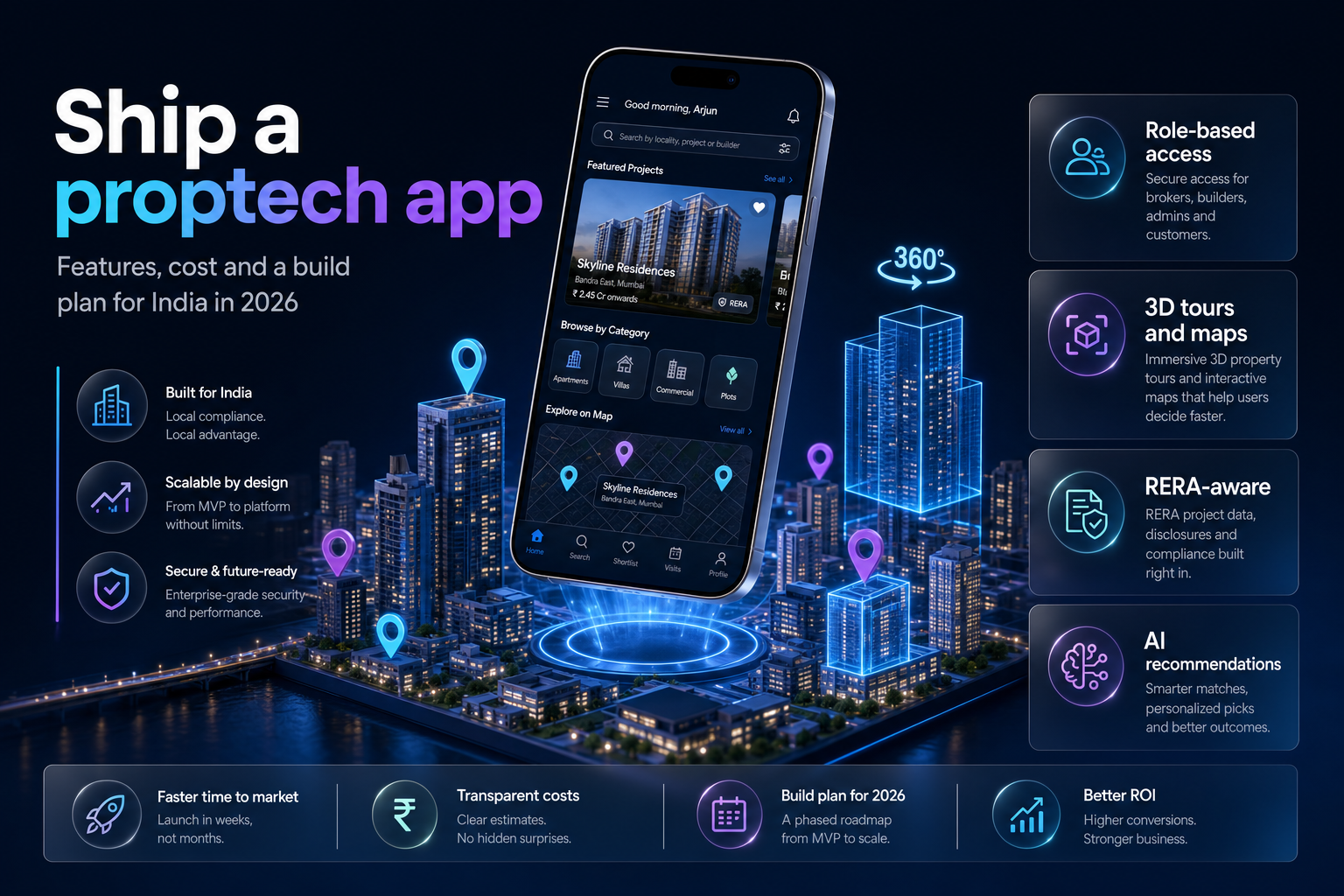
A real estate app is a multi-sided product. It serves buyers and renters, sellers and owners, agents, and an admin team, and each role needs its own permissions and workflow. Skimp on any side and the marketplace stalls. The table below maps the core modules to their build impact.
| Feature area | What it does | Build impact |
|---|---|---|
| Role-based access | Separate flows for buyers, sellers, agents, admin | Core scope, sets the architecture |
| Search and map discovery | Filters, geolocation, map pins, saved searches | Core; map and geo add integration work |
| Rich media | 360-degree tours, video walkthroughs, image galleries | Adds roughly $6,000 to $15,000 with CDN and compression |
| 3D floor plans | Interactive plans and virtual staging | Higher-tier feature, specialist assets |
| Documents and e-sign | Uploads, KYC, agreements, digital signatures | Pulls in DPDP obligations |
| RERA and verification | Registration numbers, verified listings | Compliance-critical, not optional |
| Lead capture and CRM | Enquiries, agent assignment, follow-up | Drives the commercial return |
The rich-media layer is where expectations have moved fastest. Virtual tours and video walkthroughs are now a default buyer expectation rather than a premium add-on, and doing them well, with proper compression and content-delivery, is what separates a fast app from a slow one. The real cost is usually the media pipeline and the integrations, not the listing screens.
What it actually costs to build
Published 2026 ranges for the Indian and offshore market cluster into three tiers. A basic app with essential listing, search and enquiry features runs about $15,000 to $25,000. A mid-tier build that adds custom search, maps and richer user interaction sits around $25,000 to $50,000. A feature-rich platform with multiple roles, deep integrations and virtual tours crosses $70,000 and scales from there. In rupee terms those tiers are roughly ₹13-21 lakh, ₹21-42 lakh, and ₹58 lakh and up, though currency movement makes any conversion approximate.
Two levers move the number. First, developer rates: experienced Indian teams typically charge $20 to $50 per hour, well below Western rates, which is why so much proptech engineering is delivered from India. Second, the technology choice. A cross-platform framework like Flutter can deliver both iOS and Android from one codebase at roughly 60% to 70% of the cost of two separate native builds, a large saving for an early product where speed to market matters. Our comparison of the India versus US app development cost picture and the Flutter versus React Native hiring decision both go deeper on this trade-off.
| Build tier | Indicative cost (USD) | Typical timeline | Best for |
|---|---|---|---|
| Basic listing app | $15,000-$25,000 | 3-4 months | MVP, single-city launch |
| Mid-tier with maps | $25,000-$50,000 | 4-6 months | Growing brokerage or portal |
| Multi-role platform | $70,000 and up | 6 months and up | Funded proptech, virtual tours |
For most first-time founders, the honest advice is to ship the basic tier as an MVP, prove demand in one market, then fund the richer features from real usage rather than guesses. The pattern in our guide to mobile app development for startups applies directly to proptech.
RERA and DPDP: the compliance you cannot skip
Real estate is regulated, and an app inherits that. Under the Real Estate (Regulation and Development) Act, developers, builders and agents must register with their state RERA authority before advertising, marketing or selling property, and a registered agent must display the RERA registration number in every property advertisement. Agents register under Section 9, and that registration is valid for five years. The penalty for facilitating a sale without registration is real: Section 59 sets a fine of ₹10,000 for every day of default, extendable up to 5% of the property's cost.
For an app, that translates into concrete product rules. Listings should surface RERA registration numbers, verified projects should be distinguishable from unverified ones, and agent onboarding should capture and display registration details. Because each state runs its own RERA portal, a multi-state app needs to handle state-by-state registration data rather than a single national field.
Then there is personal data. A property app collects names, phone numbers, financial eligibility details and identity documents, which places it squarely under the Digital Personal Data Protection Act, 2023. Consent capture, purpose limitation, data minimisation and the ability to honour deletion requests should be designed in from the first sprint, not retrofitted. We build to these requirements as standard, and our note on DPDP-ready app development in India explains the engineering pattern.
Where AI actually helps, and where it does not
The useful AI features in proptech are specific. Recommendation engines that rank listings by a buyer's behaviour lift engagement. Automated valuation models give an indicative price band from comparable sales, useful as guidance rather than gospel. A conversational assistant can answer availability and eligibility questions and qualify leads before an agent picks up. Document parsing can read uploaded papers and pre-fill KYC. Each of these is a bounded, measurable feature.
What does not help is bolting a generic chatbot onto a listings feed and calling it intelligent. AI features carry data-flow and cost implications, especially when they call a hosted model with a buyer's personal details, so they belong inside the same DPDP boundary as the rest of the app. Our guide to on-device versus cloud AI for mobile apps covers how to make that call without leaking data or overspending.
How eCorpIT builds proptech apps
eCorpIT is a Gurugram-based technology organisation, founded in 2021 and assessed at CMMI Level 5, with senior-led, multi-disciplinary teams and MSME certification. We work with cloud and platform partners including AWS, Microsoft and Google, and we build cross-platform and native mobile apps end to end: discovery and scoping, UX, engineering, the media and maps pipeline, compliance, and post-launch support.
Our proptech approach is deliberately staged. We define the smallest buyer-grade release that proves demand, build it on a cross-platform stack where that saves cost without hurting the experience, and design RERA handling and DPDP controls in from the start. We instrument lead capture so the app earns its keep commercially, and we add virtual tours, valuations or recommendations once the core marketplace works. It is the same senior-engineer discipline we bring to ecommerce app development, applied to real estate.
FAQ
How eCorpIT can help
eCorpIT designs and builds real estate and proptech apps for the Indian market, from a first buyer-grade MVP to a full multi-role platform with virtual tours, valuations and RERA-aware listings. Our senior-led teams handle scoping, engineering, the maps and media pipeline, and DPDP-aligned data controls, and we stay on for maintenance after launch. If you are planning a property app and want a realistic scope and cost, talk to us about a short discovery.
References
- IMARC Group — India PropTech market size and forecast
- IREED India — PropTech in India 2026: the complete guide
- Startup India — What is PropTech and why it is a sector to watch
- Expert Market Research — India Proptech market report
- IncorpX — RERA agent registration in India 2026
- MahaRERA — Guidance for agents
- Acquaint Softtech — PropTech software development guide 2026
- WebMobTech — Real estate app development cost 2026
- Emizentech — Real estate app development cost
_Last updated: July 18, 2026._