On this page · 10 sections
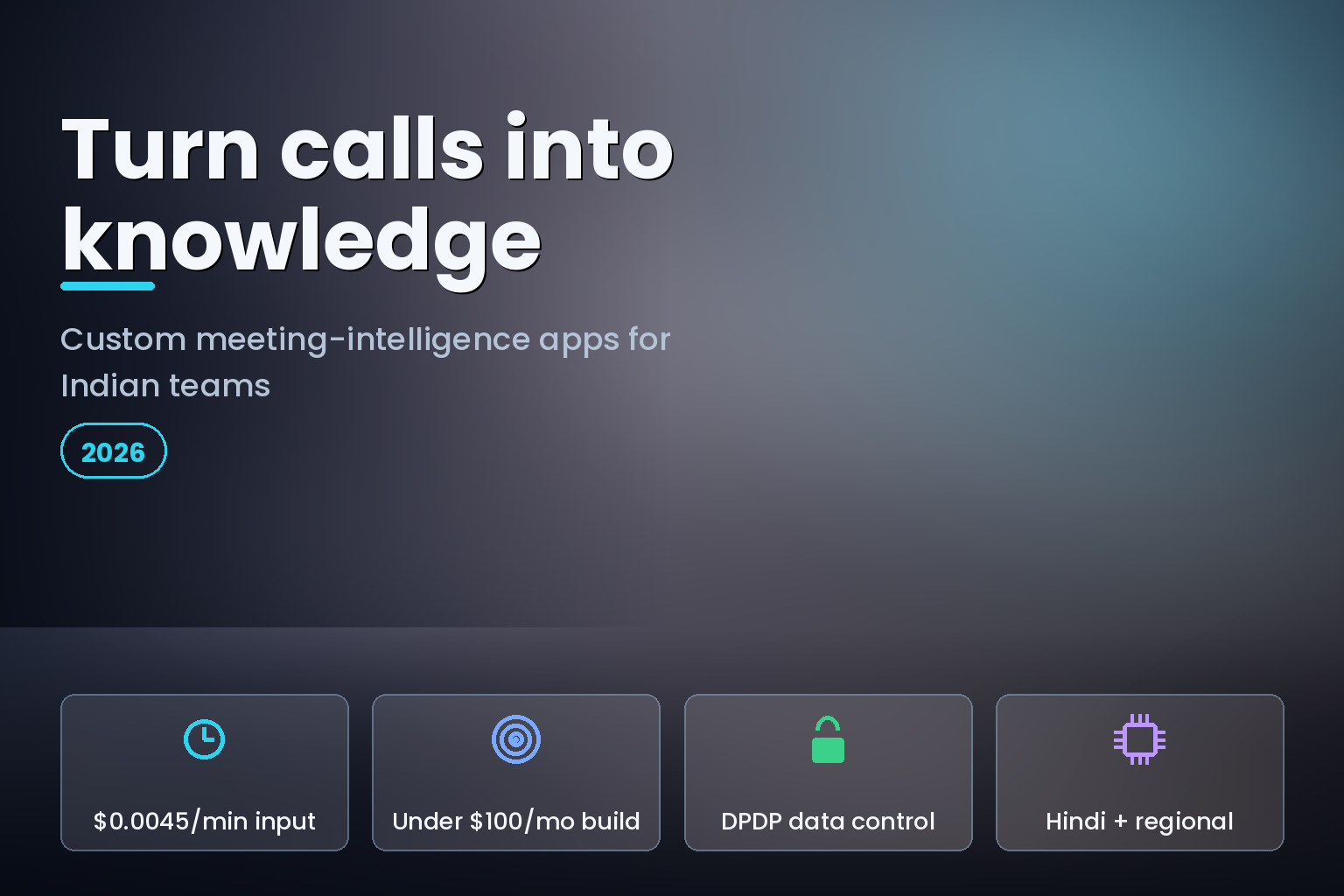
Summary. Two 2026 numbers changed the maths on meeting-intelligence software. Transcription dropped to $0.0045 a minute with OpenAI's GPT Transcribe, released on 28 July 2026, while enterprise conversation-intelligence platforms such as Gong still charge roughly $1,300 to $1,600 per user per year plus a platform fee between $5,000 and $50,000. The conversation-intelligence software market grew from $28.54 billion in 2025 to $32.25 billion in 2026, a 13% rise, and the narrower AI meeting-assistant segment is forecast to grow at 25.8% a year through 2033. For an Indian SaaS, BPO or sales team, that gap between a $0.0045-per-minute input cost and a per-seat price of ₹1 lakh-plus a year makes building a custom meeting-intelligence app a real decision, not a fantasy. This guide lays out the off-the-shelf options and their prices, the true variable cost of building, the build-versus-buy tradeoffs including DPDP data control and Indian-language support, and how eCorpIT approaches the build.
A meeting-intelligence app records a call, transcribes it, separates who said what, summarises it, makes it searchable, and pushes the result into a system your team already uses, a CRM, a ticketing tool, a dashboard. The value is not the transcript. It is that call knowledge stops evaporating the moment the call ends.
The problem: call knowledge evaporates
Sales calls, support calls, discovery calls and internal reviews carry the highest-value information a team produces, and most of it is lost within a day. People take partial notes, forget commitments, and cannot search across hundreds of past conversations for the one objection that keeps recurring. For a BPO or an inside-sales team running thousands of calls a month, that is a large, invisible loss.
Off-the-shelf tools solve part of this, and for many teams buying one is the right answer. The question is when buying stops making sense, either on cost, on data control, or on fit, and building becomes the better option. That decision turns on real numbers, so start with what the tools cost.
The off-the-shelf options and what they cost
The market splits into two tiers: lightweight note-takers priced per user, and enterprise revenue-intelligence platforms priced per seat plus a platform fee. Prices below are as of mid-2026.
| Tool | Tier | Indicative price (2026) |
|---|---|---|
| Otter.ai | Note-taker | Free 300 min/month; paid from $8.33/user/month |
| Fireflies | Note-taker | ~$10 Pro, $19 Business, ~$39 Enterprise per user/month |
| Fathom | Note-taker | Free unlimited transcription; Teams $29/month |
| Gong | Revenue intelligence | ~$1,300 to $1,600 per user/year plus $5,000 to $50,000 platform fee |
For a small team that just needs notes, a $10-per-user note-taker is hard to beat and you should buy it. The economics change at two points: when you reach enterprise scale where seat pricing compounds, and when your requirements, data residency, Indian-language accuracy, deep workflow integration, fall outside what a US-built product offers. That is where a custom build earns its place. The pricing figures here are drawn from 2026 comparisons by Granola and Nimit AI.
Why building is now viable: the transcription price drop
Building used to mean paying a premium for speech-to-text. That premium is gone. The table shows current per-minute transcription rates; the full analysis is in our GPT Transcribe vs GPT Live Transcribe cost comparison.
| Model | Provider | Mode | Price per minute |
|---|---|---|---|
| GPT Transcribe | OpenAI | Batch / file | $0.0045 |
| GPT Live Transcribe | OpenAI | Streaming | $0.017 |
| gpt-4o-mini-transcribe | OpenAI | Batch / file | $0.003 |
| Voxtral Transcribe V2 | Mistral | Batch / streaming | $0.003 |
Put those into a real workload. Ten sales reps averaging 20 hours of calls a month is 12,000 minutes. Transcribed with GPT Transcribe at $0.0045 a minute, that is $54 a month, roughly ₹4,600. Add large-language-model summarisation and the recurring cost still lands under $100 a month for the whole team. Compare that with ten Gong seats at roughly $1,400 each a year, about $14,000 or ₹12 lakh a year, before the platform fee. The recurring economics favour a build heavily at scale. What a build adds is an upfront engineering cost, which is the real tradeoff, and which we scope per project rather than quote blindly.
Build vs buy: the decision
Cost is only one axis. The honest comparison weighs four vectors: time-to-market, upfront cost, ongoing cost, and data control.
| Vector | Buy off-the-shelf | Build custom |
|---|---|---|
| Time-to-market | Days | Weeks to a few months |
| Upfront cost | Near zero | A defined one-time build |
| Ongoing cost | Per-seat, compounds with headcount | Low variable cost (transcription plus LLM) |
| Data control and DPDP | Data sits with a third-party, often overseas | You choose storage, region and retention |
| Indian-language accuracy | Variable; tuned for English | Can use Bhashini and India-tuned models |
| Workflow and CRM fit | Prebuilt integrations only | Built around your exact workflow |
The pattern is clear. Buy when you need it this week, your volume is modest, and English notes in a third-party cloud are acceptable. Build when seat costs have outgrown a one-time investment, when call recordings carry personal or regulated data you must keep in India, or when regional-language accuracy and deep workflow fit decide whether the tool gets used at all. This is the same build-versus-buy logic we apply for healthcare in our ambient AI medical scribe build-vs-buy analysis.
What a custom meeting-intelligence app includes
A production build is more than a transcription call. The components that matter: audio capture across phone, video conferencing and mobile; batch or streaming transcription depending on whether notes must appear live; speaker diarisation to separate participants; large-language-model summarisation with action items and decisions; full-text and semantic search across the archive; and integration into the CRM, dashboards or ticketing the team already runs. On mobile, this is a genuine application-engineering job, which is why it sits inside our enterprise mobile app development practice rather than a scripting task.
The engineering judgement worth stating plainly: the hard part is never the transcription API. It is the diarisation quality on overlapping Indian-accented speech, the retention and consent design, and the CRM sync that makes the output actually get used. Budget for those, not for the speech-to-text.
India-specific considerations
Three factors decide a build in India. First, language: calls are rarely clean English. Hindi, English and a regional language mix inside one conversation, and general US-tuned transcription degrades on that. Pairing a strong general model with India-tuned speech systems matters, which is the approach in our multilingual voice agents on Bhashini work.
Second, data protection. Call recordings are personal data, and often carry financial or health details. Under the Digital Personal Data Protection Act 2023, that processing needs a lawful basis, defined retention, and breach-notification readiness. A custom build lets you keep audio and transcripts in an Indian region and set your own retention, which a third-party overseas tool may not. eCorpIT designs applications aligned with DPDP Act 2023 requirements; we do not claim a compliance certification we do not hold.
Third, cost structure. Indian teams run high call volumes on tighter budgets, so a low variable cost per minute beats a per-seat price that compounds with every new hire. That is the exact shape of the 2026 opportunity.
How eCorpIT builds it
eCorpIT is a Gurugram-based technology organisation founded in 2021, with senior-led, multi-disciplinary engineering teams and CMMI Level 5, MSME and ISO 27001:2022 certifications. We build the app end to end: model selection benchmarked on your own call audio, transcription and diarisation, summarisation and search, CRM and dashboard integration, and a DPDP-aligned data design for storage, consent and retention. As partners of AWS, Microsoft and Google, we deploy on the cloud and region you require. Our engagement model is a scoped, fixed-outcome build followed by support, sized to your call volume and integrations rather than a per-seat licence.
FAQ
How eCorpIT can help
eCorpIT builds custom meeting-intelligence and transcription apps for SaaS, BPO and sales teams across India, from model selection benchmarked on your own audio through DPDP-aligned storage, diarisation, summarisation and CRM integration. As a CMMI Level 5, ISO 27001:2022 certified organisation founded in 2021 and partnered with AWS, Microsoft and Google, our senior engineering teams scope a fixed-outcome build sized to your call volume rather than a compounding per-seat licence. To weigh build versus buy for your team and get an indicative scope, talk to our team or explore our AI voice agent development service.
References
- Meeting note tool pricing: Granola vs Fireflies vs Fathom vs Otter — Granola, 2026.
- Conversation intelligence software global market report 2026 — Research and Markets.
- AI meeting assistant market size and share report, 2026-2033 — Grand View Research.
- OpenAI transcription guide — OpenAI API documentation.
- gpt-transcribe model page — OpenAI API documentation.
- GPT Transcribe pricing and benchmarks — The Decoder, 29 July 2026.
- Voxtral Transcribe 2 — Mistral AI newsroom.
- Meeting AI cost comparison 2026 — SummarizeMeeting.
- 9 best AI meeting assistants in 2026 — Read AI.
_Last updated: 30 July 2026._