On this page · 9 sections
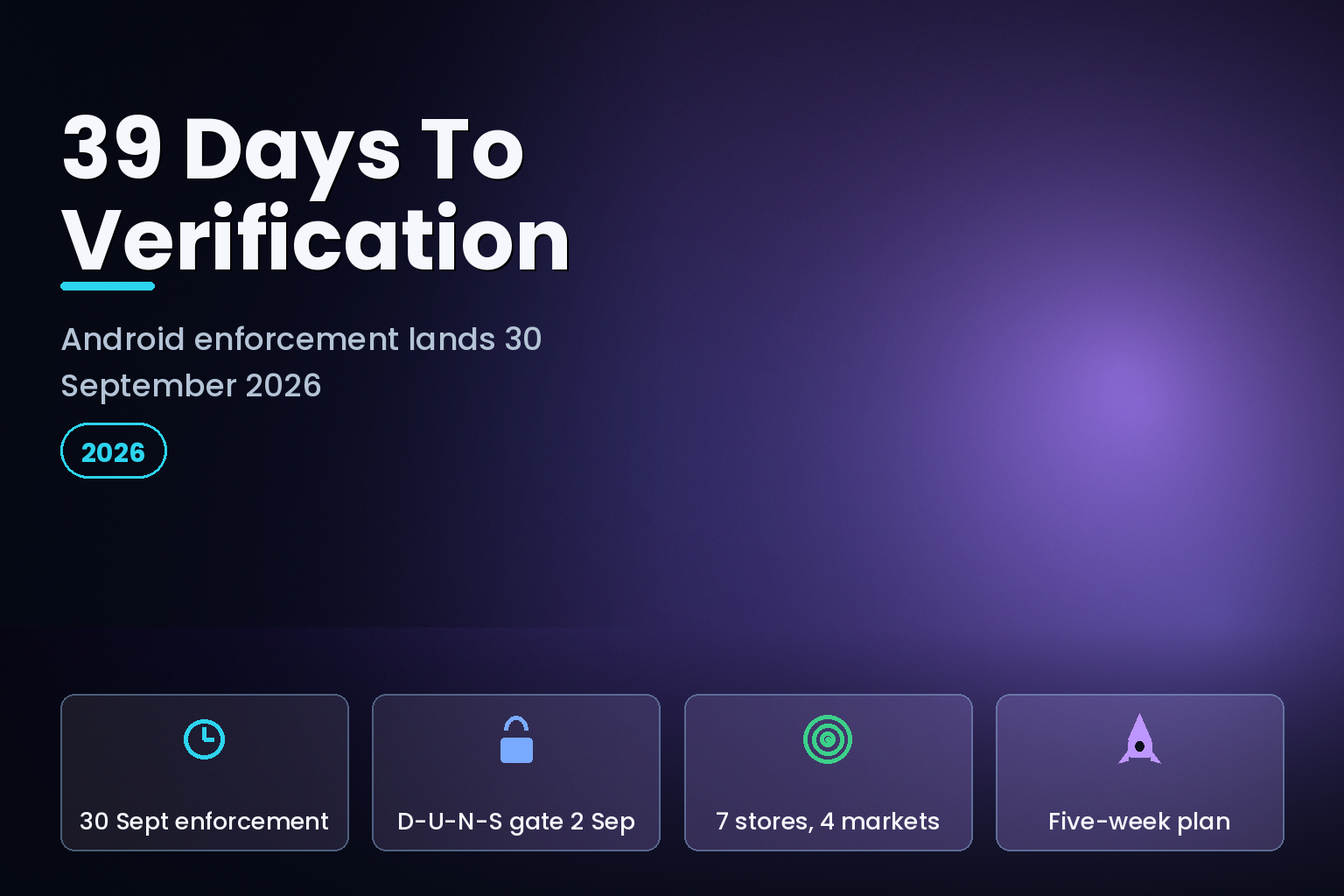
Summary. Android developer verification starts being enforced on 30 September 2026 for users in Brazil, Indonesia, Singapore and Thailand, across 7 participating app stores, on all certified Android devices running Android 7 or higher. Google's Android Developers Blog post of 18 June 2026 lists the stores: Google Play, HONOR App Market, OPPO App Market, Galaxy Store, Palm Store, V-Appstore and GetApps. Two dates matter more than the headline one. A D-U-N-S number, required to register as an organisation, can take up to 28 days to issue, so an Indian company starting the paperwork in late August is already tight. And a 15 July 2026 update to the same post warns Play developers that apps left unregistered by 30 September 2026 face removal from Google Play globally, not only in the four launch markets. Registration through the Android Developer Console costs a one-time $25 for a Full Distribution account, about ₹2,400 at the US$1 = INR 95.26 reference rate India Briefing used in May 2026, and is waived for Limited Distribution accounts.
"This rollout is an industry-wide effort to create a safer ecosystem," wrote Matthew Forsythe, Director Product Management, Android App Safety at Google, in the announcement. For an Indian studio with apps in Jakarta, Bangkok, Singapore or Sao Paulo, that industry-wide framing has a practical translation: the same registration record now has to satisfy seven different stores at once.
Where the calendar stands on 22 August 2026. Thirty-nine days remain until enforcement. That is five weeks and four days, which is why the six-week plan this page originally carried no longer fits and has been rebuilt below as a five-week one. The binding constraint is not engineering effort, it is the D-U-N-S lead time: Google's FAQ still states the Dun & Bradstreet process can take up to 28 days, so an organisation that has not started the application has until roughly 2 September 2026 before the paperwork alone can miss the date. Eleven days of slack, and none of it compressible. Everything else on this page can be run in parallel; that one item cannot.
What actually changes on 30 September
From that date, the seven stores below will verify app installations in the four launch markets. Apps whose developers have not registered are blocked from installing by users on certified Android devices in the applicable regions.
Store | Operator | Why it matters for Indian publishers ---|---|--- Google Play | Google | Primary channel; unregistered Play apps risk global removal, not just regional blocking Galaxy Store | Samsung | Preinstalled on Samsung devices, so it is rarely the channel you opted into GetApps | Xiaomi | Ships on Xiaomi hardware; check whether your APK reaches users through it OPPO App Market | OPlus | Operated by OPlus; in scope for all four launch markets V-Appstore | vivo | In scope alongside OPPO; the two often ship on sibling hardware HONOR App Market | Honor | In scope; a separate registration surface from Play Palm Store | Transsion | Reaches entry-tier Transsion devices; easy to overlook in a Play-first plan
Three scope limits are worth knowing before anyone panics. Enforcement in this phase applies only to those stores; if you distribute through a store not on the list, or users sideload your app directly, the requirement does not apply yet. For distribution outside Google Play, enforcement in the selected regions covers mobile and tablet form factors only, though Google recommends registering everything to future-proof availability. And if you distribute on Google Play at all, your apps across all form factors must be registered, which is the sentence most teams skim past.
Devices in sanctioned countries are excluded from verification checks. Apps distributed through an organisation's own store to managed devices do not need to complete verification, because the IT admin has vetted them, though Google still recommends registering them so installs stay smooth if the app ever arrives from another source.
Global expansion follows in 2027. Treat the September date as the dress rehearsal, not the deadline.
The five things that actually delay teams
Most of this process is a form. The delays come from five specific places, and four of them are outside your engineering team's control.
The D-U-N-S number. Registering as an organisation requires a D-U-N-S number, the nine-digit business identifier from Dun & Bradstreet. It is free, and Google's FAQ states the process can take up to 28 days. Counting 28 days back from 30 September puts the last safe application date at 2 September 2026 — eleven days from this update. If your Indian entity does not already have one from an Apple Developer Program enrolment, this is the long pole and it belongs to finance or company secretarial, not to the mobile team.
Signing key custody. If you use Play App Signing, Google already has what it needs and your eligible apps are part of the automatic registration process. If you hold your own keys, someone has to produce them. Google's FAQ is blunt about the failure case: lose your signing key and you cannot register your packages. There is no recovery path. For studios that inherited apps from a previous vendor, or that shipped an app in 2019 and have not touched the keystore since, this is where the week disappears.
Package name collisions. If a package name is already in use, you may be told your key is not eligible to claim it. Google's guidance is to consider a different package name. You can request registration of a contested name, but it goes to additional review and that package name may also be used by other developers. Changing a live app's package name is not a rename; it is a new listing, a lost install base and a new set of deep links. Check every package you own now, while changing one is still cheap.
The forgotten apps. Over 99% of apps on Play have been registered automatically, which is exactly why the remaining fraction is dangerous: nobody is looking for it. The white-label build for one enterprise client, the regional variant, the app a marketing team shipped in 2021 under a different account. These are the ones that trip the global removal warning.
Multiple accounts. Studios that ship for clients often have apps scattered across several Play Console accounts, some owned by the client. Registration status is per account. There is no single dashboard across accounts, so the inventory has to be assembled by hand, once, and then kept.
The five-week plan that still fits
The original version of this page set out six weeks. Thirty-nine days is five weeks and four days, so the plan below is compressed to five and the sequencing has changed: the D-U-N-S application no longer sits inside week one alongside the inventory, it moves to day one on its own, because it is the only step whose duration you do not control.
Week | Dates | What to do | What breaks if you skip it ---|---|---|--- Day 1 | by 2 Sep | Start the D-U-N-S application if you do not already hold one. Nothing else on this list is allowed to delay it | Up to 28 days of dead time, with no way to compress it and no appeal 1 | 25-31 Aug | List every Play Console and Android Developer Console account your organisation or clients control, then build the package inventory: every package name, its store, its signing key location and its owner | Forgotten apps stay forgotten until they are removed 2 | 1-7 Sep | Confirm signing key custody for every package not on Play App Signing; retrieve keystores from vendors and archive them properly | A package you cannot sign is a package you cannot register, permanently 3 | 8-14 Sep | Register through Play Console for Play apps and the Android Developer Console for everything else; resolve any package-name conflicts | Contested names go to review, and review is not something you can schedule 4 | 15-21 Sep | Wire the Android Developer ID Status API into CI so every build checks its own registration state | The next new package ships unregistered and nobody notices 5 | 22-29 Sep | Verify status in all three surfaces, then re-check the four launch markets against your store list | You find out on 1 October, from a support ticket
If you are reading this after 2 September and have no D-U-N-S number, the honest answer is that organisation registration may not complete in time. The fallback is not to hurry the application; it is to check whether your in-scope apps can register under an existing Play Console account, which carries the identity you already provided, and to treat the D-U-N-S path as work for the 2027 global phase instead.
The week four step is the one that separates a fix from a process. Google is shipping two APIs for this. The Android Developer ID Status API checks package name eligibility and registration status. The Android Developer Console API provides programmatic access for registering package names and managing keys. Both support OAuth delegation, so third-party platforms such as app stores can perform these operations on your behalf. Google said the Status API launches globally in July 2026 with early access for the Console API, and that both go global in August 2026.
A build that cannot assert its own registration status is a build that will eventually ship unregistered. Put the check in the pipeline, fail the build on a negative, and the problem stops being seasonal.
Which registration path applies to you
Your situation | Where to register | Fee | Government ID | Notes ---|---|---|---|--- Play developer using Play App Signing | Play Console, mostly automatic | Existing Play account | Already provided | Eligible apps are auto-registered; still check Play Console Home Play developer holding own signing keys | Play Console | Existing Play account | Already provided | You must produce the key to claim the package Play developer also shipping outside Play | Play Console, single place for both | Existing Play account | Already provided | Google's stated simplification; use one console, not two Organisation distributing only outside Play | Android Developer Console, Full Distribution | $25 one-time | Yes, plus D-U-N-S number | The D-U-N-S lead time is the constraint Individual distributing only outside Play | Android Developer Console, Full Distribution | $25 one-time | Yes | Fee described as similar to Play's $25 registration fee Student, teacher or hobbyist | Android Developer Console, Limited Distribution | Waived | No | Up to 20 devices; scheduled to launch globally August 2026
One trap in that table deserves its own sentence. Google will support migrating a Limited Distribution account to Full Distribution, but not the reverse, so a team that starts on Limited to avoid the ID step cannot quietly walk it back later. Choose the account type once, with the distribution plan you actually have.
What users see, and why updates are the real risk
Android is not closing. Google's FAQ says so directly, and the mechanics support it: users can still install apps from unverified developers through a one-time advanced flow. Treat that flow as announced rather than confirmed shipped: Google's June 2026 blog post scheduled it for August 2026, and as of 22 August 2026 the developer-verification FAQ entry describing it still reads "launching August 2026" and still carries a "Last updated: June 18, 2026" stamp. The same August milestone covers limited distribution accounts and the Android Developer Console API. If your contingency plan depends on power users completing the advanced flow, verify it works on a real device before you rely on it. That flow is deliberately slow. The user enables developer mode, passes a check confirming nobody is coaching them, restarts the phone and reauthenticates, waits a one-day protective period, then confirms with biometrics or a device PIN, and finally chooses to enable installs for 7 days or indefinitely. The 24-hour wait exists specifically to break the manufactured urgency that fraudsters rely on. It is completed once per account and carries across to a new device.
ADB installs are unaffected, with no waiting period, which keeps development and QA workflows intact.
Here is the part that catches product teams. Unregistered apps can only be installed or updated when the advanced flow is enabled or through ADB. If a user disables the advanced flow, updates to unregistered apps fail. So the cost of missing registration is not only lost new installs in four markets. It is a frozen install base that stops receiving your security patches, on a device population you cannot contact.
You can check registration status in three places: the Android developer verification page in Play Console, the Package names tab in the Android Developer Console, and Android Studio itself when generating a signed App Bundle or APK, available in Android Studio Panda 4 and higher. Use the Android Studio surface for day-to-day work, because it puts the answer where an engineer will actually see it.
India-specific considerations
Indian studios and D2C brands are disproportionately exposed here, for a structural reason: Southeast Asia and Brazil are the export markets Indian app teams have leaned into hardest, and they are exactly the four launch markets. An Indian consumer app with meaningful Indonesian or Thai installs is inside the first enforcement wave even though India itself is not.
Three practical notes.
The D-U-N-S requirement lands on the Indian legal entity, not the app. If you ship under a Private Limited company, the D-U-N-S is against that company's registered details, and any mismatch between the name on the Play Console account, the D-U-N-S record and the incorporation certificate becomes a support ticket with a multi-week round trip. Reconcile those three before you apply, not after.
Agency and white-label arrangements are the second problem. A large share of Indian app work ships under the client's developer account, which means the client owns the registration obligation and your team owns the knowledge of which packages exist. Neither side has the full picture. Whoever reads this first should send the other a package list this week. Teams without the in-house capacity to reconcile accounts across several clients in five weeks generally solve it by adding experienced android developers to the existing team for the duration rather than by rescheduling the release train.
Third, this deadline collides with others. Play's target API level requirements and the Play Billing Library migration have their own dates, and teams that batch all three into one release train will hit the September window with a large, hard-to-test change set. We sequence these separately for exactly that reason, and have written up the adjacent work in our Android target API 36 migration guide and the Google Play Billing Library 8 migration deadline. For the day-of checklist rather than the remediation plan, see our Android developer verification September 2026 checklist.
Cost-wise, the registration itself is trivial: $25 one-time, roughly ₹2,400, against the engineering time to find keystores and reconcile accounts, which is the real number. Teams comparing that effort against a wider build decision may find our breakdown of India versus US app development cost useful for framing.
What we would do differently from most teams
Two opinions, offered as engineering judgement rather than as Google guidance.
Register everything, not just what is in scope. The four-market, seven-store scoping is real, and it is temporary. Global rollout follows in 2027, and the cost of registering a package you did not strictly have to is a form. The cost of discovering an unregisterable package in 2027, because the keystore left with a contractor in 2022, is the app.
And treat the package inventory as a permanent asset. Most organisations do not have a list of every Android package they ship, with the signing key location and an owner against each. Building one for this deadline takes a few days. Keeping it costs nothing and pays for itself at the next platform requirement, which on the current cadence arrives roughly every quarter. The real cost here is not the registration; it is discovering how little you knew about your own portfolio.
FAQ
References
- Android developer verification: building a safer ecosystem together \- Android Developers Blog, 18 June 2026, updated 15 July 2026
- Android developer verification frequently asked questions \- Android Developers; the advanced-flow entry re-checked 22 August 2026 and still stamped 18 June 2026
- Register on Android Developer Console \- Android Developers
- Limited distribution accounts \- Android Developers
- Android developer verification overview \- Android Developers
- Get started with an Android Developer Console account \- Android Developer Console Help
- Understanding Android developer verification \- Android Developer Console Help
- Google sets Sept. 30 deadline for Android developer verification in four countries \- The Hacker News, June 2026
- Google sets timeline for Android developer verification enforcement \- Help Net Security, 19 June 2026
- Android developer verification: the 2026 timeline \- Technology.org, 19 June 2026
- Get a D-U-N-S number \- Dun & Bradstreet
- Android developer verification: rolling out to all developers on Play Console and Android Developer Console \- Android Developers Blog, March 2026
- India's DPDP timeline: critical compliance deadlines for 2026-27 \- India Briefing, 11 May 2026, source of the US$1 = INR 95.26 reference rate
- Certified Android partners \- Android
Last updated: 22 August 2026.