On this page · 10 sections
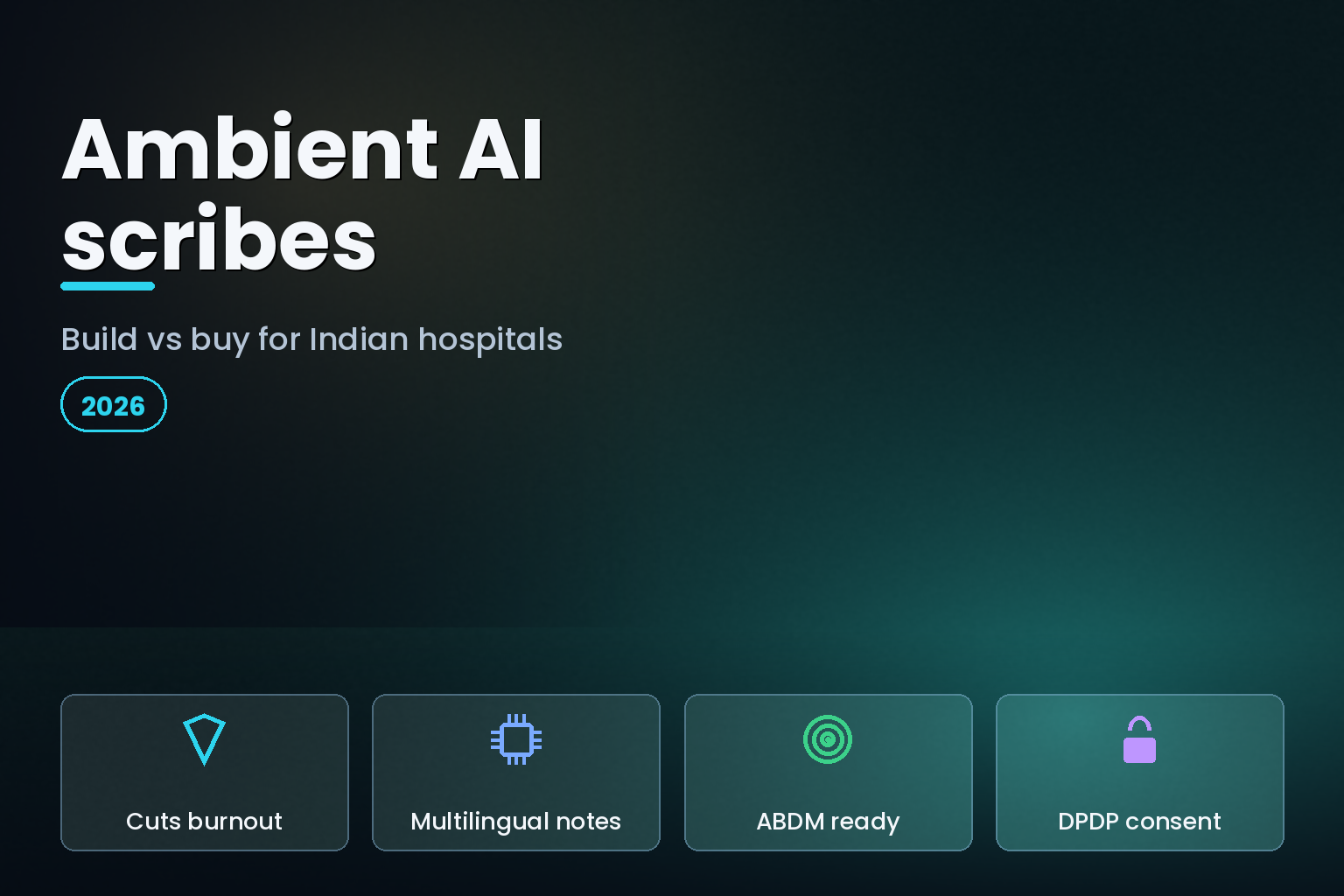
Summary. Ambient AI scribes listen to a doctor-patient consultation and draft the clinical note automatically, and the 2026 evidence says their real win is clinician wellbeing, not raw minutes. A study of 1,800 clinicians across five academic medical centres from 2023 to 2025 found scribes saved 16 minutes of documentation and 13 fewer minutes in the record per eight hours of care, while a 2025 JAMA Network Open study reported burnout falling from 51.9% to 38.8% after 30 days across six US health systems. For an Indian hospital, three things decide the build-versus-buy call: multilingual accuracy across Hindi, English and regional languages; integration with the Ayushman Bharat Digital Mission, which becomes mandatory for hospitals by 2027; and the Digital Personal Data Protection Act 2023, which treats health data as sensitive and carries penalties up to ₹250 crore. Self-serve vendor pricing runs from $39 to over $600 per clinician per month, and Eka Care has already shipped EkaScribe for the Indian market. This guide covers what to measure, what to buy, and when to build.
What an ambient AI scribe actually does
An ambient scribe runs in the background of a consultation. It captures the spoken conversation, separates the clinician from the patient, and produces a structured clinical note, usually in SOAP format (subjective, objective, assessment, plan), plus a draft prescription or referral. The word ambient is the point: there is no wake word and no manual dictation, and the clinician talks to the patient normally while the system listens and writes.
That is different from older speech-to-text dictation, which transcribed what you deliberately spoke into a microphone. It is also different from a clinical decision support tool, which recommends a diagnosis or treatment. A scribe does not decide anything; it documents. Keeping that boundary clear matters for regulation, because a documentation tool and a diagnostic tool sit under different scrutiny. For the decision-support side, our note on AI medical diagnosis in Indian hospitals covers the separate rules that apply.
The evidence: what scribes deliver, and what they do not
Buy on the right metric. The time-savings numbers are real but modest, and they vary a lot between sites. The five-centre study found 16 minutes saved per eight-hour shift, and STAT reported that some organisations saw reductions as small as 0.8 minutes. If your business case rests on freeing up hours of clinician time per day, the data does not support it uniformly.
The burnout evidence is stronger and more consistent. Beyond the JAMA Network Open finding of a drop from 51.9% to 38.8% in 30 days, a randomised trial at UW Health reported a clinically meaningful reduction in burnout scores alongside about 30 minutes less documentation per provider each day. The mechanism is cognitive load: the clinician stops splitting attention between the patient and the keyboard. For a hospital fighting attrition, that is the outcome to underwrite, and it is measurable. Score a pilot on validated burnout instruments and note quality, not just stopwatch minutes.
Accuracy is the gate. A scribe that produces a fluent but wrong note is worse than no scribe, because it adds a review-and-correct step. Every deployment needs a clinician-in-the-loop sign-off before the note enters the record, and your pilot should measure the edit rate, how much of each generated note a doctor has to change.
Build vs buy: the core decision
For all but the largest hospital groups, buying a mature scribe beats building one, because the hard part is not the language model. It is the specialty-tuned accuracy, the electronic health record integration, the multilingual handling, and the ongoing compliance work. Building makes sense only when you have a genuine reason the market cannot serve: a proprietary specialty workflow, a data-control requirement no vendor meets, or scale that makes per-seat licensing more expensive than an in-house team.
| Decision vector | Build in-house | Buy a vendor scribe |
|---|---|---|
| Time to first clinic use | 6 to 12 months, realistic | Days to weeks |
| Upfront cost | High: ML, clinical, and integration hires | Low: per-seat subscription |
| Maintenance overhead | Yours forever: models, edge cases, EHR changes | Vendor's, under contract |
| Data control | Full, if you have the security to run it | Depends on vendor residency and terms |
| Multilingual tuning | You own the Hindi and regional accuracy problem | Inherited, only as good as the vendor |
| Compliance ownership | Entirely yours (DPDP, ABDM, clinical sign-off) | Shared, but accountability stays with you |
The honest read: buy first, and build only the thin layer the vendor cannot, such as a custom prompt template for your specialty or a routing rule for your EHR. The real cost of building is not the first version; it is maintaining accuracy across every specialty and language for years.
The vendor landscape and pricing in 2026
The market has settled into three tiers, per multiple 2026 vendor comparisons: enterprise platforms with deep EHR integration, mid-market tools with a specialty or workflow angle, and self-serve tools optimised for speed. Abridge won the Best in KLAS award in the ambient speech category in both 2025 and 2026. For India specifically, Eka Care launched EkaScribe, described as India's first AI medical scribe, built on its own large language model called Parrotlet and aimed at the multilingual Indian setting.
| Vendor / tier | Indicative price (per clinician / month) | Note |
|---|---|---|
| Freed, Commure, Heidi (self-serve) | $39 to $119 | Fast to adopt, lighter EHR integration |
| Nabla | Free tier, paid roughly $119 to $239 | Mid-market, workflow differentiation |
| Suki | About $200 to $400 | Voice assistant plus scribe |
| Abridge | About $300 to $500, enterprise custom | Best in KLAS 2025 and 2026 |
| Microsoft Dragon Copilot (ex-Nuance DAX) | About $400 to $600-plus | Deep enterprise EHR integration |
| DeepScribe | About $400 to $750 | Specialty tuning |
| Eka Care EkaScribe | India-market, contact vendor | Built for multilingual India, ABDM-native ecosystem |
Enterprise platforms publish little pricing and sell multi-year contracts, so treat these as planning ranges and confirm a current quote. The pricing that matters is cost per clinician per month against the burnout and retention outcome, not the sticker price alone.
The multilingual reality for India
This is where a US-tuned scribe struggles and where the build-versus-buy call gets sharper. Indian consultations code-switch constantly: a Delhi clinic runs Hindi and English in the same sentence, a Chennai clinic adds Tamil, a Kolkata clinic adds Bengali. A scribe trained mostly on US English will drop or garble the vernacular portions, and the failure is silent, it produces a confident note that missed half the conversation.
That is the explicit reason Eka Care built EkaScribe on its Parrotlet model for the Indian environment rather than wrapping a foreign one. If you buy, test every candidate on real code-switched consultations from your own clinics, not on a clean English demo, and measure the edit rate per language. If your languages are niche and no vendor handles them, that specific gap is the one case where building or fine-tuning a thin layer can be justified. The wider engineering pattern for this sits in our clinical AI data architecture guide for India.
The DPDP and ABDM reality
A scribe records the most sensitive data a person has. Under the Digital Personal Data Protection Act 2023, health information is sensitive personal data, and a hospital is a data fiduciary responsible for it. Legal guidance for hospitals sets out the core duties: a clear, plain-language and multilingual consent notice, consent captured and managed through a registered consent manager, and defined rights of correction and erasure. Major infractions carry penalties up to ₹250 crore, so this is not a paperwork exercise.
Data residency needs care, because the common claim that DPDP mandates full localisation is an oversimplification. The Act permits cross-border transfer except to countries the government specifically restricts, so blanket localisation is not required by DPDP itself. For sensitive health data, though, India-resident storage is the defensible default that most hospitals choose, and any vendor you buy must tell you exactly where audio and transcripts are stored and for how long.
Then there is the Ayushman Bharat Digital Mission. ABDM compliance is set to be mandatory for hospitals by 2027, and it standardises records around ABHA identifiers and FHIR. A scribe that cannot write into an ABDM-aligned EHR is a dead end, so integration with your ABDM path is a hard requirement, not a nice-to-have. eCorpIT designs clinical documentation and data pipelines aligned with DPDP Act 2023 and ABDM requirements; the wider approach is set out in our clinical AI deployment guide for India.
A build-vs-buy decision path
Run it in this order. First, pick the outcome you are underwriting, and make it clinician burnout and note quality, because the time-savings case is weak on its own. Second, shortlist two or three vendors that already handle your languages and integrate with your EHR and ABDM path. Third, run a four-week pilot on real, code-switched consultations, measuring edit rate per language, note quality, and a validated burnout score, with clinician sign-off on every note. Fourth, confirm the compliance answers in writing: consent-manager integration, data residency, retention, and deletion. Only if no vendor clears those gates should you consider building, and even then build the thin specialty layer, not the whole stack.
FAQ
How eCorpIT can help
eCorpIT helps Indian hospitals and health-tech teams choose, integrate, and govern ambient AI scribes. We run structured four-week pilots that measure edit rate per language, note quality, and validated burnout scores on real code-switched consultations, then wire the chosen scribe into your ABDM-aligned EHR with clinician sign-off in the loop. We design the consent capture, residency, and retention aligned with DPDP Act 2023 and ABDM requirements. As a CMMI Level 5 and ISO 27001:2022 certified organisation, our senior engineering teams also build the thin specialty layer when a vendor cannot cover your languages. Start at /contact-us/, or see our healthcare app development work.
References
_Last updated: 29 July 2026._