On this page · 9 sections
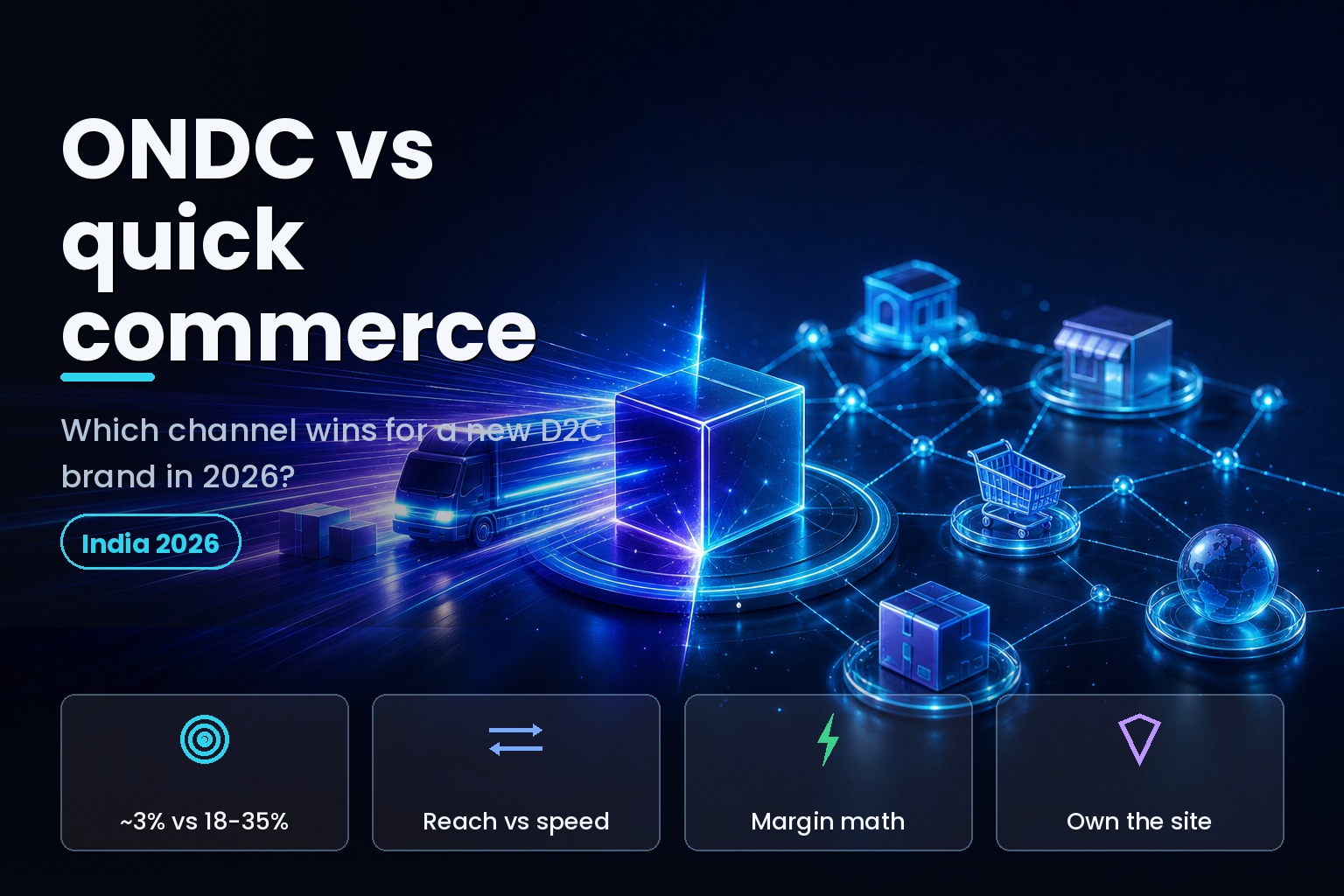
Summary. For a new D2C brand in India, ONDC and quick commerce are opposite bets. ONDC, the government-backed open network, caps buyer-app commission near 3% and spans 400+ cities. Quick commerce delivers in 10 to 30 minutes but charges 18 to 35% commission, and total platform costs can exceed 35% of the selling price once listing and advertising are added, with ₹25,000 SKU listing charges and ₹10 to 20 lakh a month in ad spend common on the big apps. The market is huge and consolidating: India's quick commerce sector is worth roughly $3.65 billion in 2026, and Blinkit leads with about 46% share, ahead of Swiggy Instamart at 24% and Zepto at 22%. The honest answer to "which wins" is that it depends on your category and margins, and that most winning brands use both while keeping their own website as the foundation. This guide gives you the decision framework.
The mistake is treating this as a single choice. Quick commerce buys you speed and impulse demand at a steep price; ONDC buys you reach and margin at the cost of a less polished experience. A new brand should match the channel to the job, not pick a side.
The two channels are not the same bet
Start by seeing them clearly. Quick commerce is a small number of large platforms that hold the customer, own the dark stores, and charge for access. ONDC is an open network where your catalogue, listed once, appears across many buyer apps at a capped commission, as we covered in our ONDC scale playbook. One optimises for instant delivery and impulse; the other for low-cost reach. Judging them on the same axis is the error that leads brands to overpay on one or ignore the other.
The economics make the contrast stark. On a ₹1,000 order, ONDC's near-3% cap is roughly ₹30, while quick commerce's 18 to 35% commission is ₹180 to ₹350 before listing and ad costs. That gap does not make quick commerce wrong; it makes it a channel you use where its speed earns back the fee.
Quick commerce: speed, reach, and brutal economics
Quick commerce is where the volume and the growth are. D2C brands generate about four times higher GMV share on quick commerce than on traditional e-commerce, because conversion is strong for the right products, per analysis of quick commerce and D2C margins. Orders typically run ₹350 to ₹600, but customers buy several times a week, which suits high-frequency categories such as snacks, ready-to-eat meals, protein bars, coffee, and personal care with 7 to 20 day repeat cycles.
The cost is severe. Commissions run 18 to 35% by category, and total platform costs can exceed 35% of the selling price once you add fees, per reporting on the cost traps. Brands face ₹25,000 SKU listing charges and ₹10 to 20 lakh a month in advertising to stay visible, and platforms often restrict a brand to just 2 to 5 SKUs, a far narrower shelf than a marketplace. The market is also consolidating around Blinkit at roughly 46% share, per coverage of the 2026 quick commerce war, which gives the platforms pricing power over the brands on them.
ONDC: low commission, open reach, maturing experience
ONDC is the opposite trade. Its near-3% commission ceiling, against the 15 to 25% of marketplaces and the higher quick commerce fees, protects margin for a bootstrapped brand, per industry analysis. It reaches 400+ cities with strength in tier-2 and tier-3 India, and it reduces dependence on any single platform because your catalogue is visible across many buyer apps.
The trade-off is experience and control. ONDC's buyer-app discovery is still maturing and varies across apps, brand storytelling is thinner in a protocol listing, and it does not offer 10-minute delivery. So ONDC wins on cost and reach, not on the instant gratification that drives impulse categories. For a brand whose products are considered purchases rather than impulse buys, that is often the better fit.
| Factor | ONDC | Quick commerce |
|---|---|---|
| Commission | Near 3% ceiling | 18 to 35%, plus fees |
| Total platform cost | Low | Can exceed 35% of price |
| Delivery speed | Standard | 10 to 30 minutes |
| Best categories | Broad, considered purchases | High-frequency impulse |
| Assortment | Full catalogue | Often 2 to 5 SKUs |
| Extra fees | Minimal | ₹25,000 listing, ₹10-20 lakh ads |
| Brand control | Protocol listing | Platform-defined |
Which wins for a new D2C brand?
The decision comes down to three questions. First, your category: if you sell high-frequency impulse products, snacks, beverages, everyday personal care, quick commerce's speed converts, and the fee may be worth it. If you sell considered purchases with less impulse pull, ONDC's economics and reach fit better. Second, your margins: if your unit economics cannot sustain a 30 to 35% platform cost while staying competitive, quick commerce will bleed you, and ONDC's near-3% cap is the safer scale channel. Third, your goal: quick commerce buys fast visibility and volume; ONDC buys sustainable, low-cost reach into a wider geography.
For a truly new brand with thin margins and a considered-purchase product, ONDC and your own website usually win first, with quick commerce added selectively once the numbers support it. For a high-frequency impulse product with the margin to absorb fees, quick commerce can drive early volume, but only with eyes open to the listing and ad costs.
The real answer: it is not either/or
The strongest 2026 brands do not choose exclusively. They use both channels for different objectives, and they treat their own website as the non-negotiable foundation even when most volume flows elsewhere, per strategy guidance on quick commerce for D2C. The website owns the brand and the first-party data; ONDC extends low-cost reach; quick commerce captures impulse demand where speed matters.
The discipline is to know what each channel is for and to hold each to its own economics. Do not let quick commerce's volume hide its margin cost, and do not expect ONDC to deliver impulse conversion. Run your own store as the hub, and treat ONDC and quick commerce as spokes chosen by category and unit economics. For the wider technology picture behind this, see our retail and D2C tech bets for 2026.
| Scenario | Best-fit channel | Why |
|---|---|---|
| Thin margins, considered purchase | ONDC plus own site | Near-3% protects margin |
| High-frequency impulse, healthy margin | Quick commerce plus site | Speed drives conversion |
| Tier-2 and tier-3 reach goal | ONDC | Open network, wide geography |
| Fast metro volume | Quick commerce | Dark-store speed and demand |
| Brand and data ownership | Own website | First-party relationship |
India-specific considerations
Two India factors shape the choice. First, geography and frequency: quick commerce is strongest in dense metros where dark stores make 10-minute delivery viable, while ONDC reaches deeper into tier-2 and tier-3 India, so your customer base decides as much as your product does. Second, data protection: whichever channel you use, you handle customer data, so the Digital Personal Data Protection Act, 2023 (DPDP) applies, and your own website remains the place where you can own the consent, the relationship, and the first-party data that both other channels dilute. Build the website as the compliant hub, and let the channels be additive. For related planning, see the eCorpIT blog.
FAQ
How eCorpIT can help
eCorpIT is a Gurugram-based technology organisation with senior-led engineering teams that build commerce technology for D2C and retail brands. We can connect your store to ONDC and quick commerce channels, model the true unit economics of each for your category, and keep your own website the compliant hub for brand and first-party data. If you want a channel strategy that protects margin rather than chasing volume, contact us. You can also browse the eCorpIT blog or read about our team.
References
_Last updated: July 5, 2026._