On this page · 11 sections
- The funding picture, without the optimism
- What the state built while private capital retreated
- What actually gets funded in 2026
- Choosing what to build: five archetypes and their real constraints
- The engineering constraints nobody scopes properly
- A realistic build sequence
- Where eCorpIT fits
- India-specific considerations
- FAQ
- How eCorpIT can help
- References
Summary. Indian agritech startups raised $202 Mn across 36 deals in 2025, down almost 25% from $269 Mn in 2024 and a long way below the $840 Mn across 62 deals in 2022, according to Inc42's Annual Indian Startup Trends Report, 2025. In the same period the state built the distribution layer these companies could never afford: India's Digital Agriculture Mission, launched in September 2024, had generated more than 8.48 crore farmer IDs by 4 February 2026, and Maharashtra moved over ₹14,000 crore to 89 lakh farmers with Aadhaar-linked accounts for Kharif 2025 crop losses. Private capital contracted while public rails scaled. That gap defines what is worth building in 2026: products that ride AgriStack and sell to governments, enterprises and lenders, not standalone advisory apps that ask a farmer to pay. This article covers what failed, what the funding data says still works, how to scope the build, and where eCorpIT fits.
The funding picture, without the optimism
The trend line matters more than any single year.
| Year | Capital raised | Deal count |
|---|---|---|
| 2021 | $728 Mn | 49 |
| 2022 | $840 Mn | 62 |
| 2023 | $220 Mn | 29 |
| 2024 | $269 Mn | Not disclosed in the same series |
| 2025 | $202 Mn | 36 |
The 2023 figure was a 74% fall from the year before, and its 29 deals were the lowest count between 2021 and 2025. Deal count recovered to 36 in 2025 while total capital kept sliding, which tells you cheque sizes shrank rather than investor interest disappearing. For context on the wider market, Indian startup funding overall reached $5.2 Bn in H1 2026, down 9% year on year.
Casualties are on the record. BharatAgri shut operations in November 2025 for lack of funds and funding opportunities. Reshamandi, a B2B natural fibres marketplace, scaled down considerably in 2024 after raising more than $40 Mn in equity.
Anand Chandra, founder of Arya.ag, gave Inc42 the clearest diagnosis of why:
Then, the focus on the very high TAM in the agricultural sector, without factoring in service, delivery, infrastructure, and acquisition costs, led to a gap between perceived and actual market potential.
That is the sentence to put on the wall before scoping an agritech product. The addressable-market slide is not the constraint. Cost to serve is.
The follow-on effect is well documented: standalone input marketplaces and advisory platforms struggled to scale sustainably because customer acquisition costs stayed high while transaction frequency and retention stayed low. Buy a farmer once a season and your CAC never amortises.
What the state built while private capital retreated
The Digital Agriculture Mission launched in September 2024 to build AgriStack as digital public infrastructure: a farmer registry, geo-referenced village maps and a crop sown registry, created and maintained by state governments. The Ministry of Agriculture and Farmers Welfare reported more than 8.48 crore farmer IDs generated as of 4 February 2026, with a stated plan to issue over 100 million farmer IDs by FY 2026-27.
The deployments show what that identity layer unlocks:
Maharashtra transferred more than ₹14,000 crore to 89 lakh farmers with Aadhaar-linked bank accounts for Kharif 2025 crop losses, and has required a farmer ID for access to government subsidies since April 2025. Chhattisgarh used the farmer ID and digital crop survey tools for paddy procurement covering an estimated 32 lakh farmers. Kisan e-Mitra, an AI chatbot, handles an average 8,000 queries a day in 11 regional languages. A pest surveillance system is used by 10,000 extension workers for early infestation detection. Krishi decision support systems combine GIS and satellite imagery for planning.
Read those as infrastructure you can build on rather than government press. Identity, land records and crop data as a queryable substrate is precisely what the last generation of agritech companies had to assemble themselves, at a cost that ate their unit economics. The comparison people in the sector reach for is NPCI and fintech: the expectation is that real scale arrives when the state supplies the rails.
What actually gets funded in 2026
Mark Kahn, managing partner of Omnivore, an agriculture-focused venture capital fund, told Inc42 that 2026 will be a modestly better year for the sector while not expecting a return to 2021 levels. The patterns investors are backing are specific.
Attach to commerce or credit. A product that only informs has no transaction to take a cut of. A product that sits next to a purchase, a sale or a loan does.
Sell to governments and enterprises, not farmers. Sector experts are direct that farmers are unlikely to pay for technology. The buyer with a budget is a state department, a procurement agency, a lender, an FPO federation or an agri-input company.
Precision agriculture and supply chain technology, where AI or IoT integration meets a real infrastructure gap, is where capital is expected to focus.
Shashank Randev, founder at 247VC, framed where this ends up:
Farmers are being given subsidies and asked to automate many aspects of farming. In the future, advanced manufacturing will also fit into agritech, because precision agriculture will have an element of IoT and drones. All these solutions will end up getting to different segments of agritech, in the form of FMCG, manufacturing or supply chain.
There is also non-dilutive money. Rashtriya Krishi Vikas Yojana (RKVY-RAFTAAR) finances incubation centres and offers grants of up to ₹25 lakh to agritech startups. For a team that needs to reach a working pilot rather than a Series A, a grant plus a paid government pilot is a more realistic 2026 path than a priced round.
Choosing what to build: five archetypes and their real constraints
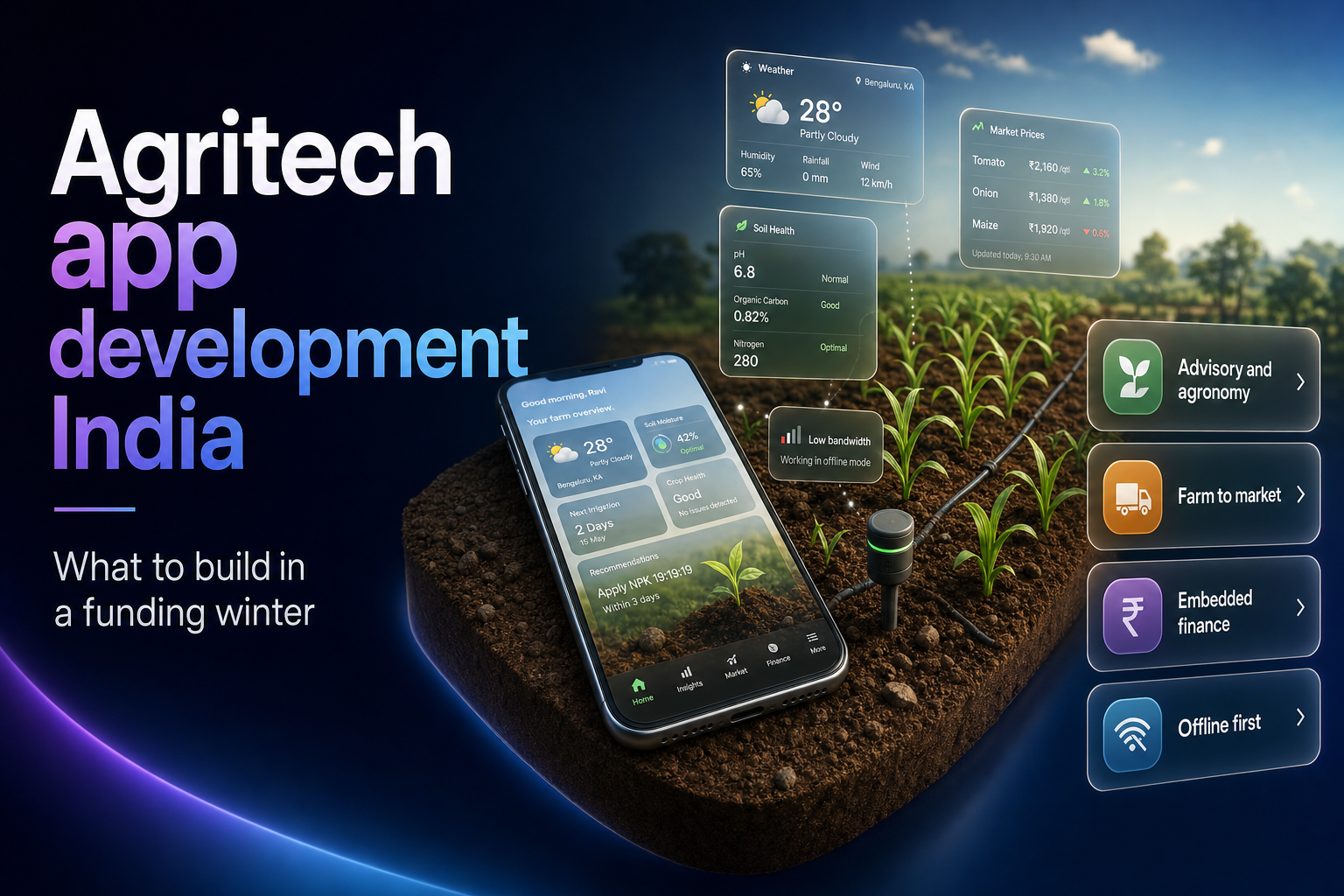
| Archetype | Who pays | Hardest engineering constraint |
|---|---|---|
| Advisory and agronomy | Government or agri-input company | Language coverage and offline behaviour |
| Farm-to-market linkage | Buyer side, per transaction | Settlement, quality grading, logistics state |
| Embedded credit and insurance | Lender or insurer | Identity, land record and crop evidence |
| Precision farming and IoT | Enterprise estate or FPO | Device fleet management and connectivity |
| Procurement and traceability | State agency or processor | Audit trail integrity across many hands |
The pattern across all five rows: the difficult part is never the mobile screen. It is reconciling messy field reality with a system that has to be defensible when money moves against its output.
The engineering constraints nobody scopes properly
Offline-first is not a feature toggle. A field worker in an area with intermittent connectivity will open the app, capture data, and close it before a sync completes. That means conflict resolution, not just local storage: two devices editing the same plot record on the same day is normal, not an edge case. Design the merge strategy before the schema.
Language and literacy. Kisan e-Mitra operates in 11 regional languages for a reason. Voice and iconography carry more of the interface than text does, and translation is not the same as localisation: crop names, units and grading vocabulary vary by district, not just by state.
Device reality. The relevant test device is not a current flagship. It is an entry-level Android handset that is several years old, on limited storage, sharing a connection. That constrains bundle size, image handling and background work. Teams that skip this build a product that demos beautifully and fails in a village.
Seasonality in the load profile. Agriculture traffic is not a smooth curve. Procurement windows, sowing and claim periods create sharp peaks against near-idle troughs. Autoscaling and cost design matter more here than in most consumer products because you pay for a baseline you use for a few weeks a year.
Evidence quality. Anything that triggers a payment, a claim or a subsidy needs a defensible trail: geotagged capture, timestamps, device attestation, and an immutable record of who changed what. Retrofitting this after a state department asks how a disputed claim was validated is the most expensive rework in the category.
Data protection. Farmer identity, land holding and financial data are personal data under the Digital Personal Data Protection Act 2023. Notice, consent and purpose limitation apply to an agritech app exactly as they do to a lending app, and integrating with a government registry does not transfer that obligation away from you. We cover the engineering shape of this in our guide to DPDP-ready app development.
A realistic build sequence
Most agritech products that survive follow a similar order, and it is not the order founders instinctively pick.
Start with the buyer's workflow, not the farmer's app. If a state procurement officer or a lender's credit team is the customer, their back-office view is the product. The field app is the data collection instrument that feeds it.
Instrument a single district before building for a state. One district, one crop cycle, real users, real failure modes. The cost of learning that your grading workflow does not survive a wet harvest is small in one district and fatal at state scale.
Build the integration surface early. AgriStack registries, Aadhaar-linked payment rails, weather and satellite sources, and the buyer's existing ERP all have their own failure semantics. Stubbing them until month five is how launch dates slip.
Treat the mobile app as the thin end. The durable engineering value sits in the data model, the reconciliation logic and the evidence trail. Cross-platform frameworks are usually the right call for the field app, which is why teams in this space often choose Flutter or React Native rather than two native codebases, and put the saved effort into the backend.
Plan for handover. Government and enterprise buyers procure for multi-year horizons and will ask about support, escalation and knowledge transfer. Ongoing mobile app maintenance and support is part of the commercial proposition, not an afterthought.
Where eCorpIT fits
eCorpIT is an engineering organisation founded in 2021 and based in Gurugram, assessed at CMMI Level 5 and MSME certified, with partnerships including AWS, Microsoft, Google, Shopify and Kaspersky. Our senior-led, multi-disciplinary teams build the parts of an agritech product that are hard to get right the second time: the offline-first field application, the reconciliation and evidence layer behind it, and the integrations into payment, identity and enterprise systems.
The engagement shape we recommend for this sector reflects the funding reality above. A short discovery to fix the buyer, the workflow and the integration surface. A single-district or single-facility pilot built to production standards rather than as a throwaway prototype, because a government pilot that succeeds becomes the reference for procurement. Then scale-out work on data volume, device fleet and support once the pilot has a signed outcome. We design applications aligned with Digital Personal Data Protection Act 2023 requirements, and we are explicit about what is in scope for each phase.
Adjacent capabilities matter here more than in most verticals, because agritech products rarely stay in one lane: logistics and supply chain systems for the movement of produce, fintech and payments engineering when credit or insurance attaches, and Industry 4.0 and manufacturing AI when precision farming brings sensors and devices into the picture.
India-specific considerations
State variation is the defining constraint. AgriStack registries are created and maintained by state governments and union territories, so coverage, data quality and integration maturity differ. Maharashtra has required a farmer ID for subsidy access since April 2025; other states are earlier in the curve. Design your identity layer so a missing or partial farmer ID degrades gracefully rather than blocking onboarding.
Procurement cycles set your runway, not your burn rate. Selling to a state department means budget cycles, tender processes and pilots that convert on government timelines. A company funded for 12 months that needs an 18-month procurement cycle to close its first contract has a planning problem, not a product problem. Grant funding such as RKVY-RAFTAAR exists partly to bridge exactly that gap.
Farmer Producer Organisations are an underused channel. They aggregate demand, have institutional bank accounts and can sign for a group, which converts an unaffordable per-farmer CAC into one manageable enterprise sale.
Do not assume smartphone parity across the household. The device that holds the account and the person who operates it in the field are often different, which has direct consequences for authentication design and for how you handle delegated access.
FAQ
How eCorpIT can help
eCorpIT builds agritech products for the buyers who actually have budgets in 2026: state agencies, agri-enterprises, lenders and FPO federations. Our senior engineering teams handle the offline-first field application, the reconciliation and evidence layer that makes its data defensible, and the integrations into identity, payment and enterprise systems, with applications designed aligned with Digital Personal Data Protection Act 2023 requirements. We scope a single-district pilot to production standards so a successful pilot converts into procurement rather than needing a rebuild. If you are scoping an agritech build or a government pilot, get in touch.
References
- Funding Winter Continues For Indian Agritech Startups - Inc42, citing the Annual Indian Startup Trends Report, 2025.
- India advances digital agriculture mission with over 84M farmer IDs generated - Biometric Update, February 2026.
- Digital Agriculture Mission - Press Information Bureau, Government of India.
- Digital Identities to Farmers - Press Information Bureau, Government of India.
- Cabinet approves the Digital Agriculture Mission - Press Information Bureau, Government of India, September 2024.
- Utilization of data collected under DAM - Press Information Bureau, Government of India.
- Digital Agriculture Mission: Tech for Transforming Farmers' Lives - Press Information Bureau, Government of India.
Last updated: 22 July 2026.