On this page · 9 sections
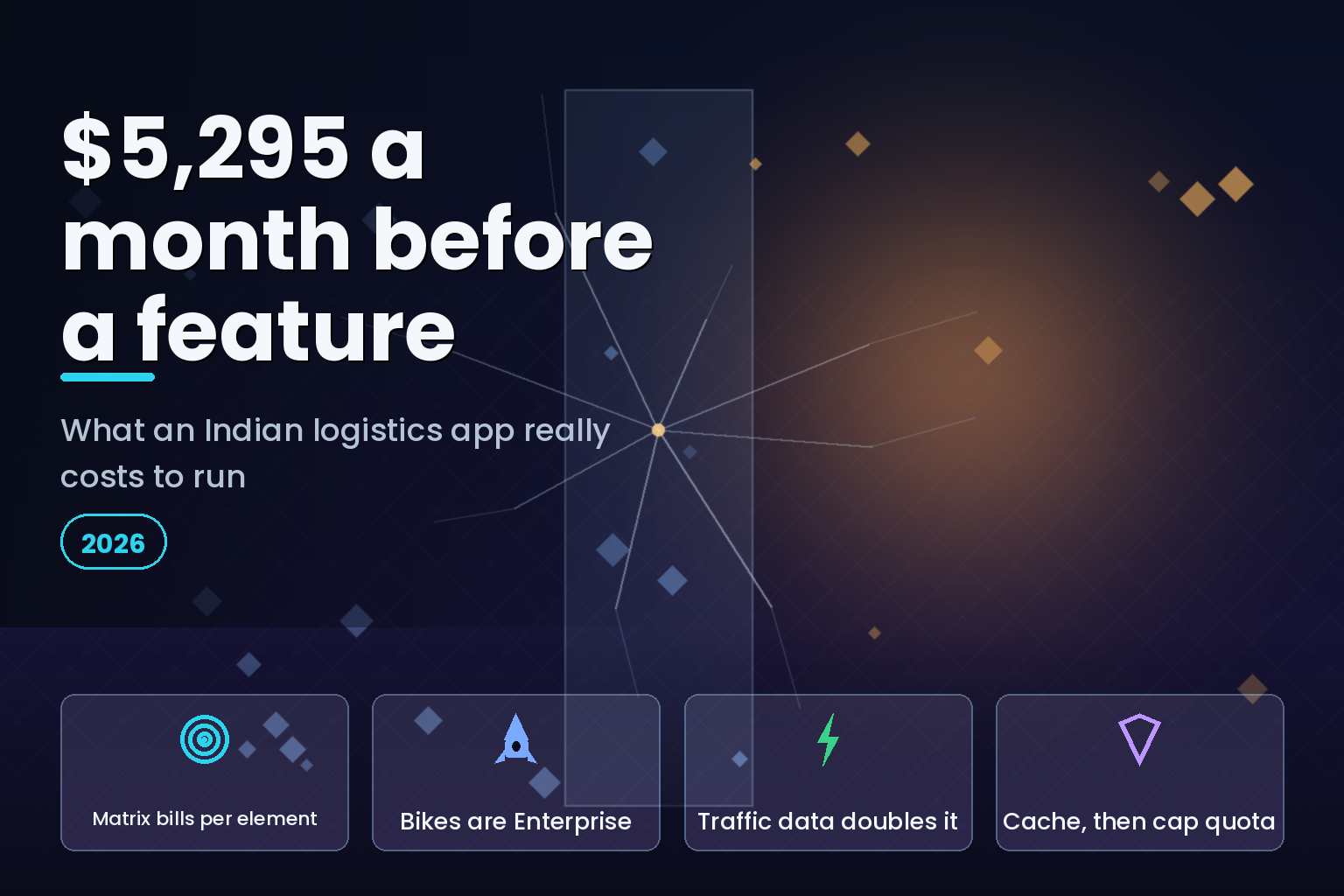
Summary. A logistics app that recalculates a 10-hub by 500-stop route matrix once an hour costs $5,295 a month in Google Maps Platform charges alone, on Google's published India rates as of 19 June 2026. Turn on traffic-aware routing, which is the only reason to build the feature, and it is $10,695. Route your riders on two-wheelers, which is how Indian last-mile actually works, and you move to an Enterprise SKU at $4.50 per 1,000 requests with a free tier of 7,000 instead of 70,000. None of that appears in a build quote. The published build ranges are wide and weakly sourced: SolGuruz, an Indian agency, lists logistics and supply chain apps at ₹23.75 lakh to ₹71.25 lakh ($25,000 to $75,000) over 3 to 7 months, with no methodology beyond its own project history. Meanwhile the market is real: IMARC puts India's logistics sector at USD 243.82 billion in 2025 heading to USD 429.02 billion by 2034, and Logistics Insider reports over 90% of India's 10 lakh-plus warehouses still run with no dedicated supply chain software. The build price is the number everyone negotiates. The run rate is the number that kills the project in month 9.
The number nobody puts in the quote
Google Maps Platform bills Compute Routes per request. It bills Compute Route Matrix per element, and an element is origins multiplied by destinations. Google's own documentation spells it out: a request with two origins and three destinations is billed for six elements, not one request.
That multiplication is where logistics budgets break. Ten hubs against 500 delivery addresses is 5,000 elements for a single call. Recalculate hourly across a 30-day month and you have 3,600,000 elements.
Run that against Google's India price list, effective 1 August 2024 and last updated 19 June 2026:
| Scenario (10 hubs x 500 stops, hourly, 30 days) | India SKU and rate | Monthly cost |
|---|---|---|
| Basic matrix, no traffic | Compute Route Matrix Essentials, 70,000 free then $1.50 per 1,000 | $5,295 |
| Traffic-aware matrix | Compute Route Matrix Pro, 35,000 free then $3.00 per 1,000 | $10,695 |
| 50,000 bike routes a day | Compute Routes Enterprise (two-wheel), 7,000 free then $4.50 per 1,000 | $6,718 |
| 50,000 car routes a day, no traffic | Compute Routes Essentials, 70,000 free then $1.50 per 1,000 | $2,145 |
| 50,000 turn-by-turn sessions a day | Navigation Request, 7,000 free then $8.00 per 1,000 | $11,944 |
Those are arithmetic on Google's published India rates, not estimates. Check them yourself against the India price list.
Three things in that table deserve a second look.
Traffic-aware doubles it. The TRAFFIC_AWARE and TRAFFIC_AWARE_OPTIMAL route modifiers move a request from the Essentials SKU to Pro. In India, Pro is $3.00 per 1,000 against Essentials at $1.50, and the free tier halves from 70,000 to 35,000. A routing engine without traffic data in Indian cities is a toy, so assume you are paying Pro rates from day one.
Two-wheeler routing is an Enterprise feature. Google lists two-wheel routing as an enterprise feature, which puts it on Compute Routes Enterprise: $4.50 per 1,000 in India, with a free tier of 7,000. Against Essentials, that is 3 times the unit rate and one tenth of the free allowance. Indian last-mile runs on bikes. The single most common assumption in an Indian delivery product sits in Google's most expensive routing tier, and almost no quote reflects it.
Speed limits never get cheaper. Roads - Speed Limits (India) is $12.00 per 1,000 both under and over 5 million events. Every other SKU on the page drops at volume. This one does not.
What actually drives the build cost
The published ranges are worth reading, and worth reading sceptically.
| Source | Figure for logistics/fleet | What it is based on |
|---|---|---|
| SolGuruz, updated 13 July 2026 | Logistics/supply chain app: ₹23.75L to ₹71.25L ($25,000 to $75,000), 3 to 7 months | The agency's own project history; no external methodology published |
| SolGuruz, same page | Fleet management app: ₹23.75L to ₹57L ($25,000 to $60,000), 2 to 5 months | As above |
| SolGuruz, same page | Blended Indian agency rate: ₹2,375 to ₹5,700/hour ($25 to $60) | Compared against $100 to $200/hour for US teams |
| Google Maps Platform, 19 June 2026 | Route Matrix Essentials (India): $1.50 per 1,000 elements | Published rate card |
| Google Maps Platform, 19 June 2026 | Compute Routes Enterprise (India): $4.50 per 1,000 requests | Published rate card |
Notice the difference in kind. The API rates are a rate card you can verify in thirty seconds. The build ranges come from a vendor pricing its own services, and the rupee figures are a straight conversion of the dollar figures at roughly ₹95 to the dollar, so they carry no independent information. A ₹23.75 lakh to ₹71.25 lakh range is a factor of three. That is not a price, it is a conversation opener.
We would rather tell you what moves the number:
- Route optimisation depth. A "show the driver the next stop" app is a mid-complexity build. A real capacitated vehicle routing solver with time windows, vehicle types and driver shifts is a different product with a different team.
- Offline behaviour. Indian delivery routes pass through dead zones daily. Offline-first sync, conflict resolution and queued proof-of-delivery uploads are not a feature toggle, they are an architecture decision made on day one.
- Compliance surface. E-way bill generation, GST data, and FASTag or RFID cross-checks each pull in an integration and an audit trail.
- Proof of delivery. Photos, OTP, signature capture and their storage and retention policy.
- Who else has to see the data. A 3PL's customers want tracking. That is a second frontend and an external API, and it usually arrives as a surprise in month 4.
The integrations that are not optional in India
An Indian logistics build is mostly integration work, and the integrations are not the ones a global template assumes.
E-way bill. GST e-way bills are generated through the NIC system, and the practical guidance is that businesses processing more than 50 consignments a day should integrate via API or a GST Suvidha Provider rather than the portal. That is an early architectural fork: GSP contract, credentials, and a retry story for a government endpoint you do not control.
FASTag and RFID. The NIC integration between the e-way bill system and FASTag/RFID reads the tag at toll plazas and logs vehicle number, timestamp and toll location against active e-way bills. For a fleet product, that is a free-ish source of in-transit position data and a compliance cross-check you did not have to build.
ULIP. The Unified Logistics Interface Platform connects more than 30 government and private logistics systems into a freight data grid. If you are building anything that touches multi-modal freight, ULIP is worth an afternoon before you design your own data model.
ONDC. The Department of Posts booked its first ONDC order as a Logistics Service Provider on 13 January 2026, which tells you the network's logistics leg is live rather than theoretical. There is also a commercial detail buried in Google's India pricing page that matters here: businesses building for ONDC on Google Maps Platform can access discounts through participating partners. If your product plugs into ONDC, ask about that before you sign a Maps commitment. On whether ONDC is the right channel at all, we have a longer view in our ONDC versus quick commerce channel analysis.
Where the market actually is
The demand is not speculative, and the gap is specific.
| Segment | Size | Growth | Source |
|---|---|---|---|
| India logistics market | USD 243.82 billion (2025) to USD 429.02 billion (2034) | 6.48% CAGR, 2026-2034 | IMARC |
| India last-mile delivery | USD 7.4 billion (2025) to USD 24.5 billion (2034) | 13.54% CAGR, 2026-2034 | IMARC |
| India warehouse market | USD 24.99 billion (2025) to USD 40.99 billion (2031) | 8.48% CAGR, 2026-2031 | Mordor Intelligence |
Against that, Logistics Insider reports more than 10 lakh warehouses in India, over 90% of them running without dedicated supply chain software, in a sector accounting for 12 to 14% of India's GDP. The unbuilt software is the opportunity. It is also why so many of these projects start as a spreadsheet replacement and only later discover the routing bill.
How to keep the run rate survivable
A few decisions we would make on day one, before any of them become expensive:
- Cache the matrix. Hub-to-hub distances do not change hourly. Static geometry belongs in your database, not in a recurring API call. The hourly recalculation in the table above is what a naive implementation does; most of those 3,600,000 elements are recomputing facts that did not change.
- Cap the quota, not the budget. Google lets you set daily quota limits per API in the Cloud console. A quota stops the service when it is hit. A budget alert only tells you afterwards. For an unattended job, the quota is the control.
- Respect the request limits as design constraints. Compute Route Matrix is capped at 3,000 elements per minute, 50 origins or destinations by place ID or address, and 625 elements per request, dropping to 100 when
TRAFFIC_AWARE_OPTIMALis set. Those numbers shape your batching before they shape your bill.
- Price the free tiers honestly. 70,000 free Essentials events sounds generous until you learn your Enterprise SKU only gets 7,000, and that Google aggregates usage monthly across every project on the billing account, so your staging environment eats the production free tier.
- Decide about traffic data deliberately. It is a doubling, not a rounding error. It is usually worth it. Make it a decision rather than a default.
The honest summary: the API bill scales with how often you ask, not how many drivers you have. Teams model the second and get surprised by the first.
India-specific considerations
Two more things that reshape an Indian logistics build.
The Digital Personal Data Protection Act, 2023 applies the moment you handle delivery addresses, recipient phone numbers and rider location traces, all of which are personal data. Rider location is the sharp one: continuous tracking of an employee's position is a purpose you have to be able to state, and retention is a decision you have to make rather than inherit from your database defaults. Teams sizing this can start with our DPDP compliance cost breakdown for Indian startups and our notes on building DPDP-ready apps.
The second is where you build. Blended Indian agency rates against $100 to $200 per hour for equivalent US teams is the well-known arbitrage, and we have written a fuller comparison in India versus US app development costs. The less-discussed part: for a logistics product, the offshore team's advantage is not the rate, it is that they have driven the routes. Understanding why a Gurugram delivery address is a landmark description and not a street number is worth more than a lower hourly rate.
FAQ
How eCorpIT can help
eCorpIT builds fleet, warehouse and last-mile products for Indian logistics operators, and we cost them the way this article does: the build, then the run rate, before you commit. Founded in 2021 and based in Gurugram, we are a CMMI Level 5 assessed, MSME certified organisation, and a Google partner, which is the relationship that matters when your routing bill is the second-largest line in your P&L. Our senior engineering teams handle the parts that actually decide the number: route optimisation depth, offline-first sync for dead zones, e-way bill and GSP integration, and DPDP-aligned handling of rider and recipient data. If you want a build estimate that includes month 9, talk to us or start with our mobile app development RFP template.
References
- Google Maps Platform core services pricing list - India - Google for Developers, updated 19 June 2026.
- Routes API usage and billing - Google for Developers, updated 26 June 2026.
- Google Maps Platform core services pricing list - Google for Developers.
- Route Optimization API usage and billing - Google for Developers.
- App development cost in India 2026 - Paresh Mayani, SolGuruz, updated 13 July 2026.
- India logistics market size, share and growth report - IMARC Group.
- India last mile delivery market size, share and report - IMARC Group.
- India warehouse market size and share analysis - Mordor Intelligence.
- Beyond digitisation: the rise of intelligent cloud logistics in India - Logistics Insider.
- Department of Posts delivers first-ever ONDC online order as logistics service provider - Press Information Bureau, January 2026.
- E-way bill under GST: FASTag and RFID explained - Binary Semantics.
- E-way bill API integration overview - Masters India.
- A comprehensive discussion on ULIP APIs - SuperProcure.
- What is ONDC? Open Network for Digital Commerce guide 2026 - Bajaj Finserv.
_Last updated: 16 July 2026._