On this page · 11 sections
- What actually changes on July 24, 2026
- The two-line rename, and the reasoning trap inside it
- The real API change: thinking mode is now a parameter
- What the switch does to your bill
- Is V4-Flash enough, or do you need V4-Pro?
- Migration checklist you can ship this week
- India-specific considerations
- Common migration mistakes
- FAQ
- How eCorpIT can help
- References
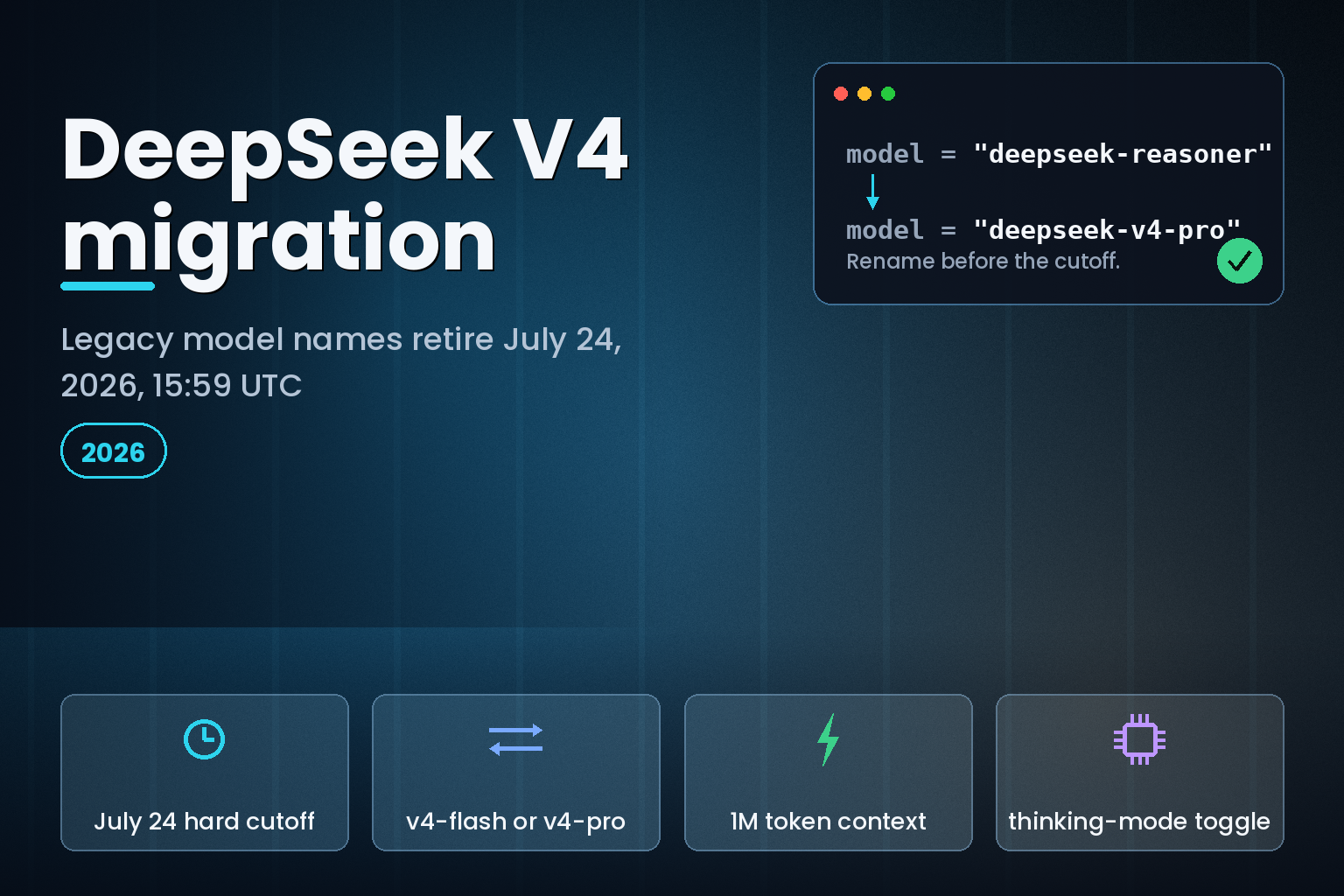
Summary. At 15:59 UTC on July 24, 2026, DeepSeek permanently retires the two model names most production code still uses: deepseek-chat and deepseek-reasoner. After that moment, any request naming them returns an error, with no grace period. Both names have routed to deepseek-v4-flash since the V4 preview shipped on April 24, 2026, so the fix is to name the model you actually want: deepseek-v4-flash (output at $0.28 per 1M tokens) or deepseek-v4-pro (output at $0.87 per 1M tokens), both with a 1M-token context window and a 384K maximum output. The trap is that deepseek-reasoner maps to Flash, not Pro, so a blind swap silently downgrades any workload that relied on it for hard reasoning. This guide gives the exact model mapping, the new thinking-mode parameter, the current prices, and a migration checklist you can ship this week.
If you run DeepSeek anywhere in production, this is a five-day problem, not a someday problem. DeepSeek published the deprecation date in its change log on April 24, 2026, and repeated it on the V4 release notes and the pricing page. The cutoff is fixed. The work to stay online is small, but it touches model names, request parameters, and cost assumptions at the same time, which is exactly the combination that breaks quietly.
What actually changes on July 24, 2026
DeepSeek shipped the DeepSeek-V4 preview on April 24, 2026 and added two explicit model names to the API: deepseek-v4-pro and deepseek-v4-flash. The base URL did not change. According to DeepSeek's pricing page, the legacy names were kept alive only as compatibility aliases: deepseek-chat points to the non-thinking mode of deepseek-v4-flash, and deepseek-reasoner points to the thinking mode of the same Flash model.
That compatibility window closes on July 24, 2026 at 15:59 UTC. DeepSeek's V4 release note states it plainly: deepseek-chat and deepseek-reasoner "will be fully retired and inaccessible" after that time. There is no automatic forward to V4-Pro, no fallback, and no soft-fail. A call that still names a retired model gets an error back, and any service that does not catch and re-route it will start throwing user-facing failures.
Three facts decide how much work you have. First, if your code already names deepseek-v4-flash or deepseek-v4-pro, you are done, because those names are stable. Second, if your code still names deepseek-chat or deepseek-reasoner, you must change the string before the cutoff. Third, if you depended on deepseek-reasoner for its reasoning quality, renaming to deepseek-v4-flash keeps you on Flash-tier reasoning, and only naming deepseek-v4-pro moves you up.
The two-line rename, and the reasoning trap inside it
For most callers the migration is a single field. Keep your base_url, keep your API key, and change the model string. The mapping below is the whole change for a non-thinking chat workload.
| Legacy model name | Auto-routes to (until July 24, 2026) | What to set explicitly after |
|---|---|---|
deepseek-chat |
deepseek-v4-flash, non-thinking mode |
deepseek-v4-flash with thinking disabled |
deepseek-reasoner |
deepseek-v4-flash, thinking mode |
deepseek-v4-flash (same tier) or deepseek-v4-pro (higher tier) |
The second row is where teams lose quality without noticing. deepseek-reasoner was the name you reached for when you wanted chain-of-thought reasoning, and many teams assume the "reasoner" lineage was DeepSeek's strongest model. Under V4 that alias resolves to Flash thinking mode, which is the 284B-parameter model with 13B active parameters, not the 1.6T-parameter Pro model. If a straight rename to deepseek-v4-flash is good enough, keep it and enjoy the lower bill. If that workload was carrying real reasoning load, evaluate deepseek-v4-pro before you decide, because the alias was never a promise of the top tier. Teams already thinking in terms of routing by cost and difficulty will recognise this pattern from our LLM hybrid-routing and API-spend framework.
The real API change: thinking mode is now a parameter
Under the legacy names, reasoning was a separate model: you picked deepseek-reasoner to get chain-of-thought and deepseek-chat to skip it. V4 unifies both into one model with a toggle, so the mode moves out of the model name and into the request body. This is the part of the migration that is easy to miss, because renaming the model is not enough if your old code encoded "reasoning" purely by model choice.
DeepSeek's thinking-mode guide documents the switch. In the OpenAI-compatible format, you pass {"thinking": {"type": "enabled"}} or {"thinking": {"type": "disabled"}}, and the toggle defaults to enabled. With the OpenAI SDK, the flag travels inside extra_body:
            from openai import OpenAI

client = OpenAI(api_key="<DeepSeek API Key>", base_url="https://api.deepseek.com")

response = client.chat.completions.create(
    model="deepseek-v4-pro",
    messages=[{"role": "user", "content": "Explain the migration in one paragraph."}],
    reasoning_effort="high",
    extra_body={"thinking": {"type": "enabled"}},
)

reasoning = response.choices[0].message.reasoning_content
answer = response.choices[0].message.content
Two behaviours will surprise anyone porting old code. Thinking mode ignores temperature, top_p, presence_penalty, and frequency_penalty; DeepSeek keeps them accepted for compatibility but they have no effect, so a "temperature=0" habit no longer does what you think. And the chain-of-thought comes back in a separate reasoning_content field alongside content. For plain chat turns you can drop reasoning_content from later context, but for tool-calling turns you must pass it back on every following request, or the API returns a 400 error. Effort is tunable too, through reasoning_effort set to high or max, where low and medium are treated as high.
What the switch does to your bill
DeepSeek bills per 1M tokens and prices cache-hit input, cache-miss input, and output separately. The table below is the full current price and capability sheet for both V4 models, taken from DeepSeek's pricing page as of July 2026.
| Attribute | deepseek-v4-flash | deepseek-v4-pro |
|---|---|---|
| Input, 1M tokens (cache hit) | $0.0028 | $0.003625 |
| Input, 1M tokens (cache miss) | $0.14 | $0.435 |
| Output, 1M tokens | $0.28 | $0.87 |
| Context window | 1M tokens | 1M tokens |
| Maximum output | 384K tokens | 384K tokens |
| Total / active parameters | 284B / 13B | 1.6T / 49B |
| Concurrency limit | 2500 | 500 |
The prices are low even against a market that has fallen fast in 2026, and they are the reason so many teams route bulk work here in the first place; the same cost logic drives the wider shift covered in our note on Chinese open models and enterprise AI cost. Two numbers change your monthly estimate the most: output tokens and whether your prompts hit the cache. To make the Flash-versus-Pro gap concrete, the table below converts the per-token output prices into monthly output cost at three volumes. It is arithmetic on the listed prices, not a quote.
| Monthly output tokens | deepseek-v4-flash | deepseek-v4-pro |
|---|---|---|
| 10M | $2.80 | $8.70 |
| 100M | $28.00 | $87.00 |
| 1B | $280.00 | $870.00 |
Pro costs roughly 3.1 times Flash on output and about 3.1 times on cache-miss input. That ratio, not the absolute price, is the decision: if Flash clears your quality bar, Pro is money spent for reasoning you did not need. A token counter helps you estimate before you commit, and our LLM token counter guide walks through sizing a workload. For teams comparing DeepSeek against United States frontier vendors on unit economics, the pattern sits alongside our analysis of GPT-5.6 inference cost for enterprise AI.
Is V4-Flash enough, or do you need V4-Pro?
DeepSeek positions the two models by size and job. Per the V4 release notes, V4-Pro carries 1.6T total parameters with 49B active and is aimed at agentic coding, reasoning, and broad world knowledge, while V4-Flash carries 284B total with 13B active and is the fast, cheap option whose reasoning "closely approaches" Pro. DeepSeek says Pro leads open-source models on agentic coding benchmarks and trails only Gemini-3.1-Pro on world knowledge among the models it compared.
Treat vendor benchmark claims as marketing until you re-run them on your own tasks. Independent write-ups of V4 report V4-Pro near the top of coding leaderboards, with DataCamp and model directories such as OpenRouter covering the released specs and scores, but the numbers move a lot between harnesses, and a self-reported score is not an independent one. The practical test is cheaper than the debate: take the ten hardest real prompts your product actually sends, run them through Flash and Pro at equal effort, and compare outputs and latency. If Flash holds, you save roughly two-thirds. This is the same build-your-own-eval discipline we use when comparing coding models, as in our Grok 4.5 enterprise coding-agent evaluation.
The strategic backdrop matters for a stability decision. DeepSeek built V4 to run on domestic silicon rather than restricted United States chips. As Wei Sun, principal analyst at Counterpoint Research, told CNN, running V4 on Huawei and Cambricon hardware "allows AI systems to be built and deployed without relying solely on Nvidia, which is why V4 could ultimately have an even bigger impact than R1." The market reaction was calmer than the R1 shock of 2025. Ivan Su, senior equity analyst at Morningstar, told CNN: "V4 is simply a follow-through on that same trend, and trends don't make headlines the way shocks do." For a buyer, a boring, well-funded release on independent supply chains is a good sign for API longevity.
Migration checklist you can ship this week
Work through these in order. Each step is small, and the whole thing is a half-day for a typical service.
- Grep every repository, notebook, and environment config for the strings
deepseek-chatanddeepseek-reasoner. Include prompt templates, evaluation scripts, and infrastructure as code, not just application code.
- Decide the target per call site. Default chat and high-volume paths go to
deepseek-v4-flash. Reasoning-heavy or agentic paths get evaluated againstdeepseek-v4-probefore you choose.
- Move the reasoning decision into the request body. Set
extra_body={"thinking": {"type": "enabled"}}where you previously useddeepseek-reasoner, and disable it where you useddeepseek-chat. Addreasoning_effortif you wanthighormax.
- Fix parameter assumptions. Remove reliance on
temperature,top_p,presence_penalty, andfrequency_penaltyin thinking mode, since they are ignored.
- Handle
reasoning_content. Read it from responses, and for tool-calling loops pass it back on every subsequent request to avoid the 400 error.
- If you call DeepSeek through the Anthropic-format endpoint at
https://api.deepseek.com/anthropic, useoutput_config.effortfor effort control instead ofreasoning_effort.
- Re-run your evaluation set on the explicit V4 model before the cutoff, and add an alert that fails loudly on an unknown-model error so a missed call site cannot fail silently.
India-specific considerations
For teams in India, two points sit on top of the technical migration. DeepSeek bills in United States dollars, so an Indian team carries currency risk on top of usage: the same 100M output tokens that cost $28 on Flash convert at the prevailing rupee rate, and a weaker rupee raises the effective bill even when token usage is flat. Budget in dollars, and hedge if the spend is material.
The larger question is data governance. DeepSeek's API is operated from China, so sending customer data to it is a cross-border transfer, and India's Digital Personal Data Protection Act, 2023 turns that into a compliance decision rather than a purely technical one. Before you route personal data to any overseas model, map what leaves the country and why, and design for consent and data-minimisation from the start. Our DPDP engineering playbook for Indian startups covers the controls that make this defensible, and the broader adoption pattern appears in our look at Chinese AI models and United States enterprise token share.
Common migration mistakes
The failures cluster in four places. Renaming deepseek-reasoner to deepseek-v4-flash and assuming you kept top-tier reasoning is the most expensive, because the quality drop is invisible until output degrades. Leaving temperature in a thinking-mode call and expecting deterministic output is the second, since the parameter is silently ignored. Dropping reasoning_content inside a tool-calling loop is the third, and it produces a hard 400 rather than a silent issue. The fourth is scope: teams patch the main service and forget a cron job, a data pipeline, or a staging config that still names a retired model and starts erroring the day after the cutoff.
FAQ
How eCorpIT can help
eCorpIT is a Gurugram software organisation with senior-led engineering teams that ship and maintain production AI systems. We help teams migrate LLM integrations without downtime: auditing every call site, moving reasoning into the right V4 tier, wiring up evaluations so a quality drop cannot slip through, and modelling the cost change before you commit. If your DeepSeek workload needs to clear the July 24, 2026 cutoff cleanly, or you want a second opinion on Flash versus Pro for your traffic, contact us and we will scope it with you.
References
- DeepSeek API Docs, "Models & Pricing." https://api-docs.deepseek.com/quick_start/pricing
- DeepSeek API Docs, "Change Log." https://api-docs.deepseek.com/updates
- DeepSeek API Docs, "DeepSeek V4 Preview Release," April 24, 2026. https://api-docs.deepseek.com/news/news260424
- DeepSeek API Docs, "Thinking Mode." https://api-docs.deepseek.com/guides/thinking_mode
- CNN Business, "China's AI upstart DeepSeek drops new model. Will it make waves like last year?", April 24, 2026. https://www.cnn.com/2026/04/24/tech/chinas-ai-deepseek-v4-intl-hnk
- Hugging Face, "DeepSeek-V4 open weights collection." https://huggingface.co/collections/deepseek-ai/deepseek-v4
- OpenRouter, "DeepSeek V4 Flash - API pricing and benchmarks." https://openrouter.ai/deepseek/deepseek-v4-flash
- DataCamp, "DeepSeek V4: Features, Benchmarks, and Comparisons." https://www.datacamp.com/blog/deepseek-v4
- Enterprise DNA, "DeepSeek API: Migrate Before July 24 or Integrations Break." https://enterprisedna.co/resources/news/deepseek-api-migration-july-24-deadline-2026/
- Developers Digest, "DeepSeek Retires deepseek-chat and deepseek-reasoner on July 24: Your V4 Migration Guide." https://www.developersdigest.tech/blog/deepseek-chat-to-v4-migration-guide
- WaveSpeed, "DeepSeek V4 API Migration: Update Model Names Before July." https://wavespeed.ai/posts/blog-deepseek-v4-model-name-migration/
_Last updated: July 19, 2026._