On this page · 9 sections
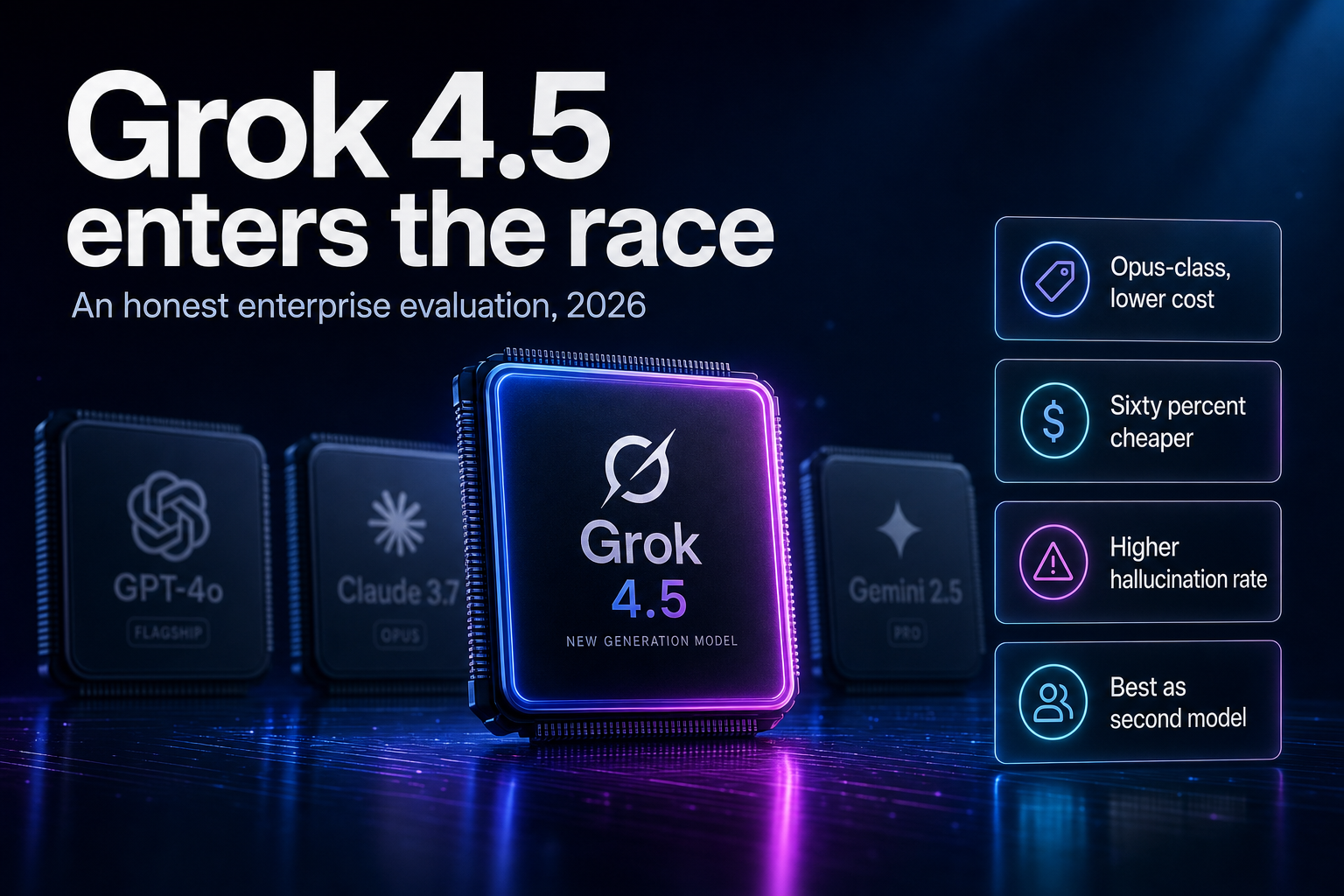
Summary. SpaceXAI, the company formerly known as xAI after SpaceX's acquisition earlier in 2026, launched Grok 4.5 on July 8, 2026. It is priced at $2 per million input tokens and $6 per million output tokens, which undercuts Claude Opus 4.8 ($5/$25) by more than 60% on headline rates and sits far below Claude Fable 5 ($10/$50). Elon Musk called it "an Opus-class model, but faster, more token-efficient and lower cost." The benchmarks are more mixed than the pitch: on SWE-Bench Pro, Grok 4.5 scores about 64.7%, behind Claude Fable 5 (80.4%) and Claude Opus 4.8 (69.2%) but ahead of GPT-5.5 (58.6%), and independent testing flags a higher hallucination rate. For engineering leaders, the honest read is that Grok 4.5 is a strong cost-efficiency play, not a peak-quality one. This evaluation covers where it fits, where it does not, and how to place it in a real stack.
The AI model race in 2026 stopped being about the single highest score. It is now a triangle of intelligence, cost, and agentic usefulness, and Grok 4.5 pushes hard on the cost corner. That makes it worth a serious look, and a careful one.
What SpaceXAI actually shipped
Grok 4.5 is the first major release since the company went public and acquired the AI coding startup Cursor, per TechCrunch and Axios. It is available in Grok Build, in Cursor across all plans, and from the SpaceXAI console. The company rebrand from xAI to SpaceXAI followed SpaceX's acquisition, as Techweez reported, so expect the old and new names to appear side by side for a while.
The model is positioned for coding and agentic work rather than consumer chat. It was co-trained with Cursor, which gives it real software-engineering task data, and its reinforcement-learning pipeline covers a large set of multi-step engineering tasks. One caveat for European teams: at launch, Grok 4.5 was not available in the EU, with availability expected mid-July 2026.
The pricing case, with real numbers
Price is where Grok 4.5 makes its argument. Here is how the headline token rates line up across the current top models as of July 2026.
| Model | Input ($/M tokens) | Output ($/M tokens) |
|---|---|---|
| Grok 4.5 | 2 | 6 |
| GPT-5.6 Luna | 1 | 6 |
| GPT-5.6 Sol | 5 | 30 |
| Claude Opus 4.8 | 5 | 25 |
| Claude Fable 5 | 10 | 50 |
The output-token gap is the one that matters for agents, which generate far more than they consume. At $6 per million output tokens, Grok 4.5 is roughly a quarter the cost of Claude Opus 4.8 and less than an eighth of Claude Fable 5 on output. In real agentic runs, TechTimes measured Grok 4.5 at about $2.49 per task, against $5.07 for GPT-5.5 in Codex and $11.80 for Fable 5 in Claude Code. For high-volume, cost-sensitive workloads, that difference compounds fast. We track these economics in our enterprise inference cost analysis and LLM spend tooling guide.
The quality case, honestly
Cheaper is only useful if the output holds up. Here the picture is nuanced.
| Model | SWE-Bench Pro | Agentic task cost |
|---|---|---|
| Claude Fable 5 | 80.4% | $11.80 |
| Claude Opus 4.8 | 69.2% | Not reported |
| Grok 4.5 | 64.7% | $2.49 |
| GPT-5.5 | 58.6% | $5.07 |
| GPT-5.6 Sol | Leads coding-agent index (80) | Not reported |
Grok 4.5 lands in the upper-middle of the pack: clearly capable, clearly not the top scorer. Claude Fable 5 holds the strongest published high-end scorecard, and GPT-5.6 Sol leads the Artificial Analysis Coding Agent Index at 80 points, per Artificial Analysis. Grok 4.5's own weakness is reliability: independent testing reports a higher hallucination rate than the frontier models, which matters more for autonomous agents than for a human-in-the-loop assistant. Speed and cost are its edge; peak accuracy and low hallucination are not.
Where Grok 4.5 fits in a real stack
The smartest pattern in 2026 is not to pick one model. It is to run two: a cheap, efficient model for the bulk of the work, and a premium model for the hard cases. Grok 4.5 is a strong candidate for the first slot.
Use Grok 4.5 for high-volume, well-scoped, human-reviewed work: bulk code generation, test scaffolding, refactors, documentation, and first-pass agent steps where a human or a stronger model checks the result. Route the genuinely hard or high-stakes tasks, the ones where a hallucination is expensive, to Claude Fable 5, Claude Opus 4.8, or GPT-5.6 Sol. This two-model routing captures most of the cost saving while protecting quality where it counts. Getting the abstraction layer right so you can route per task, and switch providers later, is the same discipline we argue for in our enterprise AI strategy guide and GPT-5.6 versus Claude comparison.
Governance and procurement cautions
Two non-technical factors deserve weight in an enterprise decision. First, the EU availability gap means teams with European data or users cannot standardize on Grok 4.5 yet; plan for a fallback. Second, the SpaceXAI rebrand and rapid pace mean contracts, data-handling terms, and model-deprecation policies are moving. Read the data-processing terms before routing production traffic, and confirm where prompts and outputs are stored and whether they train future models. For regulated Indian workloads, alignment with the Digital Personal Data Protection Act, 2023 (DPDP) is the gate, not the token price.
India-specific considerations
For Indian engineering teams, Grok 4.5's economics are attractive because so much local product work is cost-sensitive and volume-heavy. A startup running coding agents across a large codebase can cut model spend sharply by putting the routine work on Grok 4.5 and reserving a premium model for the hard 10%. Budget in rupees against real task costs, not headline token rates: the $2.49-per-task figure is a better planning number than the per-million-token price. Keep the EU limitation in mind only if you serve European users; for India-first and US-facing products, it is not a blocker. As always, verify data-residency and DPDP alignment before production use.
FAQ
How eCorpIT can help
eCorpIT (eCorp Information Technologies Private Limited, founded 2021, Gurugram) helps engineering teams choose and deploy AI models on evidence, not marketing. Our senior-led teams benchmark models like Grok 4.5, GPT-5.6, and Claude on your actual tasks, build routing layers so you use the cheap model for bulk work and a premium model for the hard cases, and align data handling with DPDP Act requirements. To run a model evaluation for your stack, contact us.
References
_Last updated: July 13, 2026._