On this page · 10 sections
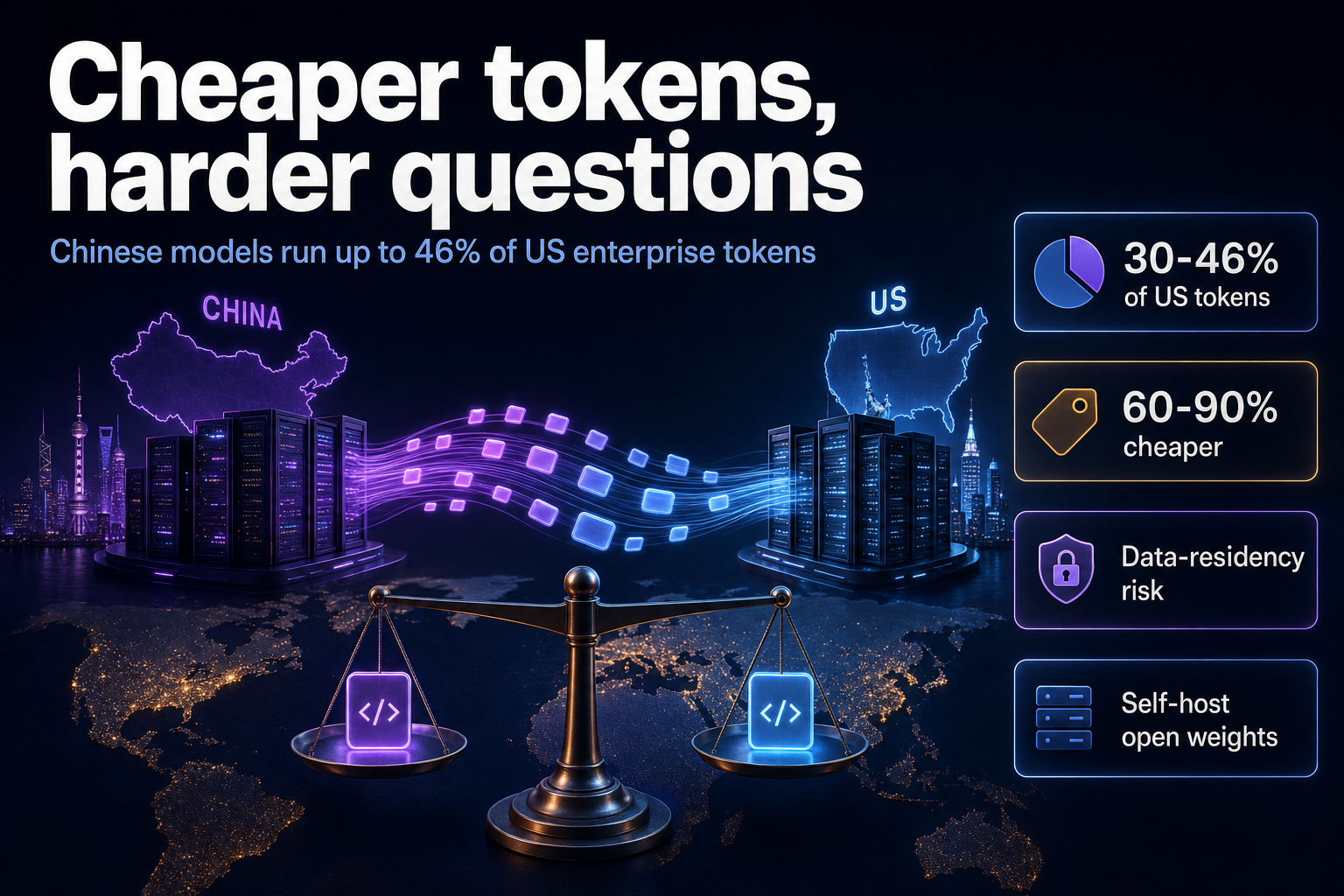
Summary. Chinese-built AI models now account for 30 to 46% of all enterprise API token traffic flowing through US developer platforms, up from about 4.5% in early 2025, per OpenRouter usage data reported by CNBC. The share has held above 30% every week since February 8, 2026, and in the week of February 9 to 15 Chinese models processed 4.12 trillion weekly tokens, passing US models for the first time. The driver is cost: open Chinese models run 60 to 90% cheaper than the leading OpenAI and Anthropic offerings, with DeepSeek V4 Flash at $0.14 per million input tokens against $5.00 for GPT-5.5. The governance questions are real too, and they have a practical answer. This article separates the cost case from the risk, and lays out what to ask before you adopt.
This is not a story about which model is smartest. It is about a cost gap so large that enterprises are routing a third of their tokens to Chinese models despite genuine data and political concerns. Both facts are true at once, and treating either as the whole picture leads to a bad decision. Here is what the numbers show, why the switch is happening, the governance risks that are real, and the middle path most careful teams are taking.
What the numbers show
The shift is fast and measured. Chinese models crossed above 30% of US enterprise tokens in February 2026 and peaked at 46%, per reporting on OpenRouter data. The crossover week, February 9 to 15, saw 4.12 trillion weekly tokens on Chinese models, as coverage of the milestone noted. DeepSeek and Qwen alone went from a combined 1% of global share in January 2025 to roughly 15% a year later, per open-model analysis.
| Metric | Value | Period |
|---|---|---|
| Chinese share of US enterprise tokens | 30 to 46% | 2026 |
| Share in early 2025 | About 4.5% | Early 2025 |
| Above-30% streak | Every week | Since February 8, 2026 |
| Crossover week volume | 4.12 trillion tokens | February 9 to 15, 2026 |
| DeepSeek plus Qwen global share | 1% to 15% | January 2025 to 2026 |
Why enterprises are switching: cost
The reason is the bill. An hour-long coding session that costs about $10 on Claude cost less than 50 cents on DeepSeek, and for a workload classifying and summarising 50,000 financial documents a day, the gap is roughly $4,000 a month against about $200, per coverage of low-cost Chinese models. Coinbase runs 1,200 AI agents on Chinese models and cut its AI spend in half, as adoption reporting noted. At that spread, cost-sensitive, high-volume work moves regardless of brand loyalty.
| Workload | US model | Chinese model |
|---|---|---|
| Input price per million tokens | $5.00 (GPT-5.5) | $0.14 (DeepSeek V4 Flash) |
| One-hour coding session | About $10 (Claude) | Under $0.50 (DeepSeek) |
| 50,000 documents a day | $4,000+ per month | About $200 per month |
| Typical price gap | Baseline | 60 to 90% cheaper |
| Coinbase agent fleet | Higher spend | Half the spend on 1,200 agents |
We looked at the pure cost case in our note on Chinese open models and enterprise AI cost; the point here is what the cost pulls with it.
The governance questions
Cost is only half the decision. The concern is where your data goes. When you use a hosted Chinese AI app or its native cloud API, your prompts are processed on servers in China, and China's 2017 National Intelligence Law can compel companies to hand data to the state, per open-weight ecosystem analysis from Stanford HAI. The political dimension is real as well: lawmakers opened investigations into Airbnb and Anysphere, the owner of the coding platform Cursor, after they disclosed using Chinese open models like Qwen and Kimi in their infrastructure, per reporting on the scrutiny. For a regulated business, sending customer data to a Chinese-hosted endpoint is a governance decision, not just an engineering one. Our guide to enterprise AI agent governance layers covers the controls this needs.
The practical middle path: self-host open weights
The important distinction is between using a Chinese company's hosted API and running its open-weight model yourself. Most of the leading Chinese models ship as open weights: GLM-5 under an MIT licence, Qwen 3.5 flagship under an Apache-style commercial licence, and Kimi K2.5 as open weights, per model licensing analysis. For regulated industries, the safer path is self-hosting those open weights inside your own cloud region with documented data-processing controls, rather than calling a Chinese-hosted API directly, per the Stanford HAI brief. That keeps most of the cost advantage while removing the data-residency problem, because the weights run on your infrastructure and no prompt leaves your boundary.
| Dimension | Hosted Chinese API | Self-hosted open weights |
|---|---|---|
| Where prompts are processed | Servers in China | Your own cloud region |
| Data-residency risk | High, subject to local law | Controlled by you |
| Cost | Lowest | Low, plus hosting overhead |
| Setup effort | Minimal | Higher, needs infrastructure |
| Fit for regulated data | Weak | Strong with documented controls |
The questions to ask before you adopt
Adoption is not all-or-nothing. The decision turns on data sensitivity and deployment mode, not on the model's origin alone. Ask: how sensitive is the data in these prompts; is the call to a hosted API or a model we run; which cloud region processes it; what licence governs the weights; do we log and control what leaves our boundary; and can we swap the model if policy changes. A team that routes public, low-sensitivity, high-volume work to a self-hosted open-weight model, while keeping regulated data on a reviewed provider, captures most of the saving without the exposure. For the model-choice framing, see our GPT-5.6 versus Claude Sonnet 5 comparison.
India-specific considerations
For Indian enterprises, the calculus has a local layer. The cost advantage is compelling at rupee scale, especially for high-volume support and document work, which pulls hard toward adoption. But the Digital Personal Data Protection Act, 2023, governs where and how personal data is processed, so a hosted endpoint outside India carries the same residency questions as a Chinese-hosted one. The clean answer is the same: run open-weight models in an Indian cloud region with documented controls, so cost savings do not come at the price of a DPDP problem. Sovereignty and cost can both be met, but only by self-hosting rather than calling a foreign hosted API.
The bottom line
Chinese models earning a third of US enterprise tokens is a cost story with a governance tail. The saving is real, 60 to 90% on high-volume work, and so is the data-residency risk of a hosted Chinese API under the 2017 National Intelligence Law. The mature move is neither a ban nor a blind switch: self-host open weights in your own region for the work that suits them, keep regulated data on a reviewed provider, and decide by data sensitivity and deployment mode rather than by the model's flag. The cost gap is not going away, so the governance discipline has to be built now.
FAQ
How eCorpIT can help
eCorpIT is a Gurugram-based technology consultancy, founded in 2021 and CMMI Level 5 certified, with senior-led AI and cloud teams. We help enterprises capture the cost advantage of open-weight models safely: self-hosting models like GLM-5, Qwen 3.5 or Kimi K2.5 in your own cloud region, building routing that keeps regulated data on reviewed providers, and designing controls aligned with DPDP requirements. If you want the savings without the data-residency risk, talk to us.
References
_Last updated: July 11, 2026._