On this page · 8 sections
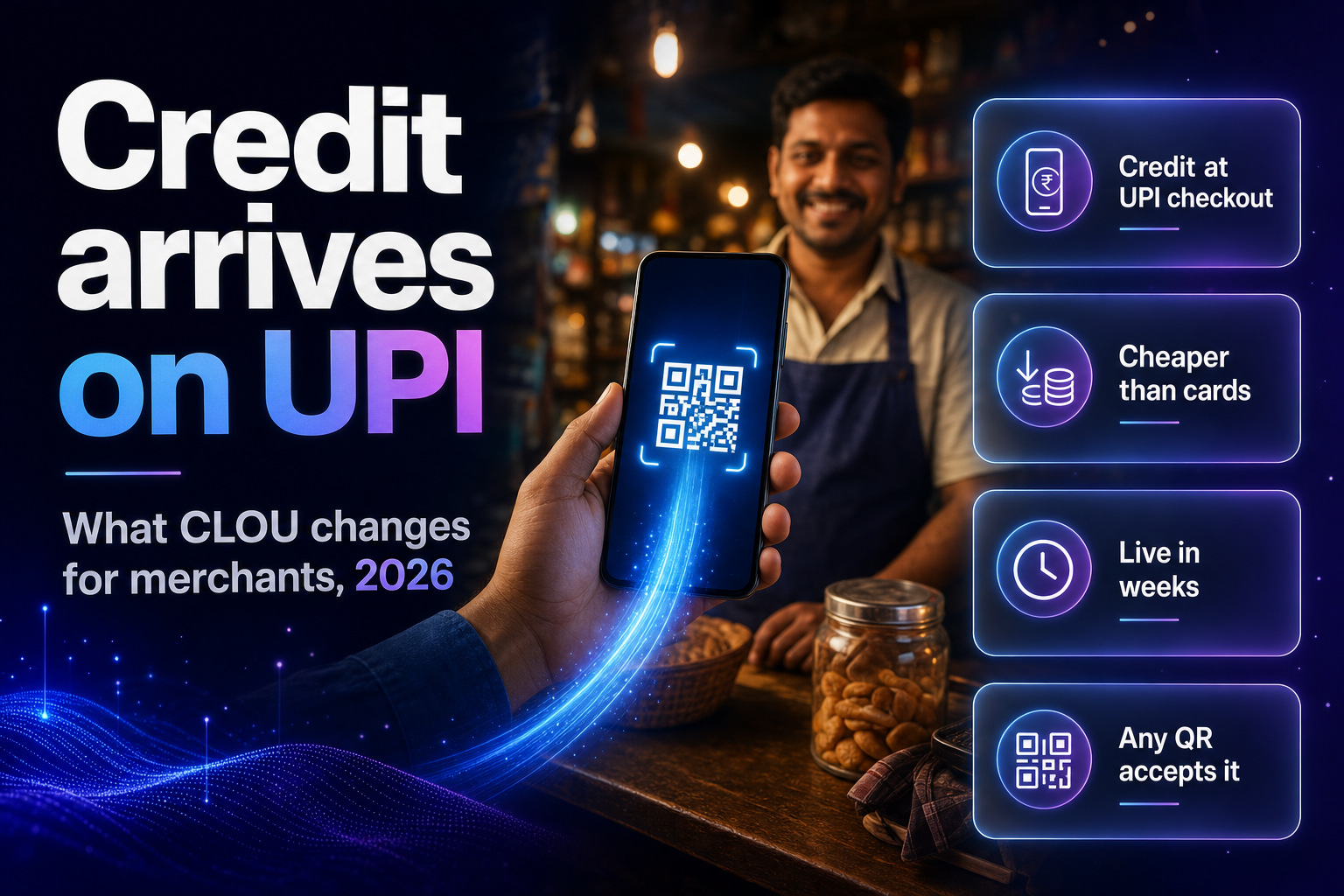
Summary. Credit Line on UPI (CLOU) lets a bank attach a pre-sanctioned credit line to a customer's UPI ID, so a payment can draw from credit instead of a savings balance, at any UPI QR code. The RBI approved pre-sanctioned credit lines on UPI on September 4, 2023, extended eligibility to small finance banks in early 2025, and by 2026 most major banks are rolling it out across savings, overdraft, and co-lending channels. The economics are the story for merchants: CLOU products can go live in 8 to 12 weeks, carry acquisition costs around one-fifth of a traditional credit card, and report NPA rates under 2% on standard small-ticket usage. This lands on rails at enormous scale: UPI processed about 22 billion transactions worth ₹27.97 lakh crore in December 2025 alone, with 2025 volume up 29.3% year on year. For a D2C founder, CLOU is credit at checkout without a card network. This article explains what changes, and what to weigh, in 2026.
Credit at the point of sale is not new. Delivering it through the UPI QR a customer already scans, at a fraction of card economics, is. That shift is why CLOU matters to anyone selling in India.
What Credit Line on UPI actually is
CLOU links a pre-approved credit limit, such as an overdraft, a personal credit line, or a small-business loan, to a UPI ID. When the customer pays, the money draws from that credit line rather than their bank balance, and repayment is managed through the bank, per NPCI and explainers from Billcut. The customer pays any merchant, online or offline, by scanning the same UPI QR they already use.
The rollout has widened. The RBI first approved pre-sanctioned credit lines on UPI in September 2023, then allowed small finance banks to offer them, as Business Standard reported. Banks including HDFC, Axis, and ICICI have run pilots, and payment apps such as PhonePe, Google Pay, and Paytm are integrating the RBI-approved APIs for onboarding and credit management, according to Lemonn.
Why the economics matter to merchants
The reason CLOU spreads is cost and speed, not novelty. Analysis from Zeta and M2P Fintech puts customer-acquisition cost for CLOU near one-fifth of a traditional credit card, with products launching in 8 to 12 weeks and NPA rates under 2% on standard small-ticket credit. That combination makes credit issuable to segments a card program could never afford to reach.
| Feature | Credit Line on UPI (CLOU) | Traditional credit card |
|---|---|---|
| Payment rail | Any UPI QR, online and offline | Card network terminal or gateway |
| Acquisition cost | About one-fifth of a card | Baseline |
| Time to launch | 8 to 12 weeks | Longer |
| Merchant acceptance | Existing UPI acceptance | Requires card acceptance |
| Repayment | Managed via the linked bank line | Monthly statement cycle |
For a merchant, the practical upside is a larger addressable base of buyers who can pay with credit through infrastructure already deployed at the counter. The practical question is cost: unlike a balance-funded UPI payment, a credit-funded transaction involves a lender, so merchants should confirm the applicable charges and settlement terms with their payment provider before assuming CLOU is free to accept.
The demand signal is already visible
Credit on UPI is not hypothetical. RuPay credit cards linked to UPI already account for about 38% of India's credit card volume by transactions, and users of UPI-enabled credit cards average 40 transactions a month, roughly eight times a traditional cardholder, with transaction counts growing about 20% monthly, per Business Standard and Outlook Money.
| Metric | Figure | Period |
|---|---|---|
| RuPay share of India credit cards | About 18% | 2025 |
| RuPay-UPI share of card volume | About 38% of transactions | 2025 |
| UPI-enabled credit card growth | About 20% monthly | 2025 |
| Transactions per user per month | About 40, roughly 8x a card | 2025 |
| Total UPI value, December 2025 | ₹27.97 lakh crore | Monthly |
The behaviour pattern matters for D2C. Credit linked to UPI drives far higher transaction frequency than a card, which points to more repeat purchases when credit is available at checkout. There is a near-term caution too: UPI transaction volume slipped about 2.1% month on month in June 2026 even as it held 23% year-on-year growth, per StartupTalky, a reminder that the rails are maturing, not only accelerating.
What D2C brands and fintech builders should do
For a D2C brand, treat CLOU as a conversion and average-order-value lever, not a payments checkbox. Offer it where basket sizes justify credit, make the credit option visible at checkout, and measure incremental conversion against any acceptance cost. For higher-ticket categories, credit at the UPI QR can move a hesitant buyer the way a card EMI does, without sending them to a card network. Our UPI shake-up analysis and D2C tech playbook cover the wider stack.
For fintech builders, CLOU is one of the fastest regulated credit products to bring to market. A live product in 8 to 12 weeks with acquisition costs a fifth of a card is a rare combination, which is why capital is flowing in: Bengaluru fintech Spense raised $2.8 million in seed funding to build Credit Line on UPI, per StartupTalky. The build itself is an app-and-API problem, integrating a lender's credit line with a UPI PSP and a clean repayment flow, the kind of work we cover in our D2C mobile app development guide.
India-specific considerations
CLOU is an India-first product, so the compliance and trust bar is the whole game. Any flow that touches a credit line and personal data must align with the Digital Personal Data Protection Act, 2023 (DPDP), with clear consent for credit checks and data sharing between the merchant, PSP, and lender. Lending is regulated: a builder is either a regulated entity or partners with one, and the RBI's digital-lending guidelines govern disclosures, cooling-off, and grievance handling. Design for the smaller-town, first-time-credit user CLOU is meant to reach, with transparent limits, repayment reminders, and no dark patterns. Done right, CLOU widens access to credit; done carelessly, it invites both regulatory action and defaults.
FAQ
How eCorpIT can help
eCorpIT (eCorp Information Technologies Private Limited, founded 2021, Gurugram) builds fintech and D2C applications that plug into India's payment rails. Our senior-led, CMMI Level 5 teams design UPI and Credit Line on UPI integrations, build checkout and repayment flows that align with DPDP Act and RBI digital-lending requirements, and ship the app-and-API work behind a compliant credit product. As a Shopify partner, we connect these flows to your storefront. To scope a CLOU or UPI build, contact us.
References
_Last updated: July 13, 2026._