On this page · 11 sections
- What changed for Web 2.0 in 2024-26 (and why it matters)
- What "high DA Web 2.0" actually means in 2026
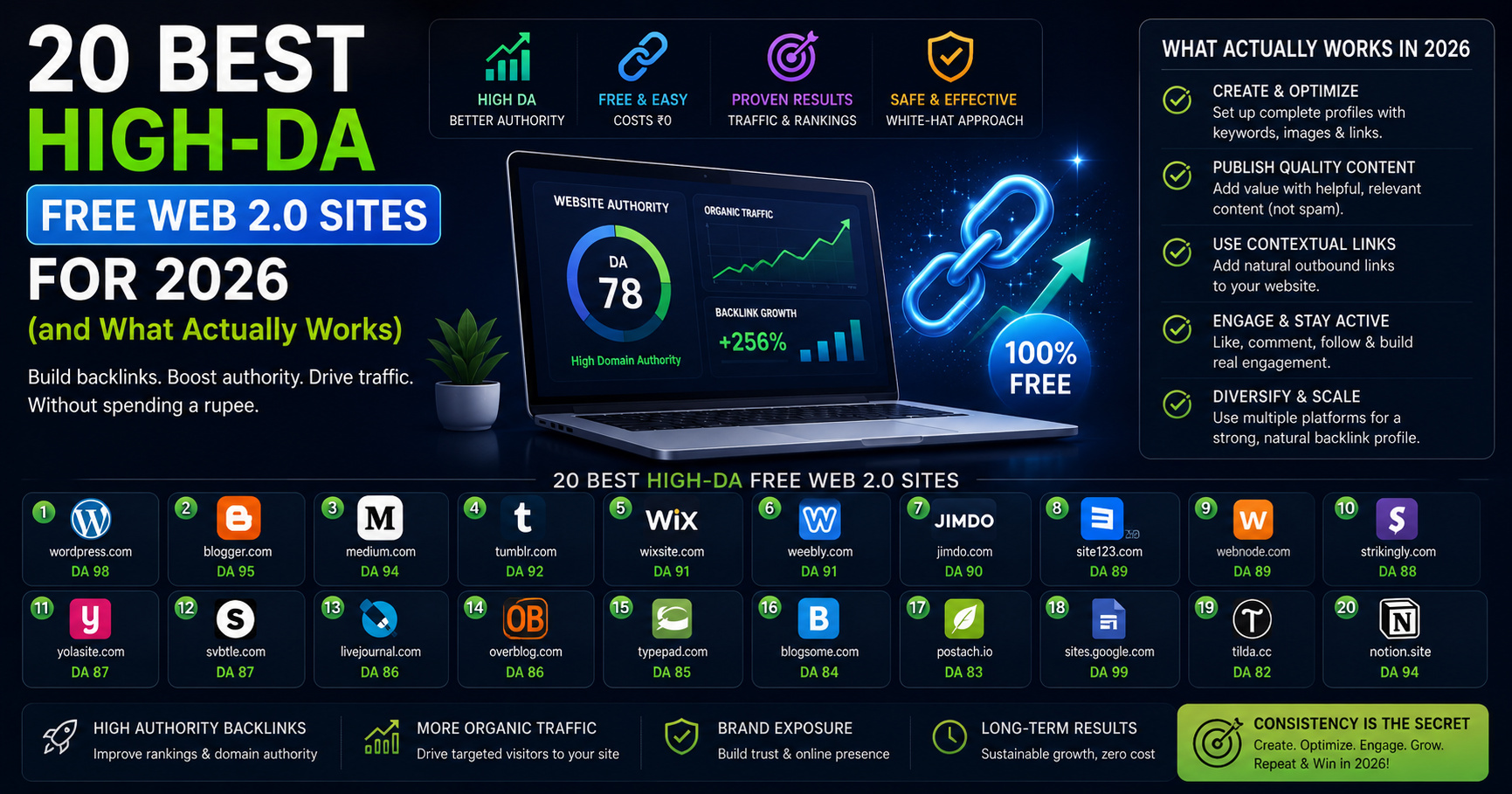
- The 20 high-DA Web 2.0 platforms that still work in 2026
- The honest pros and cons of Web 2.0 backlinks in 2026
- Paid versus free backlinks: the 2026 risk picture
- Google's compliance checklist for backlink work in 2026
- The five backlink strategies that actually work in 2026
- How to use Web 2.0 effectively in 2026
- FAQ
- How eCorpIT can help
- References
Summary. Twenty Web 2.0 platforms still pass real signal in 2026 — WordPress.com (DA 98), Blogger (Google-owned, DA 100), Medium (DA 96), Tumblr (DA 99), LinkedIn Articles (DA 98), Substack, dev.to, Hashnode, GitHub Pages (DA 100), Quora (DA 93) and similar. But the working list is much shorter than the "300+ Web 2.0 sites" guides that still circulate, and the rules of the game have changed. After Google's March 2024 core and spam updates, the October 2025 AI-guest-post-farm crackdown, and SpamBrain's now-real-time link graph analysis, low-quality Web 2.0 spam is at best ignored and at worst a route to a manual action. This article covers the 20 platforms that still matter, what they each do well in 2026, the honest pros and cons, the paid-versus-free backlink risk picture with Google's current policy quoted directly, and the five link-building strategies that actually move the needle now — digital PR, expert-quote platforms like Qwoted and Featured (HARO was sunset), original data studies, broken link building, and high-quality guest posts on relevant publications.
The truth about Web 2.0 backlinks in 2026 is that they are no longer a primary ranking tactic — they are a brand-distribution and indirect-signal tactic that occasionally produces ranking lift. Treat them that way and they work. Treat them like a shortcut to PageRank and they either do nothing or hurt you. This guide is honest about which is which.
This is built for SEO practitioners, marketing leaders, agency teams, founders running their own SEO, and link-building strategists working in India, the United States, the United Kingdom and globally. The research draws on Google Search Central documentation, Search Engine Land, Backlinko, the official Google Search blog announcements from 2024-26, and verified DA figures from Moz at the time of writing.
What changed for Web 2.0 in 2024-26 (and why it matters)
Three Google updates rewired what works.
The March 2024 core update and spam policies. Google's official Search Central post framed the update as targeting "low-quality, unoriginal content" with a stated goal of reducing it by approximately 40%. New spam policies introduced at the same time targeted three specific abuse patterns: expired-domain abuse, scaled content abuse, and site reputation abuse. The Web 2.0 implication is direct — generic 300-word Web 2.0 blog posts stuffed with exact-match anchor text were the canonical example of scaled content abuse, and many such network properties were de-indexed or stopped passing signal during this update.
SpamBrain operating in real time. SpamBrain is Google's AI-powered spam detection system. By 2026 it analyses link graphs in real time rather than through periodic algorithm sweeps. The practical effect is that a sudden burst of identical-anchor-text Web 2.0 links pointing to a target site is now usually detected and neutralised within hours, not months. The link does not produce ranking lift and the site's overall trust score may be quietly reduced.
The October 2025 spam update on AI guest post farms. Google's October 2025 spam update explicitly named "large-scale operations publishing thin, machine-generated content solely to embed paid backlinks" as a distinct violation category. Many low-quality Web 2.0 properties have been used for exactly this. Sites associated with these networks lost visibility through this update.
What survives this trio of updates is real content on real platforms read by real people. The 20 platforms below all clear that bar. The 280 platforms in the "300+ Web 2.0 sites" lists circulating online mostly do not.
What "high DA Web 2.0" actually means in 2026
Two definitions worth nailing before the list.
Web 2.0 platforms are user-generated content platforms where you can publish your own content on someone else's domain — WordPress.com, Blogger, Medium, LinkedIn Articles, Tumblr and similar. They are called "Web 2.0" because of the historical mid-2000s shift from static "Web 1.0" pages to user-contributed dynamic content.
Domain Authority (DA) is Moz's 0-100 score predicting how well a domain ranks. A WordPress.com or Blogger.com domain has DA 98-100 because of the millions of pages and inbound links pointing to that root domain. The DA of your specific Web 2.0 page on WordPress.com is not 98 — it is whatever Page Authority your individual post earns. This distinction matters because the SEO industry routinely conflates root-domain DA with the authority of any single page on that domain. They are not the same.
What this means in practice: a Medium article you publish on day one has the strong root domain of medium.com (DA 96), but the Page Authority of your specific URL is low until that page earns inbound links and engagement of its own. Most Web 2.0 backlinks pass nofollow by default — Medium adds rel="nofollow" to outbound links automatically, as do most modern Web 2.0 platforms. Nofollow links still pass discovery signal but do not directly transmit PageRank.
The 20 high-DA Web 2.0 platforms that still work in 2026
This list is alphabetical (not ranked) so the order does not imply priority. Each entry includes the current approximate DA, the link attribute behaviour, and the realistic use case in 2026.
1. About.me
DA ~90. Personal-profile platform with a single landing page per user. Allows one or two outbound links. Use case in 2026: personal-brand consolidation, schema-friendly Person entity, link from your About.me page to your professional site. Limited but stable signal. Most outbound links are nofollow.
2. Behance
DA ~92. Adobe-owned creative portfolio platform. Use case: designers, illustrators, motion artists, and creative agencies showcasing work. Project pages allow links to the client site and the artist's own site. Real audience and active discovery.
3. Blogger.com (BlogSpot)
DA ~100 (Google-owned). Free blog platform with custom-subdomain or custom-domain options. Use case in 2026: secondary brand blog with high-quality original content. Links are dofollow by default. Risk: aggressive auto-deletion of accounts that produce thin or AI-spammed content. The platform has tightened content quality enforcement materially over the past two years.
4. dev.to
DA ~91. Developer-focused community publishing platform. Real audience of working engineers. Links in articles are typically dofollow. Use case: technical content, open-source documentation, developer tools, AI engineering articles. Strong fit for developer-targeting B2B SaaS and AI companies.
5. GitHub (Pages and gists)
DA ~100. Microsoft-owned. GitHub Pages lets you publish static sites from a repository on the github.io subdomain. Use case in 2026: project documentation, technical companion sites, developer brand presence. GitHub README files and project documentation are widely cited in AI engine answers (ChatGPT, Perplexity, Claude) which use GitHub as a training and citation source.
6. Hashnode
DA ~85. Developer publishing platform similar to dev.to but with a stronger focus on technical blogs. Allows custom domains. Use case: technical thought leadership, engineering blogs, developer-relations content. Links in articles can be dofollow depending on platform settings.
7. LinkedIn Articles
DA ~98. The professional publishing layer on LinkedIn. Use case in 2026: thought leadership for B2B founders, executives and consultants. Algorithmic distribution within LinkedIn is the main value — backlinks are usually nofollow. The brand and audience signal is meaningful even when the link signal is not.
8. Medium.com
DA ~96. The largest general-purpose publishing platform. Links are nofollow by default. Use case: brand-led thought leadership, distribution to Medium's reader base, syndication of pillar articles. Membership-fenced articles can carry strong brand and engagement signal. Medium has tightened content quality controls since 2023 and now removes obvious SEO spam at scale.
9. Notion (Public pages)
DA ~89. Public Notion pages can serve as lightweight brand or product pages. Use case in 2026: public-facing internal docs, public roadmaps, brand-storytelling pages. Most outbound links are nofollow.
10. Quora
DA ~93. Q&A platform with surviving authority despite years of moderation challenges. Use case: answering high-intent questions in your domain, linking back to canonical articles on your site. Quora link attribution varies — many outbound links are nofollow but the brand exposure and traffic referrals can be meaningful for high-intent niches.
11. Reddit
DA ~91. Largest social discussion platform. Use case in 2026: community engagement, brand sentiment, AI engine training signal (Reddit is one of the most cited sources in ChatGPT and Perplexity answers because of its content licensing deals with both companies). Most Reddit outbound links are nofollow but Reddit's discovery and citation footprint is large.
12. Site123
DA ~86. Free website builder with hosting. Use case: lightweight microsites, campaign landing pages, personal sites. Outbound link attribute varies.
13. Strikingly
DA ~85. One-page website builder. Use case: simple project sites, single-page brand presence, portfolio pages. Outbound links typically nofollow.
14. Substack
DA ~89 and rising. Email-first newsletter publishing platform. Use case in 2026: founder newsletters, brand publications, expert-driven editorial work. Substack links are usually dofollow. Audience and brand value is often higher than the technical backlink value.
15. Tumblr
DA ~99. Multimedia microblogging. Use case: visual brands, creator communities, brand presence in specific subcultures. Most outbound links are nofollow but the platform has high root-domain trust.
16. Webflow.io
DA ~90. Webflow's free hosting subdomain. Use case: design-led portfolio sites and landing pages. Strong for creative teams and design-focused brands.
17. Weebly
DA ~90. Free website builder, Square-owned. Use case: small-business microsites, local-business landing pages. Outbound link attribute varies.
18. Wix.com
DA ~95. Major free-tier website builder. Use case: small-business sites and project pages. Outbound links are typically nofollow.
19. WordPress.com
DA ~98. Automattic-owned hosted WordPress. Use case in 2026: secondary brand blog, content marketing companion site, niche-topic blogs. Free-tier sites carry the wordpress.com subdomain; custom domains are available on paid tiers. Outbound link attribute depends on plan tier — free tier typically nofollow.
20. YouTube (Channel description and About)
DA ~100 (Google-owned). Channel descriptions and video descriptions allow outbound links. Use case in 2026: video-first brand presence, channel-to-site referral. Most outbound links are nofollow but the audience and discovery footprint is meaningful.
The 20 above all clear the 2026 quality bar. They survived the 2024-26 spam updates. They have real audiences. They are credible places to publish content that occasionally produces a ranking lift on the linked-from-your-own-site page through brand and discovery signal rather than direct PageRank flow.
What is not on this list, and intentionally so: closed-or-zombie platforms like Posthaven, low-quality auto-approval platforms used primarily by spam services, country-specific Web 2.0 sites with dubious moderation, and the long tail of "DA 85+" platforms that exist mainly because they bought their own backlinks. The 300+ Web 2.0 lists circulating in 2026 include many of these. Avoid them.
The honest pros and cons of Web 2.0 backlinks in 2026
Both sides matter.
The pros.
Brand and audience distribution. A Medium post, a LinkedIn article, or a Substack newsletter brings real readers, not just a PageRank vote. For founders and B2B brands, this is often the larger value.
AI engine citation footprint. Content on GitHub, Reddit, Quora, dev.to, Hashnode and Medium is heavily used in the training and citation sources for ChatGPT, Claude, Perplexity and Gemini. Web 2.0 publishing extends your AI engine visibility footprint, which is now a measurable channel — see our AI Overview defence content strategy.
Indirect ranking signal. Even nofollow links contribute to Google's understanding of your brand entity and topical authority. The signal is small per link but real.
Free to use. No budget commitment, low downside if you publish content that you would write anyway.
Brand entity reinforcement. Multiple platforms confirming the same business name, founder name, services and contact details strengthens the brand-entity profile in Google's Knowledge Graph and in AI engine grounding.
The cons.
Most links are nofollow. The direct PageRank transmission is limited. Web 2.0 is no longer a primary ranking tactic.
Quality bar is much higher than it used to be. 300-word filler with exact-match anchor text gets ignored at best and triggers manual action review at worst.
Account-deletion risk. Several platforms (Blogger, Medium, Tumblr) have tightened content quality enforcement and routinely delete accounts that publish AI-generated thin content.
Diminishing marginal returns. Posting the same content to 50 Web 2.0 properties does not produce 50x signal. After 10-15 quality platforms, you are usually in flat-return territory.
Easy to do badly. The most common Web 2.0 strategy — spin-and-distribute thin content with exact-match links — is now actively harmful. Most agencies still selling Web 2.0 packages are selling an outdated tactic.
Indirect contribution to SpamBrain link graph risk. If your Web 2.0 footprint resembles known spam network patterns (same anchor text repeated across many properties, no audience engagement, formulaic publishing schedule), SpamBrain may downweight the entire link profile.
Paid versus free backlinks: the 2026 risk picture
This is where the bigger money decisions get made. The honest landscape:
Google's stated policy. Per Google Search Central spam policy documentation, "link spam is the practice of creating links to or from a site primarily for the purpose of manipulating search rankings." Any link acquired through payment, product exchange or commercial arrangement must carry rel="sponsored" (preferred) or rel="nofollow". Links acquired through payment that pass PageRank without these attributes are direct violations of Google's spam policies.
What this means in practice. Most "buy a guest post for $300" services produce links that do not carry rel="sponsored" — these are explicit policy violations. The fact that the seller markets them as "natural-looking" does not change the policy classification.
The enforcement reality. Two enforcement paths exist. The first is manual action — a human Google reviewer flags the site and the site's manual actions report in Search Console shows the action. This is rare for individual paid links but common for sites with extensive paid link patterns. The second, more common path is algorithmic devaluation — SpamBrain neutralises the paid link's PageRank contribution silently. The site does not get a manual action, but the link produces no ranking lift either. The money is wasted but no visible damage is done.
Risk by link source.
High-traffic, topically relevant editorial publication, with explicit `rel="sponsored"` tagging. Lowest risk. This is increasingly close to legitimate sponsored content advertising, which Google has accepted for many years.
High-traffic editorial publication without sponsored tagging. Medium risk. Algorithmic devaluation is likely; manual action is possible if the pattern is repeated.
Mid-tier guest post farm or link insertion service. High risk. October 2025 spam update specifically targeted this category. Algorithmic devaluation is near-certain; manual action is meaningful.
Low-tier PBN, expired domain links, AI guest post farms. Very high risk. SpamBrain link graph analysis catches these patterns. Manual action is common.
The financial math. A high-quality paid editorial link from a DR 60-80 publication costs $400-$2,000 in 2026. Mid-tier services charge $50-$200. Low-tier offers go below $20. The high-quality end can occasionally work if the link is editorially earned even with payment; everything else is either ignored or actively harmful.
The free alternative is more competitive than it looks. A Qwoted-earned expert quote in a DR 75 publication is functionally equivalent to a $1,500 paid placement — except it is editorially earned, comes with no rel="sponsored" requirement, and signals real expertise. We cover this in the next section.
Google's compliance checklist for backlink work in 2026
Five rules drawn directly from Google's current Search Essentials documentation and spam policies.
1. Any link acquired through payment must carry `rel="sponsored"` or `rel="nofollow"`. No exceptions. This applies to paid guest posts, paid link insertions, advertorials, product reviews where you paid for placement, and influencer placements where money or product changed hands.
2. Excessive link exchanges violate policy. "I link to you, you link to me" beyond modest editorial cross-references is treated as a link scheme.
3. Low-quality directory and bookmark submissions are link schemes. Mass-submitting to 500 directories is a link scheme regardless of whether the directories appear high-DA.
4. Anchor text overuse is a clear signal. A site with 200 inbound links and 180 of them carrying the same exact-match keyword phrase as anchor is a textbook unnatural pattern.
5. The disavow tool is rarely the right answer. Google now strongly recommends disavow only when you have a confirmed manual action. For algorithmic devaluation, removing the toxic links at source is preferred; disavow has limited effect because SpamBrain has usually already neutralised them.
When a site is hit, the recovery path is: confirm there is a manual action via Search Console; identify the offending link patterns; either remove the links at source or disavow them; document the work; request reconsideration via the Manual Actions report.
The five backlink strategies that actually work in 2026
This is what serious link building looks like now. None of these depend on Web 2.0 spam.
1. Expert-quote platforms (Qwoted, Featured, Connectively)
HARO (Help A Reporter Out) was sunset by Cision in 2024. The working successors in 2026 are Qwoted, Featured, Connectively and a handful of niche platforms (HarosLink, ResponsesSourceUK). These connect journalists at major publications with subject-matter experts willing to be quoted.
The mechanics: respond to relevant queries within 1 hour for the best placement rate, lead the response with a one-sentence credential, give a specific data point or named example, end with contact info. Industry reporting suggests responses within the first hour have approximately 60% higher placement rates than slower responses. Typical placement rate is 5-15%, so expect 0-3 backlinks per month from this work — but the quality is exceptional: DR 60-85 publications, fully editorial, no rel="sponsored" requirement.
For Indian, US and UK B2B brands, this is the highest-impact link-building tactic of 2026. Cost: time, plus optional Qwoted or Featured platform subscription.
2. Original data studies
Publish original research that journalists want to cite. A small-but-real survey of 200 customers in your category, a study of cost benchmarks across vendors, a dated industry-trends report — each produces a citable resource that earns links naturally as press writers reference it.
The discipline that distinguishes link-earning data studies from forgettable ones: name a specific finding in the headline ("47% of Indian SMBs use AI for invoicing — survey"), publish the methodology transparently, allow easy citation with a quotable headline statistic, and pitch the study directly to journalists who cover your category.
3. Digital PR campaigns
Build a small set of newsworthy stories — a founder interview, a quarterly data report, a comment-piece on a regulatory event — and pitch them to journalists in your category. For Indian B2B brands, the target publication list typically includes YourStory, Inc42, ET Tech, Mint, Tech in Asia and a handful of trade publications.
Digital PR is more expensive in time than the other tactics — typically 20-30 hours per campaign — but the resulting backlinks are editorial, in-content, often dofollow, and on publications with both real traffic and AI engine citation footprint.
4. Broken link building
Find pages that link to broken or obsolete resources in your category. Build a better resource on your site. Outreach to the linking sites with the broken link plus your replacement. Conversion rates are 5-15% on well-targeted outreach.
The work is operationally heavy — you need to find broken links via Ahrefs Broken Backlinks, Semrush Backlink Audit or similar tools, build the replacement content, and run targeted outreach. The links you earn are editorial, in-content, and often dofollow.
5. High-quality guest posts on relevant publications
Distinct from paid guest posts. The difference: legitimate guest posts are pitched and accepted on editorial merit; paid guest posts are bought. Editorial guest posts on relevant publications produce strong backlinks without rel="sponsored" requirement because no money or compensation changed hands.
The pitch discipline: identify publications that genuinely accept editorial contributions, study their editorial standards, pitch a specific article idea (not a generic "I'd like to write for you") to the right editor, write the piece to publication standards.
For the deeper SEO discipline that supports all of this, see eCorpIT's Ultimate Guide to SEO in 2026 and the AEO/GEO/SEO Complete Guide.
How to use Web 2.0 effectively in 2026
If you are going to invest in Web 2.0 despite the diminishing direct-ranking returns, here is the discipline that works.
Pick 5-7 platforms, not 50. Quality over coverage. Choose platforms with real audiences where you can sustain meaningful content.
Original content per platform, not republished. Same idea, different execution per platform. Medium gets the long essay, LinkedIn gets the executive summary, dev.to gets the technical deep dive, Substack gets the founder-voice version.
Build the author profile. Author E-E-A-T on the Web 2.0 platform matters. Complete profiles, professional headshots, links between platforms, accurate bios.
Aim for engagement, not link placement. Comments, shares, citations from real readers signal authority. A Medium post with 500 reads and no inbound links is worth more than the same post syndicated to 50 platforms with zero engagement.
Track AI engine citation footprint. Tools like Profound, BrightEdge GEO module and Ahrefs Brand Radar measure where your brand appears in AI engine responses. Web 2.0 platforms with strong AI citation footprint (GitHub, Reddit, Medium, Quora, dev.to) lift this footprint meaningfully.
Avoid the anchor text overuse trap. When Web 2.0 properties do link to your site, vary the anchor text naturally. Brand-name anchor, partial-match, generic ("read more", "the full article"), URL-only anchors should all appear in any natural link profile.
FAQ
How eCorpIT can help
eCorpIT runs SEO, AEO and GEO programs for clients across India, the US and the UK — including link-building strategy, digital PR, expert-quote platform management on Qwoted and Featured, original data studies, broken link building, and AI engine citation tracking via Ahrefs Brand Radar and similar tools.
If your 2026 SEO program needs link building that actually works under current Google rules, our team can help. Reach us at ecorpit.com/contact-us/ or contact@ecorpit.com.
References
- Google Search Central — "What web creators should know about our March 2024 core update and new spam policies": developers.google.com
- Google Search Central — "Spam Policies for Google Web Search": developers.google.com
- Google Search Central — "Spam Updates": developers.google.com
- Google Search Console Help — "Manual actions report": support.google.com
- Google Search Console Help — "Disavow links to your site": support.google.com
- Search Engine Land — "Google March 2024 spam update done rolling out": searchengineland.com
- Blue Tree Digital — "Google's Backlink Policy in 2026: What the Guidelines Actually Say": bluetree.digital
- Backlinko — "5 Best HARO Alternatives in 2026": backlinko.com
- PressWhizz — "Best HARO Alternatives in 2026": presswhizz.com
- Qwoted — Expert-quote platform: qwoted.com
- Featured — Expert-quote platform: featured.com
- Connectively — Expert-quote platform: connectively.us
- LinkSurge — "Safe Link Building in 2026: White-Hat Strategies": linksurge.jp
- eCorpIT — "Ultimate Guide to SEO in 2026": ecorpit.com
- eCorpIT — "AEO vs GEO vs SEO: The Complete Guide": ecorpit.com
- eCorpIT — "Dofollow vs Nofollow Links: Best Practices 2026": ecorpit.com
- eCorpIT — "Digital Marketing Strategy for 10x ROI in 2026": ecorpit.com
Last updated 8 June 2026 by the eCorpIT Editorial team. We will refresh this article when Google publishes its next core or spam update affecting link signals, and when significant Web 2.0 platform changes occur. Domain Authority figures are approximate as of June 2026 and may shift.