On this page · 13 sections
- The five truths most articles miss
- What dofollow and nofollow actually mean
- The 2019 shift that most articles still miss
- The three rel attributes, in detail
- The 2026 AI search reality
- When to use which attribute: the practical playbook
- Common myths, debunked with current data
- The link-attribute audit framework
- Link-building strategy for 2026
- Frequently asked questions
- A short closing note
- Further reading
- References
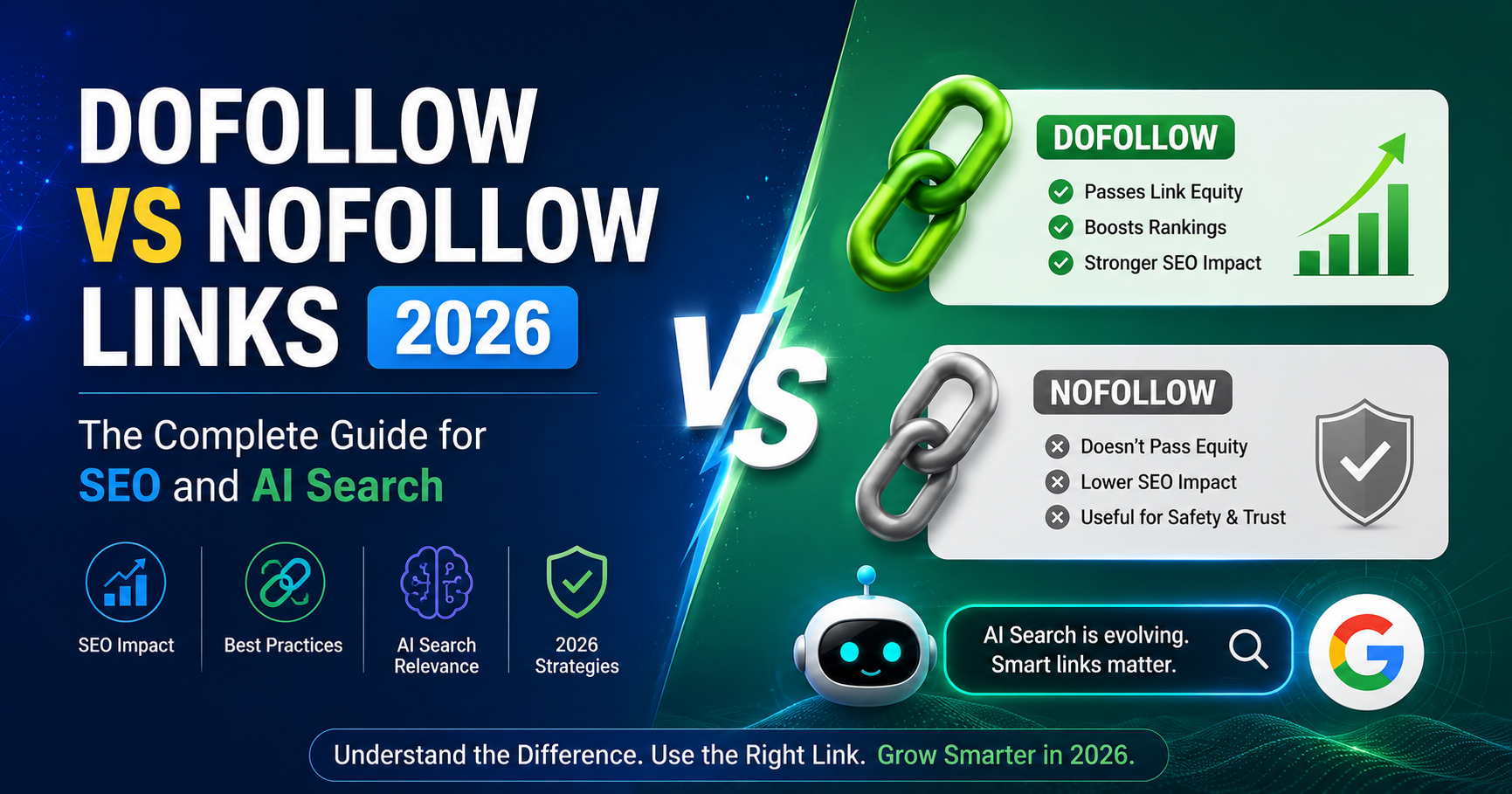
Summary. Most "dofollow vs nofollow" guides on the internet are stuck in 2018. Google moved nofollow from a strict directive to a hint in March 2020. The new rel attributes (sponsored and ugc) joined the family at the same time. And a 2025 Semrush study of 1,000 domains found that nofollow and dofollow links correlate almost identically with AI search visibility (Pearson 0.340 vs 0.334) — meaning ChatGPT, Perplexity, Claude, and Google AI Overviews treat both as meaningful signals. This guide does the actual 2026 picture: what each attribute means, when to use which, what Google really does with them, and what the AI-search era means for link-building strategy.
Talk to eCorpIT about an SEO + AEO sprint · AEO vs GEO vs SEO complete guide
The five truths most articles miss
Before the definitions and history, the things that actually matter in 2026.
1. Nofollow is a hint, not a directive. Since March 2020, Google explicitly documents that nofollow, sponsored, and ugc attributes "are treated as hints about which links to consider or exclude" rather than absolute rules. Google may still crawl the link, follow it, and use it for context and ranking signals.
2. Nofollow links can still pass value. They no longer pass PageRank reliably, but Google uses them to understand content, identify unnatural link patterns, and inform topical authority. The "nofollow = zero value" framing died in 2020.
3. Sponsored and ugc are not weaker nofollows. They are more specific signals. Using rel="sponsored" on a paid link is better SEO hygiene than using rel="nofollow" because it tells Google exactly what kind of link it is.
4. AI search engines treat nofollow and dofollow nearly identically. A 2025 Semrush study of 1,000 domains found Pearson correlation coefficients of 0.340 (nofollow) versus 0.334 (dofollow) with AI search visibility. ChatGPT and Gemini lean slightly toward nofollow links as signals; AI Overviews and Perplexity lean slightly toward dofollow. The practical takeaway: both matter.
5. There is no actual HTML attribute called "dofollow". "Dofollow" is the everyday term for a link without a nofollow attribute. The default. The opposite of nofollow. You will never see rel="dofollow" in real HTML — and if you do, it does nothing.
If you only read this section, you have most of what you need. The detail below explains why each is true.
What dofollow and nofollow actually mean
The mechanics, without the jargon.
A "dofollow" link is any HTML link without a rel="nofollow" (or related) attribute. It tells search engines: "I vouch for this link. Treat it as an endorsement. Pass any ranking signals through to the target page." That is the default behaviour for every link you write unless you mark it otherwise.
A "nofollow" link carries the attribute rel="nofollow" in its HTML. It tells search engines: "I am linking to this for a reason, but I do not necessarily vouch for it. Be cautious about passing endorsement signals." Google introduced this in 2005 to combat comment-spam abuse on blogs and forums.
The HTML difference, side by side:
            <!-- Dofollow (default) -->
<a href="https://example.com">Anchor text</a>

<!-- Nofollow -->
<a href="https://example.com" rel="nofollow">Anchor text</a>

<!-- Sponsored (paid links) -->
<a href="https://example.com" rel="sponsored">Anchor text</a>

<!-- User-generated content -->
<a href="https://example.com" rel="ugc">Anchor text</a>

<!-- Combined attributes -->
<a href="https://example.com" rel="ugc sponsored">Anchor text</a>
That is the entire universe of link attributes Google's link-qualification system uses. Everything else in this guide explains when to choose each.
The 2019 shift that most articles still miss
For 14 years after the 2005 nofollow launch, the rule was simple: nofollow links pass nothing. SEO professionals built entire link-building strategies around hunting for dofollow links and avoiding nofollow ones. Most "SEO guides" still teach this.
It is no longer correct.
In September 2019, Google announced that rel="nofollow" would become a "hint" rather than a strict directive. The change went live in March 2020. From that date, Google reserved the right to:
- Crawl nofollow links anyway.
- Follow nofollow links for indexing the target page.
- Use nofollow links as ranking signals when context suggests they are meaningful.
- Pass topical-association signals through nofollow links.
Google's stated reason, per Search Engine Land's coverage of the announcement: all links provide valuable information that can be used to understand content as well as identify unnatural link building. Treating them as binary directives threw away signal.
The hint model also introduced two new attributes alongside nofollow: rel="sponsored" for paid links and rel="ugc" for user-generated content. The three together let publishers tell Google exactly what kind of link they are publishing.
Most "dofollow vs nofollow" guides on the internet still reference the pre-2020 binary model. Treat any article that says "nofollow links pass no PageRank" as out of date.
The three rel attributes, in detail
Each attribute serves a different purpose. Use the most specific one that fits.
rel="nofollow"
The general-purpose "I am not vouching for this link" attribute. Use it when:
- You are linking to a site you do not endorse but need to cite for reference (a competitor, a controversy, a source you disagree with).
- You are linking to a low-quality or unverified site for context.
- You want to be cautious about a link's signal-passing for editorial reasons.
Nofollow remains the right choice for ambiguous cases. It is the catch-all when neither sponsored nor ugc fits.
rel="sponsored"
For paid links specifically. Use it when:
- You received money or other consideration for the link (an advertisement, sponsored post, affiliate link).
- The link is part of a paid partnership.
- The link is in content where a financial relationship exists with the target.
Per Google's outbound-links documentation, this is the correct attribute for affiliate links, sponsored mentions, and advertising. Using rel="nofollow" instead is acceptable but rel="sponsored" is more accurate and gives Google better signal.
rel="ugc"
For user-generated content. Use it when:
- The link was added by a user (blog comment, forum post, review).
- The link sits inside content the site owner did not write.
- The site's editorial team did not personally vouch for the link.
The classic case is blog comments. Discourse forums, Reddit-style user content, and review systems where users embed links should all use rel="ugc" by default.
Combining attributes
You can combine multiple rel values when more than one applies. A common example:
<a href="https://example.com" rel="ugc sponsored">Sponsored comment</a>
This tells Google: "This link is in user-generated content, and a financial relationship exists." More specific signal beats less specific signal.
The 2026 AI search reality
The most important shift since the 2020 hints model: AI search engines treat link signals very differently from how Google's traditional algorithm did. The data tells a clear story.
A 2025 Semrush study of 1,000 domains measured the correlation between link attributes and AI search visibility across ChatGPT, Perplexity, Claude, Google AI Overviews, and Gemini. The headline numbers:
- Nofollow links: Pearson correlation 0.340 with AI visibility (Spearman 0.509).
- Dofollow links: Pearson correlation 0.334 with AI visibility (Spearman 0.504).
The two correlate almost identically. Nofollow may even slightly outperform dofollow as a signal for AI engines. The platform-specific breakdown:
- ChatGPT and Gemini show a slight preference for nofollow links as signals.
- AI Overviews and Perplexity lean toward dofollow.
- Claude treats both similarly.
The practical implication for brands building AI search visibility: a balanced backlink profile that includes a healthy proportion of nofollow links from credible sources is now an asset, not a liability. The dofollow-only obsession that defined 2010-2020 link-building is genuinely outdated for 2026.
Citation behaviour across AI engines also matters. Sapt's 2026 GEO research reports:
- ChatGPT cites sources 87% of the time.
- Google AI Overviews cite 84.9% of responses.
- Google AI Mode cites 76.3%.
- Perplexity provides explicit linked citations in every response.
For brands, the question is no longer "do I have dofollow backlinks." It is "am I cited in AI answers across all the engines my buyers use." Our AEO vs GEO vs SEO complete guide covers the practical mechanics of getting cited.
When to use which attribute: the practical playbook
A decision tree most editorial and SEO teams can adopt as-is.
You wrote the link, you vouch for it, no money involved → no attribute (dofollow). The default. Most internal links and editorial outbound links to credible sources.
You wrote the link, you do not vouch for it → rel="nofollow". Citing a competitor, linking to a controversial source, referencing low-quality content for context.
You received money for the link → rel="sponsored". Affiliate links, advertising, sponsored content, paid partnerships. Required by Google's webmaster guidelines and by FTC disclosure rules in the US.
A user wrote the content containing the link → rel="ugc". Blog comments, forum posts, reviews, any content not authored or vetted by the site's editorial team.
Multiple apply → combine them. rel="ugc sponsored" is valid and common. Specificity is a feature.
You are unsure → rel="nofollow". The general-purpose fallback. Safer to nofollow an ambiguous link than to pass an endorsement you cannot defend.
Internal links pointing to your own pages → never use nofollow. A common 2018-era mistake. Internal nofollow links waste your own internal PageRank flow. Always pass internal authority through to your own pages.
Common myths, debunked with current data
Six beliefs that are widely repeated and currently wrong.
Myth: "Nofollow links are worthless for SEO." False. Google treats them as hints, not directives. The 2025 Semrush study shows they correlate as strongly as dofollow links with AI search visibility. Use them; just do not expect them to pass traditional PageRank reliably.
Myth: "Every external link should be nofollow to preserve link juice." False, and counterproductive. Editorial nofollow on credible outbound citations weakens your topical-authority signal. Google rewards sites that link generously to credible sources.
Myth: "Comments and forum links must be nofollow." Outdated. The current correct attribute is rel="ugc", not rel="nofollow". Both work; rel="ugc" is more specific and gives Google better signal.
Myth: "Adding rel='nofollow' to internal links improves crawl budget." False. Use the meta robots noindex tag for pages you do not want indexed, or the robots.txt disallow for pages you do not want crawled. Internal nofollow links waste internal PageRank without preventing crawl.
Myth: "rel='dofollow' is a real attribute you can add to links." False. Dofollow is not an HTML attribute. Adding rel="dofollow" to a link does nothing — it is the default state of any link without a nofollow attribute. The HTML standard has no rel="dofollow" value.
Myth: "AI search engines only look at dofollow backlinks." False, per the 2025 Semrush data above. AI engines weight nofollow and dofollow almost identically.
The link-attribute audit framework
A practical 60-minute exercise to verify your site is using attributes correctly.
Step 1: Crawl your site. Use Screaming Frog, Sitebulb, Semrush Site Audit, or Ahrefs Site Audit to extract every internal and external link with its rel attribute.
Step 2: Find internal nofollow links. Filter for internal links with rel="nofollow". Almost all of them are mistakes. Fix them.
Step 3: Audit your sponsored content. Find every paid link, affiliate link, and sponsored mention. They should have rel="sponsored", not just rel="nofollow". Update them.
Step 4: Audit comment and forum sections. If your CMS adds links from user comments or forums, they should carry rel="ugc". Verify the CMS is doing this; if not, configure it.
Step 5: Audit external dofollow links. Pull the list. Any link to a competitor, a controversial source, or content you do not vouch for should be rel="nofollow". Update them.
Step 6: Spot-check ad networks. Some ad networks correctly add rel="sponsored"; others still use rel="nofollow"; some use neither. Configure correctly.
For a typical mid-market site, this audit catches 50-200 attribute mistakes the first time it is run. Most are inherited from old WordPress plugins, old CMS configurations, or copy-pasted code patterns.
Link-building strategy for 2026
The strategic shift, given everything above.
Build for a balanced profile, not for "only dofollow" links. A natural backlink profile contains a mix of dofollow, nofollow, sponsored, and ugc links. The dofollow-only obsession that defined 2010-2020 link-building looks unnatural to modern algorithms and forfeits AI-search-visibility upside.
Prioritise mentions on credible sites over technical link attributes. A nofollow mention in The Wall Street Journal is worth more than a dofollow link from a low-quality directory. Brand mentions, even unlinked ones, build the entity-level strength AI engines reward, per the Princeton GEO research we covered in the AEO/GEO/SEO pillar.
Earn quotes, not just links. Named expert quotes in industry coverage produce both citation value (for AI engines) and entity-strength signal (for Google's knowledge graph). A single trade-press quote often beats dozens of low-quality backlinks.
Build Wikipedia and Wikidata presence. ChatGPT cites Wikipedia in roughly 47.9% of its top citations. The links from Wikipedia are nofollow, but the citation pattern is the most powerful AI-visibility signal available. A clean Wikidata entry is the easiest win for entity strength.
Get on Reddit, ethically. Perplexity sources nearly half of its citations from Reddit. A useful, non-spammy Reddit presence in your category often beats traditional backlink hunting for Perplexity visibility specifically.
Track AI citations as a primary metric. Backlink count and dofollow ratio are 2018 metrics. The 2026 metric is "which of my target queries return a citation to my brand across ChatGPT, Perplexity, Claude, and Gemini." Set up a monthly fixed-prompt audit. The brands that start tracking now will have the trend line when budget conversations get serious in 2027.
Need help with an AEO/GEO + link-building audit? eCorpIT runs 90-day programmes for brands in India, the UK and the US covering citation tracking, entity strengthening, expert-quote acquisition, and AI Overview inclusion strategy. Talk to our team about a sprint.
Frequently asked questions
A short closing note
The dofollow versus nofollow conversation in 2026 is less binary than it used to be. Google moved nofollow to a hint in 2020. The sponsored and ugc attributes added more precision to the picture. AI search engines treat both follow types as meaningful signals. The dofollow-only link-building obsession that defined the previous SEO era is genuinely outdated.
The right 2026 strategy is balanced profile-building, ethical brand-mention earning, entity-strength investment, and explicit AI citation tracking. The link attributes are tactical hygiene; the strategy lives in being cited where buyers actually look.
If you want a senior, honest read on what your link profile and AI citation picture should look like for your specific category, that is what we do.
Further reading
- AEO vs GEO vs SEO: The Complete 2026 Guide to Winning AI Search — the canonical AEO/GEO playbook.
- ChatGPT Hits 1 Billion Monthly Active Users — why AI search visibility now matters at consumer scale.
- Microsoft Build 2026: Enterprise AI Takeaways — Microsoft IQ and the AI grounding question.
- B2B Performance Marketing Playbook 2026 — how SEO and AEO feed measurable pipeline.
- Hindware vs Google: Delhi HC Keyword-Ads Ruling — the trademark-and-keyword conversation for branded SEO.
References
This article will be reviewed and refreshed quarterly, and immediately if Google issues new link-attribute guidance or AI engines publish updated citation behaviour data. Next planned refresh: September 2026.