On this page · 11 sections
- What AWS actually shipped
- The pricing question nobody answered
- The free native baseline most teams underuse
- Where third-party platforms earn their price
- Side-by-side: the five options in 2026
- The decision: when native is enough, and when to buy
- India-specific considerations
- How this fits your cost programme
- FAQ
- How eCorpIT can help
- References
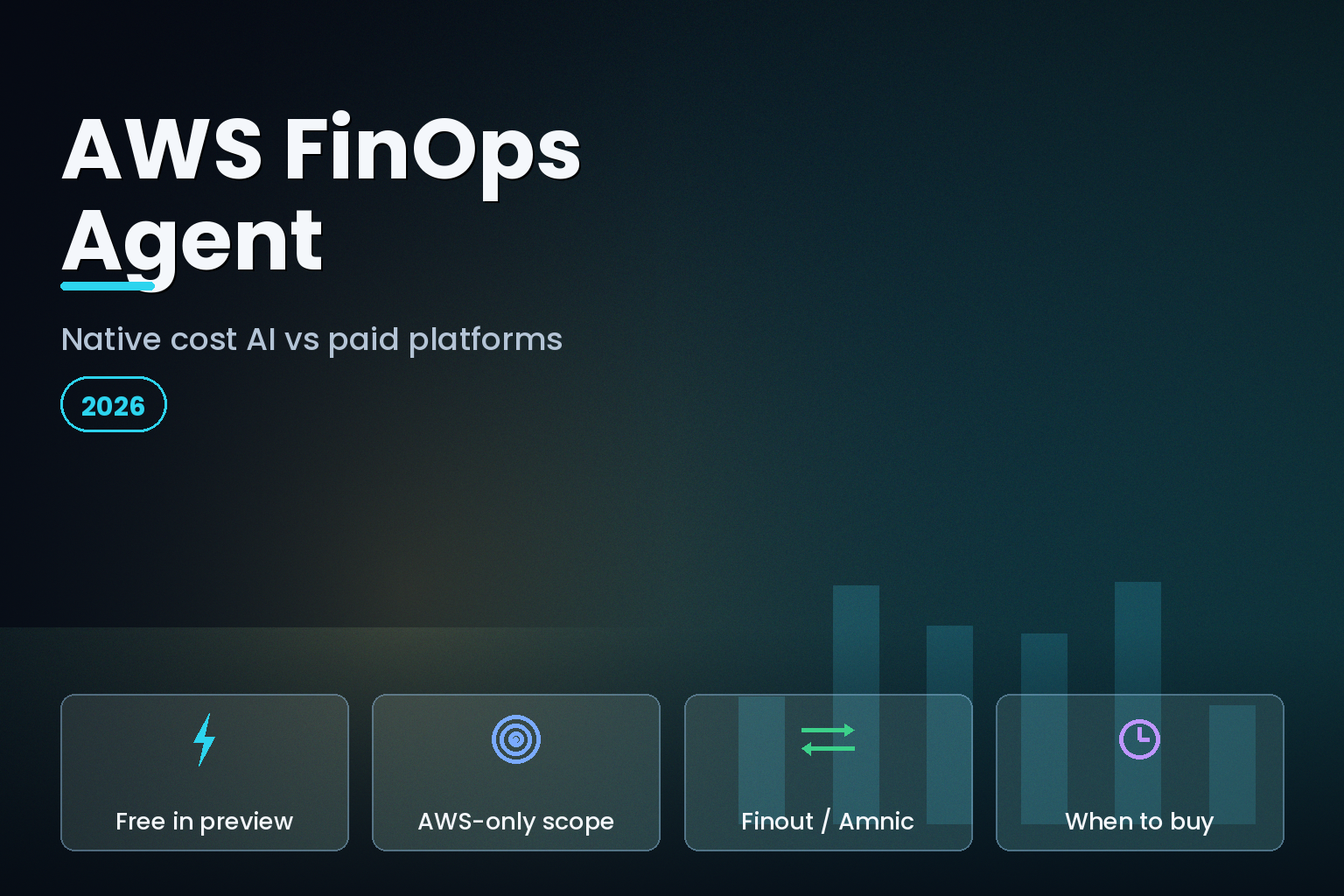
Summary. AWS put its FinOps Agent into public preview on 9 June 2026, built on Amazon Bedrock, and it is free for now with no general-availability price announced. That single gap should shape your decision. The native agent answers plain-language cost questions and investigates anomalies inside AWS, but it stops at the AWS account boundary. The third-party platforms cost real money and cover more: Apptio Cloudability runs about $30,000 a year for $1 million of cloud spend, Finout starts near $6,000 a year, and Amnic prices at 0.25% to 1% of monitored spend. Meanwhile AWS Cost Optimization Hub already gives you rightsizing and Savings Plans recommendations at no charge. This guide compares all five and shows when the free native path is enough, and when a paid platform earns its price.
What AWS actually shipped
The AWS Cloud Financial Management team described the launch plainly: "AWS announces the public preview of AWS FinOps Agent, an agentic AI solution that investigates cost anomalies to root cause and answers cost questions for engineers across your organization, in the tools they already use." It is built on Amazon Bedrock. It ties into AWS Cost Anomaly Detection, investigates a spike to its root cause, and posts a consolidated report into Slack or Jira, opening a Jira ticket when you ask it to. It also surfaces rightsizing, idle-resource and Savings Plans recommendations pulled from AWS Cost Optimization Hub and AWS Compute Optimizer.
The preview runs only in the US East (N. Virginia) region, though the cost and usage data it reads covers every commercial AWS region, excluding AWS GovCloud (US) and the AWS China regions. For an engineer who lives in the AWS console and wants to ask "why did EC2 jump 40% on Tuesday" in Slack, it is a genuine step up from reading Cost Explorer charts by hand.
The pricing question nobody answered
Free-in-preview is not a pricing model. AWS has not announced what the FinOps Agent will cost at general availability, and it is built on Bedrock, which AWS meters by token. Other Bedrock-based agents are billed on usage. A team that wires its anomaly workflow, its Slack alerts and its Jira automation around a free tool is exposed to a real cost change the day AWS sets a GA price. This was the open question at FinOps X 2026, where the agent was one of the headline demos and the "tokenomics" of agentic FinOps went pointedly unresolved. Treat the current cost of the AWS FinOps Agent as $0 with an asterisk, and do not build a workflow you cannot unwind.
The free native baseline most teams underuse
Before paying for anything, know what AWS already gives you at no charge. AWS Cost Optimization Hub aggregates recommendations from AWS Compute Optimizer, AWS Trusted Advisor and AWS Cost Explorer into one view, with no per-account fee, no data-ingestion charge and no premium tier. Cost Explorer handles historical analysis and forecasting. Cost Anomaly Detection flags spikes. The FinOps Agent sits on top of that stack as a natural-language layer. For a single-account or single-payer AWS shop, this native combination covers a large share of day-to-day FinOps without a signed contract.
The native stack has one hard limit: it ends at AWS. It cannot see Azure, Google Cloud, Snowflake, Datadog or SaaS line items, and its cost allocation is only as good as your tagging discipline.
Where third-party platforms earn their price
The paid platforms exist for the gaps the native tools leave: multi-cloud and SaaS coverage, allocation without perfect tags, and chargeback or showback to business units.
Apptio Cloudability, part of IBM since the 2023 Apptio acquisition, is the mature enterprise option. It covers AWS, Azure, Google Cloud, Oracle Cloud and third-party services, with deep allocation, budgeting and forecasting. It prices as a percentage of cloud spend under management: roughly $30,000 a year at $1 million of spend, and $76,000 to $132,000 at $3 million to $6 million, with the largest enterprises negotiating toward 1%.
Finout covers AWS, Azure, Google Cloud, Kubernetes, Snowflake and Datadog without requiring code, agents or a tagging cleanup first. Its pricing starts near $6,000 a year and scales with cloud and SaaS spend, negotiated through sales. Its AI agent, Billy, is built to investigate, decide and act across the whole estate rather than one cloud.
Amnic prices at 0.25% to 1% of monitored cloud spend with no per-seat license and a 30-day read-only free trial. Its FinOps agent adds an outcome-based twist: it charges 5% of the savings from any financial commitment it purchases on your behalf, plus a per-token conversation fee that Amnic waived through 1 July 2026.
Side-by-side: the five options in 2026
| Tool | 2026 pricing | Cloud scope | Best for |
|---|---|---|---|
| AWS FinOps Agent | Free in preview; GA price unannounced | AWS only | Engineers asking cost questions in Slack or Jira inside AWS |
| AWS Cost Optimization Hub | Free (no per-account fee) | AWS only | Rightsizing and Savings Plans recommendations without a contract |
| Apptio Cloudability | ~$30,000/yr per $1M spend; ~1% at scale | AWS, Azure, GCP, Oracle, SaaS | Large multi-cloud enterprises needing allocation and chargeback |
| Finout | From ~$6,000/yr, spend-based | AWS, Azure, GCP, Kubernetes, Snowflake, Datadog | Teams wanting multi-cloud plus SaaS without a tagging project |
| Amnic | 0.25%–1% of monitored spend | Multi-cloud, Kubernetes | Cost-conscious teams wanting outcome-based agent pricing |
The decision: when native is enough, and when to buy
| Your situation | Recommended path |
|---|---|
| Single AWS account or payer, tagging is decent | Native: Cost Optimization Hub plus the FinOps Agent |
| AWS-only but weak tagging and messy allocation | Native first; add a paid tool only if allocation stays broken |
| AWS plus Azure or Google Cloud | Buy a multi-cloud platform (Finout, Amnic or Cloudability) |
| Kubernetes, Snowflake or Datadog spend matters | Finout or Amnic, which read those sources natively |
| Enterprise chargeback and forecasting for finance | Cloudability, the mature allocation and budgeting option |
| You want autonomous savings actions, not reports | Finout (Billy) or Amnic's outcome-priced agent |
The honest answer for most single-cloud AWS teams in mid-2026 is that the free native stack plus the FinOps Agent is enough, and a paid platform is premature. The moment a second cloud, serious SaaS spend, or finance-grade chargeback enters the picture, the native tools cannot follow the money and a platform pays for itself. The real cost of the wrong choice is rarely the license. It is the six months a team spends bending a single-cloud tool around a multi-cloud problem.
India-specific considerations
For Indian teams and global capability centres running cost governance from India, two things matter. First, spend-based pricing bites harder where budgets are tighter, so the free native stack is the right starting point and a percentage-of-spend platform needs a clear allocation or chargeback case before it is justified. Second, cloud and usage data is operational data that can carry identifiers, so a FinOps tool that ingests billing and tagging metadata should be scoped under the Digital Personal Data Protection Act 2023, with data residency and retention checked before onboarding. For the wider playbook, see our guide to cloud FinOps for Indian teams.
How this fits your cost programme
An anomaly-investigating agent is one control in a larger FinOps programme. It works best next to commitment planning, which we cover in Savings Plans target coverage sizing, and next to the storage and egress decisions in our AWS, Azure and GCP storage pricing breakdown. For GPU-heavy teams, capacity pricing shifts the math further, as covered in our note on EC2 capacity blocks and GPU price rises.
FAQ
How eCorpIT can help
eCorpIT is a Gurugram-based, CMMI Level 5 and ISO 27001:2022 certified engineering organisation that runs cloud FinOps for teams on AWS and multi-cloud estates. Our senior engineers set up the free native stack first, wire anomaly alerts into Slack and Jira, and only recommend a paid platform when multi-cloud allocation or chargeback needs it. If your cloud bill is growing faster than your traffic, talk to our FinOps team about a cost review.
References
- AWS FinOps Agent is now available in preview, AWS What's New, June 2026.
- Announcing the public preview of AWS FinOps Agent, AWS Cloud Financial Management blog, June 2026.
- AWS Weekly Roundup: AWS FinOps Agent in preview, AWS News Blog, 15 June 2026.
- AWS Previews FinOps Agent for Cost Analysis and Optimization, InfoQ, June 2026.
- AWS launches FinOps agent, expands Bedrock cost tracking, TechTarget, June 2026.
- AWS Cost Optimization Hub, AWS documentation, 2026.
- Apptio Cloudability alternatives and pricing, Usage.ai, May 2026.
- Best AI agents for FinOps in 2026, Amnic, 2026.
- Finout vs Cloudability vs CloudZero, Finout, 2026.
- AWS just launched a FinOps Agent: what it actually does, CloudFix, June 2026.
- FinOps X 2026 day-one recap: tokenomics and the AWS FinOps Agent, Prince Nath, June 2026.
_Last updated: 30 July 2026._