On this page · 12 sections
- What the study actually measured, and when
- The format splits are the durable finding
- Google's own documentation says the same thing in different words
- Our own numbers: what the answer-shaped page actually returns
- What the citation number changes
- The channel that is not replacing it
- What Google shipped after the measured quarter
- India-specific considerations
- A measurement plan that does not depend on either study
- FAQ
- How eCorpIT can help
- References
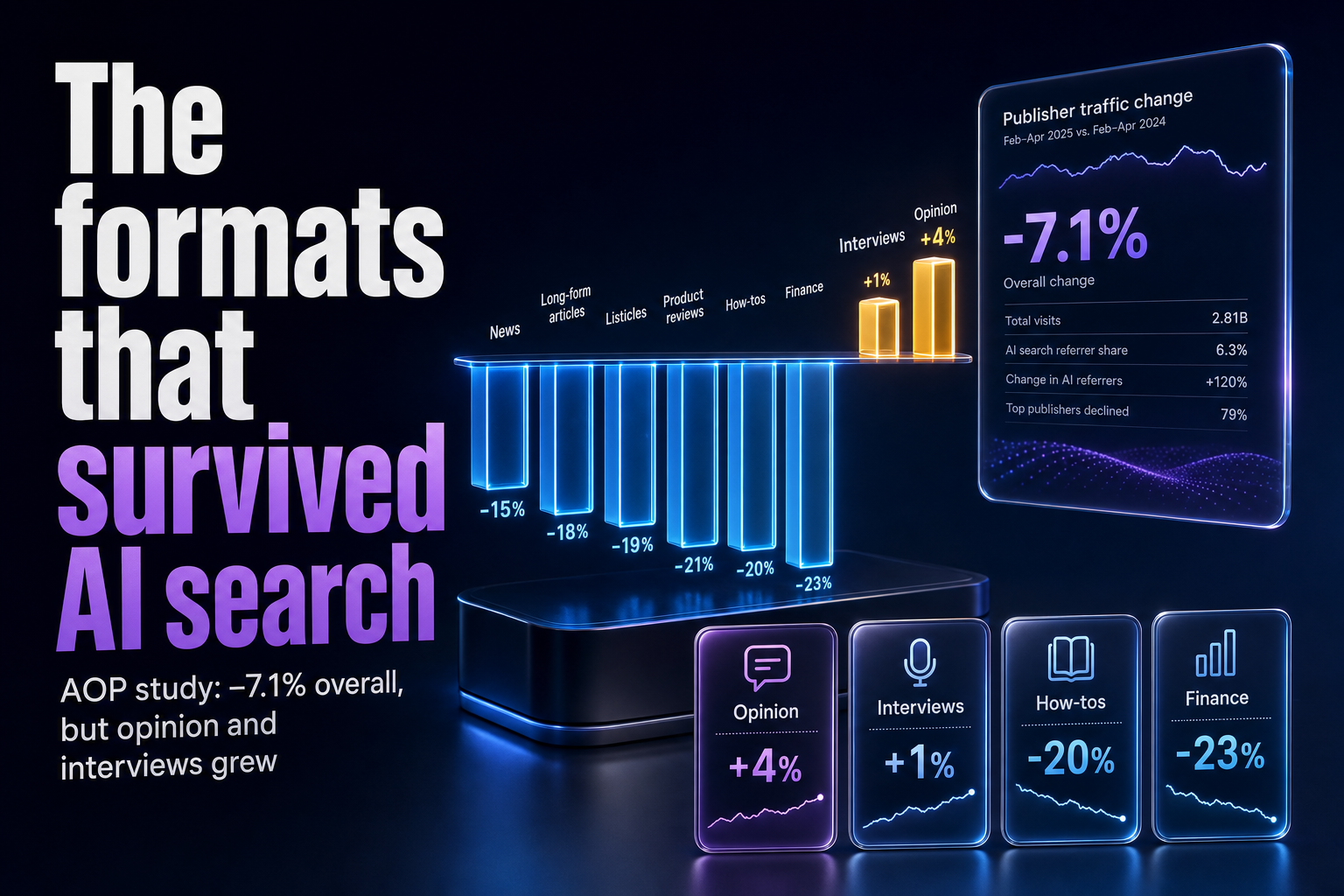
Summary. The Association of Online Publishers published its Artificial Intelligence Publisher Impact Study on 20 July 2026, reporting that organic Google Search referrals to eight major UK publishing groups fell 7.1% in a single quarter, and that a sustained decline at that rate halves Google-delivered pageviews by Q3 2027. The measured quarter is Q1 to Q2 2025, roughly a year before publication. In the same quarter, Alphabet reported Google Services revenue up 12% to $82.5 billion and consolidated revenue up 14% to $96.4 billion. The declines were not evenly spread: guide and how-to content fell by more than 20%, while opinion and commentary rose 4% and interviews rose 1%. Since that quarter, Seer Interactive measured organic click-through rate on AI Overview queries climbing from 1.3% in December 2025 to 2.4% in February 2026. Both findings can be true, and the format splits are the part that survives the passage of time.
The study, commissioned by AOP from DJB Strategies, covers six months of traffic across 147 domains and 10.8 billion pageviews, with the sample accounting for about 80% of total traffic once long-tail URLs were removed. A separate consumer survey on AI tool awareness and usage was run by Ipsos. AOP managing director Richard Reeves published the first of three articles on the findings in Press Gazette.
That is a serious dataset. The problem is what the internet is doing with one line from it.
What the study actually measured, and when
The 7.1% figure is a quarter-over-quarter delta between Q1 2025 and Q2 2025. The extrapolation to Q3 2027 is a straight-line projection from that single delta, and Reeves says so plainly in the piece: "If this trajectory is sustained, pageviews delivered by Google will be cut in half by Q3 2027."
Two words carry the weight there. If sustained.
The reason this matters is that the SEO trade press has spent the week since publication treating a Q2 2025 measurement as a description of July 2026 conditions. Between those two points sit the December 2025 CTR floor, the January and February 2026 reversal, Google I/O in May 2026, and the arrival of generative UI in Search. A model built on one quarter of 2025 data has already been tested against 2026 actuals by someone else, and it missed.
Seer Interactive ran that test. Its third AI Overviews CTR study, published in April 2026, covers 53 brands, 5.47 million queries and 2.43 billion impressions from January 2025 to February 2026, and it projected 2025's decline forward into the new year. The projection was wrong in the direction that matters. Search Engine Land reported the headline: organic CTR on AI Overview queries bottomed at 1.3% in December 2025 and reached 2.4% by February 2026, an 85% jump in two months that broke a year-long slide.
This is not a rebuttal of AOP. The two studies measure different things, on different cohorts, in different windows. It is a warning about the shape of the inference. Straight lines drawn through 2025 search data have a poor recent record.
| Study | Window measured | Headline finding |
|---|---|---|
| AOP / DJB Strategies | Q1 to Q2 2025, 8 UK publishing groups | Organic Google referrals down 7.1% quarter on quarter |
| Seer Interactive (v3) | Jan 2025 to Feb 2026, 53 brands | AIO-query organic CTR up from 1.3% to 2.4% in two months |
| Previsible AI Traffic Study | Nov 2024 to May 2026, 166 GA4 properties | LLM referral sessions up 9.9x; ChatGPT holds 92.4% share |
The format splits are the durable finding
Strip out the projection and the study still earns its place, because the segmentation is where the useful signal is. Traffic was split by topic and content type across 147 domains, which is a level of granularity most public traffic research does not reach.
By publisher type, news publishers averaged a quarterly decline of around 5%, against 18% for the consumer and B2B segment. Reeves attributes the gap to tighter guardrails around news in AI Overviews compared with evergreen content that aggregates more easily.
By topic, news rose 2%. Sports rose 37%, travel 22%, and health and wellness 7%. Everything else fell, with politics down 7%, finance and business down 23%, and technology down 28%.
By content format, the pattern is sharper and more actionable:
| Content format | Quarterly change in Google referrals | What the format has that AI cannot copy |
|---|---|---|
| Opinion and commentary | +4% | An identifiable position someone is accountable for |
| Interviews | +1% | Words that did not exist on the web before |
| Product reviews | -1% | First-hand testing of a specific unit |
| Reportage | -4% | Presence at an event, primary observation |
| Guides and how-tos | worse than -20% | Nothing. This is the format AI answers outright |
Overlay format on topic and the extremes get wider. News interviews rose 63% and health and wellness analysis rose 46%. Finance and business how-tos fell 52%; food and drink how-tos fell 54%.
Read that table again with one question in mind: which of these can a model generate from what it already knows? An opinion column is a claim attached to a named person who can be argued with. An interview contains sentences a source said once, to one reporter. A how-to on rebalancing a portfolio is common knowledge, restated. The gap between +4% and -54% is mostly the gap between original input and recombined input.
Reportage is the awkward case. It accounted for more sessions than all other formats combined and fell only 4%, so it is not collapsing. Reeves suggests "it would be worth considering how reportage can be injected with more of a human touch to make it more resilient to AI substitution."
Google's own documentation says the same thing in different words
The neatest confirmation of the AOP format data is not another traffic study. It is Google's guide to optimizing for generative AI features on Google Search, last updated on 10 July 2026.
That page draws a line between commodity and non-commodity content, and it picks its examples carefully. Commodity content, it says, is "often based on common knowledge, which could originate from anyone, and typically adds little unique insight for readers", and it names "7 Tips for First-Time Homebuyers" as the type. Non-commodity content "provides unique expert or experienced takes that go beyond common knowledge and the ordinary", and the named example is "Why We Waived the Inspection & Saved Money: A Look Inside the Sewer Line".
Both examples are property advice. One is a listicle. One is a first-person account of a specific decision with a specific outcome. Google is describing the same split AOP measured, from the other side of the index.
The guide is equally direct about volume as a defence:
While it might be tempting to create separate content for every possible variation of how people might search (for example, by focusing on other queries that people have asked, or fan-out queries), doing so primarily to manipulate rankings or generative AI responses in Google Search violates Google's scaled content abuse spam policy. This is also an ineffective long-term strategy, as a high quantity of pages doesn't make a website higher quality or more relevant to users.
Reeves lands in the same place from the traffic side: "publishers must avoid the trap of expanding URL output in affected areas to defend their traffic levels, resulting in weakening views-per-page. Doubling down on declining content only accelerates losses."
A regulator of the index and an association of publishers rarely agree on anything. They agree on this.
The Google page also closes off several tactics that circulate as AI-search advice. It states that Google Search ignores llms.txt files, that content does not need "chunking" into small pieces, that rewriting copy specifically for AI systems is unnecessary, and that structured data is not required for generative AI features. We reached the same conclusion on the first of those in our own testing, covered in our analysis of whether llms.txt helps SEO on Google. The guide does explain query fan-out, the set of concurrent related queries a model issues to gather results, which is the mechanic behind the topic-cluster approach to query fan-out.
Our own numbers: what the answer-shaped page actually returns
We can test the format thesis on a site we control. The following is first-party Google Search Console data for ecorpit.com, pulled on 21 July 2026 for the period 1 June to 20 July 2026.
| Page | Impressions | Clicks | CTR | Average position |
|---|---|---|---|---|
| /when-is-ios-27-dropping/ | 555,270 | 1,732 | 0.31% | 7.4 |
| /ios-27-date-timeline-refresh/ | 92,119 | 271 | 0.29% | 7.6 |
| /is-ios-27-launched-status/ | 8,452 | 19 | 0.22% | 7.6 |
| /ios-27-launch-date-india/ | 5,723 | 11 | 0.19% | 8.4 |
| /nextjs-16-3-typescript-7-rust-go-toolchain-2026/ | 177 | 18 | 10.17% | 5.7 |
The first four are answer-shaped pages. They target when something is released, whether it has launched, what the status is. They rank on page one, they collect enormous impression volume, and they convert between 0.19% and 0.31% of it. Our iOS 27 release-date page alone carries 7,994 ranking keywords and half a million impressions in seven weeks, and returns fewer than 1,800 clicks.
The last row is a technical piece on a toolchain migration, ranking at position 5.7 on 177 impressions, converting at 10.17%. That is roughly 33 times the click yield per impression of the release-date page, from a fraction of the visibility.
The site-level series makes the same point over a longer window:
| Month | Impressions | Clicks | CTR |
|---|---|---|---|
| December 2025 | 725 | 18 | 2.48% |
| February 2026 | 1,130 | 42 | 3.72% |
| June 2026 | 897,183 | 2,401 | 0.27% |
| July 2026 (1 to 20) | 304,659 | 927 | 0.30% |
Clicks did rise, from 18 a month to 2,401. Anyone reporting only CTR would call this a catastrophe, and Seer's second finding is precisely that: check clicks and impressions separately before diagnosing a CTR fall, because impressions growing faster than clicks produces the same chart as clicks collapsing. But the yield per impression fell from 2.48% to 0.27% as we scaled output into answer-shaped queries, which is Reeves's weakening views-per-page, visible on our own dashboard. The real cost of the volume strategy is not the pages that failed; it is the ceiling it puts on everything else.
We wrote up the mechanics of this in ranking first and getting no clicks and the citation economics in ranking versus AI Overview citation data.
What the citation number changes
Seer's other headline is what a citation is worth. On the figures Search Engine Land reported, organic CTR runs at about 3.3% when no AI Overview is present, about 2.1% when one appears and your page is cited inside it, and about 0.9% when one appears and you are not.
Translated into volume, per million impressions on informational queries: roughly 33,000 clicks, 21,000 clicks and 9,000 clicks respectively.
Three numbers, one decision. If an AI Overview is going to appear on your query whatever you do, the citation is worth something like 12,000 additional clicks per million impressions. If you have any choice about which queries to target, the pool with no AI Overview is worth more than either, and that pool got more valuable through 2025: CTR on those queries rose from 2.8% in early 2025 to 3.8% by February 2026.
That choice exists more often than people assume, because AI Overview prevalence is uneven. Seer found informational queries surface an AI Overview about 36% of the time against about 5% for transactional ones. Within informational queries, comparison phrasings trigger one about 95% of the time and question phrasings about 86%.
Which reframes the AOP how-to number. Guides and how-tos did not lose more than 20% of their referrals because guides got worse. They lost it because the query shapes that lead to guides are the query shapes that trigger an AI Overview almost every time.
The channel that is not replacing it
One reasonable response is that Google referrals matter less now because assistants send traffic instead. For publishers specifically, the data does not support that yet.
Previsible's third AI Traffic Study, covering 6.77 million LLM-driven sessions across 166 GA4 properties from November 2024 to May 2026, was written up in Search Engine Land in July 2026. Monthly LLM sessions grew 9.9x to 644,478 in May 2026, and ChatGPT accounts for 92.4% of trackable LLM referral traffic. Claude grew 64x over the same window and passed Perplexity in March 2026; Perplexity is down 61% from its March 2025 peak and Copilot fell 96% from its August 2025 peak.
The line that matters for publishers is the penetration figure. Against more than 120 million organic sessions in that dataset, publisher penetration of LLM referrals is 0.11%. As the study's author puts it, publishers produce the content that assistants cite and capture almost none of the resulting traffic.
So the substitution is real and the compensation is not arriving. That is a harder problem than the 7.1% headline describes, and it is also a narrower one: it is specific to formats that assistants can satisfy without sending anyone anywhere.
What Google shipped after the measured quarter
The AOP window closed in June 2025. Google's Search interface has changed materially since.
At Google I/O on 19 May 2026, Google announced a rebuilt search box that it describes as the biggest change to that entry point in more than 25 years, along with information agents that monitor the web in the background and generative UI that assembles custom interactive results. Liz Reid, Google's head of Search, described the last of these in a press briefing: "Search can build custom experiences just for your individual questions, from dynamic layouts, interactive visuals to persistent and stateful project spaces that you can return to again and again."
One correction is worth making, because it is repeated constantly and it is wrong. Google says AI Mode is not the default experience. TechCrunch, which reported the announcement, states this explicitly and later updated its piece to clarify that links have not disappeared, only that they are no longer the priority for many query types. If you are building a 2027 plan on the premise that AI Mode is now the default Google experience, the premise is not supported by Google's own position or by the reporting.
Scale, for context: AI Overviews reach more than 2.5 billion monthly users and AI Mode passed 1 billion monthly users, against 900 million weekly active users for ChatGPT as of February 2026.
India-specific considerations
For Indian publishers and B2B content teams the topic splits land differently, because the exposed categories are the ones the market over-indexes on. Technology fell 28% and finance and business fell 23% in the AOP data, and those two categories carry most Indian digital B2B publishing.
Three practical consequences.
Local-language and India-specific queries are thinner ground for an AI Overview, because the underlying corpus is smaller and less consistent. A page on how a specific RBI or DPDP obligation applies to a payment flow built in India is not commodity content in the sense Google's guide means, and it is not something a model can assemble confidently from general knowledge.
Retainers make the cost of the volume strategy concrete. Whatever monthly figure in ₹ a content programme is running at, spending it on a dozen commodity how-tos a month in categories measured at minus 23% and minus 28% buys impressions and the yield we recorded on our own answer-shaped pages, which is under one click per 300 impressions. We set out what those retainers actually cover in our breakdown of digital marketing pricing in Gurugram.
Compliance and sector reporting is the local equivalent of the interview category. It requires reading a circular, talking to someone who has implemented it, and stating what actually happens. That is original input, and it is the input class that grew.
A measurement plan that does not depend on either study
Both studies converge on the same instruction, which is to stop planning from aggregate benchmarks and start planning from your own numbers. Google's guide points site owners at the Generative AI performance report in Search Console and warns against third-party tools that claim to use internal Google metrics, on the grounds that no third-party tool has access to its ranking or AI systems.
A workable quarterly loop:
- Segment every page by format, not by topic. Guide, how-to, opinion, interview, review, reportage, reference. Most content inventories are tagged by subject and cannot answer the question this study raises.
- Pull clicks and impressions separately per segment, never CTR alone. A CTR fall with flat clicks and rising impressions is a different diagnosis from a click fall with flat impressions.
- Split queries by AI Overview presence and by whether you are cited. Those three states have measurably different click yields, and averaging across them hides the whole effect.
- Flag comparison-phrased and question-phrased targets. At 95.4% and 85.9% trigger rates, treat a citation as the goal on those, not a click.
- Track yield per published URL over time. If it is falling while page count rises, the volume strategy is consuming the budget that would fund the formats that grew.
- Check the age of any benchmark before it enters a plan. The number in this study is from Q2 2025.
The one judgement we will offer: publishing fewer, harder pieces is a harder sell internally than publishing more pages, because page count is legible to a spreadsheet and originality is not. That is the actual reason the volume strategy persists, and it is not a search problem.
FAQ
How eCorpIT can help
We run content and GEO programmes for founders, marketing leads and engineering teams who need search to produce qualified enquiries rather than impressions. That work starts with a format-level audit of what you already publish, measured against AI Overview presence and citation status query by query, so budget moves toward the formats that still convert. Our senior engineering teams also build the primary material that makes non-commodity content possible, including benchmarks, migration write-ups and implementation data from live systems. If your impressions are rising while clicks flatten, talk to us about a content and GEO audit.
References
- Richard Reeves, Google search traffic to leading UK publishers set to halve by Q3 2027, Press Gazette, 20 July 2026.
- Danny Goodwin, Google AI Overviews CTR shows early signs of recovery: Study, Search Engine Land, 24 April 2026.
- David Bell, ChatGPT commands 92% of AI referral traffic. Here's what 6.77 million sessions reveal, Search Engine Land, 6 July 2026.
- Previsible, AI Traffic Report, July 2026.
- Sarah Perez, Google Search as you know it is over, TechCrunch, 19 May 2026.
- Alphabet Inc., Alphabet Announces Second Quarter 2025 Results, Form 8-K Exhibit 99.1, 23 July 2025.
- Google Search Central, Optimizing your website for generative AI features on Google Search, updated 10 July 2026.
- Google Search Central, Creating helpful, reliable, people-first content.
- Google Search Central, Spam policies for Google web search: scaled content abuse.
- Google Search Central, AI features and your website.
- Google Search Console Help, Generative AI performance report.
- Association of Online Publishers, AOP news and research.
Last updated 21 July 2026. First-party Google Search Console figures for ecorpit.com cover 1 June to 20 July 2026 and were pulled on 21 July 2026.