On this page · 12 sections
- What the market numbers mean for your quote
- Retainer bands commonly seen in NCR
- The four fee models, and which one to argue for
- Project work, and when to buy it instead
- Why Gurugram quotes differ from the rest of India
- What actually moves your number
- Red flags in a Gurugram marketing proposal
- India-specific considerations
- What we would not do
- FAQ
- How eCorpIT can help
- References
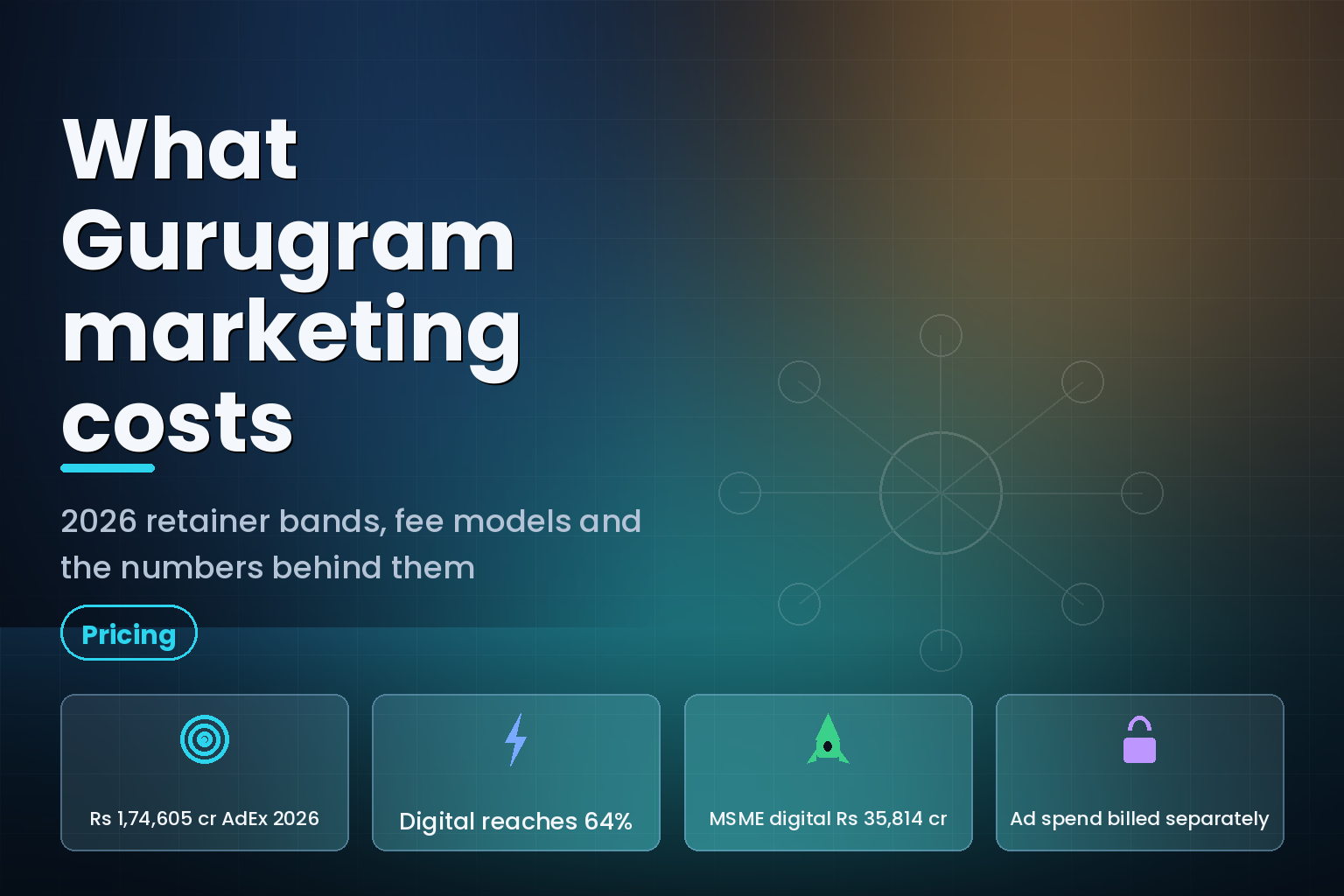
Summary. The Pitch Madison Advertising Report 2026 forecasts India's advertising market at ₹1,74,605 crore in 2026, implying 12% to 13% growth, with digital's share rising to roughly 64% or ₹1,11,976 crore. In 2025 the market reached ₹1,55,105 crore under the report's expanded definition, up 12%, with total digital at ₹93,156 crore against ₹76,261 crore in 2024, a 22% rise, while traditional media fell 1% to ₹61,949 crore. Inside that digital number sits ₹35,814 crore of MSME digital spend and ₹4,000 crore of quick-commerce advertising. Those two components are the ones most Gurugram buyers are actually part of, and they are why agency quotes in NCR have stopped looking like they did three years ago.
This guide covers what digital marketing costs in Gurugram in 2026, the four fee models agencies use, what is bundled and what is billed on top, and the questions that move a quote by a factor of three. Commonly observed ranges appear throughout as orientation for budgeting. They are not quotes, and no agency should give you a number before it has seen your site, your analytics and your current cost per acquisition.
What the market numbers mean for your quote
Agency pricing is downstream of where money is going. Two figures from the Pitch Madison Advertising Report 2026, presented by Sam Balsara, Chairman of Madison World, on 24 February 2026 in Mumbai, do most of the explaining.
The first is the structural flip. Reporting the preview on 18 February 2026, exchange4media summarised the finding as: "headline growth has moderated, but the structure of Indian AdEx has flipped decisively in favour of Digital." Under the expanded definition, digital was already 60% of the market in 2025 and traditional 40%. On the legacy definition used in earlier editions, the same year's AdEx grew 7% to ₹1,15,291 crore with digital at 46%. The two series describe the same market from different angles, and the gap between them is mostly MSME digital and quick commerce, which older definitions did not count.
The second is where the growth is. Total digital rose 22% year on year while traditional media shrank 1%. Quick-commerce advertising is a ₹4,000 crore line that did not meaningfully exist a few years ago. MSME digital spend is ₹35,814 crore, which is roughly 38% of all digital spend in the country and is, by definition, thousands of businesses the size of a Gurugram SMB rather than a handful of national advertisers.
For a buyer, the practical consequence is that you are shopping in a market where supply has moved toward exactly your segment. Agencies that once only wanted ₹10 lakh a month retainers now run productised offers at a fraction of that, because that is where the volume is. The corollary is that the gap between the cheapest and the most expensive credible quote for the same brief is now very wide, and price alone tells you almost nothing.
Retainer bands commonly seen in NCR
The bands below reflect what Gurugram and Delhi NCR buyers commonly encounter in 2026 quotes for the described scope. Treat them as orientation for a budget conversation, not as a rate card.
| Band | Monthly retainer, orientation only | Typical scope | Senior time | Who it fits |
|---|---|---|---|---|
| Entry, single channel | ₹15,000 to ₹35,000 | Basic SEO or one social platform, monthly reporting | Minimal, mostly execution | Local service business testing the channel |
| Local SMB, two channels | ₹35,000 to ₹1,00,000 | SEO plus Google Ads, or SEO plus Instagram, some content | 8 to 15 hours a month | Clinics, restaurants, real estate, local retail |
| Growth-stage performance | ₹1,00,000 to ₹4,00,000 | Paid media across Google, Meta and LinkedIn, conversion tracking, landing page work, weekly reporting | Named strategist, part-time | D2C brands, mid-market B2B |
| Mid-market integrated | ₹4,00,000 to ₹12,00,000 | Adds SEO content programs, analytics instrumentation, creative production, brand strategy | Dedicated senior strategist plus team | Companies with a real in-house marketing function |
| Enterprise mandate | ₹15,00,000 and above | Integrated brand and demand, custom analytics, media-buying transparency, procurement-grade reporting | Full pod | National brands, holding-company territory |
| Ad spend | Billed separately in almost every case | Not agency revenue | Not applicable | Everyone |
The last row is the one that causes most budget arguments. Ad spend is passed through, not included, in the overwhelming majority of Indian agency contracts. A ₹1,00,000 monthly retainer with ₹4,00,000 of media behind it is a ₹5,00,000 monthly commitment, and a proposal that blurs the two is a proposal to read twice.
The four fee models, and which one to argue for
| Model | How it works | Agency incentive | Best when | Watch for |
|---|---|---|---|---|
| Flat retainer | Fixed monthly fee for a defined scope | Neutral on spend, wants scope control | Scope is stable and known | Scope creep in month four |
| Percentage of ad spend | Commonly 10% to 15% of media managed | Rises with your spend, not your return | Spend is large and steady | The incentive to spend more |
| Project or sprint | Fixed price for a defined deliverable | Wants to finish | Audits, migrations, a campaign launch | No ownership of ongoing results |
| Hybrid | Base retainer plus a performance component | Partly aligned to outcome | You can define the outcome cleanly | Attribution disputes |
Percentage-of-spend is the model to interrogate hardest. Indian agencies commonly charge 10% to 15% of managed media, which is a defensible convention when the work genuinely scales with spend, and a poor deal when it does not. Doubling a media budget rarely doubles the work on a mature account. If you are heading toward a spend increase, ask for a tapered percentage or a cap, in the contract, before the increase rather than after.
Hybrid deals are the ones buyers get wrong most often. A performance component is only meaningful if the outcome is measurable, attributable and inside the agency's control. Revenue attributed through a shared analytics setup that both parties agreed on before the engagement is workable. "Leads" counted from a form the agency also owns is not.
Project work, and when to buy it instead
Not every problem needs a retainer, and a project is the cheapest way to find out whether an agency is any good before committing twelve months.
| Project type | Orientation range | Typical duration | What you should get |
|---|---|---|---|
| Technical SEO audit | ₹1,50,000 to ₹4,00,000 | 2 to 4 weeks | Prioritised fix list with effort estimates, not a crawl export |
| Google Ads account audit | ₹50,000 to ₹2,00,000 | 1 to 2 weeks | Wasted-spend figure, structural recommendations, quick wins |
| Content sprint | ₹2,00,000 to ₹6,00,000 | 4 to 8 weeks | A defined number of published, briefed, optimised pieces |
| Conversion rate review | ₹2,00,000 to ₹8,00,000 | 3 to 6 weeks | Instrumented funnel, ranked hypotheses, at least one shipped test |
| Analytics instrumentation | Scoped per stack | 2 to 6 weeks | Working event tracking you own, documented |
An audit that ends in a slide deck and no effort estimates is half a deliverable. The point of an audit is to make the next decision cheaper, which means every recommendation needs a rough cost attached to it.
Why Gurugram quotes differ from the rest of India
Three things move an NCR number relative to a comparable brief elsewhere.
Talent cost and churn. NCR's marketing talent market moves quickly, and senior strategists are the scarce input. An agency that keeps senior people on your account has a higher cost base than one that staffs juniors behind a senior pitch, and it should charge more. The test is not the price. It is asking who writes the strategy, who runs the media day to day, and who you will actually speak to in month four.
Category density. Gurugram concentrates real estate, healthcare, education, fintech and D2C in a small geography, which makes local search competitive in exactly the categories most likely to be reading this. Competitive auctions raise both media cost and the amount of work needed to rank, and both flow into the quote.
Enterprise adjacency. A large share of NCR agency capacity is built to serve enterprise and holding-company clients. Those firms can serve a growth-stage buyer, but their cost structure is not designed for it, and their quote will reflect the overhead. That is not a reason to avoid them. It is a reason to check whether the shape of the agency matches the shape of your problem before you compare numbers.
What actually moves your number
Six variables explain most of the spread between two quotes for what looks like the same brief.
Channel count. Each additional channel adds strategy, creative and reporting overhead, not just execution. Two channels done well beat four done thinly at the same price.
Content volume. Content is the most elastic line in any proposal. A retainer that includes four long-form pieces a month is a different product from one that includes one, and the difference is usually larger than the difference in headline price.
Creative production. Static creative is cheap. Video, motion and photography are not. A social retainer that includes video production and one that does not are not comparable, and this is the single most common reason two quotes look inexplicably far apart.
Seniority and staffing model. A dedicated pod costs more than shared resourcing, and it is worth more when your category is complex or your product is technical.
Technical work. Site speed, structured data, server-side tagging and analytics instrumentation need engineering, and most pure marketing agencies subcontract it. Whether that work is in scope, out of scope, or quietly assumed to be your problem changes both the price and the outcome.
Reporting depth. A monthly PDF is one cost. A live dashboard reconciled to your CRM is another. Ask which one you are buying.
Red flags in a Gurugram marketing proposal
Guaranteed rankings or guaranteed leads. Nobody controls Google's ranking systems, and a guarantee is either meaningless or a signal that the agency plans to buy its way to the number.
Ad spend folded into the retainer without a split. You should always be able to see what you paid the platform and what you paid the agency, separately, every month.
No named team. If the proposal describes capabilities rather than people, ask for names, roles and the percentage of their time allocated to you.
Success metrics absent from the SOW. If the definition of success in month three is not in the contract, it will be defined retrospectively by whoever is more confident in the meeting.
Tool costs unlisted. SEO platforms, call tracking, heatmaps and dashboarding tools are real monthly costs. Find out whether they are included, billed through, or expected from you.
A proposal that arrives in 24 hours without a discovery call. Somebody has sent you a template.
India-specific considerations
Two points that are specific to buying this work in India rather than anywhere else.
GST applies to agency fees and, separately, to media invoices, and how a pass-through is structured affects your input credit. Agree the invoicing structure before the first month, not at the first quarter close, because retrospectively restructuring a pass-through is unpleasant for everyone.
Data handling is now a contractual question rather than a hygiene one. Under the Digital Personal Data Protection Act 2023, the personal data your marketing stack collects, whether through lead forms, call tracking, CRM syncs or advertising pixels, sits under a defined obligation regime. Ask any prospective agency where lead data is stored, who has access, what the deletion process is, and what happens to your data when the engagement ends. eCorpIT designs marketing data architecture aligned with DPDP Act requirements, and we hold CMMI Level 5, MSME certification and ISO 27001:2022 certification, but the point stands regardless of who you hire: this belongs in the contract.
What we would not do
We would not pick an agency on price. The spread between a good and a poor engagement at the same monthly number is far wider than the spread between two prices.
We would not commit to twelve months on a first engagement. Buy a project, watch how the team works, then commit. Any agency confident in its work will accept that sequence.
We would not accept a scope that excludes technical work without knowing who does it. Marketing that cannot ship a landing page change without a three-week queue on someone else's roadmap is marketing that will underperform its budget regardless of the retainer.
The most expensive thing in a marketing budget is not the retainer. It is the six months spent finding out the reporting never reconciled to revenue.
FAQ
How eCorpIT can help
eCorpIT runs performance marketing as one of ten practices alongside engineering, cloud and data, which means conversion rate optimisation, site speed, analytics instrumentation and SEO technical work happen on the same team rather than across a hand-off. We are a Gurugram organisation founded in 2021, senior-led, CMMI Level 5 assessed, MSME certified and ISO 27001:2022 certified, and partners of AWS, Microsoft, Google and Shopify. If you want a scoped view of what your specific brief should cost before you go to market, talk to our team. Related reading: our shortlist of the best digital marketing companies in Gurugram and Delhi NCR, our guide to digital marketing for startups in Gurugram, how to choose a social media marketing agency in Gurugram and what matters when choosing a website design company in Gurugram.
References
- PMAR 2026 Preview: India's Rs 1.55 Lakh Crore ad market is already 60% digital - exchange4media, 18 February 2026, the full expanded and legacy AdEx series, digital and traditional splits, and the 2026 forecast.
- India's ad market to reach Rs 1.74 lakh crore in 2026 with 64% digital: Madison - Medianews4u on the Pitch Madison Advertising Report 2026 forecast.
- India's AdEx set for nearly 13% surge in 2026 over 2025: PMAR - exchange4media, the growth rate behind the 2026 forecast.
- PMAR 2026: India's Rs 1.55 lakh crore ad market is already 60% Digital - Roastbrief, corroborating the 2025 market size and digital share.
- PMAR 2026 Preview: Digital now accounts for 60% of India's Rs 1.55 lakh crore ad market - Impact, the same report preview.
- India's digital ad spends to reach Rs 69,856 crore by 2026: Dentsu report - Social Samosa on Dentsu India's digital advertising forecast, a narrower definition than PMAR's.
- India's ad market set to near Rs 2 lakh crore in 2026: WPP Media - Indiantelevision on WPP Media's alternative forecast.
- Digital marketing agency cost in India 2026 - Distk, published Indian agency retainer bands.
- Digital marketing agency pricing in India, 2026 guide - BetopSEO, tiered package ranges commonly quoted in India.
- Digital marketing cost India 2026: complete pricing guide - Mayank Digital Labs, service-level pricing including percentage-of-spend conventions.
- SEO pricing in India: 2026 cost guide - Nico Digital, SEO-specific monthly ranges by competitiveness.
- Digital marketing agency fees in India, 2026 pricing guide - Lapaone, fee-model comparison across retainer, project and percentage models.
Last updated: 9 August 2026.