On this page · 10 sections
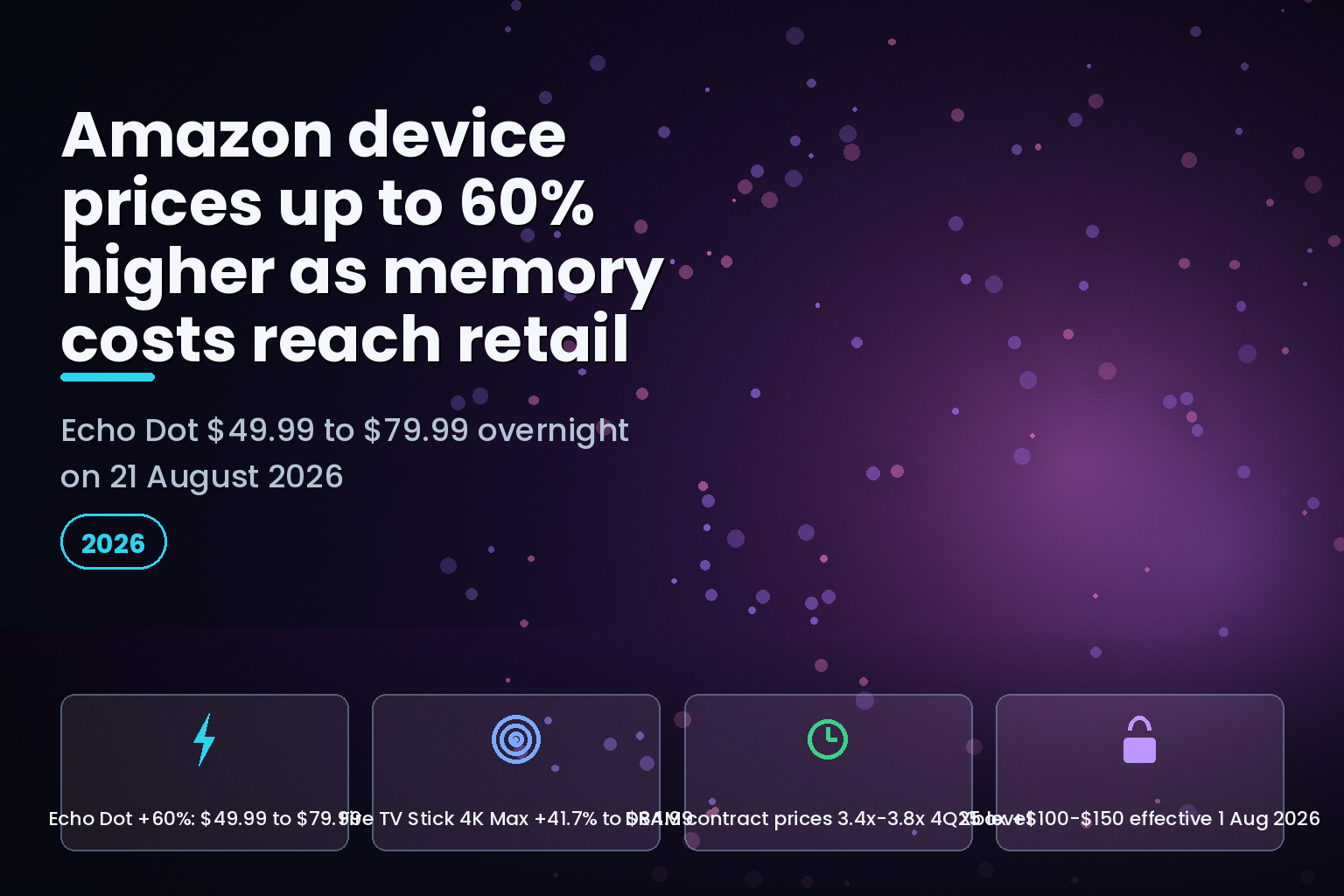
Summary. Amazon raised prices across its first-party hardware line overnight on 21 August 2026. The base Echo Dot went from $49.99 to $79.99, a 60% increase. The 16 GB Kindle moved from $109.99 to $149.99, the Fire TV Stick 4K Max from $59.99 to $84.99, and the eero Pro 7 from $699.99 to $799.99. An Amazon spokeswoman confirmed the increases and said the consumer electronics industry is "facing significant increases in memory and storage component costs." Ring products were untouched. This follows Apple in June 2026, which raised Mac prices 15% to 20% and iPad prices 15% to 25%, and Microsoft, which raised Xbox console prices by $100 to $150 effective 1 August 2026.
The pass-through is not the news. TrendForce forecast it in writing seven weeks earlier. What is worth an hour of a product lead's attention is that Microsoft and TrendForce published forecasts eight days apart that appear to point in opposite directions, and that the arithmetic says they agree.
What actually moved, and by how much
Amazon's changes, as reviewed by Fortune on 21 August 2026:
| Product | Old price | New price | Increase |
|---|---|---|---|
| Echo Dot | $49.99 | $79.99 | 60.0% |
| Echo Show 11 | $219.99 | $249.99 | 13.6% |
| Kindle, 16 GB | $109.99 | $149.99 | 36.4% |
| Kindle Paperwhite, 16 GB | $159.99 | $199.99 | 25.0% |
| Fire TV Stick HD | $34.99 | $39.99 | 14.3% |
| Fire TV Stick 4K Max | $59.99 | $84.99 | 41.7% |
| eero 7 | $349.99 | $399.99 | 14.3% |
| eero Pro 7 | $699.99 | $799.99 | 14.3% |
The shape of that table is the useful part. The largest increases land on the cheapest devices. A $49.99 Echo Dot carries a fixed quantity of DRAM and flash that has roughly tripled in cost, and there is no margin underneath it to absorb that. The eero Pro 7 at $699.99 has room, so it moves 14.3%. Percentage increase runs inversely to unit price, because memory is a larger share of the bill of materials at the bottom of the range.
That inversion is the thing to carry into your own product planning. If you ship anything with a memory component and a sub-$100 price point, the shortage has already reached you, whether or not you have repriced.
The two forecasts that disagree
On 25 June 2026, Microsoft posted its Xbox console price update. The statement is unusually specific: "console storage and memory prices have increased by more than 2.5x and we expect another doubling by the fall of 2027." Microsoft also noted it had already raised Xbox prices by $20 to $70 in October 2025, that it is sunsetting the 2 TB model, and that consoles are "typically not sold at a profit, but instead for less than they cost to make."
Eight days later, on 3 July 2026, TrendForce published its quarterly memory pricing survey with a headline that reads like the opposite conclusion: AI server demand continues to support memory prices in 3Q26, but gains moderate. Conventional DRAM contract prices were forecast to rise 13% to 18% QoQ in the third quarter, and NAND Flash 10% to 15% QoQ. TrendForce attributed the moderation to consumer buyers hitting a ceiling: "Record-high contract prices mean customers from consumer markets, such as PCs and smartphones, are reaching their affordability limit."
One vendor says a doubling is coming. One analyst says the increases are slowing. Both are right, and the reason is compounding.
The wider vendor sequence, with the reason each company gave:
| Vendor | Announced | Effective | Change | Stated cause |
|---|---|---|---|---|
| Microsoft Xbox | 3 October 2025 | October 2025 | +$20 to $70 per console | Component costs |
| Apple | June 2026 | Immediately | Mac +15% to 20%, iPad +15% to 25%, iPhone unchanged | DRAM and NAND costs |
| Microsoft Xbox | 25 June 2026 | 1 August 2026 | +$100 on 512 GB, +$150 on 1 TB, 2 TB discontinued | Storage and memory up more than 2.5x |
| Amazon | 21 August 2026 | Immediately | Up to +60% across Echo, Kindle, Fire TV, eero; Ring unchanged | Memory and storage component costs |
| Dell, HP, Lenovo, Asus | Through 1H26 | Varies | Price rises or reduced memory in products | RAM and storage cost pressure |
The arithmetic nobody published
Take TrendForce's own quarterly figures, all from its published surveys.
| Quarter | Conventional DRAM contract price change | Cumulative index, 4Q25 = 1.00 |
|---|---|---|
| 1Q26 | +93% to +98% QoQ | 1.93 to 1.98 |
| 2Q26 | +58% to +63% QoQ | 3.05 to 3.23 |
| 3Q26 | +13% to +18% QoQ | 3.45 to 3.81 |
| Four more quarters at 13% | +13% QoQ | 1.63x on top |
| Four more quarters at 18% | +18% QoQ | 1.94x on top |
Conventional DRAM contract prices are already somewhere between 3.4 and 3.8 times their fourth-quarter 2025 level after three quarters. That is consistent with Fortune's reporting in June that DRAM and NAND costs "quadrupled over the last year."
Now run the "moderate" rate forward. Four quarters at 13% compounds to 1.63x. Four quarters at 18% compounds to 1.94x. Microsoft's forecast of "another doubling by the fall of 2027" sits at the top of that range, not outside it. The two forecasts differ in tone, not in level. A quarterly increase that has slowed from 98% to 13% still nearly doubles the price in a year.
This is why "prices are moderating" is the most expensive sentence in the current cycle. It is true about the rate and false about the direction of your BOM.
Why the money went to servers first
TrendForce's 1Q26 survey put the mechanism plainly. Industry revenue rose 81% QoQ to $97 billion on conventional DRAM contract price increases of 93% to 98%. Samsung's DRAM revenue rose 93.4% QoQ to $37.32 billion for a 38.5% share, SK hynix rose 62.5% to $27.98 billion, and Micron rose 81.6% to $21.75 billion. Bit output was not the driver. Suppliers were "expected to rely primarily on process migrations to expand bit output in 2026", because new cleanroom construction takes years.
The same pattern shows in NAND. TrendForce's 2Q26 NAND survey, published 18 August 2026, three days before Amazon repriced, put combined revenue of the top five brands up 77% QoQ to $68.87 billion. Micron's NAND revenue rose 99.2% QoQ to $11.85 billion, moving it to third place. SK hynix Group rose 89.5% to more than $14.27 billion. Kioxia rose 79.9% to about $10.72 billion. SanDisk rose 50.7% to nearly $8.97 billion.
That release contains the sentence that predicted the Amazon announcement: "demand from smartphones and PCs is expected to remain weak as higher BOM costs push up device prices." It also explains why the squeeze on consumer parts is structural rather than temporary: "suppliers are generally prioritizing capital expenditure on DRAM and HBM, limiting new NAND Flash capacity."
Andy Jassy, chief executive of Amazon, gave the demand side of the same picture on the company's late-July 2026 investor call. Amazon raised its 2026 capital expenditure expectation to $220 billion from $200 billion, partly on higher memory costs, and Jassy said Amazon still will not "have enough capacity to meet all the demand we have in 2026. And I believe this dynamic will also be true in 2027, too."
Who is affected, and how to tell if that is you
The vendor announcements read as consumer news. Three groups of engineering teams are exposed and mostly have not repriced.
Teams shipping physical product with embedded memory. Kiosks, point-of-sale terminals, IoT gateways, digital signage, medical carts. If your BOM was costed before October 2025, it is wrong by a factor, not a percentage. Re-cost before you quote another unit.
Teams running device fleets for QA. A 40-device Android and iOS test matrix refreshed annually is now a materially larger line. Apple's June increase moved Mac prices 15% to 20% and iPad prices 15% to 25% while leaving iPhone prices unchanged, so the shape of your fleet decides the size of the hit.
Teams choosing between on-device and cloud inference. This is the one that gets missed. On-device models need RAM, RAM is the thing that repriced, and Android's own platform rules now cap what a foreground process may hold based on the device's memory tier. Designing for the 8 GB tier instead of the 12 GB tier is now a pricing decision as much as an engineering one. Our guides to choosing between on-device and cloud AI in mobile apps and to the Android memory limiter and its RAM tier caps both assumed a device price curve that has now shifted underneath them.
Three checks worth running this week. Pull the purchase dates on every BOM you are still quoting from. List the memory and storage line items separately from everything else, because those are the only ones moving. And put a written expiry date on every hardware quote you issue, because a quote with no expiry is a short position on DRAM.
The real cost here is usually the quote you already sent, not the parts you have not bought yet.
India-specific considerations
Indian teams face the same component prices with a weaker absorption buffer, because the hardware-touching work here concentrates in price-sensitive segments: retail POS, logistics handhelds, education tablets and entry-tier Android. Those are exactly the categories where memory is the largest BOM share and where the Echo Dot pattern applies, with the biggest percentage increase landing on the cheapest unit.
TrendForce's 3Q26 survey notes that "smartphone vendors are expected to raise retail prices in the third quarter to offset persistently high LPDRAM costs, though these higher prices are likely to weigh on handset sales", and that mid-range and entry-level procurement remains subdued. For an Indian product team, that means the entry-tier device your app targets is getting more expensive and less common at the same time, which changes the minimum-spec assumption in a product requirements document written even six months ago.
Teams sizing infrastructure rather than devices should read our notes on the server DRAM price rise and the long-term agreement split and on whether to buy servers or rent cloud through the shortage, which cover the same shortage from the data-centre side.
What is still unknown
Nobody outside the suppliers knows when new capacity lands. TrendForce says bit growth in 2026 comes from process migration rather than new wafer starts, which puts meaningful relief past the point where new cleanrooms finish. Estimates for the end of the shortage range from 2027 to 2030, with the chairman of SK hynix at the far end of that range.
It is also unclear whether Amazon's increases hold. The company said it will run promotions across the lineup through the year, and it has a device event coming this autumn. A launch-week discount that restores the old effective price would tell you the $79.99 Echo Dot is a list-price move rather than a cost floor. Watch the promotional price, not the shelf price.
FAQ
How eCorpIT can help
Our engineering teams re-cost hardware-touching bills of materials and rework minimum-spec assumptions when the device curve moves, including the on-device versus cloud inference split that memory pricing now drives. If you are quoting embedded product, refreshing a QA device fleet, or deciding which Android memory tier to target, talk to our product engineering team before the next quote goes out. For the infrastructure side of the same shortage, start with our AI compute capacity crunch planning guide.
References
Last updated: 25 August 2026.