On this page · 14 sections
- The five frameworks at a glance
- LangGraph: control and durability
- CrewAI: speed and role-based teams
- Microsoft Agent Framework: the enterprise merge
- Pydantic AI V2: type safety and the Harness
- LlamaIndex Workflows 1.0: the data layer
- Choose by your dominant constraint
- Production readiness, side by side
- The cost dimension people forget
- What we would pick, and why
- India-specific considerations
- FAQ
- How eCorpIT can help
- References
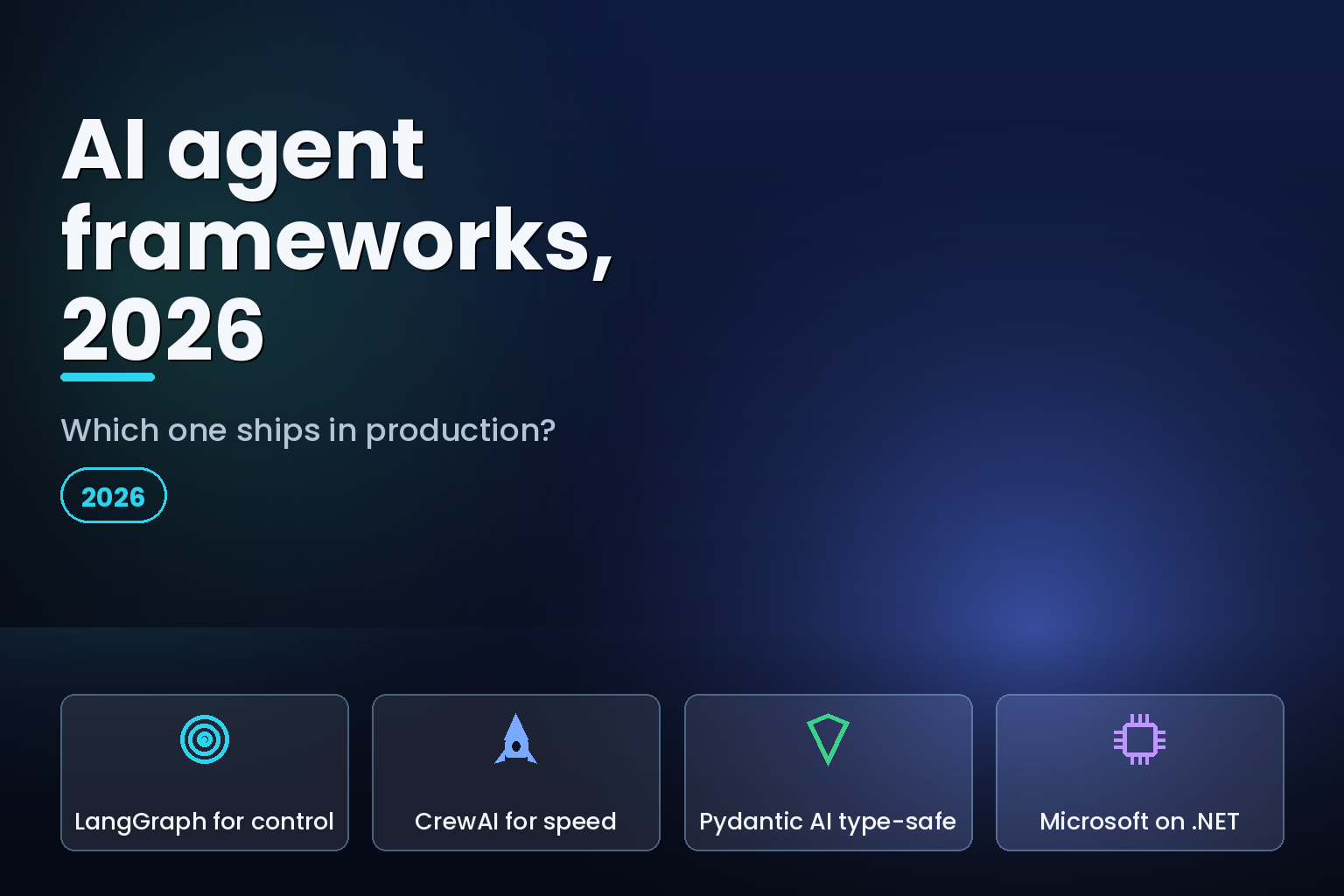
Summary. By July 2026 the agent-framework question stopped being "which is newest" and became "which one survives production." Five have earned that conversation: LangGraph, which reached 1.0 in October 2025 and runs at Uber, Klarna, LinkedIn, Replit and Elastic; CrewAI for role-based teams; Microsoft Agent Framework 1.0, shipped April 3, 2026 by merging Semantic Kernel and AutoGen; Pydantic AI V2, stable June 23, 2026; and LlamaIndex Workflows 1.0, stable a day earlier on June 22. The frameworks are mostly free and open source, but the model behind them still bills, often $1 to $5 per 1M tokens on frontier tiers as of mid-2026, so the choice shapes both reliability and cost. The honest way to pick is to start from your dominant constraint, not the star count.
Most framework comparisons rank tools as if one wins. That is the wrong frame. These five make different trade-offs on control, speed, language support, and where they keep state, and the right pick changes with what your team is optimising for. A payments company running long, auditable workflows wants something different from a two-person startup shipping a demo next week. This guide sets out what each framework is genuinely good at, backed by their 2026 releases and named production users, then gives you a decision table keyed to the constraint that actually binds you.
The five frameworks at a glance
| Framework | Milestone (2026) | Languages | Best for |
|---|---|---|---|
| LangGraph | 1.0 since October 2025 | Python, JavaScript | Precise control and durable, long-running agents |
| CrewAI | Production, role-based | Python | Fast role-based multi-agent teams |
| Microsoft Agent Framework | 1.0 on April 3, 2026 | .NET, Python | Microsoft-stack enterprises |
| Pydantic AI | V2 on June 23, 2026 | Python | Type-safe, validated agent logic |
| LlamaIndex Workflows | 1.0 on June 22, 2026 | Python, TypeScript | Reasoning over your indexed data |
Read the table as a map of constraints, not a leaderboard. The sections below explain what each one buys you and what it costs you.
LangGraph: control and durability
LangGraph is the low-level orchestration framework. You model the agent as a graph of nodes and edges, which gives you deterministic routing and typed state instead of hoping a prompt loop behaves. Its defining production feature is durable execution: every node execution is saved as a checkpoint to a backing store, Postgres by default on the LangGraph Platform and in-memory for local runs. If the process dies mid-graph, the runtime replays the event history and resumes from the last checkpoint rather than restarting the whole job.
That durability is why LangGraph shows up in serious deployments. It is in production at Uber, Klarna, LinkedIn, Replit, Elastic and AppFolio, which is the clearest signal that its checkpoint-and-resume model holds up under real load. The cost is verbosity: you write more wiring than you would in a role-based framework, and the learning curve is real. Choose LangGraph when a failed run is expensive, when you need human-in-the-loop interrupts, or when auditors will ask exactly which step ran and why. Teams shipping agents at this level usually also invest in evaluation harnesses, which we cover in our note on catching silent agent failures in CI/CD.
CrewAI: speed and role-based teams
CrewAI takes the opposite bet. Instead of a graph, you describe a crew of role-based agents, a researcher, a writer, a reviewer, and let the framework orchestrate their collaboration. It is the most approachable way to stand up a multi-agent team, and teams report idea-to-production in under a week because the abstraction genuinely minimises setup cost.
The trade-off is control. When a role-based crew misbehaves, you have fewer precise levers than a graph gives you, and complex branching logic fights the abstraction. CrewAI is the right first move for a proof of concept, an internal tool, or any workflow where a small set of cooperating roles maps cleanly onto the problem. Many teams prototype in CrewAI and migrate the parts that need durability to LangGraph later, which is a reasonable path as long as you budget for the rewrite.
Microsoft Agent Framework: the enterprise merge
Microsoft Agent Framework 1.0 shipped on April 3, 2026, and it is the most consequential release of the group because it ended a fork. Microsoft merged two of its own projects, the enterprise-focused Semantic Kernel and the research-focused AutoGen, into one SDK. Microsoft described it as combining "the enterprise-ready foundations of Semantic Kernel with the innovative orchestrations of AutoGen" into stable APIs with long-term support.
The architecture keeps Semantic Kernel as the foundation layer with session-based state, type safety, middleware and telemetry, and puts AutoGen-style graph workflows on top for explicit multi-agent orchestration. Two things make it stand out for enterprises. It ships .NET and Python with first-class parity, so C# teams finally get an agent SDK that tracks the Python feature set instead of trailing it. And Model Context Protocol plus the Agent-to-Agent protocol are native at 1.0, not bolt-ons, with six model providers supported out of the box: Azure OpenAI, OpenAI, Anthropic Claude, Amazon Bedrock, Google Gemini and Ollama, so swapping the model is close to a one-line change. If your organisation already runs on Azure and .NET, this is the default, and the governance story pairs with the layers we describe in multi-agent governance for enterprise AI.
Pydantic AI V2: type safety and the Harness
Pydantic AI V2 went stable on June 23, 2026 with a harness-first redesign. The core idea is the capability: a single composable primitive that bundles tools, instructions, lifecycle hooks and model settings into one reusable unit, so an agent is assembled from capabilities rather than wired by hand. A first-party package, the Harness, ships pre-built capabilities for memory, guardrails and sandboxed code execution, and Pydantic AI integrates the Model Context Protocol and human-in-the-loop tool approval.
The reason to pick it is validation. If your agents pass structured data between steps and you want the compiler and Pydantic's schema validation catching malformed output before it reaches your systems, this is the framework built around that discipline. It is Python-only and younger as a V2 than LangGraph is as a 1.0, so the ecosystem of examples is thinner. For teams whose pain is unpredictable, unvalidated model output rather than orchestration complexity, the type-safe path pays for itself quickly.
LlamaIndex Workflows 1.0: the data layer
LlamaIndex Workflows 1.0 was announced on June 22, 2026 as a lightweight, event-driven, async-first, step-based framework for agentic systems, available in Python and TypeScript. Its heritage is the data layer, and that is where it is strongest: when the agent's main job is to reason over your indexed private data, retrieval and workflow live in one place instead of being stitched across two tools.
Workflows is deliberately unopinionated about orchestration, which is a feature if you want a light event-driven core and a drawback if you want batteries-included multi-agent patterns. Reach for it when retrieval-augmented generation over your own documents is the centre of the product and the agent logic is secondary. Pairing a retrieval framework with a separate orchestration layer is common, and the two-framework stack is fine as long as you keep the boundary clean.
Choose by your dominant constraint
The selection question is not "which is best" but "what binds you most." Start there.
| Your dominant constraint | Pick | Why it fits |
|---|---|---|
| Precise control and failure recovery | LangGraph | Checkpointed durable execution, deterministic routing |
| Team velocity on a role-based task | CrewAI | Role abstraction, idea-to-production in under a week |
| Microsoft and .NET stack | Microsoft Agent Framework | C# and Python parity, native MCP and A2A, Azure guardrails |
| Type safety and validated output | Pydantic AI V2 | Capabilities primitive, Harness, schema validation |
| Reasoning over your indexed data | LlamaIndex Workflows | Event-driven core sitting on the retrieval layer |
The pattern most senior teams follow is to prototype fast in whatever is quickest, usually CrewAI or Pydantic AI, then harden the workflow that has to run reliably in LangGraph or Microsoft Agent Framework. The migration is real work, so decide early whether the workload is a demo or a system of record.
Production readiness, side by side
Framework choice is only half the job. What decides whether an agent survives is the operational layer around it: durability, tool access, and guardrails. Here is where the five stand at their 2026 releases.
| Framework | Durable execution | Native MCP | Multi-language |
|---|---|---|---|
| LangGraph | Yes, checkpoint and resume | Yes | Python, JavaScript |
| CrewAI | Via platform runtime | Yes | Python |
| Microsoft Agent Framework | Yes, session state | Yes, MCP and A2A | .NET, Python |
| Pydantic AI V2 | Via Harness capabilities | Yes | Python |
| LlamaIndex Workflows | Yes, event-driven | Yes | Python, TypeScript |
Two points matter beyond the table. First, every one of these frameworks now speaks the Model Context Protocol, so tool integrations you build against MCP are portable across them, which lowers the cost of a later migration. Second, none of them makes your agent safe by default. Prompt injection, tool misuse, and unvalidated output are your responsibility regardless of framework, which is why we treat prompt-injection guardrails as a separate design layer, not a framework feature.
The cost dimension people forget
The frameworks are free. The tokens are not. An agent that reasons over several steps and calls tools can burn far more tokens than a single completion, and frontier models bill $1 to $5 per 1M input tokens on their mid-2026 tiers. A chatty multi-agent crew that re-sends its full context on every step is the fastest way to a surprising bill. Frameworks that support prompt caching and let you cap reasoning per step, or that keep context tight through structured state, control that spend better than a loose role-based loop. Model cost, not framework licence, is usually the line item that grows, and we break down that math in our guide to enterprise inference cost. Evaluate the total picture, framework plus model plus token pattern, before you commit.
What we would pick, and why
Across delivery work, the useful default is a two-framework stance. Prototype in CrewAI or Pydantic AI V2 to learn the problem quickly, then run the workload that cannot fail in LangGraph if you are Python-first, or Microsoft Agent Framework if you are a .NET and Azure shop. LlamaIndex Workflows earns its place when the product is fundamentally retrieval over private data. The real cost is rarely the framework and almost always the migration and the evaluation harness, so the earlier you decide whether a workload is a demo or a system of record, the less you pay later. For coding-agent evaluations specifically, our review of enterprise coding agents applies the same production lens.
India-specific considerations
For teams building from India, three factors shape the choice. Talent: Python skills are deep and widely available, so LangGraph, CrewAI, Pydantic AI and LlamaIndex all have a large hiring pool, while Microsoft Agent Framework is the natural fit for the many enterprise shops already standardised on .NET and Azure. Cost discipline: with the rupee near the weaker end of its range in mid-2026, token spend in dollars is the sensitive line, so favour frameworks and patterns that cache prompts and cap reasoning. Data protection: agent logs and any retrieved customer data are personal data under the Digital Personal Data Protection Act 2023, so keep state stores in-region, minimise retention, and validate every tool input. Enterprises weighing a build usually start with the delivery approach in our enterprise AI agent development service and the lessons in our production agent engineering notes.
FAQ
How eCorpIT can help
eCorpIT (eCorp Information Technologies Private Limited), founded in 2021 in Gurugram, builds and ships production AI agents, and framework selection is the first decision we make with a client rather than the last. Our senior engineering teams match the framework to your constraint, control and durability, team velocity, .NET parity, type safety, or retrieval depth, and then build the parts that decide reliability: evaluation harnesses, guardrails, durable state, and cost control. As a CMMI Level 5 and MSME-certified organisation working with AWS, Microsoft and Google, we design deployments aligned with your compliance requirements. See our enterprise AI agent development service, or contact us to scope your agent stack.
References
_Last updated: July 19, 2026._