On this page · 12 sections
- Why most agents never reach production
- Lesson 1: build the eval before you build the feature
- Lesson 2: context engineering beats a bigger model
- Lesson 3: reliability is compositional, so design for failure
- Lesson 4: governance cannot be binary
- Lesson 5: token cost is an architecture decision, not a line item
- Putting the five lessons together
- A practical 90-day path from pilot to production
- India-specific considerations
- FAQ
- How eCorpIT can help
- References
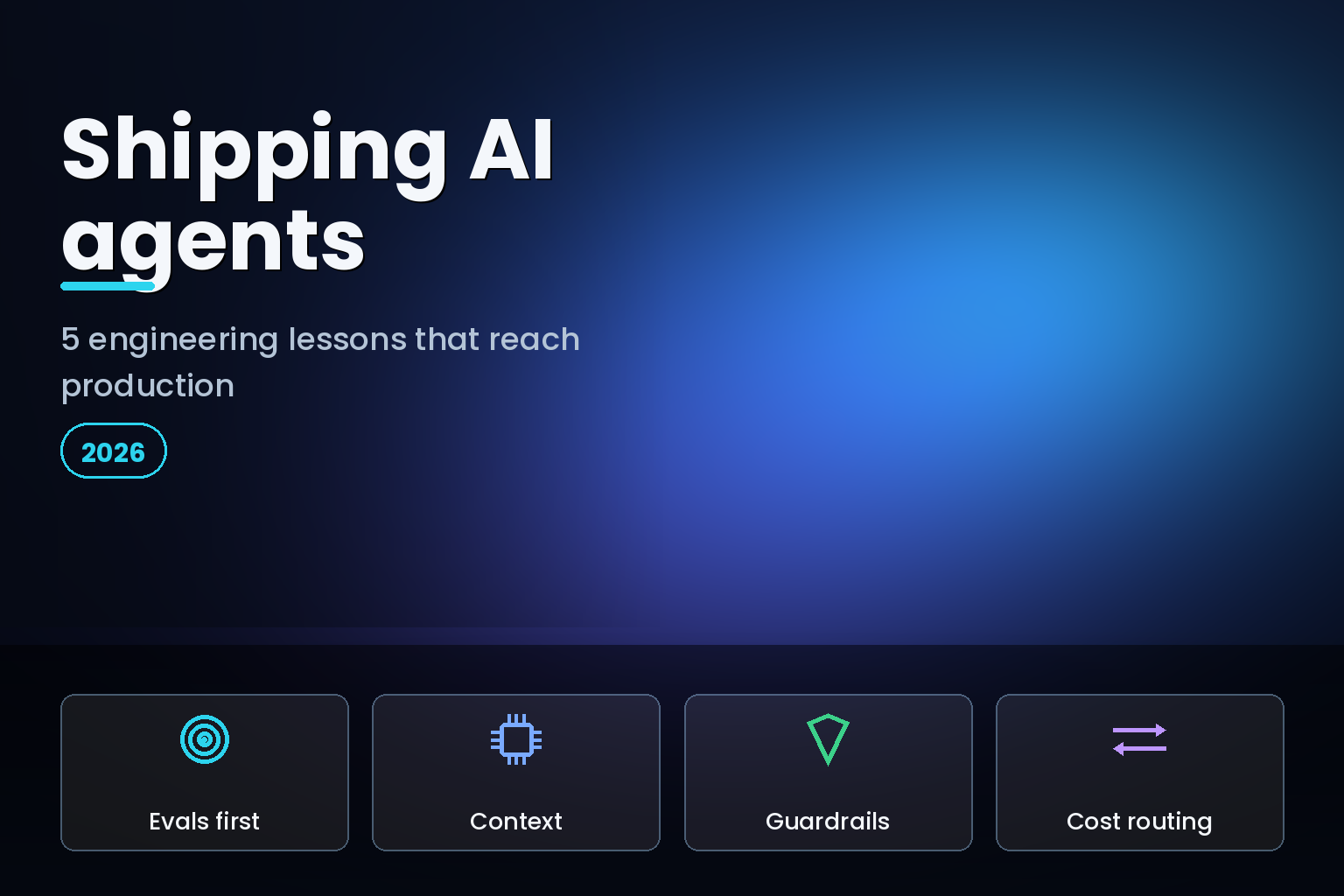
Summary. The gap between an AI agent demo and a production agent is wide and well documented. Gartner reports that only 31% of organisations have an agent running in production, even as 40% of enterprise applications are set to integrate task-specific agents by the end of 2026, up from under 5% a year earlier. A March 2026 reliability study of 6,259 production agents across 4.49 million tests found an aggregate success rate of 56.6%, and fewer than 15% of enterprise pilots reach production scale. The lessons below are drawn from that public data and from the engineering reality behind it: evals decide whether you ship, context beats model size, reliability is compositional, governance cannot be binary, and token cost is an architecture choice. With Claude Opus 4.8 at $5 per million input tokens and Gemini 3.1 Flash-Lite at $0.10, the model you pick per step changes both the bill and the behaviour.
These are engineering lessons, not a pitch. eCorpIT builds and operates agentic systems, and the patterns that separate a working pilot from a reliable product are consistent across teams. None of them are about a smarter model. They are about the scaffolding around the model: measurement, context, failure handling, permissions, and cost. If you are a founder or CTO deciding how to take an agent past the demo, start here, then read our deeper guide to enterprise AI agents in production.
Why most agents never reach production
Before the lessons, the scale of the problem. A March 2026 survey of 650 enterprise technology leaders found that while 78% have agent pilots, fewer than 15% have reached production scale, and analysts at AgentMarketCap put 86% of companies in "pilot purgatory." The common thread in failure analyses is that roughly 60% of production failures trace to data quality, context, or governance rather than to model limitations. In other words, the model is rarely the bottleneck. The engineering around it is.
That reframes the whole problem. If you believe agents fail because the model is not smart enough, you wait for the next release. If you accept that they fail because of context, evaluation, and operational design, you can fix it now with the models you already have. Every lesson below follows from that second view.
Lesson 1: build the eval before you build the feature
The single highest-use practice in 2026 is eval-driven development. If your agent does real work, build a deterministic evaluation harness before you add features, because without it you are shipping on vibes. The benchmark the field has settled on is tau-bench, and its successor tau²-bench, which test agents in dynamic user-agent dialogues and report a reliability metric called pass^k rather than a single-run pass rate.
The reason pass^k matters is brutal and specific: a 90% benchmark score can correspond to roughly 70% reliability in production, where the same task is retried across different sessions. Research has found gaps of up to about 25 percentage points between pass@k and pass^k across agentic benchmarks. If your eval reports only a single-run number, you do not yet know how reliable your agent is. The teams that ship build a golden dataset from real failures, calibrate an LLM judge against a human-reviewed gold set, and gate continuous integration on the score. The eval is not a phase before launch; it is the thing that tells you whether you can launch at all. Our write-up on engineering lessons from shipping enterprise AI agents goes deeper on building that harness.
Lesson 2: context engineering beats a bigger model
The biggest reason agents fail in production is bad context, not a weak model. As an agent runs for many steps, calls tools, and accumulates history, its context window fills with low-signal tokens that crowd out what matters, a failure mode now called context rot. The fix is context engineering, which has become the defining skill of AI engineering in 2026: a governed system that loads only the highest-signal tokens an agent needs at each step.
The discipline has four moves. Write context out to durable storage instead of holding it in the window. Select only what is relevant for the current step. Compress history into summaries to save tokens. Isolate sub-tasks so each gets its own clean context. The bar is concrete: if you cannot explain why each block of tokens is in the window for this specific step, it probably should not be there. This is not academic. GPT-4 class function-calling agents succeed in only about 50% of realistic tool-use tasks when context is left unmanaged, and the same agent improves sharply once the context is curated. You cannot debug context you cannot see, so observability that traces what entered the window on each call is non-negotiable.
| Failure symptom | Usual root cause | Engineering fix |
|---|---|---|
| Agent ignores a key instruction mid-task | Context rot; signal buried | Select and compress; trim the window |
| Wrong tool called or wrong arguments | Unmanaged tool context | Isolate tool context; curate schemas |
| Degrades over long sessions | Window fills with history | Write to memory; summarise |
| Works in demo, fails on real data | Data quality and context gaps | Golden-dataset evals on real inputs |
| Silent wrong answer | Compositional reasoning error | pass^k evals; step-level tracing |
Lesson 3: reliability is compositional, so design for failure
A single agent run involves dozens of decisions, and failures compound. An agent can execute every individual step correctly and still produce a wrong result because the reasoning connecting those steps was flawed. That is why the aggregate success rate across 6,259 production agents sat at just 56.6% in the March 2026 reliability study, while production systems generally need failure rates below 1% to 5% to be trusted with real work.
The engineering response is to stop treating the agent as a single oracle and start treating it as a distributed system that will fail. Make tool calls idempotent so a retry is safe. Add verification steps that check the agent's own output against a deterministic rule before it acts. Put hard guardrails around irreversible actions, payments, deletions, external messages, so a wrong step cannot do lasting damage. Log every decision so you can replay a failure. The goal is not a perfect agent; it is a system where the inevitable wrong step is caught, contained, and recoverable. The real cost of an agent is rarely the model tokens. It is the cleanup when a silent failure reaches a customer.
Lesson 4: governance cannot be binary
Governance is where adoption goes to die. Gartner predicts that by 2027, 40% of enterprises will demote or decommission autonomous AI agents because of governance gaps discovered only after a production incident. The mistake is treating trust as an on-off switch. As Shiva Varma, Senior Director Analyst at Gartner, put it, "Enterprises are treating AI agent governance as binary, either locked down or fully trusted, and that is the root cause of failure."
The alternative is graduated authority. Give an agent scoped, least-privilege permissions for the specific task it does, not blanket access. Keep a human in the loop for high-risk or irreversible actions while letting the agent run autonomously on low-risk ones. Make every action auditable, with a clear record of what the agent did and why. This is also where regulation lands: under India's Digital Personal Data Protection Act, 2023, an agent that processes personal data needs a lawful basis and a consent trail, and "the agent did it" is not a defence. Our breakdown of enterprise AI agent governance layers maps the permission model in detail.
Lesson 5: token cost is an architecture decision, not a line item
At demo scale, token cost is invisible. At production scale, where an agent may make dozens of model calls per task across thousands of tasks a day, it dominates the bill and shapes the design. The prices below, current as of late June 2026, show why model selection per step is an engineering decision.
| Model (June 2026) | Input per 1M tokens | Output per 1M tokens |
|---|---|---|
| Claude Opus 4.8 | $5.00 | $25.00 |
| Claude Sonnet 4.6 | $3.00 | $15.00 |
| GPT-5.4 | $2.50 | $15.00 |
| Gemini 3.1 Pro | $2.00 | $12.00 |
| Gemini 3.1 Flash-Lite | $0.10 | $0.40 |
The lesson is to route by task. Use a cheap, fast model such as Gemini 3.1 Flash-Lite or a small open model for classification, routing, and extraction, and reserve an expensive reasoning model such as Claude Opus 4.8 or GPT-5.4 Pro for the few steps that genuinely need it. A single-model agent that sends every step to a top-tier model can cost ten to fifty times more than a routed one with no improvement in outcomes. Combine routing with the context discipline from Lesson 2, fewer tokens per call, and the savings compound. For practical tooling, see our guide to measuring and cutting LLM spend.
Putting the five lessons together
These lessons reinforce each other. Evals tell you whether the system is reliable. Context engineering is the largest single lever on that reliability. Designing for failure contains the errors evals reveal. Governance decides whether the business will let the agent run at all. Cost discipline keeps the whole thing economical at scale. Skip any one and the others weaken: an agent with great evals but binary governance gets switched off after one incident; a well-governed agent with unmanaged context fails quietly and erodes trust.
The encouraging part is that none of this waits on a better model. The 56.6% aggregate success rate is not a ceiling imposed by today's models; it is a measure of how much engineering most teams have not yet done. The teams crossing into the reliable minority are not using secret models. They are doing the unglamorous work of measurement, context curation, failure handling, scoped permissions, and cost routing.
A practical 90-day path from pilot to production
The lessons are easier to act on as a sequence. In the first month, build the eval harness before anything else. Collect 50 to 100 real tasks, including the ones your pilot already failed, turn them into a golden dataset, and stand up a judge calibrated against a human reviewer. You now have a number that tells the truth about reliability, and a continuous-integration gate that blocks regressions. Resist the urge to add features until this exists, because every feature you add without it is unmeasured risk.
In the second month, attack context and failure handling together. Instrument the agent so you can see exactly which tokens enter the window on each call, then apply write, select, compress, and isolate until the high-signal ratio is good. In parallel, make tool calls idempotent, add verification before any irreversible action, and wrap payments, deletions, and outbound messages in hard guardrails. Re-run the eval after each change so you can see reliability climb rather than guess at it.
In the third month, layer in governance and cost. Define scoped, least-privilege permissions per task and decide which actions need a human in the loop. Add the audit trail and, if you handle personal data, the consent records the DPDP Act requires. Then route models by step, sending simple work to a cheap model and reserving a top-tier reasoning model for the few hard steps, and watch the bill fall without the eval score moving. By the end of the quarter you have a measured, context-managed, failure-safe, governed, cost-routed agent, which is precisely the profile of the minority that reaches production.
A short list of metrics is worth tracking throughout: pass^k reliability on the golden dataset, the high-signal token ratio per call, the rate of guardrail interventions, the cost per completed task, and the share of actions that required human approval. These five numbers, reviewed weekly, surface every one of the failure modes the lessons describe before they reach a customer.
India-specific considerations
For Indian founders, two points sharpen the lessons. First, cost routing matters more where budgets are tighter and where rupee revenue must cover dollar-denominated token bills; a routed multi-model architecture is often the difference between a viable unit economic and a loss-making one. Second, governance under the Digital Personal Data Protection Act, 2023, is now a live requirement, not a future one. An agent that touches customer data needs consent records, purpose limitation, and an audit trail by design. Building those in from the first version is far cheaper than retrofitting them after a launch, and it aligns with the graduated-authority model in Lesson 4.
FAQ
How eCorpIT can help
eCorpIT is a Gurugram-based, CMMI Level 5 and MSME-certified technology organisation with senior engineering teams that design, build, and operate production AI agents. We bring the scaffolding these lessons describe: eval harnesses with real-failure datasets, context-engineered retrieval, failure-safe tool execution, graduated governance, and multi-model cost routing. If you have an agent stuck between demo and production, talk to us through our contact page and we will assess what it needs to ship reliably.
References
- Gartner: applying uniform governance across AI agents will lead to failure — Gartner, May 26, 2026.
- How production AI agents are being tested in 2026: reliability patterns — AI Agent Insights.
- AI agent adoption 2026: enterprise data points — Digital Applied.
- Why AI agents fail in production: the reliability gap — Inovabeing.
- AI agent failure rate: why 70-95% fail in production — Fiddler AI.
- Context engineering: agent reliability playbook 2026 — Digital Applied.
- Building an AI agent evaluation pipeline: 2026 methodology — Digital Applied.
- LLM API pricing comparison 2026 — CloudZero.
- The enterprise agent deployment maturity model 2026 — AgentMarketCap.
_Last updated: June 30, 2026._