On this page · 13 sections
- The 2026 framing
- The 7-question decision matrix
- What iOS-only SwiftUI delivers in 2026
- What Kotlin Multiplatform Mobile delivers in 2026
- Performance comparison
- Cost comparison
- When iOS-only SwiftUI clearly wins
- When SwiftUI + KMP + Compose clearly wins
- When Flutter beats both
- Frequently asked questions
- A short closing note
- Further reading
- References
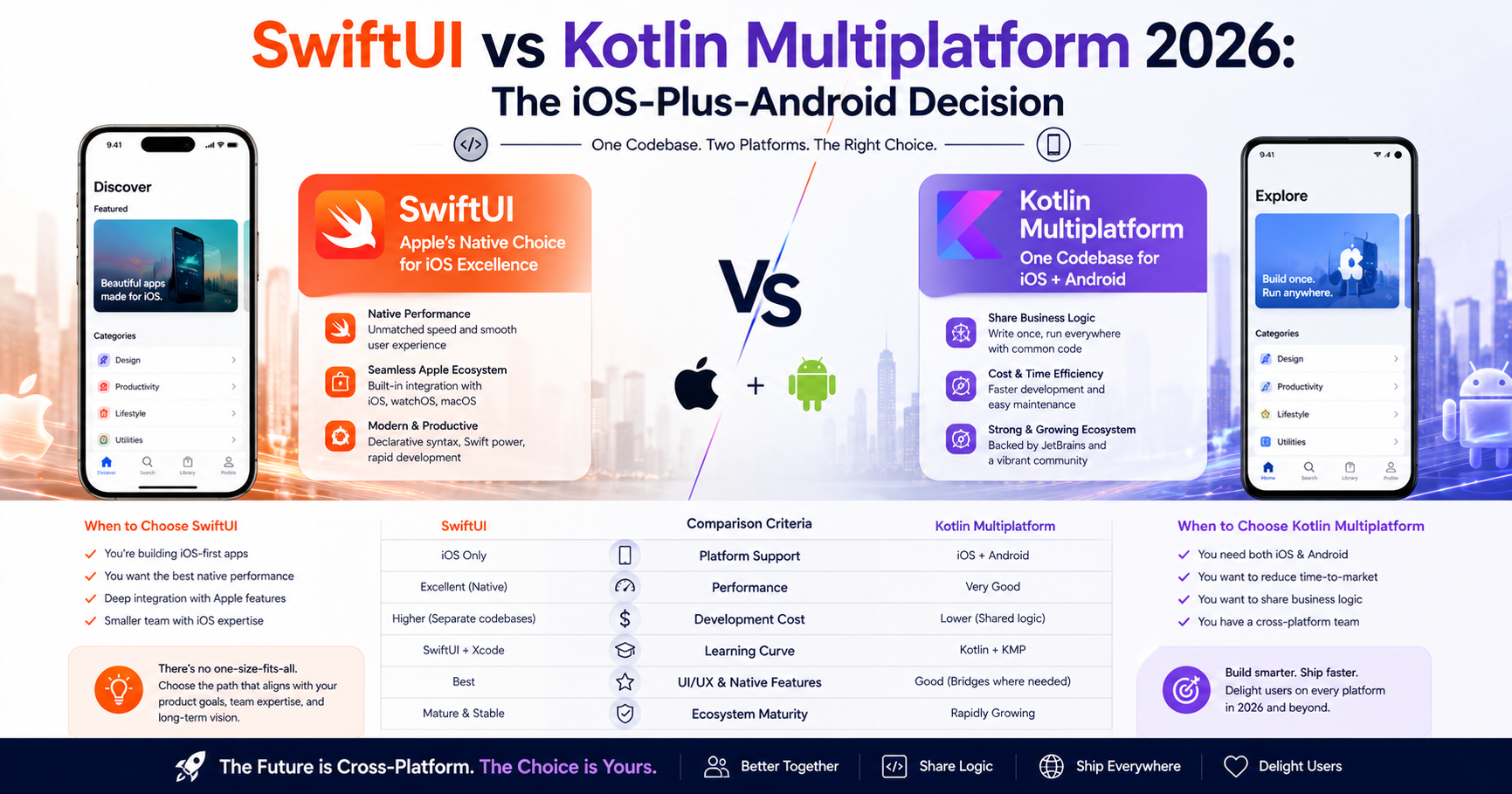
Summary. SwiftUI is Apple's native iOS UI framework. Kotlin Multiplatform Mobile (KMP) is JetBrains' shared-business-logic framework that pairs with SwiftUI on iOS and Compose on Android. The decision is not SwiftUI versus KMP as alternatives — it is "iOS-only SwiftUI" versus "SwiftUI plus KMP plus Compose Android." The first ships one platform fast with peak Apple integration. The second ships both platforms with shared data layer, API integration, and business logic. This guide gives you the seven-question decision matrix and the cost math for both approaches.
Talk to eCorpIT about your build · Hire iOS Developers
The 2026 framing
Three things to understand before the decision.
SwiftUI is for iOS UI specifically. Swift, runs on iOS / iPadOS / macOS / watchOS / visionOS / tvOS. Day-one access to every Apple platform feature: Apple Intelligence, Dynamic Island, Live Activities, Vision Pro, App Clips, Widgets, Live Notifications.
Kotlin Multiplatform Mobile (KMP) shares non-UI code across iOS and Android. The shared layer covers business logic, data models, API integration, and validation. UI stays platform-specific: SwiftUI on iOS, Compose on Android. KMP does not replace SwiftUI; it complements it.
The real comparison is iOS-only SwiftUI vs SwiftUI-plus-KMP-plus-Compose. The first is one codebase, one platform. The second is three codebases (UI for iOS, UI for Android, shared logic) but ships two platforms with substantial code reuse.
Most articles muddle this by treating SwiftUI and KMP as alternatives. They are complementary technologies addressing different layers.
The 7-question decision matrix
Each question maps to a preference. Whichever approach gets the most preferences fits your build.
| Question | iOS-only SwiftUI preference if | SwiftUI + KMP + Compose preference if |
|---|---|---|
| Platforms required | iOS only (or iOS first, Android later) | iOS plus Android from start |
| Audience platform mix | 80%+ Apple users | Mixed iOS and Android meaningfully |
| Day-one Apple feature parity | Critical (Vision Pro, Apple Intelligence, Live Activities) | Important on iOS, acceptable on Android |
| Team composition | iOS team with Swift depth | iOS team + Android team + shared business logic ownership |
| Engineering budget | Single-platform budget | Dual-platform budget (1.5–1.7× single) |
| Codebase ownership | One codebase | Three coordinated codebases |
| 3-year roadmap | iOS-feature-led | Cross-platform feature parity |
For most iOS-only builds (premium US consumer, US healthcare-iPad-standardised, premium-audience B2B SaaS), iOS-only SwiftUI wins. For most iOS-plus-Android builds where native feel on both platforms matters, KMP wins.
For iOS-plus-Android builds where brand consistency across platforms matters more than native feel, Flutter is usually a better choice than KMP. The Flutter comparison is covered in our Flutter vs React Native and Native vs Cross-Platform pillars.
What iOS-only SwiftUI delivers in 2026
Five capabilities that define the SwiftUI value proposition.
Day-one new-iOS-feature support. When iOS ships a new feature (Vision Pro support, Apple Intelligence integration, Dynamic Island APIs, Live Activities), SwiftUI exposes it immediately. Cross-platform frameworks (KMP shared logic, Flutter, React Native) wait 3–9 months.
Peak Apple platform performance. Native rendering, native animation pipeline, peak cold-start optimisation, smallest app size. For premium audiences and Apple-feature-led roadmaps, SwiftUI's performance ceiling is the highest.
Apple ecosystem integration. Apple Pay, Sign in with Apple, iCloud, HealthKit, ARKit, App Clips, Widgets, Live Activities, AirPlay, Handoff, MagSafe-aware accessories. All accessible without a cross-platform-framework layer.
SwiftUI + UIKit interop. SwiftUI does not replace UIKit; the two interop. For builds with specific UIKit requirements (legacy components, custom Core Animation work), the hybrid is straightforward.
Async/await and Swift concurrency. Modern Swift concurrency model that simplifies network code, background tasks, and UI threading. Easier to write correctly than the equivalent in cross-platform frameworks.
What Kotlin Multiplatform Mobile delivers in 2026
Five capabilities that define the KMP value proposition.
Shared business logic across iOS and Android. API integration, data models, validation, business rules, offline-first sync logic. Typically 30–60% of a typical app's code shares cleanly.
Native UI on both platforms. SwiftUI on iOS, Compose on Android. Both feel native because both are native. No cross-platform-rendering compromise.
Mature tooling. JetBrains' Kotlin Multiplatform tooling, including AndroidX KMP libraries, has matured significantly since 2023. Production-ready for most workloads in 2026.
Easier hiring than Flutter or Dart-specific roles. Kotlin engineers can write the shared layer. Swift engineers handle the iOS UI. Both are mainstream skills with deep talent pools.
Incremental adoption. You can add KMP to an existing native iOS app (or existing native Android app) gradually. Start with one shared module; expand from there. No big-bang rewrite required.
Performance comparison
iOS-only SwiftUI: Peak iOS performance. Native rendering, native animations, smallest app size, lowest cold-start time.
SwiftUI + KMP shared logic: Same iOS performance as SwiftUI-only (UI runs native; KMP shared logic runs the same on iOS). Slight memory overhead from the Kotlin/Native runtime on iOS (typically 5–10% in production), which is well below the user-perception threshold for most workloads.
Flutter cross-platform for comparison: Adds the Impeller rendering layer on iOS. Memory usage 20–40% higher than SwiftUI for equivalent UIs. Cold-start 0.5–1 second slower.
For peak iOS performance, SwiftUI (with or without KMP shared logic) wins. The KMP shared logic costs nothing meaningful on iOS performance.
Cost comparison
The three approaches at three complexity levels through eCorpIT senior rates. US agency benchmarks from TechAhead.
Simple MVP
| Approach | eCorpIT cost | Timeline |
|---|---|---|
| iOS-only SwiftUI | $10K – $28K | 6–10 weeks |
| SwiftUI + KMP + Compose Android | $18K – $48K | 8–12 weeks |
| Flutter cross-platform | $8K – $25K | 6–10 weeks |
For simple MVPs, single-platform SwiftUI matches Flutter on cost. KMP adds Android delivery for a meaningful cost increment.
Mid-complexity app
| Approach | eCorpIT cost |
|---|---|
| iOS-only SwiftUI | $20K – $70K |
| SwiftUI + KMP + Compose Android | $35K – $115K |
| Flutter cross-platform | $15K – $60K |
For mid-complexity builds, Flutter typically wins on cost for iOS-plus-Android. KMP wins on native UI feel at higher cost.
Complex enterprise build
| Approach | eCorpIT cost |
|---|---|
| iOS-only SwiftUI | $50K – $150K |
| SwiftUI + KMP + Compose Android | $80K – $190K |
| Flutter cross-platform | $40K – $100K |
For complex builds, the trade-off becomes clearer: KMP's premium over Flutter buys native UI feel; the cost difference is the price.
For your specific project the interactive cost calculator returns a personalised range in 90 seconds.
When iOS-only SwiftUI clearly wins
Five buyer situations.
Premium US, UK, EU consumer apps. Apple-dominant audience (often 70%+ iOS share). Premium-audience-only product strategies.
Vision Pro, ARKit, Apple Intelligence-led products. Day-one Apple feature support is the strategic moat.
iOS-first MVPs with Android-later strategy. Validate on iOS; add Android in a year if the product is proven. Cheaper than dual-platform from start.
Apple-ecosystem-deep apps. HealthKit, HomeKit, Apple Pay, Sign in with Apple as central features. Native iOS integrates more deeply than any cross-platform alternative.
Enterprise iPad-standardised deployments. US healthcare systems, US enterprises that issued iPads. Android support is not required.
When SwiftUI + KMP + Compose clearly wins
Five buyer situations.
iOS-plus-Android with native UI feel on both. Premium D2C, premium B2B SaaS, premium consumer apps where users notice the cross-platform-rendering compromise.
Business-logic-heavy apps with thin UI. Most of the build is API integration, data transformation, business rules. KMP's shared layer captures most of the codebase; UI is a thin platform-specific layer per platform.
Existing native iOS or Android codebase being extended to the other platform. KMP allows incremental adoption: extract shared logic gradually, build the second platform's UI separately.
Hiring constraints with strong Swift and Kotlin teams. Two native teams with shared business logic is sometimes easier to hire for than a Dart-specialist Flutter team or a TypeScript-specialist React Native team.
Long-term ownership prioritising native performance. KMP preserves native performance on both platforms while sharing the maintainable layer (business logic).
When Flutter beats both
Honest framing for when neither approach in this guide is the right call.
Brand-led D2C apps. Flutter's pixel-identical rendering across iOS and Android matters strategically for brand consistency.
Cross-platform-cost-conscious builds. Flutter ships iOS plus Android at roughly 1.15× single-platform cost. KMP runs 1.6–1.8× because Android UI is built separately. Flutter wins for cost-sensitive cross-platform builds.
Limited engineering team capacity. Flutter needs one engineering team for both platforms. KMP coordinates iOS UI work, Android UI work, and shared business logic work — three concurrent workstreams.
Brand-consistent motion design across platforms. Flutter's direct rendering pipeline gives finer-grained control over animations than platform-native components.
The Flutter comparison is covered in detail in our Flutter vs React Native and Native vs Cross-Platform pillars.
Frequently asked questions
A short closing note
The SwiftUI vs Kotlin Multiplatform decision in 2026 is genuinely "iOS-only vs iOS-plus-Android-with-shared-logic." For most premium iOS-first builds, SwiftUI-only wins on speed, cost, and Apple feature parity. For most iOS-plus-Android builds where native UI feel matters, the SwiftUI + KMP + Compose triad wins over Flutter on native fidelity, with a cost premium that is the price of that fidelity. The seven-question matrix above maps your project to the right approach.
If you want a senior read on which fits your specific build, that is what we do.
Further reading
References
Page last reviewed by Manu Shukla, Founder, eCorpIT, on 30 May 2026. Next review: August 2026.