On this page · 12 sections
- Why "beyond quick commerce" is the 2026 question
- Play 1: own the storefront and the first-party data
- Play 2: turn WhatsApp into a retention engine
- Play 3: list on ONDC for cheaper, open reach
- Play 4: win AI search with AEO, GEO and SEO
- Play 5: go omnichannel before the channel goes against you
- Play 6: use quick commerce as discovery, not as the whole business
- India-specific considerations
- How to sequence the six plays
- How eCorpIT can help
- FAQ
- References
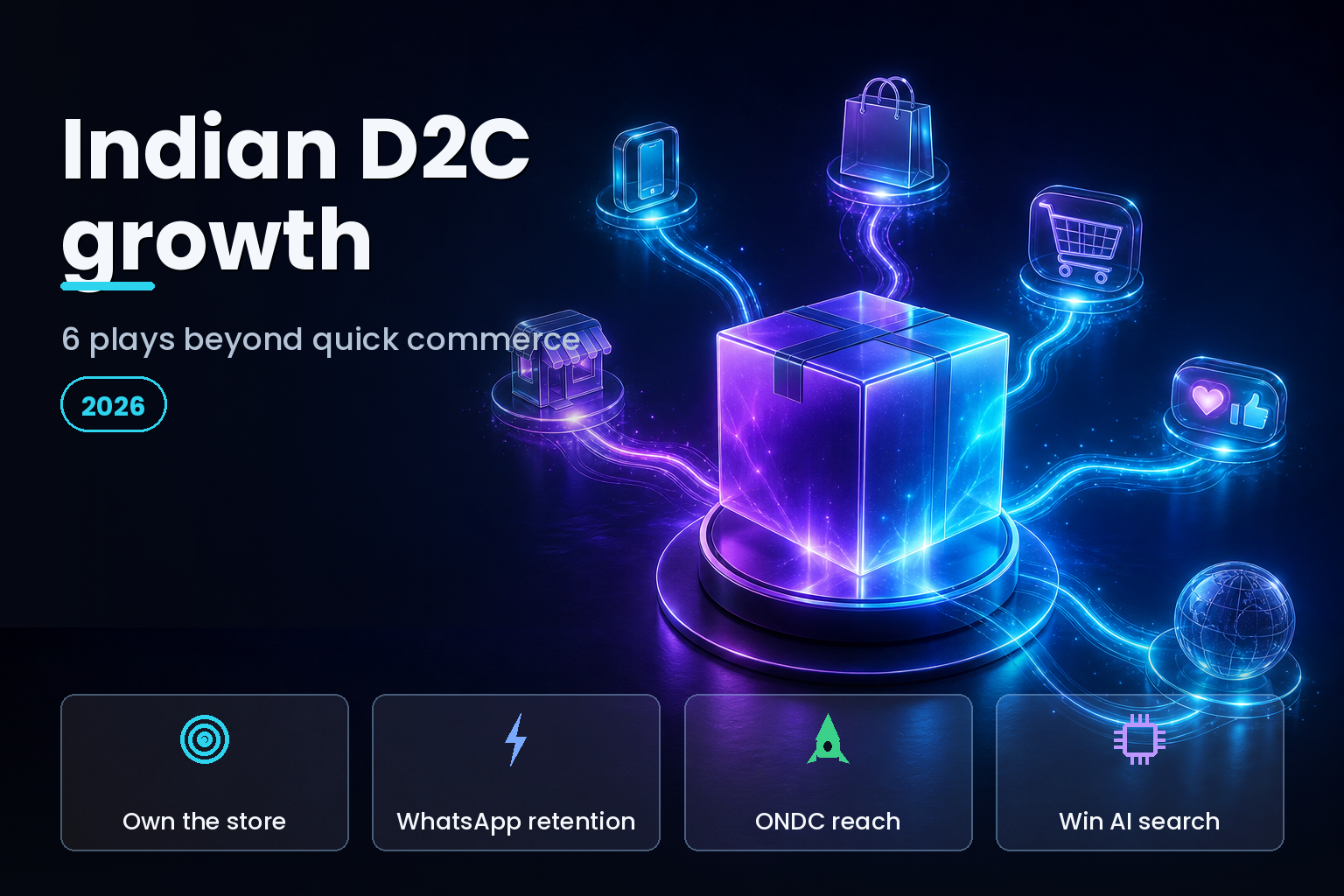
Summary. India's direct-to-consumer market is projected to reach $60 billion by FY27, growing at roughly 40% a year from a $12 billion base, per the Shiprocket, CII, and Praxis Global Alliance D2C report. Quick commerce grabbed the spotlight, hitting about $11.5 billion (₹95,500 crore) by the end of 2025 and growing over 75% year on year, with Blinkit at 46% share, Swiggy Instamart at 24%, and Zepto at 22% in January 2026 (Datum Intelligence). The problem for brands: quick-commerce platforms charge 18% to 35% commission, Blinkit lists a ₹25,000 per-SKU-per-state fee, small self-funded brands rarely beat a 1.2x to 1.5x return on ad spend, and profitability needs gross margins above 65%. These six growth plays build demand you own, at better margins, beyond the quick-commerce treadmill.
Saahil Goel, co-founder and CEO of Shiprocket, tied the category's rise to behaviour: "The rise of online-first shopping behavior and conscious consumerism fueled the era of direct-to-consumer (D2C) brands." The brands that last in 2026 turn that behaviour into channels they control.
Why "beyond quick commerce" is the 2026 question
Quick commerce is real demand, but it is expensive rented demand. Beyond the 18-35% commission and per-SKU fees, platforms now push private labels, turning Blinkit, Instamart, and Zepto into direct competitors on the same shelf. ZOFF Foods has said quick commerce is 65-70% of its business while it spends 10-15% of GMV on the channel and watches margins compress. Concentration like that is a risk, not a strategy. The six plays below reduce it.
| Growth play | What it fixes | 2026 signal |
|---|---|---|
| Owned storefront and data | Commission and data loss | 18-35% platform commission avoided |
| WhatsApp retention | Weak repeat purchase | 98% message open rate |
| ONDC listing | Costly reach | 15M+ monthly network transactions |
| AEO, GEO and SEO | Paid-only discovery | AI engines cite sourced brands |
| Omnichannel and offline | Single-channel risk | Reduces quick-commerce dependence |
| Disciplined quick commerce | Margin leakage | Needs 65%+ gross margin to profit |
Play 1: own the storefront and the first-party data
Every sale on a marketplace or quick-commerce app hands away 18% to 35% of the price and, worse, the customer relationship. A first-party storefront keeps both. It is where your margin, your pricing control, and your consented customer data live. Under the Digital Personal Data Protection Act 2023 (DPDP), data you collect with clear consent on your own store is an asset you can use for retention; data locked inside a platform is not. Build the store, instrument it, and treat the email and phone list as the point of the exercise. Our stack view is in the D2C and quick-commerce tech stack for India.
Play 2: turn WhatsApp into a retention engine
WhatsApp is where India shops and replies. The WhatsApp Commerce Intelligence Report 2026, which analysed 26 billion messages from more than 1,800 D2C brands, found a 98% message open rate, automated customer journeys averaging an 11.1% click-through rate, and 83% of WhatsApp-driven festive-quarter orders (October to December 2025) coming from first-time buyers. Brands using WhatsApp marketing tools on the GoKwik network recorded median GMV growth 2.25 times higher than those that did not.
The play is retention, not blast marketing. Cart-recovery, back-in-stock, and order-update flows recover revenue that acquisition ad spend already paid for. When your quick-commerce ROAS sits at 1.2x, a repeat purchase driven by a ₹0-media WhatsApp flow is the most profitable order you will take that month.
Play 3: list on ONDC for cheaper, open reach
The Open Network for Digital Commerce (ONDC) went from 1 million monthly transactions in early 2023 to more than 15 million by the end of 2024, and had onboarded about 1.16 lakh retail sellers across 630-plus cities by December 2025. The government wants ONDC to carry 25% of India's e-commerce by 2030, targeting $48 billion in GMV. For a D2C brand, ONDC is reach without a single gatekeeper taking a 35% cut, because buyers and sellers on the open network are not locked to one app. It is not a full replacement for quick commerce, but it widens distribution at a lower structural cost. We cover the mechanics in the quick commerce and ONDC playbook.
Play 4: win AI search with AEO, GEO and SEO
Discovery is moving from ten blue links to answer engines. When a shopper asks ChatGPT, Perplexity, Gemini, or Google's AI Overviews for "the best cold-pressed oil brand in India," the brands that get named are the ones with clear, sourced, well-structured content, not the ones with the biggest quick-commerce ad budget. Answer engine optimisation (AEO) and generative engine optimisation (GEO) are how you earn those citations, and they compound instead of resetting to zero when you stop paying. This is owned demand at its cheapest. Start with the AEO vs GEO vs SEO guide and, for local intent, SEO services in Gurugram.
Play 5: go omnichannel before the channel goes against you
A brand that is 65-70% dependent on one channel is one policy change away from a bad quarter. General trade, modern trade, and a small owned-retail footprint spread that risk and reach shoppers who never open a quick-commerce app. Offline also does something the apps cannot: it builds physical brand memory that lowers the cost of every future online sale. The 40%-a-year category growth to $60 billion by FY27 is not confined to apps; a meaningful share is omnichannel. Treat offline as demand generation, not just distribution.
Play 6: use quick commerce as discovery, not as the whole business
None of this means abandoning quick commerce. It means sizing it correctly. Use it for trial, launches, and hero SKUs where the 65%-plus gross margin math actually works, and watch the private-label shelf next to you. Keep the channel under a disciplined share of revenue so a commission hike or a fee change does not sink the P&L. Quick commerce is a powerful discovery surface; it is a dangerous single point of failure. Our full retail transformation view is in D2C and retail digital transformation in India.
India-specific considerations
Two India realities shape these plays. First, DPDP makes first-party data both more valuable and more governed: consented data on your own store powers retention legally, while sloppy consent creates liability, so build consent capture into the storefront from day one. Second, the cost structure is unforgiving at Indian price points. A snack or personal-care SKU priced at ₹99-₹299 cannot absorb a 30% commission plus a ₹25,000 per-SKU fee and still fund acquisition, which is exactly why ONDC, WhatsApp retention, and AI-search discovery matter more here than in higher-ticket Western markets. The winning 2026 mix is a small, disciplined quick-commerce presence wrapped in owned channels that carry the margin.
How to sequence the six plays
Do not attempt all six at once. A practical order for most Indian D2C brands: start with the owned storefront and consent capture (Play 1), because every other play feeds customer data into it. Layer WhatsApp retention next (Play 2), since it monetises the list you are now building at near-zero media cost. Add ONDC and AI-search discovery (Plays 3 and 4) once the owned funnel converts, so new reach lands on a store that retains rather than leaks. Treat omnichannel (Play 5) as the medium-term bet and keep quick commerce (Play 6) deliberately capped throughout. The aim is a demand base where owned channels carry the margin and rented channels carry trial, not the reverse. That sequencing is what turns a $60-billion-by-FY27 category tailwind into a profit-and-loss you actually control.
How eCorpIT can help
eCorpIT is a CMMI Level 5, MSME-certified technology and digital-marketing organization in Gurugram. We build first-party D2C storefronts, wire up WhatsApp retention flows and analytics, set up ONDC and marketplace listings, and run AEO, GEO, and SEO programs that earn AI-engine and search citations. We also design consent and data handling aligned with DPDP so your first-party data is an asset, not a risk. To build a growth plan that reduces quick-commerce dependence, talk to our team.
FAQ
References
_Last updated: July 3, 2026._