On this page · 12 sections
- What AWS announced, and what the calendar says
- The policy change behind the dates
- RDS Extended Support does not cover MariaDB
- Two dates that are already close
- What breaks on the way into 12.3
- A gap inside one AWS page
- How to tell whether this is your problem
- India-specific considerations
- What is still unknown
- FAQ
- How eCorpIT can help
- References
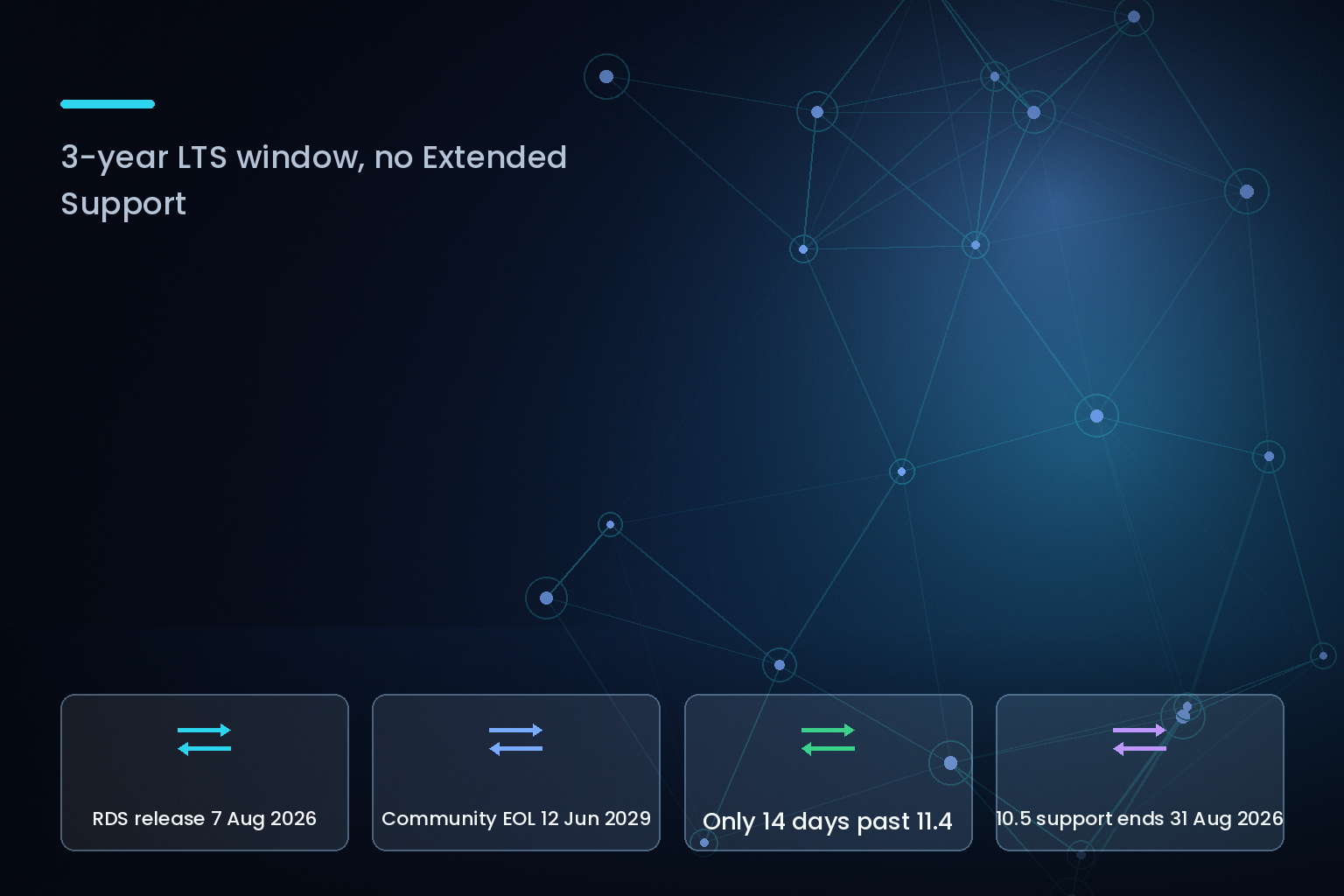
Summary. Amazon RDS added MariaDB 12.3 on 7 August 2026, 71 days after the community 12.3.2 release on 28 May 2026. AWS describes it as "the latest Long-Term Support release from the MariaDB community." The MariaDB Foundation's maintenance calendar ends community support for 12.3 on 12 June 2029. It ends support for MariaDB 11.4, which reached GA on 29 May 2024, on 29 May 2029. Moving two major versions forward buys 14 days. The reason is a policy change most upgrade plans have not caught: community LTS binaries now run 3 years from GA, not 5. Two other dates matter more. RDS for MariaDB 10.5 loses standard support on 31 August 2026, and RDS Extended Support, the paid extension AWS sells for MySQL and PostgreSQL, does not cover MariaDB at all.
What AWS announced, and what the calendar says
The AWS What's New entry dated 11 August 2026 lists three headline changes in 12.3: Oracle TO_DATE() function compatibility, a SQL standard IS JSON predicate, and optimiser work on reorderable LEFT JOIN statements and ordered scans over RANGE partitions. The MariaDB changes page confirms all three, tracked as MDEV-19683, MDEV-37072 and MDEV-36055.
The support arithmetic is where the announcement and the calendar part company. AWS's own MariaDB version management page publishes a major-version table, and the MariaDB Foundation publishes its own. They agree on the dates. They just do not agree with the intuition that a newer LTS lasts longer.
| MariaDB major version | Community GA date | Community end of life |
|---|---|---|
| 12.3 | 28 May 2026 | 12 June 2029 |
| 11.8 | 4 June 2025 | 4 June 2028 |
| 11.4 | 29 May 2024 | 29 May 2029 |
| 10.11 | 16 February 2023 | 16 February 2028 |
| 10.6 | 6 July 2021 | 6 July 2026 |
| 10.5 | 24 June 2020 | 24 June 2025 |
Read that column downward and the ordering breaks. MariaDB 11.4, the oldest of the three current LTS lines, outlives 11.8 by 359 days and falls 14 days short of 12.3. A team that upgraded from 11.4 to 11.8 in the past year shortened its runway by almost a year while believing it had extended it.
The policy change behind the dates
The MariaDB Foundation maintenance policy states the rule plainly: "MariaDB Community LTS binaries are released for 3 years after the GA date on mariadb.org/download." A footnote carries the history: "For releases up to MariaDB 11.4, the binaries are released for 5 years after the GA date."
So 11.4 is the last release on the old five-year term. Every LTS after it, 11.8 and 12.3 included, runs three years. Nothing in the AWS announcement mentions this, and the phrase "the latest Long-Term Support release" reads the same as it did when long-term meant five years.
A second footnote offers partial cover: "Critical and security fixes will be provided in source code releases for 2 additional years beyond Community LTS binary release period." Source releases are no help on RDS. You cannot compile your own engine on a managed instance, so the practical wall for an RDS customer is the binary date, 12 June 2029.
The paid escape route is also thinner than it looks for 12.3. The Foundation's table gives MariaDB 11.4 an Enterprise date of 16 January 2030 and an Extended date of 16 January 2033. For 12.3, both columns read "TBC."
RDS Extended Support does not cover MariaDB
This is the finding with the most operational weight, and it is stated in one sentence on the Versions with Amazon RDS Extended Support page: "RDS Extended Support is available for RDS for MySQL and for RDS for PostgreSQL."
MariaDB appears zero times on that page and zero times on the RDS Extended Support overview. Both pages document the offering entirely through MySQL and PostgreSQL examples. AWS gave RDS for MySQL 5.7 customers up to three years past the 29 February 2024 standard support date, with automatic enrolment and charges starting 1 March 2024. RDS for MariaDB customers get no equivalent, and there is no price at which they can buy one.
That changes what an end of standard support date means. For MySQL and PostgreSQL it is a billing event. For MariaDB it is a deadline.
| Engine on RDS | Paid runway past end of standard support | What the date means |
|---|---|---|
| RDS for MySQL | Up to 3 years of RDS Extended Support | Cost increase, timeline stays flexible |
| RDS for PostgreSQL | Up to 3 years of RDS Extended Support | Cost increase, timeline stays flexible |
| RDS for MariaDB | None documented | Hard upgrade deadline |
The Extended Support documentation adds one behaviour worth knowing even though MariaDB cannot enrol: "If you disable the enrollment status of a DB instance or DB cluster that is already past its standard support end date, the instance or cluster automatically upgrades to the next supported major version." An unplanned major version jump is the outcome you are managing against.
Two dates that are already close
AWS's major-version table sets RDS end of standard support for MariaDB 10.5 at 31 August 2026. That is eight days after this article's publication date. Community support for 10.5 ended on 24 June 2025, more than a year ago, and AWS lists MariaDB 10.0 through 10.5 as deprecated versions on RDS.
MariaDB 10.6 is next. Community end of life passed on 6 July 2026. AWS carries RDS standard support to 31 December 2026, which gives 10.6 instances roughly four months on an engine the upstream project has already stopped patching.
Neither line has a paid extension available. Major version upgrades on RDS for MariaDB are manual by design: the upgrade documentation states that major upgrades "can contain database changes that are not backward-compatible with existing applications" and "you must manually perform major version upgrades of your DB instances."
What breaks on the way into 12.3
The MariaDB 12.3 changes and improvements page lists an incompatible-changes section that deserves more attention than the feature list.
CONVERSION and TO_DATE are now reserved words. They can no longer be used as identifiers without quoting. The same TO_DATE() function AWS pitches as the Oracle migration win is what makes TO_DATE reserved, so a schema that already has a column or routine of that name breaks on the version that was supposed to ease Oracle work. Grep your DDL before you plan the upgrade, not after.
Three deprecated system variables are gone: big_tables, large_page_size and storage_engine. All three were removed in MariaDB 12.0, so they land in the first jump from 11.8 or earlier rather than in 12.3 itself. A parameter group carrying any of them needs editing before the upgrade runs.
The replication note is the sharpest one. From the MariaDB release notes: "When upgrading a replica from a pre-12.3 release to MariaDB 12.3.2, the CHANGE MASTER TO ... master_use_gtid setting is not carried over and is reset to DEFAULT. This is fixed in 12.3.3 via MDEV-39788." RDS ships exactly one 12.3 minor version today, and it is 12.3.2. The fix is in a minor version RDS does not yet offer, so any RDS for MariaDB replica upgraded into 12.3 needs master_use_gtid re-applied by hand afterwards.
MariaDB 12.3.2 also closed seven CVEs, the highest scoring CVE-2026-44168 at CVSS 8.0, with CVE-2026-47064 at 6.5 and four more between 4.3 and 6.3.
A gap inside one AWS page
AWS's version management page contains two tables that give MariaDB 12.3.2 different end dates. The minor-version table lists 12.3.2 with an RDS end of standard support date of August 2027. The major-version table lists MariaDB 12.3 with an RDS end of standard support date of June 2029.
The two columns measure different things. A minor version stops being offered when RDS approves its replacement; the major line runs to community end of life. The consequence for a team pinning a specific minor version is still real. If auto minor version upgrade is switched off and the instance is pinned to 12.3.2, the supported-version clock that applies is the August 2027 one, not the 2029 headline. AWS's minor-upgrade guidance is that enabling the option means the instance "is automatically upgraded after Amazon RDS tests and approves the new version."
Two RDS-specific changes arrive with 12.3.2 as well. The rdsproxyadmin user is now reserved and cannot be modified or dropped, and drop protection for rdsrepladmin applies regardless of host value, so DROP USER 'rdsrepladmin'@'host' now errors for any host. Automation that recreates database users during a cutover should be checked against both.
How to tell whether this is your problem
Run describe-db-engine-versions and describe-db-major-engine-versions through the AWS CLI against every account and region, not just production. The second command returns support dates directly, which is faster than reading the table.
Then sort the results by three questions. Is anything on 10.5 or 10.6? Those are the instances with a dated wall and no paid extension. Is anything on 11.8? That line ends 4 June 2028, earlier than the 11.4 instances sitting next to it. Is anything on 11.4? Those have until 29 May 2029, and moving them to 12.3 gains 14 days for a full major version upgrade, which is rarely a trade worth making on support grounds alone.
The upgrade case for 12.3 is the optimiser work, the IS JSON predicate and Oracle compatibility. Those are real. The support runway is not the argument, and any plan built on the assumption that the newest LTS carries the longest term needs the dates checked against the calendar. The same reasoning applies on the MySQL side, where the MySQL 8.0 end of life and RDS Extended Support cost path works differently precisely because the paid extension exists, and on PostgreSQL, where the RDS PostgreSQL 19 preview and its dropped extension shows how much a major version can change underneath a workload.
MariaDB has also moved past 12.3 upstream. The MariaDB documentation already publishes release notes for the 13.0 and 13.1 series, so 12.3 is the current LTS rather than the newest code.
India-specific considerations
Indian teams running RDS for MariaDB under DPDP Act 2023 obligations have a second reason to treat the 10.5 and 10.6 dates as firm. Running a database engine past the point where the upstream project issues security fixes weakens the reasonable security safeguards argument, and unlike MySQL there is no paid support tier to point at as a mitigating control. Budget planning is simpler here than on MySQL for the same reason: there is no Extended Support line item to model, only the engineering cost of the upgrade itself.
For cost planning around the upgrade window, the trade-offs are the ones covered in AWS database Savings Plans cost math and in the broader cloud FinOps playbook for Indian teams. A blue/green deployment shortens the cutover but runs a second instance for the duration, which is the part most upgrade budgets miss.
What is still unknown
The Enterprise and Extended support dates for MariaDB 12.3 read "TBC" on the Foundation's table, so the long-term commercial ceiling for this release is not yet published. AWS has not stated whether RDS Extended Support will ever cover MariaDB, and the documentation gives no roadmap language either way. AWS's own note on the major-version table leaves room to move: "If Amazon extends support for an RDS for MariaDB version for longer than originally stated, we plan to update this table to reflect the later date." Plan against the published dates and treat any extension as a bonus.
FAQ
How eCorpIT can help
eCorpIT runs managed database version upgrades on AWS for teams facing dated end of standard support walls, including inventory across accounts and regions, schema and parameter group checks against the incompatible-changes list, and blue/green cutovers with rollback plans. The same team handles major version end of life upgrades on managed Postgres and broader cloud migration and modernization work. eCorpIT is CMMI Level 5, MSME Certified and ISO 27001:2022 certified, and works as an AWS partner. To scope your MariaDB estate against the 2026 and 2029 dates, book a database upgrade review.
References
Last updated: 23 August 2026.