On this page · 9 sections
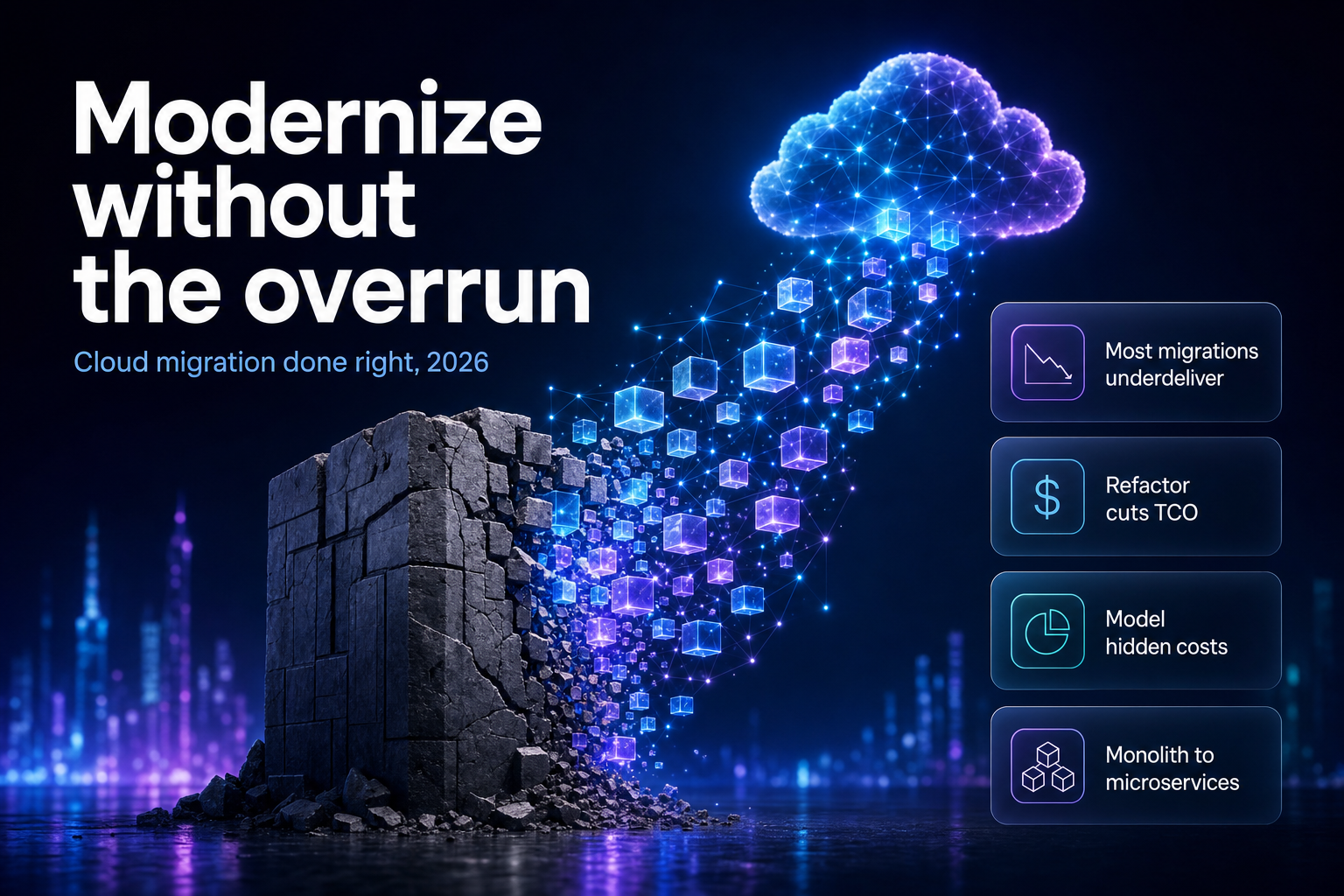
Summary. Cloud migration is not the risk; a badly planned one is. About 60% of cloud migrations deliver below their projected ROI, and hidden costs, data egress, parallel running, licensing changes, retraining, can inflate a final bill by 200-300% when they are not modeled upfront. Done well, the payoff is large: refactored workloads reach roughly 40% lower three-year total cost of ownership, and enterprise migrations return around 230% over three years. The waste in staying put is worse, with IBM research finding legacy infrastructure consumes about 70% of the IT budget on maintenance alone. Gartner puts a typical mid-sized migration at $300,000 to $500,000, while in India legacy migration runs ₹8 lakh to ₹40 lakh-plus over 12-20 weeks. The difference between the migrations that pay back and the ones that do not is planning. This is how eCorpIT approaches it.
Most migration disappointment comes from two mistakes: lifting and shifting a monolith without modernizing it, and failing to model the costs that appear after go-live. Avoid both and the economics work. Here is the plan.
The cost of getting it wrong, and of doing nothing
The failure modes are well documented. Roughly 60% of cloud migrations deliver below projected ROI, and unmodeled hidden costs can inflate a bill by 200-300%, per Wishtree and Cloudaware. The good news is that discipline is improving: about 65% of migrations now finish on time and within budget, up from 54% in 2022.
Doing nothing is not the safe option. IBM research finds organizations running legacy infrastructure spend about 70% of their IT budget on maintenance, leaving only 30% for growth, and legacy systems can consume up to 80% of enterprise IT budgets. That is the real cost of delay: a shrinking share of budget available for new features and AI capabilities. We cover the spend side in our FinOps playbook and cloud cost optimization guide.
What migration actually costs
Cost depends entirely on scope, so anchor the budget to the work, not a headline number.
| Scope | Typical cost | Notes |
|---|---|---|
| Small lift-and-shift | From $50,000 | Minimal refactoring |
| Mid-sized, 200-500 servers | $300,000-$500,000 | Gartner average |
| 50-application modernization | $1M-$3M | Full portfolio refactor |
| Enterprise, 5,000+ users | $1.2M-$4.5M | Complexity-dependent |
| India legacy migration | ₹8-40 lakh-plus | 12-20 weeks to go-live |
The spread between a lift-and-shift and a full modernization is the choice that matters most. A lift-and-shift is cheap and fast but carries the monolith's limits into the cloud. Modernizing to cloud-native architecture costs more upfront and returns more, which is why the plan has to match the goal.
Lift-and-shift or refactor: the real decision
Not every workload should be refactored, and not every one should be lifted as-is. The right mix is per-application. Lift-and-shift suits stable, low-change systems where speed to exit a data center matters more than architecture. Refactoring to microservices suits the systems that hold your business back, where slow releases, poor scaling, or fragility cost you daily.
The refactor payoff is concrete. Modernized systems show 40% fewer failures and recover five times faster on DORA metrics, with 65% faster time-to-market, per WalkingTree and Ciklum. One large Indian financial institution moved a 20-year-old monolithic core banking system from quarterly deployments to multiple deployments a day after refactoring into a multi-cloud microservices architecture. That is the difference between infrastructure that limits the business and infrastructure that serves it. Our application modernization guide and platform engineering patterns go deeper.
The outcomes when it is done right
| Metric | Result | Source context |
|---|---|---|
| Three-year TCO for refactored workloads | About 40% lower | Managed services, rightsizing |
| Enterprise three-year ROI | About 230% | Full migration |
| Migrations on time and budget | About 65% | Up from 54% in 2022 |
| Migrations below projected ROI | About 60% | Planning gap |
| Time-to-market improvement | About 65% faster | Post-modernization |
The pattern is clear: the teams that model total cost, refactor selectively, and manage spend after go-live land in the 40%-lower-TCO, 230%-ROI outcome. The teams that skip planning land in the 60% that underdeliver. Nothing about the technology forces the bad result; the planning does.
How eCorpIT runs a migration
eCorpIT modernizes legacy stacks without the budget surprises. Our senior-led, CMMI Level 5 teams start with a discovery and application-portfolio assessment that classifies each workload as lift-and-shift, refactor, or retire, then models the full cost, including the egress, parallel-running, and licensing items that wreck unplanned budgets. We refactor the systems that hold the business back into cloud-native services, set up FinOps from day one so spend stays visible, and design for the Digital Personal Data Protection Act, 2023 (DPDP) so data residency is handled before, not after, go-live. As partners of AWS, Microsoft, and Google, we are cloud-neutral, and we sequence the work so the business keeps running throughout.
India-specific considerations
For Indian enterprises, the migration case is strong and the constraints are specific. Cost in rupees is lower than in the West, ₹8 lakh to ₹40 lakh-plus for a typical legacy migration over 12-20 weeks, but capacity and data-residency rules add planning weight. Under the DPDP Act, personal data may need to stay in an Indian region, so target-region availability has to be confirmed before design, not discovered during cutover. Model the rupee cost against the 40% TCO reduction a proper refactor delivers, and treat the maintenance drain of legacy, up to 70-80% of IT budget, as the baseline you are escaping. Our cloud FinOps managed service keeps the savings from leaking back out after migration.
FAQ
How eCorpIT can help
eCorpIT (eCorp Information Technologies Private Limited, founded 2021, Gurugram) plans and delivers cloud migration and application modernization that stays on budget. Our senior-led, CMMI Level 5 and MSME-certified teams assess your portfolio, model total cost, refactor the workloads that pay back, and run FinOps so savings stick. As partners of AWS, Microsoft, and Google, we are cloud-neutral and design for DPDP Act requirements. To scope a migration or modernization, contact us.
References
_Last updated: July 13, 2026._