On this page · 11 sections
- What AWS actually shipped at re:Invent 2025
- The discount tiers, service by service
- The catch: 1 year, no upfront, Gen 7 and newer only
- Database Savings Plans vs Reserved Instances: the honest comparison
- The real cost math
- The four cases where the flexibility is worth it
- How to buy without over-committing
- India-specific considerations
- FAQ
- How eCorpIT can help
- References
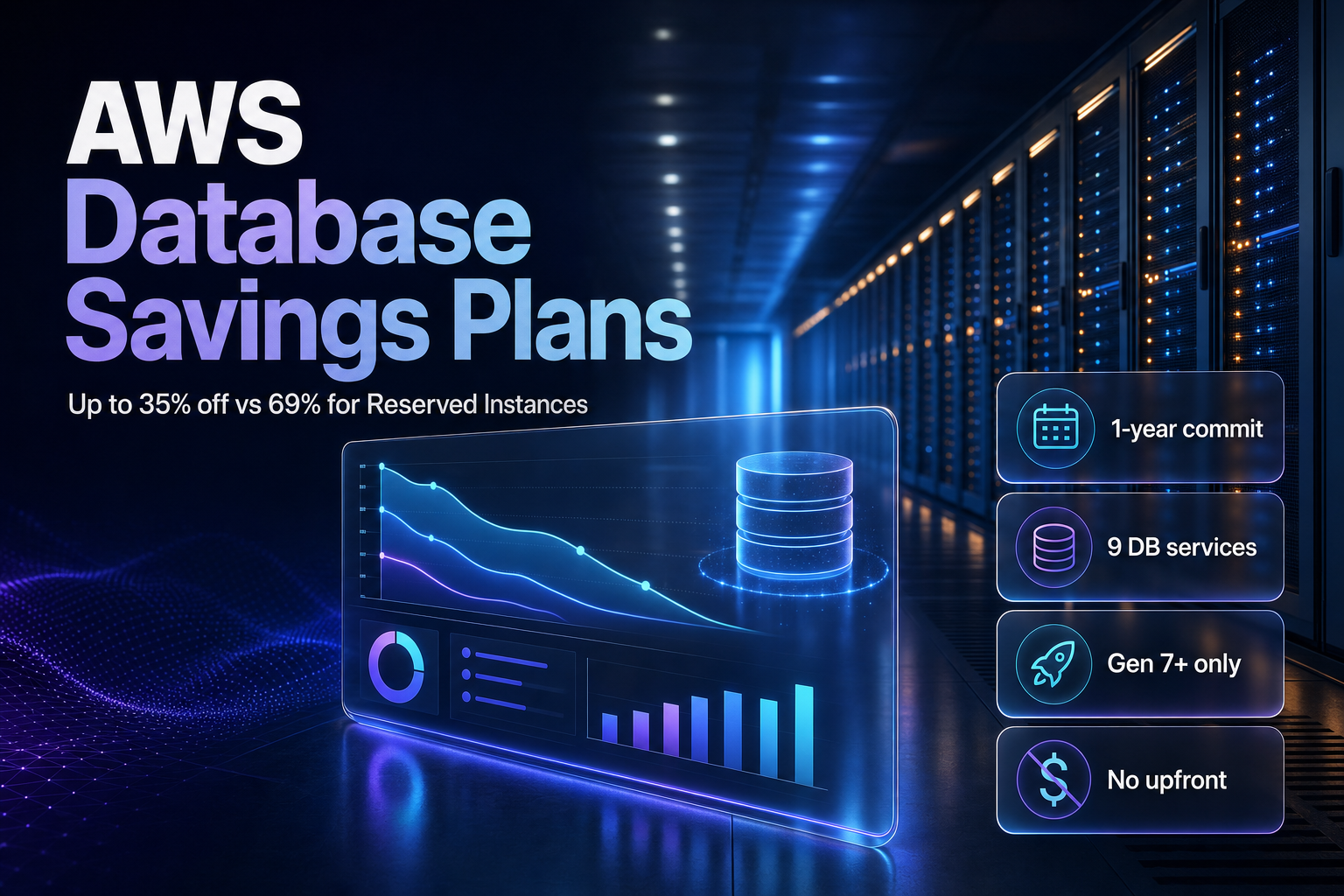
Summary. AWS launched Database Savings Plans on 2 December 2025 at re:Invent, extending its commitment-discount model to nine managed database services for the first time. Commit to a fixed dollar-per-hour spend for 1 year, no upfront payment, and AWS applies up to 35% off serverless usage and up to 20% off provisioned instances every hour. The catch: the ceiling is 35%, while a 3-year Standard Reserved Instance on Amazon RDS still reaches up to 69%. On a single db.r7g.xlarge running 24/7 in us-east-1 at $0.72 per hour, a Database Savings Plan saves about $1,261 a year, versus roughly $4,352 from a deep 3-year Reserved Instance at up to 69% off. So the plan is a flexibility instrument, not a discount instrument. This guide runs the real cost math across RDS, Aurora and DynamoDB, and shows the four cases where the flexibility is worth paying for.
What AWS actually shipped at re:Invent 2025
Before December 2025, AWS commitment discounts split cleanly. Compute Savings Plans and EC2 Instance Savings Plans covered Amazon EC2, AWS Lambda and AWS Fargate. Databases had only Reserved Instances, bought per engine, per Region, per instance family. If you reserved a db.r6g cluster and later moved it to db.r7g or to Aurora Serverless v2, the reservation stranded.
Database Savings Plans, announced by Betty Zheng, a Senior Developer Advocate at AWS, close that gap. You commit to a consistent amount of usage measured in dollars per hour over a 1-year term. Savings apply automatically each hour to eligible usage, and anything above the commitment bills at normal on-demand rates. The hourly commitment applies regardless of Region (every Region except China), and it follows you across engines, instance families, sizes and deployment types.
That last point is the whole product. AWS built this for teams mid-migration. In its own words, if you switch database engines or move from provisioned to serverless as part of cost optimization, you keep the discounted rate. A Reserved Instance cannot do that.
Coverage spans nine services: Amazon Aurora, Amazon RDS, Amazon DynamoDB, Amazon ElastiCache, Amazon DocumentDB, Amazon Neptune, Amazon Keyspaces, Amazon Timestream and AWS Database Migration Service. As new eligible engines, instance types or Regions ship, the plan extends to them without any action from you.
The discount tiers, service by service
The headline "up to 35%" hides four different ceilings. The number you actually get depends on the deployment model, not the engine.
| Service or usage type | Deployment | Maximum saving vs on-demand |
|---|---|---|
| Aurora, RDS, DocumentDB, Neptune, ElastiCache | Serverless | Up to 35% |
| Aurora, RDS, DocumentDB, Neptune, ElastiCache | Provisioned instances | Up to 20% |
| DynamoDB, Keyspaces | On-demand throughput | Up to 18% |
| DynamoDB, Keyspaces | Provisioned capacity | Up to 12% |
| DMS, Timestream | Usage-based | Applied per the pricing page |
Serverless earns the deepest cut because AWS wants to steer sustained workloads onto Aurora Serverless v2, ElastiCache Serverless and DynamoDB on-demand. If your fleet is mostly provisioned instances, your realistic ceiling is 20%, and that is the number to plan against.
The catch: 1 year, no upfront, Gen 7 and newer only
Three restrictions decide whether a Database Savings Plan fits your estate.
First, the term is 1 year only. There is no 3-year option, which is exactly where Reserved Instances earn their deepest discounts. Second, the only payment option is No Upfront, so you cannot buy down the rate further with an All Upfront lump sum. Third, per analysis from DoiT International, the plan requires current-generation Graviton instances, the db.r7g and db.m7g families and newer. Older db.r5, db.r6g or db.m6i fleets are not covered until you migrate.
There is one more clause that bites at enterprise scale. A Savings Plan with a commitment over $100 per hour cannot be returned at all. Under $100 per hour, you get a 7-day return window inside the same calendar month, capped at 10 returns per year. Treat a large commitment as permanent for its full term and size it conservatively.
Database Savings Plans vs Reserved Instances: the honest comparison
Reserved Instances are not deprecated. AWS still maintains RDS Reserved Instance pricing, Cost Explorer still recommends them, and the RI Marketplace still runs. The two tools solve different problems.
| Dimension | Database Savings Plans | Standard RDS Reserved Instances |
|---|---|---|
| Maximum discount | Up to 35% serverless, 20% provisioned | Up to about 69% (3-year All Upfront) |
| Term options | 1 year only | 1 or 3 years |
| Payment options | No Upfront only | No, Partial or All Upfront |
| Scope | Any eligible engine, family, size, Region (Gen 7+) | Fixed engine and Region, size-flexible within a family |
| Survives an engine or Region change | Yes | No, the reservation strands |
| Covers Aurora Serverless v2 | Yes | No |
| Covers a Graviton migration mid-term | Yes, discount follows | No |
"Database Savings Plans are a flexibility play, not a discount play, 35% versus 69% for Standard RIs," writes Dima Kramskoy, a Senior Cloud Architect at DoiT International, in a June 2026 decision guide. His framing is the one to keep: "The right commitment strategy is not about maximizing discount, it is about matching your commitment to your architectural direction."
The real cost math
Discount percentages are abstract. Dollars are not. Here are three worked examples in us-east-1, using published July 2026 on-demand rates.
Take a single Amazon RDS for PostgreSQL instance on db.r7g.xlarge (4 vCPU, 32 GB), a common production size, at $0.72 per hour. Running it every hour of the year is 8,760 hours, or $6,307 on-demand.
| RDS db.r7g.xlarge, 24/7, us-east-1 | Effective rate | Annual cost | Saving |
|---|---|---|---|
| On-demand | $0.72/hr | $6,307 | baseline |
| Database Savings Plan (provisioned, up to 20%) | ~$0.576/hr | ~$5,046 | ~$1,261 |
| 3-year Standard RI (All Upfront, up to 69%) | ~$0.223/hr | ~$1,955 | ~$4,352 |
The provisioned Savings Plan is the weaker discount here for a stable, unchanging instance: 20% against up to 69% from a 3-year Reserved Instance. This is why the plan is the wrong tool for a database that has not changed configuration in two years.
Now change the workload to Aurora Serverless v2, billed per Aurora Capacity Unit at $0.12 per ACU-hour. Assume a workload that averages 8 ACU around the clock.
| Aurora Serverless v2, avg 8 ACU, us-east-1 | Effective rate | Annual cost | Saving |
|---|---|---|---|
| On-demand | $0.12/ACU-hr | $8,410 | baseline |
| Database Savings Plan (serverless, up to 35%) | ~$0.078/ACU-hr | ~$5,466 | ~$2,944 |
| Standard Reserved Instance | Not available | Not available | 0 |
Here the picture flips. Reserved Instances do not apply to Aurora Serverless v2 at all, so before December 2025 this spend had no commitment discount of any kind. The Database Savings Plan is the only way to take 35% off it, worth about $2,944 a year on this one workload. For Amazon DynamoDB, the same logic gives up to 18% off on-demand throughput and up to 12% off provisioned capacity, again on spend that Reserved Instances never touched.
The rule that falls out of the arithmetic: provisioned and stable, use a Reserved Instance; serverless or moving, use a Database Savings Plan.
The four cases where the flexibility is worth it
A 35% ceiling looks weak next to 69%. It stops looking weak the moment your database estate is in motion. Four situations make the flexibility premium obviously correct.
A Graviton migration in progress. Moving from db.r5 or db.r6i to db.r7g gives roughly 20 to 40% better price-performance, but a Standard RI bought for the old family cannot follow. A Database Savings Plan keeps the discount as the instances change.
A serverless transition. Teams consolidating a fleet of small provisioned instances onto Aurora Serverless v2 or ElastiCache Serverless have no RI option for the destination. The plan covers it.
A multi-engine estate. A single hourly commitment spans Aurora, RDS, DynamoDB, DocumentDB and more. You stop managing a dozen separate reservations per engine and Region.
A multi-Region footprint. The commitment applies across Regions, so opening ap-south-1 in Mumbai or consolidating two Regions into one never strands a reservation.
If none of these apply, and you run stable provisioned instances, the honest answer is that Reserved Instances remain cheaper. Buy the RI and skip the plan for that workload.
How to buy without over-committing
The fastest way to waste a commitment is to size it against your peak. Kramskoy's most expensive anti-pattern is exactly this: commit $50 per hour because that is the Monday-morning spike, when the sustained floor is $35 per hour, and burn roughly $131,000 a year running the commitment at 70% utilization.
Two tools inside the AWS Billing and Cost Management console do the sizing for you. The Recommendations view analyses 7, 30 or 60 days of on-demand usage and proposes the hourly commitment with the highest overall saving. The Purchase Analyzer lets you model a custom commitment and see projected cost, coverage and utilization before you buy. Set the commitment at roughly 70 to 80% of your sustained floor, using 60 to 90 days of data, and let spikes bill at on-demand. Under-committing slightly and topping up later is far cheaper than stranding an oversized plan for a year.
Layering matters too. AWS applies Reserved Instances first, then EC2 Instance Savings Plans, then Compute Savings Plans, covering the highest-discount usage first within each tier. Database Savings Plans sit alongside this stack, so keep your proven, stable databases on Reserved Instances and point the new plan at the serverless and in-migration spend that RIs cannot reach. Our own AWS EC2 capacity and GPU pricing analysis and the broader cloud FinOps playbook for Indian teams walk through how these layers interact on a real bill.
India-specific considerations
For Indian teams the flexibility is not a luxury, it is the common case. Most product companies and Global Capability Centres running on AWS are still consolidating instance families or moving workloads onto serverless, so a 3-year Reserved Instance is a poor fit for a fleet that will look different in six months.
Database Savings Plans apply in the Asia Pacific (Mumbai) ap-south-1 and Asia Pacific (Hyderabad) ap-south-2 Regions, the same as everywhere outside China. That matters for data residency. Fintech and health teams that keep personal data inside India to align with the Digital Personal Data Protection Act 2023 can hold their databases in Mumbai and still take the discount, because the commitment is Region-flexible but never forces data to leave the country. At current rates the roughly $2,944 saved on a single Aurora Serverless v2 workload is about ₹2.5 lakh a year, and a mid-sized estate with a dozen such workloads reaches several tens of lakhs before anyone touches the schema. For teams weighing a wider database modernisation, our MySQL 8.0 end-of-life and RDS migration cost guide covers the upgrade economics that usually precede a commitment decision.
FAQ
How eCorpIT can help
eCorpIT is a CMMI Level 5 and ISO 27001:2022 certified engineering organisation in Gurugram that runs cloud cost optimisation and database modernisation for teams on AWS, Azure and Google Cloud. Our senior engineers model your commitment mix across Reserved Instances and Savings Plans, size it to your real usage floor, and stage the Graviton or serverless migration that unlocks the deeper tiers. If a database bill is climbing faster than the workload, talk to us or read more about our cloud FinOps managed service.
References
- Introducing Database Savings Plans for AWS Databases — AWS News Blog, Betty Zheng, 2 December 2025.
- Announcing Database Savings Plans with up to 35% savings — AWS What's New.
- Savings Plans types — AWS Savings Plans User Guide.
- AWS Savings Plans vs Reserved Instances 2026: the decision guide engineers actually need — Dima Kramskoy, DoiT International, June 2026.
- Amazon RDS pricing — AWS.
- db.r7g.xlarge RDS pricing and specs — Vantage instance explorer.
- Amazon Aurora pricing — AWS.
- AWS Database Savings Plans explained — Vantage.
- Savings Plans FAQ — AWS.
_Last updated: 27 July 2026._