On this page · 12 sections
- What AWS announced, and the date that matters more
- The extension table is the story
- pg_hint_plan out, pg_plan_advice in: a rewrite, not an upgrade
- What the Preview Environment actually costs and constrains
- Getting data out is a dump, not a snapshot
- The documentation contradicts itself
- Who is affected, and how to tell if that is you
- India-specific considerations
- What is still unknown
- How eCorpIT can help
- FAQ
- References
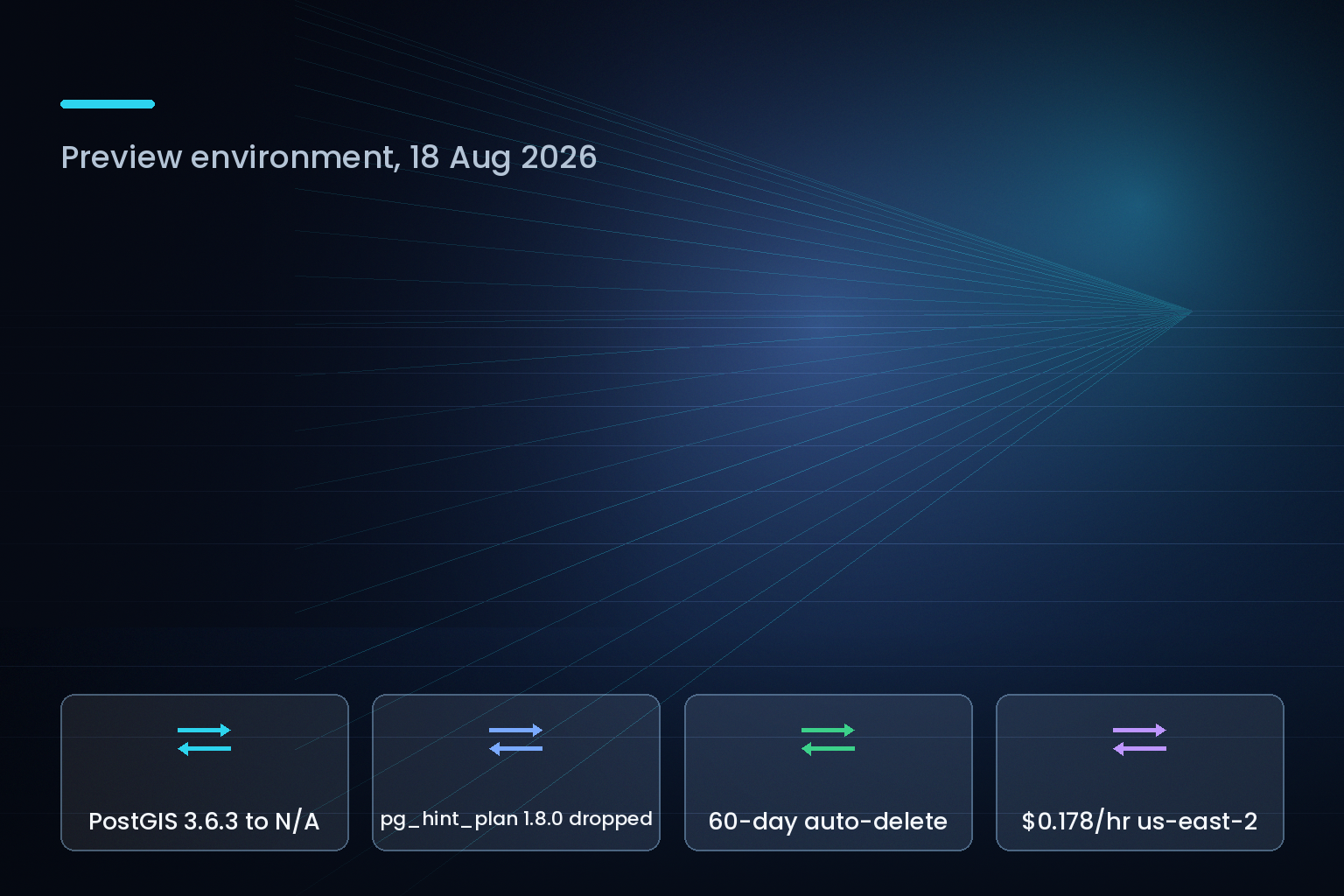
Summary. Amazon made PostgreSQL 19 Beta 3 available in the Amazon RDS Database Preview Environment on 18 August 2026, five days after the PostgreSQL Global Development Group released Beta 3 on 13 August 2026. The launch note lists the headline features. It does not list what you lose. The RDS extension table marks PostGIS 3.6.3, pg_hint_plan 1.8.0, pgRouting, pgactive, pg_stat_monitor, plprofiler and five others as N/A for all three PostgreSQL 19 betas, while pg_plan_advice 1.0 and pg_stash_advice 1.0 ship in the same table. A 60-day preview instance on db.m6i.large Single-AZ costs $256.32 at the US East (Ohio) list rate of $0.178 per hour, and every instance, backup and snapshot is deleted automatically at day 60.
That combination decides who can actually run this beta and who cannot.
What AWS announced, and the date that matters more
The AWS announcement is dated 18 August 2026 and covers four community features: the pg_stat_autovacuum_scores view, parallel autovacuum workers, the pg_plan_advice module, and eager aggregation for analytical queries.
The upstream dates are the ones to plan against. The PostgreSQL project released 19 Beta 3 on 13 August 2026 alongside minor releases 18.6, 17.11, 16.15, 15.19 and 14.24. The PostgreSQL 19 release notes carry the line "Release date: 2026-??-??, AS OF 2026-07-18". There is no general availability date for PostgreSQL 19 yet. The project's beta page states that betas are feature-frozen and warns that features "are subject to changes that are backwards incompatible at any time during the development of the betas, and could possibly be removed altogether."
So the beta is stable enough to test against and not stable enough to build against. That is the normal position for a PostgreSQL beta. What is not normal is the shape of the RDS build.
The extension table is the story
The Amazon RDS for PostgreSQL release notes publish a per-version extension matrix. For PostgreSQL 19 the matrix has three columns (Beta 3, Beta 2, Beta 1) and roughly 99 rows. Reading it next to the PostgreSQL 18 matrix shows what a preview instance cannot do.
| Extension | RDS PostgreSQL 18 | RDS PostgreSQL 19 Beta 3 | What breaks |
|---|---|---|---|
| PostGIS | 3.6.3 | N/A | No spatial types, indexes or functions |
| pg_hint_plan | 1.8.0 | N/A | Existing hint comments stop being honoured |
| pg_plan_advice | not listed | 1.0 | New, different syntax and workflow |
| pg_stash_advice | not listed | 1.0 | Companion auto-apply module |
| pgAudit | 18 | 19 | Version bump, config re-check |
| address_standardizer | 3.6.3 | N/A | Address normalisation unavailable |
| postgis_topology | 3.6.3 | N/A | Topology schemas cannot be created |
The RDS release notes name the full unsupported set for Beta 3: address_standardizer, address_standardizer_data_us, h3-pg, pg_hint_plan, pg_similarity, pg_stat_monitor, pgactive, pgrouting, plprofiler, postgis, postgis_raster, postgis_tiger_geocoder and postgis_topology. Beta 3 did add four extensions that Beta 2 lacked: mysql_fdw, pg_bigm, pg_transport and tds_fdw.
The set moves between betas. Anything you validate on Beta 3 may sit on a different extension baseline in Beta 4 or in the release candidate.
pg_hint_plan out, pg_plan_advice in: a rewrite, not an upgrade
The most expensive line in that table is the quiet one. pg_hint_plan 1.8.0 is available on RDS PostgreSQL 13 through 18. It is N/A on all three PostgreSQL 19 betas. In its place the same RDS table lists pg_plan_advice 1.0 and pg_stash_advice 1.0, both linked to upstream PostgreSQL 19 documentation.
The upstream release notes describe the pair directly: "A new pg_plan_advice extension for stabilizing and controlling the query planner's decisions, and a companion pg_stash_advice extension that applies this advice automatically based on the query." The PostgreSQL 19 documentation files pg_plan_advice under Appendix F, Additional Supplied Modules and Extensions, titled "pg_plan_advice — help the planner get the right plan."
If your team pins plans on RDS PostgreSQL with /*+ IndexScan(...) */ comments today, none of that syntax carries forward. Hint comments are inert once the extension is absent. The planner ignores them silently rather than erroring, so a regression shows up as a slow query in production, not as a failed migration step. Every pinned plan has to be re-expressed as advice and re-verified. That work is proportional to the number of hints you carry, and nothing in the AWS announcement mentions it.
The plain engineering read: the planner-stability migration is the PostgreSQL 19 upgrade for most teams, and it needs to start now, not at general availability.
What the Preview Environment actually costs and constrains
The Database Preview Environment is a separate environment with its own endpoint, rds-preview.us-east-2.amazonaws.com, and its own console at console.aws.amazon.com/rds-preview/. The AWS announcement states that preview instances "are priced as per the pricing in the US East (Ohio) Region."
Those are real list prices, not preview discounts. From the AWS Price List API offer file for AmazonRDS in us-east-2, published 20 August 2026 with an effective date of 1 August 2026:
| Item | us-east-2 list price | 60-day cost |
|---|---|---|
| db.m6i.large Single-AZ, PostgreSQL | $0.178 per hour | $256.32 |
| db.m6i.large Multi-AZ, PostgreSQL | $0.356 per hour | $512.64 |
| db.m6g.large Single-AZ, PostgreSQL | $0.159 per hour | $228.96 |
| db.r6g.large Single-AZ, PostgreSQL | $0.225 per hour | $324.00 |
| gp3 storage, PostgreSQL | $0.115 per GB-month | $23.00 for 100 GB over two months |
Sixty days is not a budgeting convenience, it is the hard ceiling. The RDS User Guide states that "All DB instances are deleted 60 days after you create them, along with any backups and snapshots." The AWS announcement puts the same limit as a maximum retention period with automatic deletion at the end.
The instance classes are restricted too. The User Guide allows "M6i, R6i, M6g, M5, T3, R6g, and R5 instance types only." Every one of those is a previous-generation class. Graviton4 is not on the list, though db.m8g.large PostgreSQL is generally available in us-east-2 at $0.168 per hour Single-AZ and $0.336 Multi-AZ. So you benchmark PostgreSQL 19 on an instance family that costs about 6% more per hour than the one you would actually deploy on, and the numbers you collect do not transfer.
Storage is limited to General Purpose SSD and Provisioned IOPS SSD. Single-AZ and Multi-AZ deployments both work. Cross-Region snapshot copy and cross-Region read replicas do not.
Getting data out is a dump, not a snapshot
This is where preview testing most often stalls. Snapshots created in the Preview Environment can only create or restore instances inside the Preview Environment. The User Guide is blunt: "You can't copy a snapshot of a DB instance to a production environment."
The supported path is standard PostgreSQL dump and load. For a multi-terabyte estate that is a different exercise from a snapshot restore, with its own runtime, its own network cost and its own consistency window. Plan the export before day 55, not after.
AWS Support does not cover these instances either. The User Guide routes questions to AWS re:Post instead. If a preview instance misbehaves at 2 a.m., there is no ticket to raise.
The documentation contradicts itself
The RDS User Guide page "Working with the Database Preview environment" still carries a section headed "PostgreSQL version 17 in the Database Preview environment," stating that "PostgreSQL version 17.0 is now available in the Amazon RDS Database Preview environment." PostgreSQL 17 has been generally available on RDS for a long time; the release notes list PostgreSQL 17 versions among those where "some of these versions have reached the end of standard support or deprecated."
Meanwhile the RDS for PostgreSQL release notes carry three separate PostgreSQL 19 preview sections for Beta 1, Beta 2 and Beta 3. Two AWS pages describing the same environment disagree about which version it holds.
Treat the release notes as authoritative here and the User Guide page as authoritative only for the limits, which have not changed. The limits are the part that costs money.
Who is affected, and how to tell if that is you
Run three checks against your current RDS PostgreSQL fleet.
First, SELECT extname, extversion FROM pg_extension; on every production database. If postgis, pg_hint_plan, pgrouting, pgactive, pg_stat_monitor or plprofiler appears, that database cannot be tested on PostgreSQL 19 Beta 3 at all in its current shape.
Second, grep your application and migration repositories for /*+ hint comments. Each one is a rewrite candidate against pg_plan_advice.
Third, check your instance classes. If you run Graviton4 (M8g, R8g) or any class outside the seven the preview allows, your beta benchmark runs on different silicon and the latency numbers are indicative only.
Teams on plain OLTP PostgreSQL with no spatial extensions and no hints have the cleanest run at this beta. Spatial workloads have no path until AWS ships PostGIS for PostgreSQL 19, and AWS has published no date for that.
India-specific considerations
The Preview Environment runs only from the us-east-2 endpoint. For teams in India that means test data crosses into a US region. Under the Digital Personal Data Protection Act 2023, personal data moved for testing carries the same obligations as production data, so the usual answer is to test with synthetic or masked datasets rather than a production dump. That also sidesteps the 60-day deletion problem, because synthetic data does not need to come back.
Cross-Region read replicas are unsupported in the preview, so a Mumbai-region replica of a preview instance is not an option. Budget the whole exercise as us-east-2 spend.
What is still unknown
There is no PostgreSQL 19 general availability date. There is no AWS statement on whether PostGIS or the other twelve missing extensions return before general availability, and no statement on whether pg_hint_plan is gone permanently on RDS or only absent during preview. The instance-class list may widen. None of that is announced, and none of it should be assumed.
How eCorpIT can help
eCorpIT runs PostgreSQL major-version upgrades and RDS migrations for teams that cannot afford a planner regression in production. Our PostgreSQL major version EOL upgrade and migration service covers extension inventory, hint-to-advice conversion and dump-and-load rehearsal against the preview environment. We are CMMI Level 5 and ISO 27001:2022 certified, and work is delivered by senior engineering teams. If PostgreSQL 19 is on your 2027 roadmap, talk to us about starting the extension audit while the beta is still current. Related reading: MySQL 8.0 EOL and RDS extended support cost, AWS database savings plans cost math and Azure HorizonDB versus Flexible Server for PostgreSQL.
FAQ
References
Last updated: 22 August 2026.